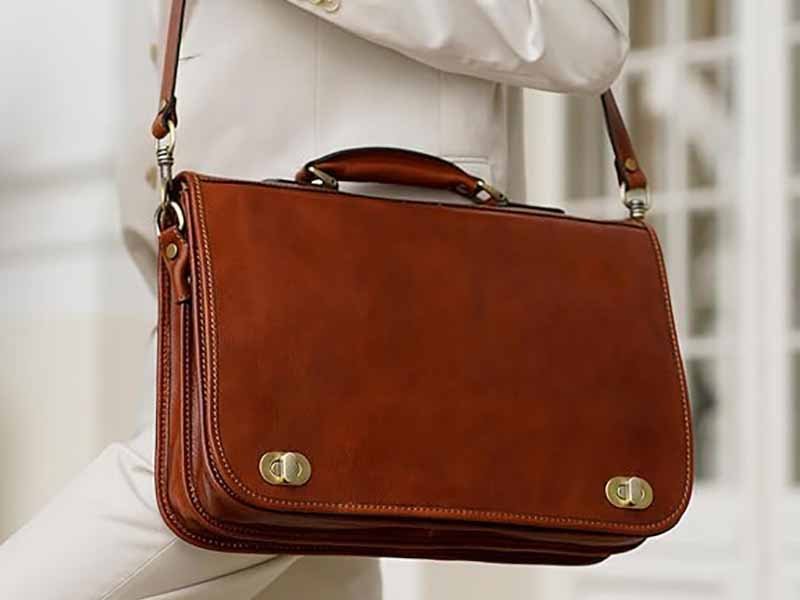
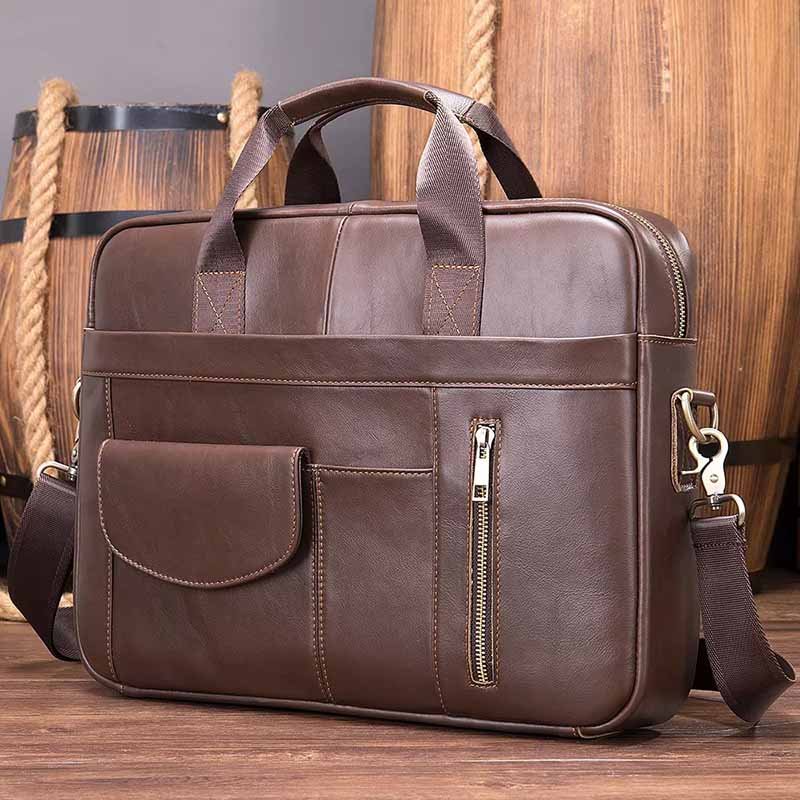
A leather laptop bag is no longer just a polished business accessory. For many working professionals, it is the daily home for a laptop, charger, phone, passport, contracts, samples, notebooks, and sometimes a full day of work. The bag may sit on a wet café floor, pass through airport security trays, hang beside a rain-soaked coat, or travel between office buildings during sudden showers. When a customer pays for a leather laptop bag, the expectation is not only beauty. The bag must protect valuable electronics while keeping the premium character of leather.
The key waterproof features in leather laptop bags include treated leather surfaces, water-resistant coatings, covered zipper openings, improved seam construction, protected stitch holes, sealed or well-finished edges, water-resistant lining, raised laptop compartments, padded sleeves, reinforced bottom panels, and careful sample testing before bulk production. A leather laptop bag does not need to look like outdoor gear to perform better in daily rain. Good protection is often hidden inside the material choice, pattern design, sewing method, and compartment structure.
For brands developing leather laptop bags, the real question is not whether leather can become the same as rubber, TPU, or PVC. The better question is how much water resistance the product needs for its target use. A slim executive briefcase, a commuter laptop tote, a travel work bag, and a rugged leather messenger bag all need different waterproof decisions. Too little protection can lead to water spots, damaged laptops, and poor reviews. Too much coating can make leather feel artificial and reduce the premium appeal customers expect. The best product sits in the middle: elegant enough for business use, strong enough for daily weather, and honest enough in its performance claims.
Are Leather Laptop Bags Waterproof?
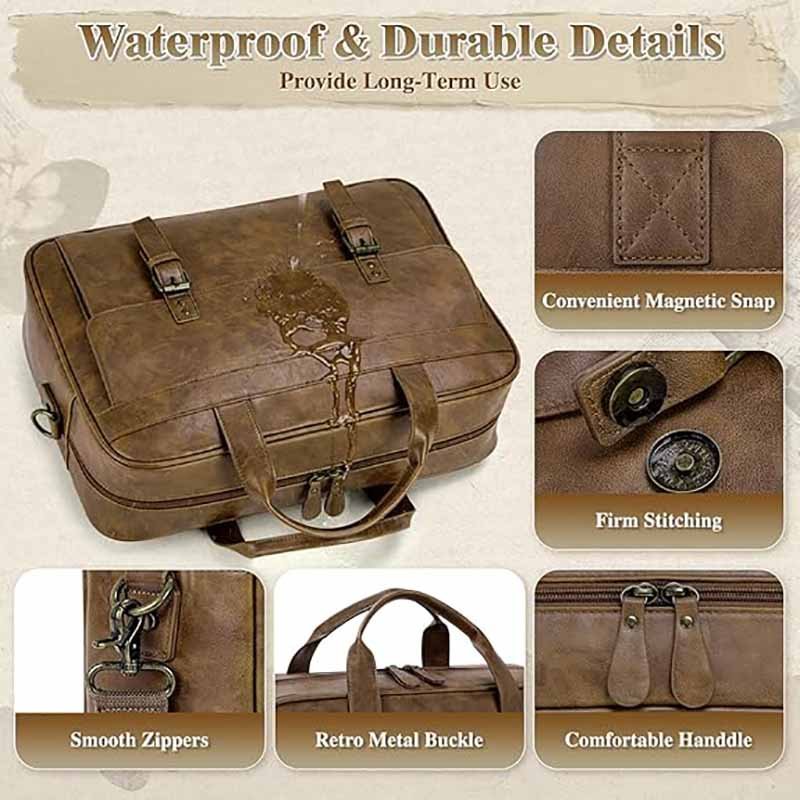
Leather laptop bags are usually water-resistant rather than fully waterproof. Well-treated leather can handle light rain, splashes, and short outdoor exposure, but long rain, standing water, and wet storage can still damage leather or allow moisture through openings. Strong protection comes from a complete design system: treated leather, protected zippers, improved seams, quality lining, padded sleeves, and raised laptop compartments.
A professional leather laptop bag should be developed around real use, not only around a product photo. Customers rarely read material details before leaving home in the rain. They simply expect the bag to protect their laptop during a normal commute. For this reason, water protection should be planned from the first design stage.
Leather is made from natural fiber structure. Even after tanning and finishing, it can still react to moisture. Some leather surfaces bead water for a short time. Some darken quickly. Some resist stains well but feel less natural. Some look beautiful in dry conditions but are not suitable for rainy markets. This is why the same design may perform very differently when made with different leather types.
The outer leather surface is only one part of the waterproof question. Many leather laptop bags fail because of exposed zippers, open seams, weak bottom corners, untreated edges, absorbent lining, or a laptop sleeve placed too close to the base. A bag can use expensive leather and still allow moisture inside if the structure is not planned correctly.
For brand clients, the most useful way to think about waterproof performance is to divide it into four levels:
| Protection Level | Real Use Situation | Suitable Bag Design | Product Language |
|---|---|---|---|
| Basic surface protection | Indoor office use, light contact with water drops | Finished leather, normal zipper, basic lining | Easy-care leather |
| Daily water resistance | Short rain, wet hands, café table spills | Treated leather, covered zipper, improved edge finishing | Water-resistant leather laptop bag |
| Rain-focused protection | Commuting in wet weather, business travel, outdoor walking | Coated leather, water-resistant zipper, protected seams, raised laptop sleeve | Rain-resistant laptop bag |
| Technical waterproof structure | Heavy rain, outdoor work, long wet exposure | Hybrid leather construction, coated textile panels, sealed seams, technical zipper | Only suitable when tested as waterproof |
For SzoneierLeather, this distinction is important because it helps clients avoid overpromising. A premium leather laptop bag can be built with strong daily water resistance, but if the final product is not tested for heavy rain or immersion, it should not be described like a dry bag. Honest product positioning builds long-term trust and reduces after-sales risk.
Can Leather Laptop Bags Handle Rain?
Leather laptop bags can handle rain when the leather surface, bag opening, seam structure, and inner compartment are designed for short wet exposure. Light rain during a commute is very different from being left outdoors for an hour. A good product design should match the real weather conditions customers face.
For daily use, many clients focus on three rain scenarios:
- Walking from car to office for 3–5 minutes
- Commuting between subway, bus, café, and workplace for 10–20 minutes
- Business travel where the bag may face wet airport floors, taxi loading, and hotel movement
A leather laptop bag for these situations should not absorb water immediately. Water should bead or roll off the surface for a short period. The top zipper should not sit fully exposed without cover. The laptop sleeve should not touch the bottom panel directly. The lining should not absorb moisture quickly. These small details make a large difference in real use.
For rain-focused designs, SzoneierLeather can support several construction choices:
- Water-resistant coated leather for the main panels
- Leather flap or zipper cover to reduce direct rain exposure
- Water-resistant zipper tape for top openings
- Reinforced side gussets to reduce water entry at corners
- Raised laptop sleeve with bottom buffer
- Water-resistant polyester, nylon, or microfiber lining
- Bottom reinforcement to reduce moisture transfer from wet floors
A leather laptop bag does not need to survive being soaked to be valuable. Most customers want reliable daily rain protection, clean appearance, and safe laptop storage. When the product is positioned around that real need, the design becomes more practical and easier to manufacture consistently.
Are Leather Laptop Bags Water-Resistant?
Leather laptop bags can be water-resistant when the leather has a protective finish and the construction prevents moisture from moving directly into the laptop area. Water resistance means the bag can slow down water absorption and reduce damage from short exposure. It does not mean water can never enter under pressure, long rain, or poor storage conditions.
Water resistance has two parts. The first is material resistance. This refers to how the leather surface reacts when water touches it. A good surface finish can help water bead, reduce staining, and slow absorption. The second is structural resistance. This refers to zippers, seams, stitch holes, lining, bottom panels, flaps, pockets, and internal sleeve placement.
Many product complaints happen because only the first part was considered. The leather looks water-resistant in a swatch test, but the finished bag still leaks through the zipper or seam. For laptop bags, structural resistance is often more important than customers realize.
A useful development checklist includes:
| Area | What to Check | Why It Matters |
|---|---|---|
| Leather surface | Water beading, darkening, stain marks | Controls first contact with rain |
| Top opening | Zipper type, zipper cover, flap depth | Most direct water entry point |
| Stitch holes | Density, thread tension, seam position | Reduces moisture path through seams |
| Edges | Edge paint bonding, sealing, flexing | Prevents swelling and peeling |
| Lining | Water resistance, colorfastness, odor risk | Protects inside contents |
| Laptop sleeve | Padding, height, bottom distance | Keeps device away from wet base |
| Bottom panel | Reinforcement, feet, leather thickness | Handles wet floors and abrasion |
For custom production, the client should not only ask, “Is this leather waterproof?” A better question is, “How will the complete bag protect a laptop during daily rain?” This gives the factory a clearer direction and reduces misunderstandings before sampling.
Do Leather Laptop Bags Need Coating?
Leather laptop bags often need some form of surface protection if they are expected to resist water, stains, and daily wear. The coating does not always need to be heavy. In many cases, a balanced protective finish is enough to improve water resistance while keeping the leather touch comfortable.
Different coating levels create different results:
| Coating Level | Surface Feel | Water Resistance | Best Use |
|---|---|---|---|
| Light finish | Natural, soft, more leather grain | Moderate | Premium office bags |
| Medium coating | Smooth, clean, controlled surface | Good | Daily business laptop bags |
| Strong pigment finish | Uniform, easy-care surface | Higher | Corporate programs, retail work bags |
| Wax or oil finish | Rich, changing, vintage feel | Good for short rain | Messenger bags, travel styles |
| Technical backing | More structured, less natural | Stronger | Rain-focused or hybrid laptop bags |
The main risk with coating is losing the leather character. If a coating is too thick, customers may feel the bag looks synthetic. If the coating is too weak, the bag may stain or darken too easily. The best choice depends on the sales channel and customer expectation.
A high-end executive leather laptop bag may use treated full-grain leather with a lighter protective finish. A commuter laptop bag may need a stronger finish because it faces more weather and daily handling. A custom wholesale program may prefer a more uniform coated leather to reduce color differences across bulk production.
During sample development, SzoneierLeather can help clients compare leather swatches under realistic use checks:
- Water drop observation after short contact
- Surface darkening after wiping
- Drying mark review
- Flexing around corners
- Scratch visibility
- Color consistency across leather panels
- Hand feel after finishing
- Edge paint compatibility with leather finish
Coating should not be selected only from a supplier photo. It should be reviewed with physical material, target bag shape, bending areas, and final customer use in mind.
How Does Water Harm Leather Laptop Bags?
Water can damage leather laptop bags in several ways. The first visible problem is usually dark spots, stains, or uneven surface color. Over time, moisture can also cause stiffness, fiber swelling, loss of oils, mold risk, edge cracking, glue weakening, lining odor, hardware corrosion, and shape deformation.
Laptop bags carry weight, so water damage is more serious than it may look. A wet leather panel under load can stretch or crease more easily. Handles and strap tabs may weaken faster if moisture enters stitch holes. Bottom corners may become soft or deformed if the bag is often placed on damp surfaces. Edge paint can peel if water enters through unfinished or poorly sealed edges.
The inner structure can also suffer. Many leather laptop bags use reinforcement materials between the outer leather and lining. If these materials absorb moisture or lose bonding strength, the bag may lose shape. The customer may notice wrinkling, bubbling, soft corners, or uneven panels after repeated wet use.
Water can affect laptop protection in hidden ways:
- A damp lining can transfer moisture to documents or electronics.
- A compressed wet bottom panel can reduce shock absorption.
- A wet padded sleeve may dry slowly and create odor.
- A stained inner lining can reduce perceived product quality.
- A warped base may make the bag lean or collapse.
For this reason, waterproof feature development should cover both appearance and function. It is not enough for the outside to look good after rain. The bag must also keep its structure, protect the laptop area, and dry without leaving serious defects.
A useful quality target for daily-use leather laptop bags is simple: after short rain exposure, the bag should wipe clean, keep shape, avoid obvious water marks, keep the laptop sleeve dry, and maintain smooth zipper and hardware performance. This standard is much closer to real customer expectations than a vague “waterproof” claim.
Which Leather Laptop Bags Resist Water Better?
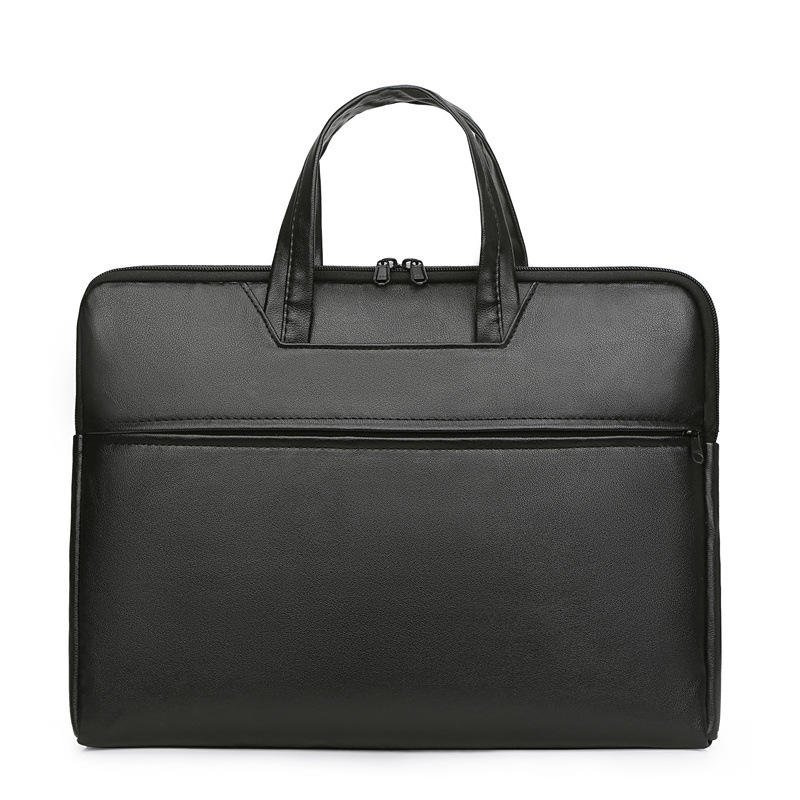
Leather laptop bags resist water better when they use the right leather finish for the target market. Coated leather, pigment-finished leather, waxed leather, oiled leather, and selected treated full-grain leather can all work, but each one gives a different balance of appearance, hand feel, water resistance, cost, and maintenance.
The best leather choice depends on the product story. A polished business briefcase may need a clean and stable surface. A rugged messenger bag may benefit from waxed or oiled leather. A premium retail laptop tote may need a softer grain with moderate protection. A travel work bag may need treated leather combined with technical lining and stronger zipper construction.
Clients often ask for the “best leather,” but in manufacturing, there is rarely one answer. Leather selection should be based on five questions:
- What price range will the final bag target?
- Will the bag be used mainly indoors, during commuting, or for travel?
- Does the market prefer a clean surface or natural aging?
- Should scratches and patina be accepted as part of the style?
- How much after-care will the customer realistically perform?
For leather laptop bags, the material must look good and perform under load. It must bend around gussets, hold stitching, accept edge finishing, work with reinforcement, and stay stable during packaging and shipping. Water resistance is important, but it cannot be separated from thickness, flexibility, colorfastness, surface durability, and batch consistency.
A simple material comparison can help during early development:
| Leather Type | Water Resistance | Appearance | Maintenance Need | Suitable Laptop Bag Style |
|---|---|---|---|---|
| Pigment-finished leather | High for daily use | Clean, uniform, polished | Low | Business briefcase, office laptop bag |
| Treated full-grain leather | Medium to high | Natural, premium, textured | Medium | Executive laptop bag, luxury work tote |
| Waxed leather | Medium to high | Rugged, vintage, changing | Medium | Messenger bag, travel laptop bag |
| Oiled leather | Medium | Rich, soft, natural aging | Medium to high | Casual premium work bag |
| Top-grain coated leather | High | Smooth and controlled | Low | Retail laptop bags, corporate programs |
| Suede or nubuck | Low | Soft, elegant, delicate | High | Accent details, not main rain surface |
| Split leather with coating | Medium | Cost-controlled, uniform | Low to medium | Entry-level programs |
| Leather with technical backing | High | More structured, less soft | Low | Hybrid weather-focused designs |
For SzoneierLeather, material selection is not only about sourcing. The company’s advantage comes from raw material supply chain strength, material development ability, finished product development, product design, sampling, production, packaging design, and packaging quality inspection. This allows clients to compare leather choices before finalizing the structure. When material and bag design are developed together, the final product has a better chance of meeting both appearance and performance goals.
Which Leather Laptop Bags Use Coated Leather?
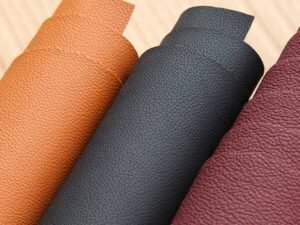
Leather laptop bags use coated leather when the product needs a cleaner surface, better stain resistance, stronger water resistance, and more stable bulk production. Coated leather is common in business laptop bags, corporate gift programs, commuter bags, private label work bags, and retail collections where customers expect easy maintenance.
Coated leather is especially useful when the bag will be sold to customers who use the product every day. Daily laptop bags face hand oils, desk surfaces, rain drops, coffee spills, car seats, public transport, and airport trays. A delicate leather may look beautiful at first, but it can create complaints if it marks too easily.
The main benefits of coated leather include:
- Better short-term water beading
- More stable surface color
- Easier cleaning after light stains
- Lower risk of visible water spots
- More consistent appearance across bulk orders
- Better suitability for repeat production
However, coated leather also needs careful selection. If the coating is too plastic-like, the bag may lose premium value. If the coating cracks during bending, the finished product may fail around gussets and handles. If the coating does not bond well with edge paint, edges may peel after use.
During development, coated leather should be checked in areas where the bag bends:
| Bag Area | Risk | What to Check |
|---|---|---|
| Top zipper opening | Repeated flexing | Surface cracking and stitch stress |
| Side gusset | Folding and pressure | Coating stretch and color change |
| Handle tabs | Load and pulling | Coating lift near stitch holes |
| Bottom corners | Abrasion and moisture | Wear resistance and swelling |
| Front pocket | Hand contact | Scratch visibility and oil marks |
| Edge paint areas | Moisture and flexing | Edge bonding and peeling |
For clients who want a water-resistant leather laptop bag with stable appearance, medium-coated or pigment-finished leather is often a strong direction. It gives a better balance between real-life use and premium design.
Are Waxed Leather Laptop Bags Better?
Waxed leather laptop bags are better for products that need a rugged, natural, travel-inspired, or heritage look. Wax helps improve short-term water resistance and gives the leather a rich surface character. It also allows the bag to develop patina, which many customers see as part of the value.
Waxed leather works especially well for:
- Leather messenger laptop bags
- Vintage-style briefcases
- Travel work bags
- Men’s business casual bags
- Outdoor-inspired laptop bags
- Premium weekend office bags
The strength of waxed leather is also its challenge. The surface changes with use. It can show scratches, light marks, color movement, and creases. Some customers love this because the bag becomes personal over time. Other customers may expect a perfect surface and see these marks as defects.
For brand planning, waxed leather should be used when the product story supports natural aging. Product photos, descriptions, and care instructions should make this clear. If the bag is sold as a polished corporate item, waxed leather may create too much variation. If the bag is sold as a rugged daily companion, waxed leather can make the product feel more authentic.
Important development checks include:
- Wax level and surface touch
- Color change after bending
- Water beading after short exposure
- Scratch visibility
- Color transfer risk
- Compatibility with lining and packaging
- Heat sensitivity during storage and shipping
Waxed leather can make leather laptop bags more interesting and more weather-friendly, but it should be matched with the right audience. It is not only a material decision. It is a style decision, a care decision, and a customer expectation decision.
Do Oiled Leather Laptop Bags Age Well?
Oiled leather laptop bags can age well when the product is designed for a warm, natural, and slightly casual premium look. Oiled leather has a rich hand feel and can resist light moisture better than very dry or open-pore leather, but it needs careful control in color, transfer, finish stability, and packaging.
Oiled leather is often chosen because it feels substantial. It gives a bag weight, softness, and a sense of craftsmanship. For laptop bags, this can work very well in premium work totes, casual briefcases, messenger bags, and travel leather bags.
The advantage of oiled leather includes:
- Richer touch
- Better flexibility
- Natural aging effect
- Good surface depth
- Improved resistance to light moisture compared with untreated leather
- Strong emotional appeal for customers who like patina
The concerns are also clear:
- It may darken with use.
- It may show scratches.
- It may transfer color if finishing is not stable.
- It may react to heat or long storage.
- It may require more careful packaging.
- It may not suit ultra-clean corporate programs.
For laptop bags, oiled leather should be tested with lining and inner materials. The outer leather should not stain inner fabric, documents, light clothing, or packaging paper. The bag should also be checked after being packed for shipping because pressure and heat can affect the leather surface.
SzoneierLeather can help clients decide whether oiled leather fits the product’s market. If the client wants a bag that looks richer after months of use, oiled leather may be a good choice. If the client wants a perfectly uniform surface with low maintenance, coated leather may be safer.
Which Leather Laptop Bags Fit Wet Weather?
Leather laptop bags for wet weather should combine treated leather with protected construction. The material should slow water absorption, but the bag also needs covered openings, controlled seams, water-resistant lining, raised laptop storage, and stronger bottom protection.
A wet-weather leather laptop bag should focus on the areas where water actually attacks the product:
- Top opening: rain falls directly onto the zipper or flap.
- Side gussets: water can collect along seam lines.
- Bottom panel: the bag may touch wet ground.
- Front pocket: phones and documents may sit near exposed openings.
- Handle area: stitch holes face pulling force and moisture.
- Laptop sleeve: the device must stay away from damp outer panels.
The best wet-weather design is not always the heaviest design. A smart pattern can protect the laptop without making the bag bulky. For example, a slightly recessed top zipper, a leather zipper cover, a raised inner sleeve, and a reinforced bottom panel can improve rain performance while keeping the bag elegant.
For clients planning a custom leather laptop bag for rainy regions, business commuters, travel users, or premium outdoor-office crossover markets, the following design package is worth considering:
| Feature | Recommended Direction | Customer Benefit |
|---|---|---|
| Main leather | Treated full-grain, coated top-grain, or waxed leather | Better daily rain resistance |
| Top opening | Covered zipper or water-resistant zipper | Reduces direct water entry |
| Laptop sleeve | Raised and padded inner sleeve | Keeps device away from wet base |
| Lining | Water-resistant polyester, nylon, or microfiber | Reduces moisture transfer |
| Bottom panel | Reinforced base or protective feet | Handles wet floors better |
| Seams | Avoid exposed water channels | Reduces leakage risk |
| Edges | Strong edge paint and sealing | Prevents swelling and peeling |
| Care card | Clear water-care instructions | Reduces misuse and complaints |
A wet-weather leather laptop bag should still feel like a leather product. Customers choose leather because they want beauty, touch, structure, and professional style. The goal is to improve water performance without turning the bag into a plastic shell. That balance is exactly where custom development has value.
How Do Leather Laptop Bags Stop Leaks?
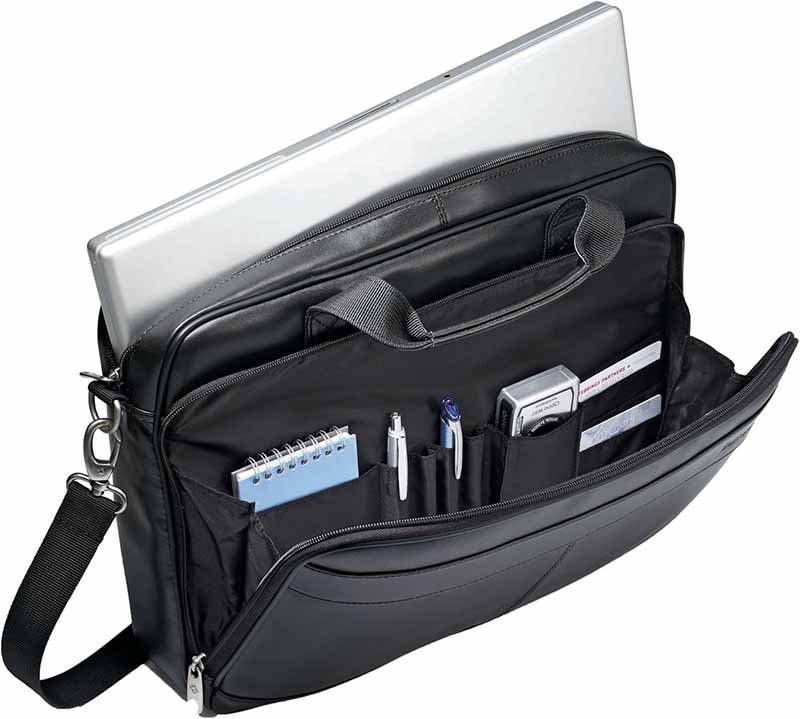
Leather laptop bags stop leaks by controlling the places where water naturally tries to enter: top openings, zipper gaps, stitch holes, seams, bottom corners, front pockets, handle bases, flap edges, and lining joints. The leather surface may resist rain, but leakage usually happens where different parts are connected. A strong design uses protected zippers, smarter seam direction, reinforced gussets, sealed edges, water-resistant lining, and raised laptop storage.
For many leather laptop bag projects, the leak problem is not dramatic. Water does not always pour into the bag at once. More often, it enters slowly through weak construction details. A few drops may pass through the top zipper. Moisture may move through stitch holes after the bag stays in rain for several minutes. Water may collect at the bottom corner when the bag is placed on wet ground. The outer bag may still look fine, but the inner sleeve, documents, charger, and laptop surface may already feel damp.
This is why leak control should be built into the pattern, not repaired after the sample is finished. Once the zipper position, seam route, gusset shape, flap size, and inner sleeve location are fixed, later improvements become harder and more expensive. A professional leather goods factory should review leak risks before cutting bulk leather.
In leather laptop bag development, water usually follows four paths:
| Water Path | Common Entry Point | Product Risk | Better Design Direction |
|---|---|---|---|
| Direct rain path | Top zipper, flap gap, pocket opening | Water enters main compartment | Covered zipper, wider flap, recessed opening |
| Seam path | Stitch holes, side gussets, bottom seams | Moisture passes through construction lines | Smarter seam placement, internal backing, tighter stitching control |
| Edge path | Raw edges, weak edge paint, folded leather edges | Swelling, peeling, shape loss | Stronger edge coating, better drying, edge flex review |
| Bottom path | Wet floor, pavement, airport tray, car floor | Laptop sleeve and documents become damp | Reinforced base, raised sleeve, protective feet |
For brand clients, leak resistance should be discussed in product language before sampling. “Make it waterproof” is too broad. A clearer request would be: “The bag should protect a 14-inch laptop during 10–15 minutes of light rain, with a covered top zipper, water-resistant lining, reinforced base, and raised padded sleeve.” This gives the factory a real direction.
A clean leather laptop bag can still hide strong protection. The best designs do not look overbuilt. The zipper cover may be slim. The seam route may be moved slightly downward. The laptop sleeve may be raised only 20–30 mm from the base. The lining may look soft but use a water-resistant backing. The bottom may include invisible reinforcement. Small changes make a large difference when the bag is used every day.
Do Leather Laptop Bags Need Waterproof Zippers?
Leather laptop bags need waterproof or water-resistant zippers when the zipper is exposed to rain and the bag is promoted for commuting, travel, or wet-weather use. If the zipper sits under a flap, a high-quality standard zipper may be enough for light daily water resistance. If the zipper is exposed on the top panel, zipper choice becomes one of the most important waterproof features.
A standard zipper is not sealed. It has small gaps between teeth or coils, and the zipper tape itself can absorb moisture. When rain lands directly on the zipper line, water may pass through slowly. This is especially risky for laptop bags because the main zipper often sits above the computer compartment.
There are three common zipper solutions for leather laptop bags:
| Zipper Solution | Water Protection | Appearance | Cost Impact | Best Use |
|---|---|---|---|---|
| Standard zipper with leather cover | Medium | Classic, clean, premium | Low to medium | Business briefcases, laptop totes |
| Water-resistant zipper tape | Medium to high | More modern, slightly technical | Medium | Commuter bags, travel work bags |
| Waterproof zipper structure | High when properly built | Technical, stiffer feel | Higher | Outdoor-inspired laptop bags |
A leather zipper cover is often a strong choice for premium bags because it improves rain protection without making the bag look like sports equipment. The cover should be wide enough to shield the zipper line, and the zipper should not sit too close to the edge. If the cover is too narrow or too soft, wind and movement may expose the zipper during rain.
For modern commuter bags, water-resistant zipper tape can be a better choice. It gives a cleaner top opening and better direct rain performance. However, it may feel stiffer than standard zipper tape and may affect the bag’s luxury impression. This is especially important for brands selling leather laptop bags at a higher retail price.
When choosing zippers, brand clients should check:
- Zipper tape surface and coating quality
- Smooth opening and closing after sewing
- Compatibility with leather thickness
- Puller strength and finish
- Color match with leather and hardware
- Curve performance around bag corners
- Water behavior after short spray exposure
- Bulk availability for repeat orders
A good zipper decision should match both performance and product style. A rugged travel laptop bag can accept a more technical zipper. A formal leather briefcase may perform better with a hidden zipper cover and a refined metal puller.
How Do Seams Affect Leather Laptop Bags?
Seams affect leather laptop bags because every stitch creates a possible water path. Leather panels are joined by needle holes, thread tension, folded edges, adhesives, reinforcement, and lining connections. If water reaches these areas repeatedly, moisture can move inside or weaken the structure over time.
The seam problem becomes more serious in laptop bags because the product carries weight. A loaded laptop bag pulls on handles, side panels, bottom corners, and shoulder strap tabs. If these areas also face rain, the stress becomes higher. Water softens some materials, affects adhesives, and can make edge areas swell. A seam that looks clean on a showroom sample may fail faster under daily use if its position is poorly planned.
Different seam areas need different attention:
| Seam Area | Main Risk | Better Control Method |
|---|---|---|
| Top opening seam | Direct rain exposure | Keep seam under cover or away from zipper edge |
| Side gusset seam | Water collection along folds | Use panel overlap and careful stitch tension |
| Bottom seam | Wet floor and weight pressure | Add base reinforcement and inner moisture barrier |
| Handle attachment seam | Pulling force and rain contact | Use reinforced tabs and strong backing |
| Front pocket seam | Rain and hand contact | Add flap, lip, or protected pocket opening |
| Laptop sleeve seam | Device movement and pressure | Use clean inner stitching and soft protective lining |
For rain-focused leather laptop bags, seam direction is very important. Water should be guided away from the main compartment, not toward it. A slightly adjusted seam route can reduce water entry without changing the bag’s appearance much.
Thread selection also matters. Strong polyester thread is commonly used for leather bags because it has better durability than cotton thread. Thread thickness should match leather weight and design style. If the thread is too thin, strength may suffer. If it is too thick, stitch holes become larger and may allow more moisture movement. Stitch density should also be controlled. Too many stitches can weaken the leather edge. Too few stitches can reduce strength and create uneven gaps.
For custom leather laptop bags, SzoneierLeather can review seam placement during the sample stage and adjust the pattern before bulk production. This is much easier than trying to fix water resistance after thousands of pieces have already been cut and sewn.
Why Do Edges Matter in Leather Laptop Bags?
Edges matter in leather laptop bags because cut leather edges are exposed to moisture, friction, bending, hand contact, and pressure. Poor edge finishing can lead to swelling, peeling, cracking, color loss, and a lower-quality appearance. For waterproof performance, edge finishing is not decoration. It is one of the barriers that protects the leather structure.
A leather laptop bag often has many exposed edge areas:
- Handles
- Shoulder strap tabs
- Zipper openings
- Front pocket edges
- Flap edges
- Side gussets
- Bottom corners
- Inner laptop sleeve edges
- Card pockets or organizer panels
- Logo patch edges
These areas are touched, bent, pulled, and rubbed often. If water enters through a poorly finished edge, the leather may swell or become rough. Edge paint may lift after repeated flexing. Folded leather edges may lose shape if the adhesive layer weakens. On a premium laptop bag, edge defects are highly visible and can make the product feel cheaper than it is.
Good edge finishing usually requires several controlled steps: trimming, sanding, base coating, drying, polishing, second coating, drying again, and final inspection. The exact process depends on leather type, edge design, and product level. A thick vegetable-tanned leather edge may need a different process from a soft chrome-tanned leather edge. A formal briefcase may need cleaner and smoother edges than a casual messenger bag.
For water-resistant leather laptop bags, edge quality should be checked after flexing, not only when the sample is new. Many edge problems do not appear on day one. They appear after the handle bends, the flap opens many times, or the bottom corner rubs against surfaces.
A useful edge review includes:
| Edge Check | What It Shows |
|---|---|
| Visual smoothness | Whether the edge looks premium and even |
| Finger touch | Whether the edge feels rough, sticky, or sharp |
| Flex test | Whether edge paint cracks during bending |
| Water contact review | Whether the edge swells or changes color |
| Adhesion check | Whether coating lifts from the leather |
| Color match | Whether edge color fits leather and thread |
| Bulk consistency | Whether edge quality can be repeated in production |
For brand clients, edge finishing should be included in the sample approval checklist. A bag may photograph well from the front, but edge quality often decides whether the product feels truly premium in hand.
Are Flaps Useful for Leather Laptop Bags?
Flaps are useful for leather laptop bags because they protect zippers, pockets, and openings from direct rain. A flap works like a small roof. Instead of allowing water to fall directly onto the zipper, it guides water away from the main compartment. For leather bags, flaps are especially valuable because they improve water resistance while keeping a classic leather look.
Flaps can be used in several ways:
| Flap Type | Main Function | Suitable Bag Style |
|---|---|---|
| Full front flap | Covers main opening and front pocket | Messenger bags, satchels |
| Zipper rain flap | Covers top zipper only | Briefcases, laptop totes |
| Pocket flap | Protects front organizer pocket | Business bags, work bags |
| Hidden inner flap | Adds protection under outer opening | Premium commuter bags |
| Side gusset flap | Reduces side rain entry | Travel laptop bags |
The flap should not only look good. It needs correct size, stiffness, closure strength, and overlap. If the flap is too short, rain can still reach the zipper. If it is too soft, it may lift during movement. If the closure is weak, the flap may open when the bag is full. If the flap is too large, the bag may feel old-fashioned or inconvenient.
For leather laptop bags, the best flap design often balances three goals:
- Rain protection
- Easy access
- Clean appearance
A business user may need to remove the laptop quickly at airport security or meetings. A flap with complicated buckles may look beautiful but slow down daily use. Hidden magnets, quick-release buckles, snap closures, or structured leather lips can improve usability.
Flaps also protect front pockets. Many users put phones, passports, business cards, chargers, and documents in outer pockets. These pockets often face direct rain. A pocket flap or hidden zipper lip can protect small items and reduce complaints.
For SzoneierLeather custom projects, flap shape can be adjusted during sampling. A few millimeters of extra coverage can improve rain protection without changing the product style. This is one of the reasons physical samples are so important. A flat drawing cannot always show how a flap behaves when the bag is filled, carried, opened, and closed.
How Do Leather Laptop Bags Protect Devices?
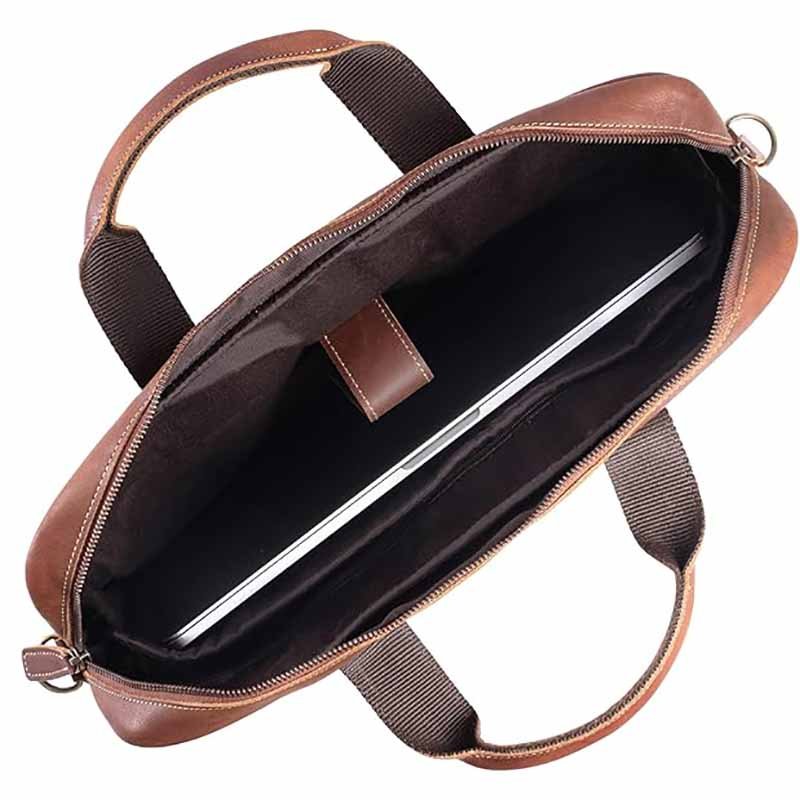
Leather laptop bags protect devices through layered structure: treated outer leather, controlled openings, water-resistant lining, padded laptop sleeve, raised bottom, protected corners, reinforced panels, and organized inner storage. The laptop should not sit directly against the outer wall, wet base, metal hardware, charger, keys, or sharp accessories. Good protection combines water control, shock absorption, shape stability, and user-friendly organization.
A laptop bag has to protect against more than rain. In daily use, the device may face pressure from the charger, impact from a table corner, vibration during travel, compression in a car trunk, or a sudden drop from chair height. For leather laptop bags, the challenge is to add protection without making the bag bulky or destroying the clean leather profile.
The inner structure is where many product quality differences appear. Two leather laptop bags may look similar from the outside, but one may have a simple fabric divider while the other has a raised padded laptop compartment with reinforced corners, soft lining, and bottom buffer. The second bag gives the end user a much better experience, especially after months of daily use.
Device protection should be planned around real laptop sizes. A “15-inch laptop bag” is not enough information because actual device dimensions vary by brand, model, screen bezel, and thickness. Internal sleeve dimensions, tolerance, padding thickness, and opening width should be confirmed before sampling. If the sleeve is too tight, users may force the laptop inside and damage seams. If it is too loose, the laptop moves and hits other objects.
A strong leather laptop bag usually protects devices in four ways:
| Protection Area | Main Purpose | Good Design Choice |
|---|---|---|
| Water protection | Keeps moisture away from laptop | Water-resistant lining, covered zipper, raised sleeve |
| Impact protection | Reduces shock from bumps and drops | Foam padding, reinforced corners, structured panels |
| Pressure protection | Prevents charger or items pressing into laptop | Separate pockets, dividers, elastic holders |
| Bottom protection | Keeps laptop away from wet or hard surfaces | Raised sleeve, reinforced base, protective feet |
For brand clients, laptop protection is one of the strongest selling points because it is easy for end users to understand. A premium leather surface attracts attention, but safe laptop storage builds trust after purchase. The product should feel beautiful outside and calm inside.
Do Leather Laptop Bags Need Padded Sleeves?
Leather laptop bags need padded sleeves if they are designed to carry computers safely. Leather alone is not enough to protect a laptop from impact, pressure, and moisture transfer. A padded sleeve creates a protected zone inside the bag and separates the device from the outer shell, accessories, and bottom panel.
A padded sleeve should be developed based on the target laptop size. It should hold the device securely without creating friction or pressure. The sleeve should also be easy to access. If the opening is too narrow, users may scratch the laptop or stretch the bag during daily use.
Common laptop sleeve sizes include:
| Target Laptop | Suggested Internal Sleeve Range | Common Product Style |
|---|---|---|
| 13-inch laptop | Approx. 330 × 230 mm range | Slim executive bag, compact tote |
| 14-inch laptop | Approx. 350 × 250 mm range | Daily business laptop bag |
| 15.6-inch laptop | Approx. 390 × 275 mm range | Commuter briefcase, office work bag |
| 16-inch laptop | Approx. 380–400 × 270–290 mm range | Premium travel work bag |
| Tablet + laptop | Separate dual sleeves | Business travel bag |
Exact dimensions should always be checked against the target device list. The bag’s internal size must also consider padding thickness. If 5 mm foam is used on both sides, the outer sleeve panel needs enough extra space. Otherwise, the finished sleeve may be too tight after sewing.
Padding material should match the product style:
| Padding Type | Feel | Protection Level | Suitable Use |
|---|---|---|---|
| Thin foam | Slim, light | Basic | Executive slim bags |
| Medium-density foam | Balanced | Good | Daily laptop bags |
| Thick sponge padding | Soft, bulky | Good for casual use | Travel and messenger bags |
| EVA sheet support | Structured | Stronger | Premium commuter bags |
| Layered foam + lining | Comfortable and protective | High | High-end laptop compartments |
For leather laptop bags, medium-density foam is often a practical choice because it protects without making the bag too thick. For travel bags, reinforced corners and thicker bottom padding may be added. For slim business bags, the padding must be more controlled to keep the silhouette clean.
The padded sleeve should also be raised from the bottom. Even 20–30 mm of distance can help reduce direct impact when the bag touches the floor. This detail is small, but it is very important for laptop safety.
Which Linings Help Leather Laptop Bags?
Linings help leather laptop bags by protecting the inside from moisture, abrasion, scratches, dust, and pressure. A good lining also improves the user experience because people touch the inside of the bag every day when placing laptops, chargers, documents, and personal items.
For waterproof feature development, lining selection is not only about color or feel. It affects moisture control, cleaning, durability, weight, and product positioning. A poor lining can absorb water, wrinkle, tear, stain, or transfer color. A strong lining supports the bag’s structure and keeps the inside cleaner for longer.
Common lining options include:
| Lining Material | Water Resistance | Touch | Best Use |
|---|---|---|---|
| Polyester lining | Medium to high | Smooth, practical | Daily work bags |
| Nylon lining | High | Strong, technical | Travel and commuter bags |
| Microfiber lining | Medium | Soft, premium | Executive laptop bags |
| Suede-like fabric | Low to medium | Luxury feel | High-end interiors, dry use |
| Coated fabric lining | High | More technical | Wet-weather laptop bags |
| Recycled polyester lining | Medium to high | Practical | Sustainability-focused programs |
For laptop compartments, soft touch is important because the device surface should not be scratched. For the bottom and side areas, water resistance and durability may matter more. Some designs use two lining materials: a softer material inside the laptop sleeve and a stronger water-resistant lining in the main compartment or bottom section.
Color selection also affects daily usability:
- Light gray lining makes items easier to find.
- Black lining hides stains but makes small items harder to see.
- Tan or brown lining matches classic leather bags.
- Branded lining can improve retail value.
- Bright lining can support fashion or lifestyle collections.
For brand clients, lining quality should not be downgraded too much to save cost. The lining is not as visible in product photos, but it strongly affects repeat use. If the lining tears, smells, stains, or feels cheap, the whole bag feels lower quality.
For water-resistant leather laptop bags, the lining should be checked for:
- Moisture absorption
- Colorfastness
- Odor after packing
- Abrasion resistance
- Seam strength
- Compatibility with padding
- Wrinkle behavior after sewing
- Appearance after loading test
SzoneierLeather can support lining selection based on product level, target retail price, leather type, and desired interior feel. A premium bag should feel premium both outside and inside.
Should Leather Laptop Bags Have Raised Bottoms?
Leather laptop bags should have raised bottoms when laptop protection is important. A raised bottom keeps the laptop away from direct contact with wet floors, hard surfaces, impact points, and the outer base panel. This is one of the most useful hidden features in a high-quality laptop bag.
Many users place laptop bags on unsafe surfaces without thinking:
- Café floors
- Office carpets near wet umbrellas
- Airport security trays
- Taxi floors
- Train platforms
- Hotel lobby floors
- Conference room floors
- Car trunks
- Outdoor benches
If the laptop sleeve sits directly on the base, moisture and impact transfer more easily to the device. A raised bottom creates a buffer zone. The structure can be simple or advanced depending on the product level.
Common raised bottom solutions include:
| Raised Bottom Method | Structure | Benefit |
|---|---|---|
| Suspended laptop sleeve | Sleeve stops above the base | Keeps laptop away from floor impact |
| Foam base buffer | Padding added under laptop area | Reduces shock |
| Reinforced false bottom | Hidden support layer inside base | Improves shape and protection |
| Protective metal feet | Hardware lifts bag from surface | Reduces leather contact with wet ground |
| Double-layer base | Outer leather plus inner support | Stronger bottom durability |
A raised bottom does not need to make the bag thick. In many designs, the laptop sleeve can be lifted slightly while the outside shape remains slim. This is especially useful for executive briefcases and business totes where the design must stay clean.
Protective feet can also help, but they are not always suitable for every style. Metal feet work well for structured briefcases and premium totes. They may look too formal or heavy for soft messenger bags. If feet are used, they should be placed correctly so the bag stands evenly and does not scratch surfaces.
For wet-weather leather laptop bags, a raised bottom should be paired with a water-resistant lining or base barrier. If the outer base becomes damp, the inner sleeve still needs separation. This combination gives better real-world protection than a flat sleeve placed directly at the bottom.
How Do Leather Laptop Bags Protect Corners?
Leather laptop bags protect corners through reinforced laptop sleeves, padded side walls, structured bottom panels, stronger outer corners, careful seam placement, and controlled hardware position. Laptop corners are vulnerable because they often hit first when the bag drops, bumps into furniture, or slides under a desk.
Corner protection must be designed carefully because too much padding can make the bag bulky. The goal is to protect the device while keeping the leather bag elegant. This is especially important for premium business bags, where the end user expects a slim and refined shape.
Corner risks appear in two places:
| Corner Area | Risk | Protection Method |
|---|---|---|
| Laptop sleeve corners | Device impact during drop or movement | Foam padding, rounded sleeve corners, soft lining |
| Outer bag corners | Abrasion, rain, floor contact, deformation | Reinforced leather, structured base, edge finishing |
| Bottom side corners | Wet floor and compression | Base support, raised sleeve, protective feet |
| Front pocket corners | Item pressure and seam stress | Reinforced stitching, better pocket layout |
| Gusset corners | Folding stress and water collection | Pattern control, seam placement, internal support |
A strong laptop sleeve should not have sharp inner seams pressing against the device. Soft lining should cover the contact area. If the sleeve uses a closure strap, the strap hardware should not touch the laptop surface. If there is an inner zipper pocket near the laptop compartment, the zipper puller should be positioned away from the device.
For outer bag corners, leather thickness and reinforcement matter. A soft leather laptop bag may collapse at the corners if the base is weak. A structured bag may hold shape better but needs careful edge finishing to avoid cracking. The factory must balance softness, structure, weight, and durability.
For custom projects, SzoneierLeather can adjust corner protection based on the final bag style:
- Slim business bags: thinner foam, structured sleeve, clean corners
- Travel laptop bags: thicker padding, reinforced base, stronger corner support
- Messenger bags: flexible padding, flap protection, soft corner shaping
- Premium totes: hidden raised sleeve, reinforced base, soft-touch lining
- Corporate laptop bags: stable structure, consistent bulk appearance, durable corners
The best corner protection is not always visible. In many strong leather laptop bags, the end user only feels that the bag is stable, balanced, and safe. That feeling comes from internal construction.
How Should Brands Develop Leather Laptop Bags?
Brands should develop leather laptop bags by defining the end user, use environment, laptop size, leather type, water-resistance level, zipper structure, seam design, lining, padding, hardware, packaging, testing, and product claim before sampling. A clear development brief helps the factory build the right product from the beginning and reduces costly changes after sample approval.
A leather laptop bag project often starts with a reference photo, a target size, and a logo requirement. That is not enough for a serious product. If the bag needs waterproof features, the development brief should go deeper. The factory needs to know whether the bag is for office use, daily commuting, business travel, retail shelves, corporate gifts, online sales, or a full private label leather goods collection. Each situation changes the material and construction plan.
For example, an office laptop briefcase may focus on clean structure, smooth leather, hidden protection, and elegant hardware. A commuter leather laptop bag may need better rain resistance, reinforced bottom, water-resistant lining, and faster access. A travel laptop bag may need larger capacity, trolley sleeve, raised laptop compartment, stronger zipper, and better corner protection. A premium leather laptop tote may need soft appearance, light weight, comfortable handles, and hidden padded storage.
Before sampling, clients should answer several practical questions:
- What laptop size must the bag fit?
- Is the main market rainy, dry, hot, cold, or humid?
- Will the bag be carried by hand, shoulder, crossbody, or over luggage?
- Should the leather age naturally or stay clean and uniform?
- Does the product need a formal business look or a casual travel look?
- What water-resistance claim will appear on the product page?
- What retail price range must the final product support?
- What packaging style is required for shipping and presentation?
- Will the brand expand into wallets, belts, straps, leather boxes, or matching accessories later?
These questions affect design choices. If the customer wants a 16-inch laptop travel bag, the structure must be stronger than a slim 13-inch executive bag. If the bag will be sold in rainy cities, zipper cover and lining become more important. If the bag will be sold as a luxury item, the leather feel and edge finishing cannot be sacrificed for a heavy plastic-like coating.
A good development process should connect design, function, cost, and production stability. A sample that looks beautiful but is difficult to repeat in bulk can create delays and quality variation. A bag that is too technical may protect well but fail to attract customers looking for leather elegance. A low-cost version may hit the price target but create complaints when used in rain. The factory’s role is to help the client find a balanced solution.
For SzoneierLeather, waterproof feature development is handled as part of the complete product workflow. The company supports raw material sourcing, material development, product design, sampling, leather cutting, sewing, edge finishing, hardware matching, packaging design, packaging inspection, and bulk production. This is valuable for clients who need a factory that understands both leather beauty and functional structure.
What Specs Matter for Leather Laptop Bags?
The most important specs for leather laptop bags include outer dimensions, laptop compartment size, leather type, leather thickness, surface finish, lining material, padding thickness, zipper type, seam structure, handle strength, strap design, hardware finish, edge treatment, bottom support, logo method, packaging, and water-resistance target.
A strong leather laptop bag specification should not only describe how the bag looks. It should explain how the bag will perform. For waterproof features, the technical details are especially important because small differences in construction can change the final result.
A basic specification may say: leather laptop bag, black, 15-inch, logo embossing. That is too vague for a professional product. A better specification should include:
| Specification Area | What to Define | Why It Matters |
|---|---|---|
| Laptop fit | Internal sleeve length, height, thickness, tolerance | Prevents tight fit or loose movement |
| Leather type | Full-grain, top-grain, coated, waxed, oiled, split leather | Controls appearance, durability, and water resistance |
| Leather thickness | Panel thickness range by bag area | Affects shape, weight, sewing, and cost |
| Surface finish | Light finish, pigment finish, wax, oil, coating | Controls rain behavior and hand feel |
| Zipper system | Standard zipper, covered zipper, water-resistant zipper | Controls top opening leakage |
| Seam design | Seam route, stitch density, thread type | Controls strength and water path |
| Lining | Polyester, nylon, microfiber, coated fabric | Affects moisture control and inner quality |
| Padding | Foam thickness, density, sleeve position | Protects laptop from impact |
| Bottom structure | Flat base, reinforced base, raised sleeve, feet | Protects against wet floors and bumps |
| Hardware | Buckle, D-ring, zipper puller, rivet, feet | Affects durability and visual quality |
| Logo method | Embossing, debossing, metal logo, woven label | Affects brand presentation |
| Packaging | Dust bag, tissue wrap, insert, carton | Protects shape during shipping |
Laptop compartment dimensions deserve special attention. A “15-inch laptop bag” can mean many things. A 15.6-inch Windows laptop, a 16-inch MacBook, and a slim 14-inch business laptop do not share the same body size. If the product is sold online, poor fit can lead to returns.
A practical laptop sleeve planning table can help:
| Target Device Range | Suggested Sleeve Direction | Best Product Type |
|---|---|---|
| 13-inch laptop | Slim sleeve, light padding, compact layout | Executive briefcase, small work tote |
| 14-inch laptop | Balanced sleeve, medium padding, daily layout | Office laptop bag, commuter bag |
| 15.6-inch laptop | Wider opening, stronger padding, larger base | Business briefcase, travel work bag |
| 16-inch laptop | Reinforced sleeve, structured base, stable handle | Premium travel laptop bag |
| Laptop + tablet | Dual compartments, soft divider, cable pocket | Business travel and tech work bag |
For waterproof features, the spec should define the expected use condition. Instead of writing “waterproof,” a more buildable request would be:
- Water-resistant treated leather for daily rain
- Covered top zipper to reduce direct water entry
- Water-resistant lining in main compartment
- Raised padded laptop sleeve
- Reinforced bottom panel
- Strong edge finishing for exposed leather edges
- Sample review after short water exposure
This type of specification gives the factory clear direction. It also protects the client because the final product claim is tied to real construction.
Hardware specs also matter. Metal zipper pullers, buckles, D-rings, rivets, magnetic buttons, and protective feet should match the product’s use environment. If hardware finish is weak, moisture and hand sweat may cause discoloration. For premium leather laptop bags, hardware should be selected for both appearance and corrosion resistance.
Handle and strap specs should be reviewed with load in mind. A laptop bag often carries 2–5 kg in daily use, depending on device, charger, documents, power bank, and personal items. Reinforcement around handle bases and shoulder strap tabs is necessary. If waterproof features are added but load-bearing areas are weak, the product still fails in real life.
Which Tests Fit Leather Laptop Bags?
Leather laptop bags should be tested for water behavior, zipper leakage, seam quality, lining moisture control, laptop fit, loading strength, handle pull, strap durability, bottom abrasion, edge paint flexing, colorfastness, hardware stability, and packaging protection. Testing should match the product claim and real use environment.
Testing does not always mean expensive laboratory testing during the first sample round. Many important problems can be found through structured sample review. The key is to check the product like a customer will use it, not only like a display item.
A practical sample review process can include:
| Test Item | Simple Review Method | What It Reveals |
|---|---|---|
| Water drop review | Place water drops on leather, wipe after short time | Surface darkening, beading, staining |
| Short spray review | Spray top and front areas lightly | Zipper and seam water behavior |
| Zipper check | Open and close repeatedly after sewing | Smoothness, stiffness, tape quality |
| Seam inspection | Check stitch holes, tension, route | Strength and water entry risk |
| Lining check | Touch and inspect after water exposure | Moisture transfer and drying behavior |
| Laptop fit test | Insert target laptop or dummy board | Fit, access, sleeve tolerance |
| Loading test | Fill bag with working weight | Shape, handle strength, base stability |
| Bottom contact review | Place on damp surface for short time | Base protection and sleeve height |
| Edge flex review | Bend handles, flap, strap tabs | Edge cracking or peeling risk |
| Colorfastness review | Rub surface with dry and damp cloth | Transfer risk to clothing or lining |
| Packaging review | Pack sample as bulk shipment | Shape retention and pressure marks |
For waterproof feature development, testing should focus on weak points. The leather surface is only one part. The top zipper, side seams, front pocket, bottom corners, and laptop sleeve must also be checked.
A water-resistant leather laptop bag should pass basic daily-use expectations:
| Customer Situation | Product Should Do |
|---|---|
| Short light rain | Outer surface should wipe clean without serious marks |
| Wet hand contact | Leather should not stain immediately |
| Damp café table | Bottom should resist moisture transfer |
| Laptop storage | Sleeve should remain dry during light exposure |
| Daily opening | Zipper should move smoothly without coating damage |
| Loaded carrying | Handles and straps should stay stable |
| Regular use | Edges should not crack or peel quickly |
For more advanced claims, additional testing may be needed. If a client wants to promote the bag as rain-resistant, the sample should be reviewed under more direct spray exposure. If the bag is designed for travel, handle load, strap pull, abrasion, and packaging pressure should be checked more carefully. If the bag uses light-colored leather, colorfastness and stain resistance become more important.
Bulk production quality control should include repeated checks, not only one sample approval. Leather is a natural material, so color, grain, thickness, and stretch may vary. The factory should control panel selection, cutting direction, sewing consistency, edge paint quality, hardware attachment, lining cleanliness, and final packaging.
For SzoneierLeather, quality review can include material confirmation, sample comparison, in-process inspection, finished product inspection, packaging check, and shipment preparation. The goal is not only to make a good first sample. The goal is to make bulk products that stay close to the approved sample.
How Do Costs Change for Leather Laptop Bags?
Costs change in leather laptop bags when clients upgrade leather grade, surface finish, zipper type, lining, padding, reinforcement, hardware, edge finishing, logo method, testing, packaging, and quality inspection requirements. Waterproof features usually increase cost, but smart design can control the increase without weakening the product.
The largest cost driver is often leather. Better leather costs more because of raw material grade, tanning, finishing, thickness control, usable cutting area, and defect rate. In leather goods, material utilization is very important. Natural marks, scars, uneven grain, loose areas, and color differences may reduce the usable area. A higher-grade leather may improve appearance and consistency, but it also raises cost.
Construction complexity is another major factor. A simple laptop sleeve costs less than a raised padded sleeve. A standard zipper costs less than a water-resistant zipper. A flat bottom costs less than a reinforced base with protective feet. A clean edge with multiple finishing steps costs more than a basic folded edge. More compartments, organizer pockets, trolley sleeves, strap pads, and custom lining all add labor time.
A helpful cost structure table:
| Cost Area | Lower-Cost Direction | Higher-Performance Direction | Cost Impact |
|---|---|---|---|
| Leather | Basic finished leather | Treated full-grain or coated top-grain | High |
| Zipper | Standard zipper | Covered or water-resistant zipper | Medium |
| Lining | Basic polyester | Water-resistant nylon or microfiber | Low to medium |
| Laptop sleeve | Simple divider | Raised padded sleeve | Medium |
| Bottom | Flat base | Reinforced base with protective feet | Medium |
| Edge finishing | Basic edge process | Multi-layer polished edge finishing | Medium |
| Hardware | Standard metal parts | Custom plated or branded hardware | Medium |
| Logo | Simple embossing | Metal logo, patch, custom plate | Low to medium |
| Packaging | Polybag and carton | Dust bag, insert, gift box | Medium to high |
| Testing | Visual check | Water, load, fit, and durability review | Low to medium |
Waterproof features should be chosen according to market positioning. Not every bag needs every upgrade. A mid-range commuter bag may benefit most from coated leather, covered zipper, water-resistant lining, and raised sleeve. A premium executive bag may spend more on leather, edge finishing, hardware, and hidden protection. A travel laptop bag may prioritize zipper strength, base reinforcement, strap comfort, and capacity.
Cost control does not mean removing important protection. It means spending in the places customers feel most:
- The leather must look and feel right.
- The laptop sleeve must fit securely.
- The bag must not leak during normal use.
- The zipper must work smoothly.
- The handles must carry weight safely.
- The bottom must keep shape.
- The packaging must protect the bag during shipment.
Clients should also consider after-sales cost. A slightly cheaper zipper may save money during production but create complaints if rain enters the main compartment. A lower-cost lining may look acceptable at first but tear or stain quickly. Weak edge finishing may reduce factory cost but hurt the premium feel. For leather laptop bags, the cheapest option is rarely the strongest commercial choice.
A smarter development approach is to define three versions:
| Version | Suitable Market | Main Features |
|---|---|---|
| Standard office version | Entry to mid-range retail, corporate use | Finished leather, basic padded sleeve, covered zipper |
| Enhanced commuter version | Daily work and wet-weather markets | Coated leather, water-resistant lining, raised sleeve, reinforced base |
| Premium travel version | Higher-end business travel | Treated leather, upgraded zipper, structured base, refined edge finishing, custom packaging |
This version planning helps clients compare cost and value clearly. It also allows the brand to build a product line instead of only one SKU.
Why Choose SzoneierLeather for Leather Laptop Bags?
SzoneierLeather is suitable for clients who need a professional leather goods factory to develop and manufacture leather laptop bags with better material selection, functional structure, waterproof features, packaging support, and stable production control. The company has over 18 years of experience in leather product development and production, covering bags, wallets, belts, straps, accessories, leather boxes, and related custom leather goods.
For waterproof leather laptop bags, the strength of SzoneierLeather is not only sewing. The value comes from the complete development chain:
- Strong raw material supply chain
- Raw material development support
- Finished product development
- Product design support
- Sample making
- Manufacturing production
- Packaging design
- Packaging quality inspection
- Custom logo and branding support
- Product structure optimization
- Material and hardware matching
- Production communication for brand clients and custom wholesale clients
This full-chain support matters because leather laptop bags involve many connected decisions. A leather choice affects coating, edge finishing, stitching, structure, and cost. A zipper choice affects pattern, opening size, sewing process, and water resistance. A lining choice affects laptop protection and perceived quality. A packaging choice affects shipping safety and final presentation. When these decisions are handled separately, mistakes become easier. When the factory reviews them together, the product becomes more stable.
SzoneierLeather can support different custom leather laptop bag directions:
| Project Type | Development Focus | Suitable Client Need |
|---|---|---|
| Executive leather briefcase | Clean shape, premium leather, refined edge | Business and corporate collections |
| Commuter laptop bag | Water resistance, comfort, laptop protection | Daily work and urban use |
| Leather laptop tote | Soft structure, fashion appeal, hidden sleeve | Lifestyle and women’s work bag lines |
| Messenger laptop bag | Flap protection, waxed leather, shoulder comfort | Casual business and travel markets |
| Travel laptop bag | Capacity, reinforced base, trolley sleeve, strong zipper | Business travel and premium work gear |
| Private label collection | Consistent leather, logo, packaging, matching accessories | Brand expansion programs |
| Custom wholesale project | Controlled cost, practical structure, repeat production | Small and medium custom orders |
For clients who already understand leather products, communication can go deeper than basic quotation. They can discuss leather finish, water-resistance target, hardware grade, laptop size, edge style, lining quality, packaging structure, and bulk consistency. This is especially useful when the product is meant for a real brand collection rather than a one-time low-cost purchase.
SzoneierLeather can also help clients prepare a clearer development brief before sampling. A strong brief may include:
| Client Input | Example Detail |
|---|---|
| Product reference | Photos, sketches, competitor style, target shape |
| Laptop size | 13-inch, 14-inch, 15.6-inch, 16-inch, or exact device dimensions |
| Leather preference | Full-grain, top-grain, coated, waxed, oiled, vegan alternative if needed |
| Water protection | Daily water resistance, rain-focused use, protected commute |
| Structure | Briefcase, tote, messenger, backpack, travel bag |
| Logo method | Debossing, embossing, metal logo, woven label, leather patch |
| Hardware color | Silver, gunmetal, brass, black, custom finish |
| Lining | Polyester, nylon, microfiber, branded lining |
| Packaging | Dust bag, gift box, carton, retail packaging |
| Target order plan | Sample development, first order, repeat order forecast |
A professional leather laptop bag factory should help clients turn ideas into a manufacturable product. SzoneierLeather can review whether a requested feature makes sense for the target price and structure. For example, a client may ask for a fully waterproof leather briefcase with soft luxury leather and very low cost. These goals may conflict. The factory can explain which parts are realistic, which features raise cost, and which alternatives keep the product attractive.
That honest development discussion is valuable. It helps clients avoid weak samples, unstable bulk production, and unclear product claims.
What Should Brands Prepare Before Inquiry?
Brands should prepare product references, target laptop size, leather preference, water-resistance expectations, logo method, hardware color, lining direction, packaging style, estimated order quantity, target market, and retail positioning before contacting the factory. The clearer the project information, the faster the factory can give useful development advice and a more accurate quotation.
Many leather laptop bag inquiries begin with only one sentence: “Please quote a waterproof leather laptop bag.” This makes it difficult for the factory to respond accurately. Waterproof performance can mean different things. Leather type can change the price greatly. Laptop size affects pattern and material use. Hardware, lining, padding, and packaging all affect cost.
A better inquiry does not need to be complicated. It only needs to answer the practical questions that drive production.
Product Reference
Product references help the factory understand the expected shape, style, and function. A reference can be a photo, sketch, current product sample, competitor link, or mood board. The client should mark which parts they like and which parts they want to change.
For example:
- Keep the same slim briefcase shape
- Add a raised padded sleeve for 14-inch laptop
- Change leather to water-resistant coated black leather
- Add a covered zipper
- Use gunmetal hardware
- Add embossed logo on front panel
- Add microfiber lining
- Add dust bag packaging
This type of reference is much more useful than a photo alone. A photo shows style, but written notes explain intention. The factory can then develop a sample closer to the target.
For waterproof leather laptop bags, clients should also point out the rain-protection areas they care about most:
- Top zipper
- Front pocket
- Laptop compartment
- Bottom panel
- Side gusset
- Handle base
- Shoulder strap
- External document pocket
If the client already has complaints from a previous supplier, those should also be shared. Common issues include water spots, weak zipper, loose handle, lining tear, edge paint peeling, leather color difference, poor laptop fit, or shape collapse. These problems can be improved during new product development.
Laptop Size
Laptop size must be defined clearly before sampling. Screen size alone is not enough. A 15-inch laptop from one brand may have a different body size from another 15-inch laptop. Thickness also matters because padding reduces internal space.
Clients can provide:
- Exact laptop model
- Device length, height, and thickness
- Target laptop size range
- Required sleeve internal dimensions
- Whether the laptop uses a protective case
- Whether the sleeve must also fit tablet or documents
A safe sleeve should allow easy insertion without too much movement. For custom projects, tolerance should be discussed. A very tight sleeve looks neat but may annoy users. A loose sleeve is easier to use but provides less protection. The ideal fit depends on product style and target customer habits.
A practical sleeve planning example:
| Device Target | Sleeve Planning Direction |
|---|---|
| 13-inch laptop | Slim, light padding, compact bag body |
| 14-inch laptop | Good balance for daily business bags |
| 15.6-inch laptop | Wider opening, stronger structure, more base support |
| 16-inch laptop | Premium travel work bag structure recommended |
| Laptop + documents | Add document divider behind sleeve |
| Laptop + tablet | Use double sleeve or soft divider |
For waterproof feature design, the laptop sleeve should sit away from direct water routes. It should not be placed directly under an exposed zipper without protection. It should not touch the bottom panel without a buffer. It should not share space with water bottles unless there is separation.
Waterproof Target
The waterproof target should be described in real use language. Instead of saying “must be waterproof,” clients should define what the bag needs to handle. This helps the factory recommend the correct material and construction.
Useful waterproof target examples:
| Client Request | Better Technical Meaning |
|---|---|
| For office use | Light water resistance, clean surface, basic protection |
| For daily commute | Short rain resistance, covered zipper, raised laptop sleeve |
| For rainy cities | Stronger coating, water-resistant zipper, protected seams |
| For business travel | Rain resistance, reinforced bottom, trolley sleeve, strong hardware |
| For outdoor work | Hybrid material or technical structure may be needed |
The waterproof target affects cost and design. A bag for light office use does not need the same construction as a rain-focused commuter bag. A bag for heavy outdoor exposure may not be suitable as a pure leather product unless hybrid materials are accepted.
Clients should also decide how the product will be described to customers. If the bag is only tested for daily rain, the product copy should say water-resistant or rain-resistant, not fully waterproof. Clear wording helps protect the brand.
Branding Details
Branding details should be confirmed early because logo method affects leather selection, panel layout, production process, and packaging. Leather laptop bags can use several branding methods, and each one creates a different impression.
Common logo options include:
| Logo Method | Appearance | Suitable Use |
|---|---|---|
| Debossed logo | Subtle, premium, pressed into leather | Executive bags, luxury styles |
| Embossed logo | Raised effect, stronger visibility | Brand-focused collections |
| Metal logo plate | Polished and visible | Retail products, fashion bags |
| Leather patch | Casual and flexible | Messenger bags, travel bags |
| Woven label | Lower cost, practical | Inner branding or wholesale programs |
| Hot stamping | Clean color effect | Premium packaging and small details |
| Custom zipper puller | Functional brand detail | Higher-end custom bags |
For waterproof leather laptop bags, logo placement should avoid high water and high abrasion areas when possible. A debossed logo on a front panel may work well. A metal logo near the bottom may face scratches. A leather patch near a seam may affect water movement if poorly attached.
Packaging branding is also important. A premium leather laptop bag may include a dust bag, tissue wrapping, paper insert, hang tag, care card, and outer carton protection. If the product is sold online, packaging must protect shape during shipping. If the product is for retail, packaging should also support presentation.
Final Thoughts: Build Leather Laptop Bags Customers Can Trust
Waterproof features in leather laptop bags should feel natural, not forced. Customers choose leather because they want beauty, texture, structure, and a professional image. They also expect the bag to protect their laptop during real life: light rain, wet desks, airport travel, crowded commutes, and daily carrying. The best leather laptop bags do both. They look refined and work quietly in the background.
For brands, the strongest product is not always the one with the loudest waterproof claim. It is the one with the clearest match between promise and construction. If the bag says water-resistant, the leather, zipper, seams, lining, bottom, and laptop sleeve should support that claim. If the bag is designed for business travel, the handles, base, compartments, and packaging should be strong enough for repeated use. If the bag is sold as premium leather goods, the material, edge finishing, hardware, and inner details should feel worthy of the price.
A good leather laptop bag is built through many small decisions:
- Treated leather that resists short rain exposure
- Zipper structure that reduces water entry
- Seam placement that avoids direct water channels
- Edge finishing that protects cut leather
- Lining that helps keep the inside clean and dry
- Raised padded sleeve that protects the laptop
- Reinforced bottom that handles wet floors
- Hardware that stays stable under daily use
- Packaging that protects the bag during shipment
- Quality control that keeps bulk production close to the approved sample
SzoneierLeather helps clients develop custom leather laptop bags with a complete manufacturing approach. With over 18 years of experience in leather goods development and production, SzoneierLeather supports leather bags, wallets, belts, straps, accessories, leather boxes, and related custom leather products. The company has strong raw material supply chain capabilities and supports material development, finished product development, product design, sampling, production, packaging design, and packaging quality inspection.
For brand clients and custom wholesale clients, this means the project can move from idea to sample to production with clearer control. The team can help review leather options, waterproof feature direction, laptop compartment structure, zipper and seam details, lining, hardware, logo method, packaging, and production feasibility.
If you are planning a custom leather laptop bag project, send SzoneierLeather your reference design, target laptop size, leather preference, waterproof feature expectations, logo requirements, packaging idea, target order plan, and market positioning. SzoneierLeather can help turn your leather laptop bag concept into a product that looks premium, protects devices better, and feels ready for real daily use.