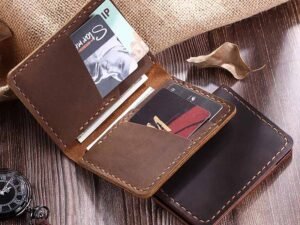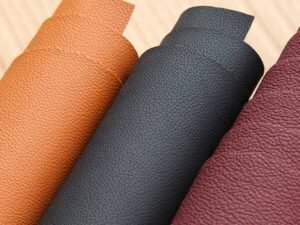
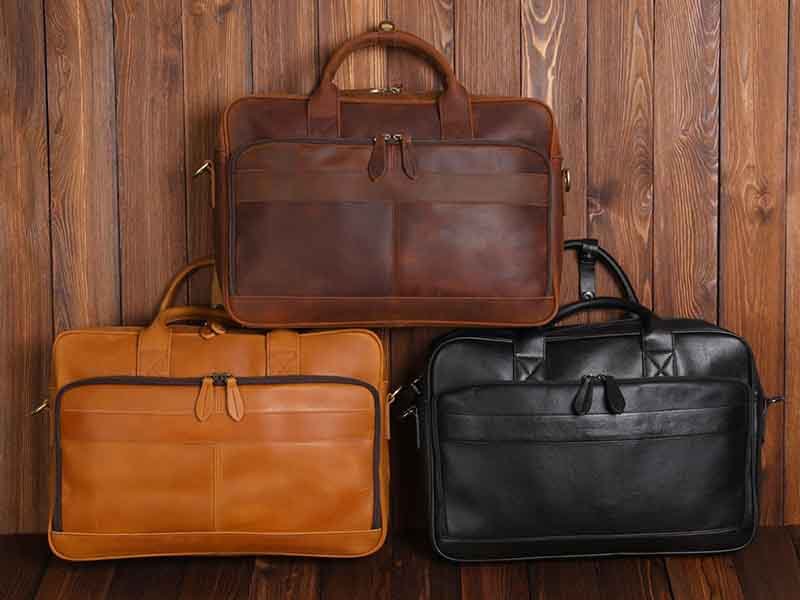
A finished leather accessory often looks straightforward. A wallet folds neatly, a belt sits flat, a briefcase holds its shape, and a leather presentation box opens with a clean, controlled movement. What is less visible is the amount of material planning and structural work required to make those results repeatable across hundreds or thousands of units.
A leather business accessory is rarely made from leather alone. It may contain lining fabric, reinforcement board, microfiber, foam, zipper tape, metal fittings, magnets, adhesive, thread, edge paint, molded components, and protective packaging. Every component affects appearance, weight, durability, cost, and production time.
Leather manufacturing for business accessories is the process of developing, sampling, producing, finishing, inspecting, and packing leather products such as business bags, wallets, belts, straps, organizers, cases, and leather boxes. A reliable process controls leather type, thickness, structure, hardware, stitching, dimensions, logo application, packaging, and performance before mass production begins.
The real challenge is not making one attractive sample. It is producing an entire order in which the leather shades remain controlled, card pockets fit correctly, straps resist stretching, edge paint stays smooth, hardware works consistently, and packaging protects the product through international transport.
A design can look excellent on a screen and still fail in daily use. A document case may be too narrow once files are inserted. A card holder may become bulky after six cards are added. A shoulder strap may look refined but stretch because the internal reinforcement is too weak. These are the details that separate decorative leatherwork from dependable leather manufacturing.
What Is Leather Manufacturing?
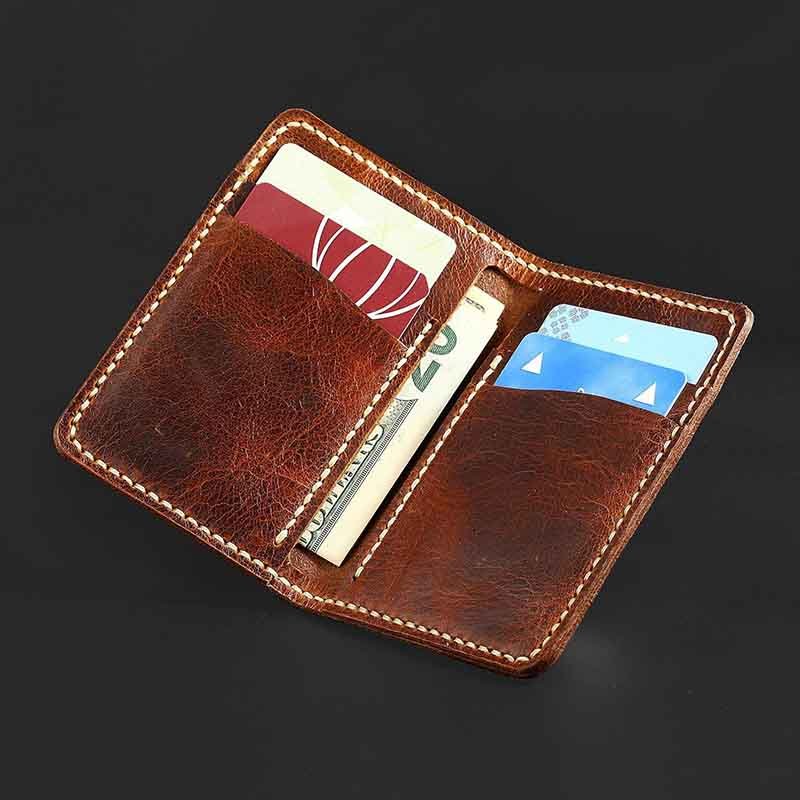
Leather manufacturing is the complete process of turning leather, hardware, lining, reinforcement, and packaging materials into a finished product. It includes product planning, material development, pattern engineering, sampling, cutting, skiving, assembly, sewing, edge finishing, hardware installation, inspection, testing, and packing.
The process must be adjusted for the product’s function. A slim card holder, a reinforced travel strap, a structured business bag, and a leather gift box cannot use the same leather thickness, internal support, sewing method, or finishing standard.
Leather Manufacturing Products
Leather business accessories cover a wide range of products used in offices, travel, retail collections, corporate programs, hospitality, technology, finance, automotive sales, and professional services.
Common product groups include:
- Business bags and briefcases
- Laptop sleeves and computer bags
- Document folders and folios
- Portfolios and conference organizers
- Wallets and card holders
- Passport covers and travel wallets
- Leather belts and waist straps
- Shoulder straps and replacement bag straps
- Watch straps and device straps
- Luggage tags and key holders
- Desk mats and mouse pads
- Pen cases and cable organizers
- Notebook covers and menu covers
- Leather trays and storage organizers
- Presentation boxes and gift boxes
- Leather-covered packaging cases
Each category creates its own technical priorities.
A business bag must support the weight of a laptop, charger, documents, and personal items without allowing the handles or shoulder attachments to deform. A wallet must hold several layers of cards and banknotes while remaining compact when closed. A belt must resist repeated bending, hole stretching, and buckle pressure. A leather box must maintain clean corners and accurate alignment without showing glue marks or raised joints.
| Product | Main Structure | Recommended Control Point | Common Production Risk |
|---|---|---|---|
| Business bag | Leather shell, lining, board, foam, hardware | Handle and strap reinforcement | Handle stretching or panel collapse |
| Wallet | Outer leather, card layers, lining | Layer thickness and fold allowance | Bulky edges or poor closure |
| Belt | Leather layer, backing, buckle | Tensile strength and hole spacing | Hole elongation or edge cracking |
| Card holder | Pocket layers and outer shell | Pocket opening tolerance | Cards fit too tightly or fall out |
| Shoulder strap | Leather, webbing, padding, hooks | Load-bearing construction | Twisting, stretching, or hook failure |
| Leather box | Board core and leather wrap | Corner folding and lid alignment | Warped panels or uneven gaps |
| Laptop sleeve | Leather shell, foam, lining | Device fit and impact protection | Loose fit or insufficient padding |
| Document folio | Leather panels, pockets, closure | Paper capacity and closing room | Folder cannot close when filled |
A capable factory should review the product according to its intended load, frequency of use, storage conditions, and expected service life. Selecting leather before defining these requirements often results in unnecessary cost or weak construction.
For example, using a thick 2.0 mm leather for every wallet component may sound durable, but the finished product could become too bulky. The better solution may be a 1.2 mm outer shell, 0.6–0.8 mm card pockets, carefully skived folding areas, and a thin internal lining.
Leather Manufacturing Uses
Leather accessories can serve many commercial purposes, and each use requires a different balance between appearance, durability, consistency, and cost.
Retail collections often place greater emphasis on distinctive leather grain, color development, hardware design, and packaging presentation. Corporate programs may require tighter color control, stable delivery schedules, logo consistency, and clear unit pricing. Hotel and restaurant products may need surfaces that tolerate frequent cleaning. Travel accessories must resist abrasion, moisture, repeated opening, and contact with metal luggage components.
Common application areas include:
- Fashion and lifestyle collections
- Executive gift programs
- Employee welcome kits
- Hotel and restaurant accessories
- Airline and travel programs
- Automotive customer gifts
- Financial institution gift sets
- Technology company organizers
- Conference and event merchandise
- University and alumni products
- Premium retail packaging
- Private-label accessory collections
The intended environment should be defined before product development begins.
A leather desk mat used in an office needs a flat, stable structure and a backing material that does not slip. A passport holder must fit different passport thicknesses without becoming loose. A hotel room key holder may be opened hundreds of times, so hinge flexibility and edge durability matter more than decorative detail.
Product use also determines how much natural leather variation can be accepted. A limited collection may welcome visible grain differences. A large employee program may need more uniform surface appearance so every recipient receives a product that looks consistent.
The leather finish should also match the maintenance expectations. A highly natural aniline finish can look refined but may show water marks and scratches quickly. A semi-aniline or pigmented finish may be more practical for daily business use.
Leather Manufacturing Benefits
Leather remains a strong material choice for business accessories because it combines structure, flexibility, surface character, repair potential, and long-term visual appeal.
Its value is not limited to appearance. Properly selected leather can withstand folding, pulling, rubbing, and repeated handling while maintaining a professional feel. It can also be cut, skived, molded, stitched, embossed, polished, painted, wrapped, and combined with metal, fabric, wood, and paperboard.
Leather allows a company to build a coordinated product family. The same leather color, hardware finish, edge color, lining pattern, and logo method can be applied across bags, wallets, belts, straps, organizers, and boxes.
This creates several practical benefits:
- Stronger visual consistency across product categories
- Easier collection expansion
- More recognizable material and color identity
- Better coordination between products and packaging
- Greater flexibility in logo application
- Wider choice of textures and finishes
- Long service life when construction is suitable
- Repair or component replacement possibilities for selected products
Leather also allows different price and performance levels within one collection.
For example, a business bag may use full leather on visible panels, microfiber inside high-friction pockets, reinforced fabric behind handles, and coated metal hardware in load-bearing areas. This does not reduce product quality. It improves performance by placing each material where it works best.
A common mistake is assuming that more leather always means a better product. In reality, excessive leather thickness can increase weight, make folding difficult, cause bulky seams, and raise shipping costs. A carefully engineered multi-material structure often performs better than an accessory made from heavy leather throughout.
Which Leather Manufacturing Materials Work Best?
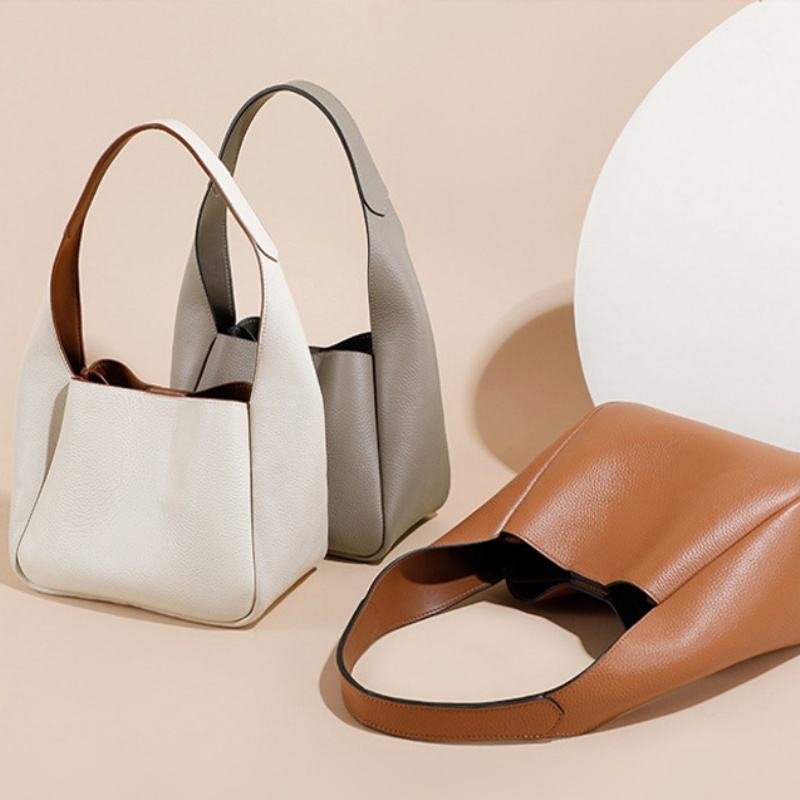
The best leather manufacturing material is the one that meets the product’s requirements for appearance, strength, flexibility, thickness, color stability, maintenance, and target cost. Full-grain, top-grain, corrected-grain, split, vegetable-tanned, and chrome-tanned leathers all have suitable applications when their properties are properly matched to the product.
Material selection should begin with the accessory’s use rather than a leather name. A heavily used business bag, a formal gift box, a flexible wallet, and a rigid belt require different fiber structures, finishes, temper, and thickness.
Leather Manufacturing Grades
Leather grade descriptions can be confusing because suppliers may use similar names for materials with very different properties. A clear specification should describe more than whether the leather is full-grain or top-grain.
It should identify:
- Animal origin
- Hide layer
- Tanning method
- Surface treatment
- Grain type
- Thickness range
- Temper
- Color standard
- Gloss level
- Backing condition
- Performance requirements
- Approved tannery or material source
Full-grain leather keeps the natural outer grain and can show pores, wrinkles, scars, and shade differences. It is often selected for products where natural character and aging are important. It can develop an attractive patina, but it may be harder to maintain uniform appearance across a large order.
Top-grain leather has usually received light surface correction or finishing. It can offer a useful balance between natural appearance and production consistency.
Corrected-grain leather is sanded or buffed and then finished or embossed. It provides more uniform grain and color, making it suitable for products that require consistent appearance and easier maintenance.
Split leather comes from the lower layer of the hide. It can be coated, embossed, or finished for selected applications. Its use should be clearly stated because its fiber structure differs from the grain layer.
| Leather Type | Appearance | Main Advantage | Main Limitation | Suitable Products |
|---|---|---|---|---|
| Full-grain leather | Natural grain and visible variation | Strong character and aging | Harder to match across large quantities | Premium bags, belts, wallets |
| Top-grain leather | Cleaner and more controlled surface | Balance of quality and consistency | Less natural variation than full grain | Business bags, folios, straps |
| Corrected-grain leather | Uniform grain and color | Stable appearance and easier care | Less natural surface character | Corporate gifts, luggage accessories |
| Split leather | Coated or embossed surface | Lower material cost | Lower fiber strength than grain leather | Inner parts and selected accessories |
| Vegetable-tanned leather | Firm, structured, develops patina | Good molding and edge burnishing | Sensitive to water and color change | Belts, cases, structured wallets |
| Chrome-tanned leather | Soft, flexible, wide color range | Good flexibility and production efficiency | Finish quality varies by tannery | Bags, wallets, straps, organizers |
The term “genuine leather” does not provide enough information for product development. It can describe several leather structures and quality levels. Professional projects should use detailed material specifications rather than relying on broad marketing terms.
Leather Manufacturing Thickness
Leather thickness influences product weight, folding behavior, stitch quality, edge appearance, durability, and cost. The correct thickness often changes from one component to another within the same product.
A wallet may require:
- 1.0–1.4 mm leather for the outer shell
- 0.5–0.8 mm leather for card pockets
- 0.4–0.7 mm leather near fold areas
- Thin fabric or microfiber lining inside hidden sections
A business bag may require:
- 1.2–1.8 mm leather for main panels
- 1.5–2.2 mm leather for handles
- 0.8–1.2 mm leather for wrapped piping
- Reinforcement board or fabric inside the base
- Additional support behind strap attachment points
Using one thickness throughout the product is rarely the most efficient choice. Layers are skived to reduce bulk around folded edges, seams, corners, and pocket openings.
| Component | Practical Thickness Range | Main Reason |
|---|---|---|
| Card pocket | 0.5–0.8 mm | Keeps stacked layers slim |
| Wallet exterior | 1.0–1.4 mm | Provides shape without excessive bulk |
| Bag main panel | 1.2–1.8 mm | Balances strength, shape, and weight |
| Bag handle | 1.5–2.2 mm | Supports pulling and repeated handling |
| Strap end | 1.2–1.8 mm | Allows folding around hardware |
| Single-layer belt | 3.0–4.0 mm | Provides stiffness and tensile strength |
| Laminated belt layer | 1.4–2.0 mm each | Allows reinforcement between layers |
| Leather box wrap | 0.6–1.0 mm | Folds cleanly over board corners |
| Notebook cover | 1.0–1.6 mm | Keeps cover flexible but stable |
| Desk mat surface | 1.2–2.0 mm | Creates a flat and durable working surface |
Thickness also affects edge paint. A very thick raw edge may require more sanding, filling, coating, and drying. Thin leather may need backing or folded construction to prevent waviness.
Leather thickness should be measured across several areas of each hide because natural material is not perfectly uniform. A project may specify a target thickness of 1.4 mm with an acceptable range, such as 1.3–1.5 mm, depending on the product and leather type.
Leather Manufacturing Finishes
Leather finishing controls color, gloss, touch, stain resistance, rubbing performance, scratch visibility, and water sensitivity.
Aniline leather has a transparent finish that preserves natural grain. It feels rich but can show marks and color variation more easily.
Semi-aniline leather uses a light protective coating while keeping much of the natural surface visible. It is often suitable for premium business products that need better practical performance than untreated aniline leather.
Pigmented leather has a more protective surface layer. It can provide better color uniformity and easier maintenance, making it useful for large accessory programs and frequently handled products.
Other finishes include:
- Matte finish
- High-gloss finish
- Waxed finish
- Oil pull-up finish
- Pebbled embossing
- Saffiano embossing
- Crocodile embossing
- Metallic coating
- Patent coating
- Printed surface
- Water-resistant coating
- Antique two-tone finish
The finish must be tested according to the product’s use.
Dark leather used on straps or bags can transfer color to light clothing if rubbing resistance is weak. Highly flexible wallet folds may crack if the surface coating is too rigid. Metallic and patent finishes can show scratches during packing and transport. Pull-up leather may display strong color changes when bent, which should be accepted during sample approval rather than treated as a production defect later.
Before confirming a leather finish, the development team should check:
- Dry rubbing resistance
- Wet rubbing resistance
- Surface cracking after flexing
- Scratch visibility
- Adhesion of the finish
- Water spotting
- Color change after bending
- Compatibility with adhesive and edge paint
- Reaction to protective film or tissue paper
- Odor after enclosed packaging
A leather swatch may perform differently after it is stitched, folded, glued, heated, or packed. For this reason, final approval should be based on a complete sample rather than a small color chip alone.
Leather Manufacturing Sustainability
Sustainable leather sourcing should be supported by material records, responsible chemical management, improved cutting efficiency, durability planning, and clear product claims.
The first step is traceability. A company should know which tannery supplied the leather, how the leather was processed, what finish was applied, and whether the material meets the requirements of the destination market.
Important review areas include:
- Tannery environmental management
- Water and energy use
- Wastewater treatment
- Chemical storage and control
- Restricted substance management
- Hide traceability
- Production waste handling
- Worker safety
- Material testing records
- Packaging reduction
- Product service life
Cutting efficiency also affects sustainability. Leather is an irregular natural material, so usable yield depends on hide shape, scars, grain condition, shade tolerance, and pattern size. A product with large uninterrupted panels may create more cutting waste than one with smaller components.
Product design can improve material use by:
- Reducing unnecessary oversized panels
- Using smaller offcuts for tabs and logo patches
- Sharing leather colors across several products
- Designing replaceable straps or handles
- Avoiding excessive decorative layers
- Selecting durable edge construction
- Using packaging sized closely to the product
Alternative materials can be considered for selected components, but claims should remain precise. Recycled microfiber, plant-fiber composites, coated fabrics, and engineered materials have different structures and performance levels. They should be tested for peeling, hydrolysis, rubbing, odor, flexing, and aging before being presented as substitutes for leather.
Long product life is one of the most practical sustainability factors. A well-built bag that remains usable for years can create less replacement demand than a poorly constructed product made with an attractive environmental claim.
SzoneierLeather evaluates leather, lining, reinforcement, hardware, edge materials, and packaging as one connected system. This makes it possible to balance material responsibility with durability, appearance, production stability, and realistic commercial requirements.
How Does Leather Manufacturing Work?
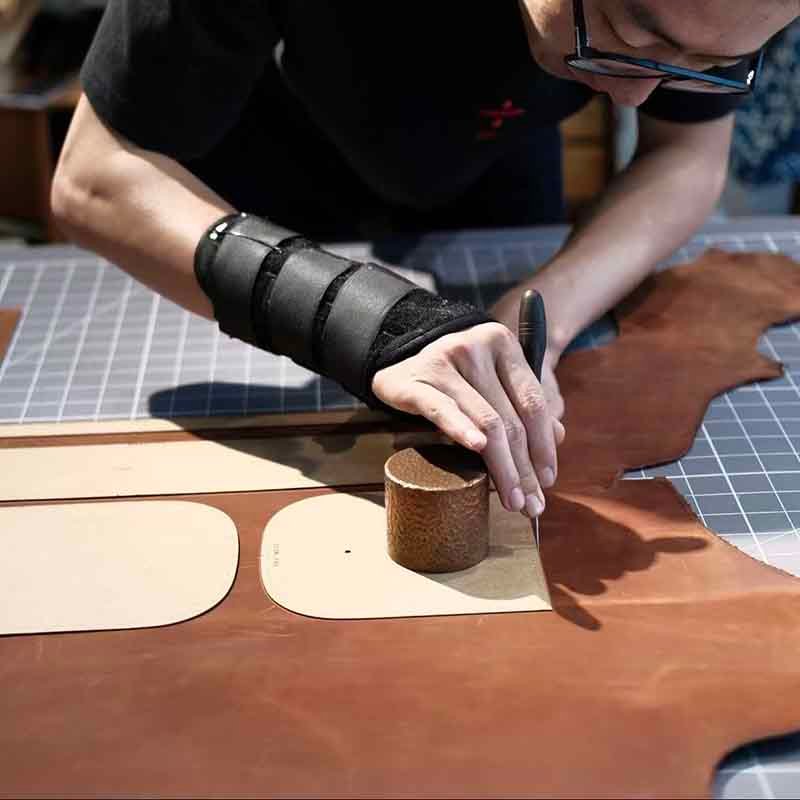
Leather manufacturing moves through a controlled sequence of design review, material approval, sampling, cutting, skiving, assembly, stitching, edge finishing, hardware installation, inspection, and packing. Each stage must follow the approved sample and product specification so that size, color, structure, function, and appearance remain consistent throughout production.
A leather accessory should never move directly from a drawing into mass production. Even a simple wallet contains several layers, folded edges, pocket allowances, adhesive zones, stitch lines, and stress points. A business bag may include more than 40 separate pattern pieces before the lining, reinforcement, zipper, handle, and hardware components are counted.
The manufacturing process must answer practical questions before leather is cut:
- What will the product carry?
- How often will it be opened, folded, or pulled?
- Which parts will bear weight?
- Which areas must remain soft?
- Which panels must hold their shape?
- How much leather variation can be accepted?
- Which dimensions are critical to function?
- Which surfaces will touch clothing or skin?
- How should the product be protected during transport?
These decisions affect the pattern, leather thickness, reinforcement, stitching method, edge construction, hardware, testing, and packaging.
A reliable factory also records changes during development. Without a controlled specification, a sample maker may solve a construction problem one way while the production line interprets the same detail differently. The approved sample must therefore be supported by measurements, material codes, color references, hardware details, stitch requirements, logo position, packaging instructions, and inspection criteria.
Leather Manufacturing Design
Leather product design begins with a clear product brief. This document explains what the accessory should do, how it should look, who will use it, what it must hold, and where it will be sold.
A strong development brief normally includes:
- Product category
- Overall dimensions
- Intended contents
- Required pocket count
- Preferred leather type
- Leather color reference
- Surface texture
- Hardware finish
- Logo method
- Lining preference
- Packaging method
- Estimated order quantity
- Sales market
- Target delivery date
The factory then converts the visual idea into a technical structure.
A business bag drawing may show a front pocket, two handles, and a shoulder strap. The technical review must determine the handle drop, handle width, attachment length, reinforcement position, zipper opening, base width, laptop compartment size, and weight distribution.
A wallet design may appear slim on screen, but the internal layers may create 8–12 mm of total thickness after folding. The factory must calculate pocket overlaps, leather skiving, seam allowance, card capacity, and fold clearance before the sample is made.
Important design checks include:
- Whether the product can close when fully loaded
- Whether card slots are wide enough after stitching
- Whether handles sit evenly
- Whether zipper openings provide enough access
- Whether the base remains stable
- Whether metal parts touch or scratch the leather
- Whether folded corners become too bulky
- Whether logos remain visible after assembly
- Whether packaging compresses the product
SzoneierLeather reviews product design together with material, pattern, sampling, production, and packaging requirements. This allows design changes to be evaluated before they create additional tooling, material waste, or production delays.
Leather Manufacturing Sampling
Sampling confirms whether the design can be manufactured, used, and repeated. The first physical sample often reveals issues that are not visible in drawings or digital renderings.
A first sample should be checked for:
- Overall proportion
- Internal capacity
- Leather hand feel
- Product weight
- Opening movement
- Pocket usability
- Stitch placement
- Edge thickness
- Hardware scale
- Logo position
- Color coordination
- Packaging fit
Sample feedback should be measurable and specific.
Instead of saying “make the bag more structured,” the development team should identify the area that needs support and specify the desired result. The instruction may be to increase the base reinforcement from 1.0 mm to 1.5 mm, add a 0.6 mm support layer behind the front panel, or reduce the softness of the side gusset.
Instead of saying “the wallet is too thick,” the solution may involve:
- Reducing pocket leather from 0.8 mm to 0.6 mm
- Skiving pocket overlaps
- Shortening hidden pocket layers
- Replacing leather lining with microfiber
- Reducing the number of folded edges
- Adjusting the center fold allowance
A sample approval record should list each requested correction and its status. This prevents earlier changes from being lost during later revisions.
| Sample Check | Measurement or Test | Approval Question |
|---|---|---|
| Overall size | Length, width, height | Does it match the approved dimensions? |
| Pocket fit | Insert intended cards or devices | Can contents be inserted and removed easily? |
| Closure | Fill product and close it | Does the zipper, snap, or magnet work without strain? |
| Handle balance | Lift with expected load | Does the product remain level? |
| Edge quality | Visual and flex inspection | Are edges smooth and free from cracking? |
| Hardware | Open and close repeatedly | Does each component move correctly? |
| Logo | Measure location and size | Is it centered and readable? |
| Packaging | Pack complete sample | Does the product retain its shape? |
For complex products, a structure sample may be produced using available leather and standard hardware before final materials are ready. This allows the pattern, capacity, and construction method to be corrected without consuming custom leather or exclusive components.
Leather Manufacturing Cutting
Cutting controls product appearance, strength, and material yield. Leather cannot be treated like uniform fabric because every hide contains natural differences.
Before cutting, leather should be inspected for:
- Shade variation
- Grain direction
- Scars
- Wrinkles
- Loose fiber areas
- Thickness changes
- Neck grain
- Belly softness
- Surface coating defects
- Usable cutting area
The cutting team grades each hide and decides where individual pattern pieces should be placed.
Large visible panels require the cleanest and most consistent areas. Small hidden parts can often use sections with minor acceptable variation. Load-bearing pieces should avoid weak belly areas because those areas may stretch more easily.
Shade grouping is also important. The front, back, side panels, handles, and straps of one product should come from compatible color groups. Without shade sorting, one bag may show visible color differences between adjacent components.
Several cutting methods may be used:
- Steel-rule die cutting for repeated small parts
- Hydraulic press cutting for production efficiency
- Computer-guided knife cutting for complex patterns
- Hand cutting for low-volume or selective placement
- Strip cutting for belts, straps, and piping
Material yield depends on the relationship between hide size, defect allowance, pattern shape, and quality standards. Large clean panels require more selective cutting and often lower usable yield.
A leather bag may require 2.0 square feet of finished visible area but consume more than 2.0 square feet of purchased leather because some sections cannot be used. The real leather cost must account for cutting loss, shade matching, defects, test pieces, and production allowance.
Leather Manufacturing Skiving
Skiving reduces leather thickness in selected areas so that edges can fold cleanly, seams remain slim, corners do not become bulky, and layered components can be assembled accurately.
Common skiving areas include:
- Wallet card pockets
- Folded bag edges
- Strap ends
- Zipper openings
- Piping strips
- Box corners
- Handle wraps
- Pocket overlaps
- Seam joins
- Logo patches
Skiving depth must be controlled carefully. If too much leather is removed, the part may tear, stretch, or show an uneven surface. If too little is removed, the finished edge may become thick, stiff, or difficult to sew.
A wallet pocket made from 0.8 mm leather may be reduced to 0.4–0.5 mm at the folded entry edge. A strap end wrapped around a metal ring may be skived gradually so the fold lies flat without weakening the load-bearing section.
The operator must also consider the leather’s fiber structure. Soft belly leather and firm shoulder leather react differently to the same machine setting. Blade sharpness, feed speed, pressure, and skiving width all affect the result.
Production teams should use approved samples and thickness checks rather than relying only on visual judgment.
Leather Manufacturing Stitching
Stitching secures the product structure and strongly affects its visual quality. Thread size, needle type, stitch length, seam allowance, edge distance, and machine tension must be matched to the leather and construction.
Important stitching controls include:
- Straight stitch lines
- Equal edge distance
- Stable stitch length
- Balanced thread tension
- Clean corners
- Secure backstitching
- No skipped stitches
- No loose thread ends
- No needle marks outside the seam
- No leather puckering
Very short stitches can weaken leather by creating closely spaced perforations. Very long stitches may reduce seam strength and look unfinished.
Common stitch ranges for leather accessories may include:
| Product Area | Stitch Length | Main Consideration |
|---|---|---|
| Wallet edge | 2.5–3.0 mm | Clean appearance and controlled curves |
| Bag panel seam | 3.0–3.5 mm | Strength and production stability |
| Handle attachment | 2.5–3.0 mm | Secure load-bearing connection |
| Decorative topstitch | 3.0–4.0 mm | Visual balance with thread size |
| Belt edge | 3.0–4.0 mm | Straightness over long distances |
| Small logo patch | 2.0–2.8 mm | Control around tight corners |
These values must be adjusted according to leather thickness, thread size, needle diameter, and product style.
Load-bearing points require additional reinforcement. Handle bases, shoulder strap anchors, D-ring tabs, belt loops, and case hinges may use:
- Internal reinforcement patches
- Nylon or polyester webbing
- Folded leather layers
- Cross-box stitching
- Rivets
- Bar tacks
- Hidden support plates
- Additional seam rows
Decorative stitching alone should not be expected to support heavy loads. The internal structure must carry the force while the visible stitching keeps the product secure and visually balanced.
Leather Manufacturing Assembly
Assembly brings together leather, lining, reinforcement, zippers, pockets, hardware, and internal components in the correct order.
The production sequence must be planned carefully because some parts become inaccessible after the product is closed.
A business bag may follow this sequence:
- Prepare and skive leather parts.
- Apply reinforcement to panels and handles.
- Assemble internal pockets.
- Install zippers and lining sections.
- Attach logo plates or embossed patches.
- Build handles and strap tabs.
- Join front, back, and gusset panels.
- Install base support.
- Close lining openings.
- Shape and finish the bag.
- Clean and inspect the product.
Adhesive is widely used during leather assembly to hold parts before stitching, laminate layers, secure folds, and attach reinforcement. The adhesive must be compatible with the leather finish, lining, foam, board, and working environment.
Too much adhesive may create hard spots, stains, or visible glue lines. Too little adhesive can cause bubbles, separation, or movement during stitching.
Drying time and pressure are also important. A laminated panel may look flat immediately after assembly but develop bubbles later if the adhesive was not fully activated or cured.
Leather Manufacturing Edge Work
Leather edges may be folded, painted, burnished, bound, polished, or intentionally left raw. The correct method depends on leather type, product style, thickness, use, and price level.
Painted edges are common on wallets, bags, straps, belts, and presentation products. A reliable painted-edge process may include:
- Trim and level the raw edge.
- Sand the edge surface.
- Apply primer or filler.
- Dry under controlled conditions.
- Sand again.
- Apply the first color coat.
- Dry and inspect.
- Apply additional coats as needed.
- Polish or seal the surface.
- Check flexibility and adhesion.
A thick single coat may look smooth at first but crack after bending. Several controlled coats usually provide better leveling and durability.
Edge paint defects include:
- Waves
- Pinholes
- Bubbles
- Color mismatch
- Overflow onto leather
- Cracking
- Poor adhesion
- Uneven thickness
- Rough corners
- Visible layer lines
Burnished edges are more suitable for firm vegetable-tanned leather. The edge is shaped, smoothed, treated, and polished until the fibers are compressed. Soft chrome-tanned leather may not burnish as cleanly and may require paint or folded construction.
Leather Manufacturing Hardware
Hardware affects both function and appearance. Buckles, zippers, rings, clasps, locks, rivets, snaps, magnets, feet, screws, and logo plates must match the product’s size, weight, and expected use.
Hardware approval should include:
- Component dimensions
- Base metal
- Plating finish
- Color
- Surface gloss
- Logo detail
- Opening movement
- Attachment method
- Weight capacity
- Corrosion resistance
- Scratch resistance
- Edge sharpness
A large heavy buckle may overpower a slim strap. A small snap may fail to hold a thick wallet closed. A strong magnet may leave a visible impression through thin leather. A screw-back logo plate may loosen if no thread-locking method is used.
Hardware finish must also be coordinated across the product. Gold zipper teeth, pale gold buckles, and dark brass logo plates may all be described as “gold,” but they can look mismatched when assembled.
Custom hardware may require molds, plating samples, logo engraving, and separate approval before production. Development time should account for these steps.
Leather Manufacturing Packaging
Packaging must protect shape, surface, edges, hardware, and color during storage and international transport.
A leather product may require:
- Tissue wrapping
- Dust bag
- Foam inserts
- Paper supports
- Handle sleeves
- Metal protection film
- Corner guards
- Moisture-control materials
- Individual boxes
- Printed care cards
- Barcode labels
- Shipping cartons
Business bags often need internal support to prevent panel collapse. Straps should be positioned without creating permanent bends. Hardware should be wrapped so it does not press into the leather surface.
Dark and light leather products should not be packed in direct contact because color transfer can occur during heat and pressure. Printed tissue paper and dyed dust bags should also be tested for rubbing and migration.
Carton size should match the packed product closely. Too much empty space allows movement. Excessive compression can deform handles, corners, and padded panels.
How Is Leather Manufacturing Quality Checked?
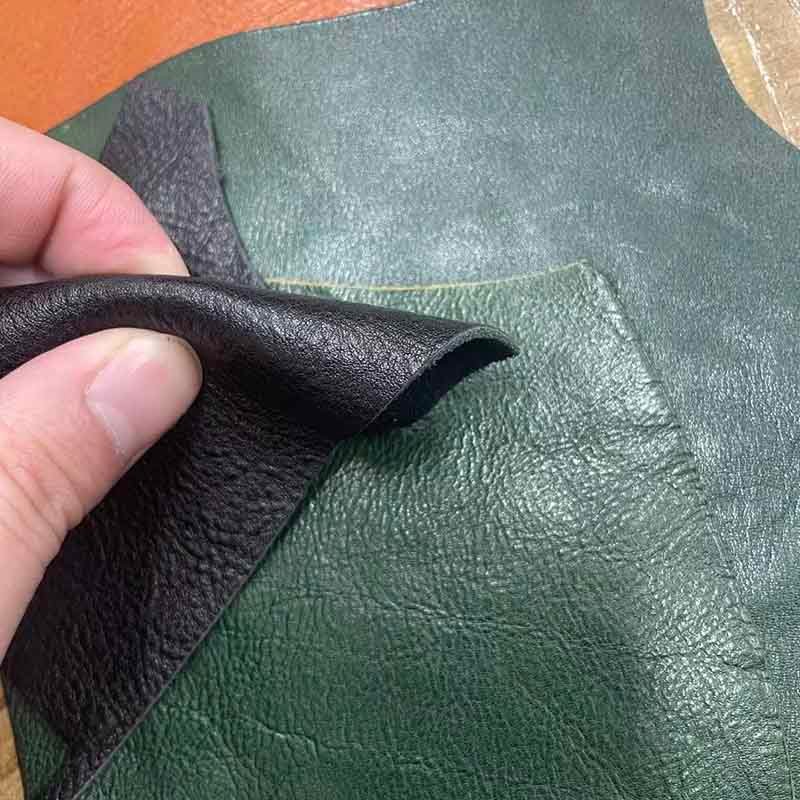
Leather manufacturing quality is checked before, during, and after production. The process covers leather, lining, reinforcement, hardware, stitching, dimensions, edge finishing, function, packaging, and market compliance. Quality control should prevent defects from continuing through the production line instead of relying only on final inspection.
Inspection starts with agreed standards. The factory and client should approve a sample, measurement sheet, material set, color range, hardware reference, logo placement, and packaging method before production begins.
A leather product cannot be judged only by whether it “looks good.” Inspection criteria should be measurable and linked to how the accessory will be used.
Key quality areas include:
- Leather consistency
- Product dimensions
- Structural strength
- Stitching quality
- Edge durability
- Hardware function
- Logo accuracy
- Surface cleanliness
- Packaging protection
- Chemical compliance
Leather Manufacturing Inspection
Incoming inspection checks materials before they enter production.
Leather inspection may cover:
- Color
- Grain
- Thickness
- Temper
- Surface finish
- Scars
- Wrinkles
- Coating defects
- Odor
- Rubbing performance
Hardware inspection may cover:
- Size
- Plating
- Color
- Movement
- Sharp edges
- Scratches
- Logo detail
- Attachment parts
Lining, thread, edge paint, adhesive, reinforcement, foam, board, zippers, packaging, and printed materials should also be checked against approved references.
In-process inspection focuses on production stages where defects can still be corrected.
Examples include:
- Pattern alignment after cutting
- Skiving depth
- Pocket size before assembly
- Reinforcement placement
- Stitch tension
- Handle attachment
- Edge paint between coats
- Hardware installation
- Product symmetry
- Lining fit
Final inspection confirms that finished products match the approved standard.
| Inspection Stage | Main Checks | Why It Matters |
|---|---|---|
| Incoming materials | Leather, hardware, lining, paint | Stops unsuitable materials before cutting |
| Cutting | Defect placement and shade matching | Controls appearance and material strength |
| Assembly | Alignment, glue, reinforcement | Prevents structural problems |
| Stitching | Tension, spacing, seam accuracy | Controls strength and visual quality |
| Finishing | Edge paint, cleaning, logo | Protects final appearance |
| Final inspection | Size, function, packing | Confirms shipment readiness |
Defects should be classified by their effect.
Critical defects may create safety, legal, or severe functional risks. Major defects may affect use, appearance, strength, or saleability. Minor defects may involve limited cosmetic variation that does not prevent use.
Clear defect categories help both sides understand what is acceptable and what requires rework or replacement.
Leather Manufacturing Color Control
Leather color must be controlled across hides, components, production batches, edge paint, thread, lining, and hardware.
Natural leather can vary due to hide structure, dye absorption, finishing, moisture, and surface grain. A single color name cannot provide enough control.
Projects should use:
- An approved physical swatch
- An approved finished sample
- Defined light and dark limits
- Standard lighting conditions
- Shade grouping before cutting
- Batch identification
- Component matching rules
Large visible parts should be matched carefully. A front panel, back panel, gusset, handles, and shoulder strap should not show strong shade differences when they are assembled into one product.
Color should be checked under more than one light source. A leather may look acceptable under warm factory lighting but appear red, green, or gray under daylight.
Surface gloss also affects perceived color. Matte leather can appear lighter than glossy leather even when the pigment formula is similar.
Color control should include:
- Leather surface
- Leather reverse side where visible
- Edge paint
- Stitching thread
- Lining
- Zipper tape
- Hardware plating
- Printed packaging
- Logo foil
Dark leather used near pale clothing should receive special rubbing checks. A surface that releases dye can stain shirts, furniture, or packaging materials.
Leather Manufacturing Stitch Tests
Stitch inspection begins with visual checks but should also include functional testing for high-stress areas.
Visual checks include:
- Straight stitch lines
- Equal stitch length
- Correct thread color
- Stable tension
- No skipped stitches
- No broken thread
- Clean backstitching
- No loose ends
- No excessive needle holes
- Correct edge distance
Functional checks may include:
- Pulling handles under load
- Flexing wallet folds
- Opening and closing zippers
- Repeatedly bending belt holes
- Pulling shoulder strap tabs
- Loading laptop compartments
- Cycling case hinges
- Testing pocket entry strength
A bag designed to carry a laptop should not be tested empty. The inspection plan should use a realistic load and hold period.
For example, a business bag may be loaded with 5–8 kg and suspended for several hours. The test should check handle elongation, seam movement, tab distortion, panel deformation, and hardware movement.
A shoulder strap can be tested with repeated pulling or static loading. A belt can be flexed around the buckle area and holes to check cracking, delamination, and surface damage.
Test values should match the product’s construction and intended use. A slim card holder does not need the same load test as a travel bag.
Leather Manufacturing Edge Tests
Edge paint should be checked for appearance, adhesion, flexibility, and resistance to rubbing.
Inspection points include:
- Smoothness
- Color consistency
- Edge thickness
- Corner shape
- Adhesion
- Cracking
- Pinholes
- Overflow
- Surface stickiness
- Layer separation
A simple edge-flex test can reveal whether the coating cracks when the leather bends. Strap ends, wallet folds, zipper openings, and handle wraps deserve additional attention because they move repeatedly.
Edge paint should also be compatible with packaging. Some coatings become sticky under heat or react with plastic film, tissue, or foam.
The factory should allow enough drying and curing time before products are packed. Packing too early can cause edge impressions, sticking, or surface marks.
Burnished edges should be checked for loose fibers, uneven polishing, rough sections, and color transfer.
Leather Manufacturing Hardware Tests
Hardware testing covers appearance, movement, attachment, strength, plating, and corrosion resistance.
Common checks include:
- Zipper opening and closing
- Snap cycling
- Buckle operation
- Lock alignment
- Magnet holding force
- Rivet attachment
- Screw tightness
- Ring opening
- Hook rotation
- Plating adhesion
- Salt-spray testing where required
A zipper should move smoothly without catching the lining. A snap should close securely without requiring excessive force. A buckle tongue should align with belt holes. A bag foot should sit flat and remain firmly attached.
Pull tests can be used for rings, hooks, handles, strap tabs, rivets, and logo plates. The load should be selected according to the product’s intended use.
Hardware surfaces should be checked for:
- Scratches
- Bubbles
- Exposed base metal
- Color variation
- Rough edges
- Plating marks
- Fingerprints
- Corrosion spots
Protective film should remain in place during production when possible, but it must be removed during final inspection if the underlying surface needs to be checked.
Leather Manufacturing Dimensions
Dimensions should be measured at defined reference points. Informal measurement can create disputes because soft products change shape depending on how they are placed.
The measurement sheet should show:
- Overall length
- Overall height
- Base width
- Gusset width
- Handle drop
- Strap length
- Pocket dimensions
- Zipper opening
- Logo position
- Hardware position
- Belt hole spacing
- Box lid clearance
Each dimension should have an agreed tolerance.
A small card holder may require tighter tolerances than a soft tote bag. A rigid leather box may need precise lid gaps, while a flexible pouch can allow slightly wider variation.
Measurements should be taken with the product in a defined condition, such as lying flat, lightly shaped, empty, or fully assembled.
Leather Manufacturing Surface Checks
The finished product should be clean, free from glue marks, and consistent with the approved leather standard.
Surface inspection may check:
- Scratches
- Scuffs
- Press marks
- Glue stains
- Oil marks
- Uneven grain
- Shade differences
- Wrinkles
- Dust
- Fingerprints
- Hardware impressions
- Edge paint marks
Natural leather variation should be separated from production damage. Scars, pores, and wrinkles may be acceptable when they fall within the approved material standard. Cuts, glue marks, deep scratches, and machine impressions are production defects.
The factory and client should agree on how much natural character is expected. Without this agreement, the same mark may be viewed as desirable grain by one person and a defect by another.
Leather Manufacturing Packaging
Packaging inspection confirms that the product is protected and that all commercial information is correct.
Checks may include:
- Product shape after packing
- Hardware protection
- Dust bag size
- Tissue placement
- Box dimensions
- Barcode accuracy
- Care card content
- Color labels
- Quantity per carton
- Carton strength
- Shipping marks
- Moisture protection
A packed sample should be reviewed before mass packaging begins. This allows the team to identify pressure points, wasted space, and product movement inside the box.
Transport testing may include:
- Carton drop checks
- Compression checks
- Vibration simulation
- Heat exposure
- Humidity exposure
- Product unpacking review
Leather products should be stored and shipped in controlled conditions. Excessive moisture can encourage mold, while excessive dryness may affect certain leathers, edge coatings, and adhesives.
Packaging materials must also be clean and low in odor. A leather product enclosed in a strong-smelling box or plastic bag can absorb unwanted odors during transport.
Leather Manufacturing Compliance
Compliance requirements depend on the product category, material content, destination market, and user group.
Possible requirements may cover:
- Restricted chemicals
- Chromium VI
- Azo dyes
- Lead
- Cadmium
- Phthalates
- Nickel release
- Formaldehyde
- Organotin compounds
- Dimethyl fumarate
- Packaging materials
- Children’s product rules
The leather itself is only one part of the compliance review. Edge paint, adhesive, lining, printed coating, hardware plating, magnets, foam, plastic parts, and packaging may also require testing.
Before testing, the factory should confirm:
- Destination country
- Product age group
- Intended use
- Skin-contact areas
- Material composition
- Required standard
- Number of colors
- Number of material combinations
Testing should be based on the final production materials. A test report from an earlier leather batch may not represent a new color, finish, coating, or supplier.
SzoneierLeather can support inspection planning from incoming materials through finished packaging. The goal is to identify issues early, maintain approved standards during production, and reduce the risk of defects appearing after shipment.
How Do You Choose Leather Manufacturing?
Choose a leather manufacturing partner by examining its product-development experience, material control, sampling accuracy, production processes, quality system, communication, and packaging capability. A suitable factory should understand how leather thickness, pattern structure, reinforcement, hardware, stitching, edge work, testing, and order quantity affect the finished accessory.
A low quotation alone does not show whether a factory can deliver a stable product. The more useful question is whether the supplier can identify design risks before cutting production leather.
A professional factory should be able to explain:
- Which leather is suitable for the intended use
- Where reinforcement is required
- How product thickness can be controlled
- Which hardware areas carry the most load
- How natural leather variation will be graded
- Which tests are suitable for the product
- How the approved sample will be followed
- Which factors affect price and lead time
- How finished goods will be protected during shipping
The strongest leather manufacturing relationship begins with technical discussion rather than immediate price negotiation. When the product structure is clear, quotations become easier to compare, samples require fewer corrections, and production planning becomes more reliable.
Leather Manufacturing Experience
Manufacturing experience should be evaluated by product category, material knowledge, and problem-solving ability. A factory that has produced simple promotional card holders may not have the same capabilities as one experienced in structured briefcases, reinforced straps, multilayer wallets, belts, and leather-covered boxes.
Ask for experience with products that have similar structures rather than products that merely look similar.
For a business bag, relevant experience may include:
- Laptop compartment construction
- Handle and shoulder-strap reinforcement
- Metal zipper installation
- Structured base development
- Lining and pocket assembly
- Large-panel leather grading
- Shape protection during packaging
For a wallet, relevant experience may include:
- Thin leather skiving
- Card-pocket tolerance
- Multilayer alignment
- Fold allowance
- Edge-paint control
- Snap or magnet positioning
- Compact construction
For belts and straps, the factory should understand tensile strength, elongation, hole reinforcement, buckle attachment, edge durability, and repeated bending.
A company may state that it has many years of experience, but experience becomes valuable only when it helps prevent practical problems. The development team should be able to look at a drawing and point out where the structure may become too thick, where leather may stretch, or where hardware could damage the surface.
SzoneierLeather has more than 18 years of experience in leather product development and manufacturing. Its product range covers leather bags, wallets, belts, straps, accessories, and leather boxes, allowing development teams to draw on experience from several construction types.
Leather Manufacturing Capabilities
A leather factory should be assessed as a complete production system. The finished product depends on much more than sewing capacity.
Important capabilities include:
- Leather and material sourcing
- Raw-material development
- Product design
- Pattern engineering
- Sample making
- Cutting and skiving
- Stitching and assembly
- Edge finishing
- Hardware development
- Logo application
- Quality inspection
- Packaging design
- Packaging inspection
- Export packing
Factories with connected departments can respond more effectively when one change affects several parts of the product.
For example, increasing the leather thickness on a bag handle may require:
- Wider pattern allowances
- Deeper skiving around folds
- A different needle size
- Stronger thread
- More edge-paint preparation
- Larger hardware openings
- Thicker packaging protection
When these processes are managed separately, small changes can create inconsistent results. An integrated factory can review the full effect before approving the adjustment.
SzoneierLeather has its own raw-material supply-chain support and capabilities covering material research, finished-product development, design, sampling, manufacturing, packaging design, and packaging quality inspection. This structure allows a project to be reviewed from material selection through shipment preparation.
| Capability | What to Check | Risk When Missing |
|---|---|---|
| Material sourcing | Leather grades, colors, finishes, hardware | Unstable materials or long delays |
| Product engineering | Pattern, reinforcement, dimensions | Attractive sample with poor function |
| Sampling | Revision control and measurement records | Repeated corrections and lost changes |
| Production | Cutting, skiving, stitching, finishing | Inconsistent construction |
| Quality control | Incoming, in-process, and final checks | Defects found too late |
| Packaging | Product support and carton planning | Damage or deformation in transport |
A factory should also explain which processes are completed internally and which are managed through partner suppliers. Outsourcing is not automatically a weakness, but responsibilities and quality controls should be clear.
Leather Manufacturing Communication
Leather product development involves many small decisions. Poor communication can create more risk than limited machinery.
The factory should respond clearly to questions about:
- Material availability
- Construction feasibility
- Sample corrections
- Color approval
- Hardware tooling
- Price changes
- Production schedule
- Testing
- Packaging
- Shipping preparation
Good communication is specific. A useful factory response does not simply say that a design is “possible.” It explains how it will be made, which areas need adjustment, and what effect those changes may have on appearance, cost, or lead time.
During sampling, revision comments should be organized by product area. Each correction should show the original condition, requested change, revised measurement, and approval status.
A practical revision record may include:
| Item | Current Condition | Requested Change | Final Requirement |
|---|---|---|---|
| Handle drop | 120 mm | Increase by 15 mm | 135 mm |
| Logo position | Too close to pocket | Move upward | 20 mm above seam |
| Card pocket | Entry too tight | Add width | Increase by 2 mm |
| Edge finish | High gloss | Change appearance | Matte edge paint |
| Base structure | Too soft | Add reinforcement | 1.2 mm support board |
This level of detail helps sample makers, production supervisors, and inspectors work from the same information.
Communication should continue after sample approval. Material delays, leather shade differences, hardware changes, or packing concerns should be raised before they affect delivery.
Leather Manufacturing MOQ
Minimum order quantity depends on material purchasing, color development, hardware, logo methods, packaging, and production setup. It is not determined by factory capacity alone.
Several parts of one accessory may have different minimum requirements:
- Leather may have a minimum purchase quantity per color.
- Custom-dyed leather may require a full tannery batch.
- Metal hardware may require a minimum plating quantity.
- Custom buckles or logo plates may require tooling.
- Printed lining may require a minimum fabric run.
- Gift boxes may require a minimum printing quantity.
- Barcode labels may be produced in smaller quantities.
A project with standard black leather, stock zippers, and an embossed logo is usually easier to start than one requiring exclusive leather colors, custom buckles, printed lining, and rigid gift packaging.
Product variety also affects efficiency. An order of 1,000 pieces divided into ten colors is not equivalent to an order of 1,000 pieces in one color. Each color requires separate leather control, cutting, component matching, production tracking, and packing.
A more efficient order structure may use:
- One leather color across several products
- One hardware finish across the collection
- Shared zipper and lining materials
- Standard internal construction
- Customization focused on visible elements
- Fewer color combinations in the first production run
The goal should not be to force the smallest possible quantity. It should be to find a quantity that allows the selected materials and construction to be produced consistently.
| Customization Level | Common Requirement | Effect on MOQ |
|---|---|---|
| Standard leather and hardware | Existing materials | Lower setup requirement |
| Custom leather color | Tannery dyeing batch | Higher material commitment |
| Custom metal logo | Mold and plating | Higher component minimum |
| Printed lining | Printing setup | Minimum per design or color |
| Custom gift box | Printing and board setup | Separate packaging minimum |
| Multiple color combinations | Separate material preparation | Lower efficiency per color |
SzoneierLeather can review the product specification and identify which components are creating the minimum quantity. This makes it easier to adjust materials or customization without changing the main design direction.
Leather Manufacturing Costs
Leather manufacturing cost is calculated from materials, labor, hardware, finishing, testing, packaging, production quantity, and commercial terms. The leather price itself is only one part of the final quotation.
Main cost factors include:
- Leather type and grade
- Leather thickness
- Usable cutting yield
- Product dimensions
- Number of pattern pieces
- Number of pockets and layers
- Reinforcement materials
- Hardware quantity and finish
- Stitching complexity
- Edge construction
- Logo method
- Sample revisions
- Testing requirements
- Packaging design
- Order quantity
- Delivery terms
Leather yield has a major effect on cost. Hides are irregular and contain natural marks, soft areas, and shape limitations. A factory may purchase a large hide but use only part of it for visible panels.
Large bags with broad front and back panels require cleaner leather areas. Small accessories can use smaller usable sections more efficiently. This means two products with the same finished surface area may have different material costs.
Labor cost is also affected by the number of operations. A simple card holder with raw edges requires fewer steps than a wallet with eight pockets, lining, folded edges, painted edges, foil stamping, and a gift box.
Edge painting can involve repeated sanding, coating, drying, and inspection. Increasing from one simple edge process to three or four controlled coats adds time, but it may also improve the appearance and durability of the finished product.
Hardware pricing depends on:
- Base metal
- Size and weight
- Plating method
- Surface protection
- Custom logo
- Mold requirements
- Order quantity
- Corrosion standard
Packaging can also create a noticeable price difference. A dust bag and export carton cost less than a rigid presentation box with molded support, printed tissue paper, magnetic closure, care card, and outer sleeve.
A reliable quotation should state the assumptions behind the price.
| Quotation Item | Information That Should Be Clear |
|---|---|
| Leather | Type, finish, thickness, and color |
| Lining | Material and construction |
| Hardware | Finish and whether it is standard or custom |
| Logo | Size, position, and application method |
| Packaging | Individual packing and carton method |
| Quantity | Quantity per style and color |
| Testing | Included or charged separately |
| Delivery term | EXW, FOB, CIF, DAP, or other agreed term |
| Sample | Sample charge and revision conditions |
| Validity | Period during which the price remains valid |
Comparing quotations is meaningful only when each factory is pricing the same product specification. A lower price may reflect thinner leather, simpler reinforcement, different hardware, fewer edge coats, reduced inspection, or basic packaging.
Leather Manufacturing Lead Times
Lead time begins before mass production. It includes technical review, material sourcing, sampling, revisions, testing, pre-production approval, manufacturing, inspection, packaging, and transport preparation.
A practical project schedule may be divided into five stages.
| Stage | Working Range | Main Activities |
|---|---|---|
| Technical review | 2–5 days | Design review, material discussion, quotation |
| Material preparation | 3–15 days | Leather, lining, hardware, and packaging sourcing |
| Sample development | 7–20 days | Pattern making, sample production, review |
| Pre-production setup | 3–10 days | Final specification, material approval, production planning |
| Mass production | 25–50 days | Cutting, assembly, finishing, inspection, packing |
These periods vary according to the product.
A card holder using available materials may move through sampling quickly. A structured business bag with custom leather, metal tooling, printed lining, and rigid packaging requires more preparation.
Lead-time risks often come from:
- Custom leather dyeing
- Special surface finishes
- Hardware mold development
- Plating approval
- Printed lining
- Packaging prototypes
- Laboratory testing
- Multiple sample revisions
- Late design changes
- Delayed client approval
- Peak production periods
The delivery schedule should be planned backward from the required arrival date. International transport, customs clearance, and local delivery must be included rather than treating the factory completion date as the final deadline.
Fast production is useful only when the product remains correct. Skipping material approval or shortening edge-paint drying time can create more expensive problems after shipment.
Leather Manufacturing Customization
Leather accessories can be customized through material, structure, color, hardware, branding, interior layout, and packaging. The best results come from selecting a small number of strong identifying features and developing them carefully.
Available customization areas include:
- Product dimensions
- Leather type
- Leather thickness
- Custom leather color
- Grain or embossing
- Panel construction
- Pocket layout
- Handle length
- Strap width
- Lining material
- Printed lining
- Zipper type
- Hardware finish
- Custom buckle
- Logo plate
- Edge-paint color
- Stitching color
- Debossed logo
- Foil-stamped logo
- Printed logo
- Embroidered logo
- Custom gift box
- Dust bag
- Care card
- Barcode and labeling
Logo methods should be matched to the leather finish.
Blind debossing creates a pressed logo without added color. It works best when the leather holds a clean impression. Foil stamping adds metallic or colored foil but requires careful heat and pressure control. Metal logo plates provide strong visibility but add hardware cost and attachment requirements. Screen printing can reproduce color but must be tested for adhesion and rubbing.
| Logo Method | Appearance | Suitable Use | Main Control Point |
|---|---|---|---|
| Blind debossing | Subtle pressed mark | Wallets, folios, straps | Depth and edge clarity |
| Foil stamping | Metallic or colored logo | Gift products and accessories | Heat, pressure, and adhesion |
| Metal plate | Strong visible identity | Bags and boxes | Plating and attachment |
| Screen printing | Flat colored graphic | Lining or smooth leather | Rubbing resistance |
| Laser marking | Precise tonal mark | Selected leather finishes | Burn level and contrast |
| Embroidery | Textured logo | Fabric panels and patches | Stitch density and backing |
Customization should also respect product function. A large metal logo may look impressive on a drawing but add weight, scratch nearby leather, or interfere with pocket use. A wide strap may improve comfort but require larger hooks. A rigid leather may produce sharp structure but make a wallet difficult to fold.
SzoneierLeather can review these relationships during development and recommend solutions that preserve the visual idea while improving production stability.
Leather Manufacturing Samples
A sample should be treated as a working standard, not simply a presentation piece.
The sample approval process should confirm:
- Overall dimensions
- Leather type
- Leather color
- Leather thickness
- Product weight
- Pocket size
- Hardware finish
- Logo size
- Stitching
- Edge color
- Opening and closing function
- Packaging
The sample should also be tested with its intended contents. A laptop bag should be tested with a laptop, charger, and documents. A wallet should be filled with cards and banknotes. A belt should be worn and flexed around the buckle area. A box should be opened repeatedly and checked for lid alignment.
When revisions are required, each change should be documented. Verbal approval alone may create uncertainty later.
Once the final sample is approved, it should be supported by:
- Product specification sheet
- Measurement chart
- Approved leather swatch
- Hardware reference
- Logo artwork
- Color references
- Packaging standard
- Inspection checklist
This set of information helps the production line reproduce the product and gives inspectors a clear approval basis.
Leather Manufacturing Quality System
A factory should have quality checks at several production points rather than waiting until finished goods are packed.
A practical control system includes:
- Incoming leather inspection
- Hardware inspection
- Cutting inspection
- First-piece approval
- In-process stitching inspection
- Edge-work inspection
- Assembly checks
- Measurement inspection
- Functional testing
- Final appearance inspection
- Packaging inspection
- Carton verification
First-piece approval is especially important. The first completed unit from the production line should be compared with the approved sample before full production continues.
This check may identify:
- Wrong leather shade
- Incorrect stitch distance
- Pocket placement error
- Hardware color mismatch
- Edge-paint variation
- Logo position error
- Measurement difference
- Packaging problem
Correcting one first piece is far easier than reworking hundreds of completed products.
Quality records should also track repeated defects. When the same problem appears several times, the cause may be related to material, machine setting, tooling, operator training, or an unclear specification.
Leather Manufacturing Questions
Before confirming a factory, prepare a practical list of questions.
Ask about product development:
- Have you manufactured similar products?
- Can you review the structure before sampling?
- Can you help select leather thickness and reinforcement?
- How are sample changes recorded?
- How many approval stages are recommended?
Ask about materials:
- Which leather types are available?
- Can you develop custom colors or finishes?
- How is leather shade variation controlled?
- Can material records be provided?
- How are hardware and edge colors matched?
Ask about production:
- Which processes are completed internally?
- How is the approved sample transferred to production?
- How are first pieces checked?
- How are cutting defects and leather yield managed?
- How are load-bearing areas reinforced?
Ask about quality:
- What incoming inspections are performed?
- Which in-process checks are used?
- How are finished goods measured?
- Can product-specific functional tests be arranged?
- How is packaging inspected?
Ask about commercial terms:
- What creates the MOQ?
- What is included in the quotation?
- What affects the production lead time?
- Which delivery terms are available?
- How are price changes handled if specifications change?
The quality of the factory’s answers can reveal as much as the quotation. Clear, practical explanations show that the team understands the product beyond its appearance.
Leather Manufacturing Inquiry
SzoneierLeather supports leather bags, wallets, belts, straps, accessories, organizers, cases, and leather boxes. With more than 18 years of leather product development and manufacturing experience, the company combines material sourcing, product research, design, sampling, production, packaging design, and packaging quality inspection.
A successful custom leather project begins with clear requirements and early technical review. Send your concept, drawing, reference sample, or product list to SzoneierLeather. Our team will evaluate the materials, construction, customization, quantity, and delivery plan, then prepare a development and quotation proposal for your project.