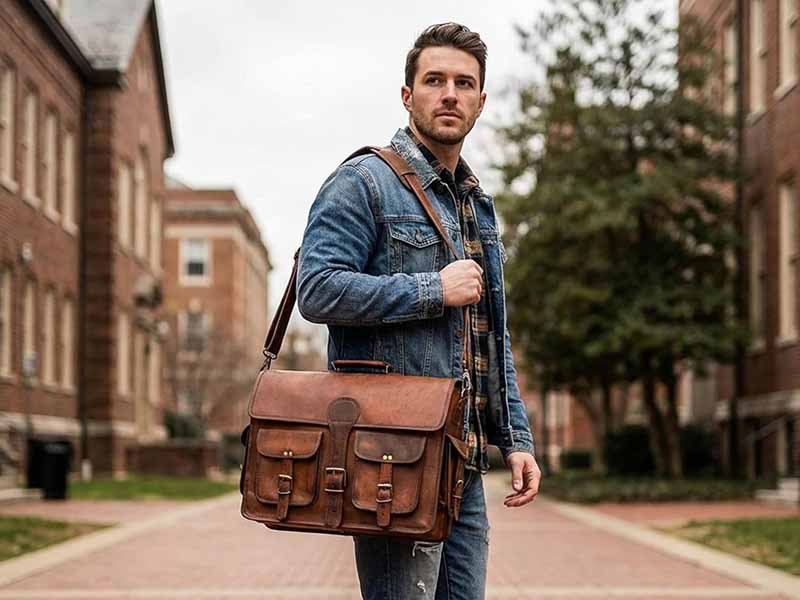
A leather messenger bag may win attention with its leather grain, rich color, clean stitching, and polished hardware, but the strap system decides whether people actually enjoy using it every day. A customer rarely says, “I love the internal reinforcement structure of this strap.” What they say is much simpler: “It feels comfortable,” “It sits well,” “It does not slide,” “It does not hurt my shoulder,” or “I can carry my laptop without worrying.” Behind those simple comments is a full engineering system involving leather thickness, strap width, hardware strength, buckle movement, attachment angle, sewing structure, shoulder pressure, and long-term wear resistance.
Adjustable strap systems in leather messenger bags help users control strap length, carrying height, body fit, and shoulder comfort. A good system combines leather, backing material, metal hardware, reinforcement, stitching, and shoulder support, allowing the bag to carry daily loads while staying stable, comfortable, and visually premium.
For brands developing leather messenger bags, the strap should never be treated as a small accessory added at the end. It is one of the main contact points between the product and the user. A beautiful leather bag with a weak strap may look good in product photos but fail during real commuting, business travel, or laptop carry. A well-developed adjustable strap system, on the other hand, can turn a standard messenger bag into a reliable everyday product that customers use for years.
What Are Adjustable Strap Systems?
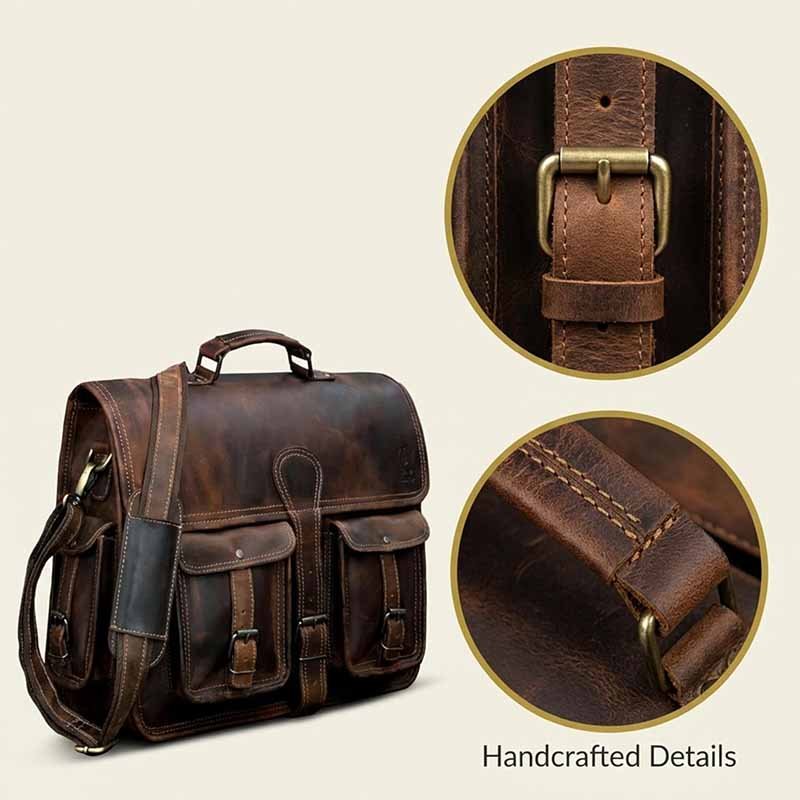
Adjustable strap systems are the shoulder-carry structures that allow leather messenger bags to fit different users, body heights, clothing layers, and carrying styles. They include the strap body, adjustment buckle, rings, hooks, reinforced tabs, stitching, shoulder pad, and connection points. A strong system improves comfort, load balance, durability, and daily usability.
What do adjustable strap systems do?
Adjustable strap systems give users control over how a leather messenger bag sits on the body. Some users prefer a higher position close to the ribs for security and quick access. Others prefer a lower position near the hip for a relaxed look. A commuter wearing a thin shirt in summer will need a different strap length from someone wearing a coat in winter. Without enough adjustment range, the same bag may feel comfortable for one person and awkward for another.
For most leather messenger bags, the adjustable strap length is often developed within a practical range of 90–150 cm. Smaller messenger bags may work with a shorter range, while laptop messenger bags and crossbody styles often need a longer adjustment range. The goal is not only to make the strap “long enough,” but to make sure the bag can sit correctly for different user groups.
A good adjustable strap system should solve several real-use problems:
- Allow shoulder carry and crossbody carry without changing the bag structure.
- Keep the bag close to the body when walking, cycling, or moving through airports.
- Support different body heights, usually from about 155 cm to 190 cm.
- Adjust smoothly without the buckle scratching the leather surface.
- Hold its position after loading the bag with 3–6 kg of daily items.
- Reduce swinging when the user walks quickly.
- Keep the strap flat without twisting through the buckle or hook.
The adjustment experience also affects perceived quality. When the slider moves smoothly but does not slip, users feel the product is well made. When the strap is hard to pull, too loose, or uneven after adjustment, the whole bag feels less refined even if the leather itself is good.
Why do leather messenger bags need them?
Leather messenger bags are often used for work, travel, school, commuting, meetings, and daily carry. These situations require flexibility. A customer may carry a 13-inch laptop one day, a tablet and documents the next day, and travel items during a business trip. The bag must feel stable in each situation, even when the load changes.
A leather messenger bag usually carries more weight than it looks. A normal work setup can easily include:
| Item | Approx. Weight |
|---|---|
| 13-inch laptop | 1.2–1.5 kg |
| 15-inch laptop | 1.6–2.2 kg |
| Charger and cable | 0.2–0.5 kg |
| Tablet | 0.4–0.7 kg |
| Notebook and documents | 0.5–1.2 kg |
| Wallet, keys, phone, small items | 0.3–0.8 kg |
| Water bottle | 0.4–0.8 kg |
A daily leather messenger bag may carry around 3–6 kg. A larger work or travel messenger bag may carry more. This weight goes directly through the strap system before it reaches the user’s shoulder. If the strap is too narrow, the shoulder pressure becomes uncomfortable. If the hardware is weak, stress builds around the connection points. If the stitching is not reinforced, the strap tab may loosen over time. If the buckle slips, the user keeps readjusting the length during daily use.
For brands, a strong adjustable strap system helps reduce product complaints. Common complaints linked to poor strap design include:
- The strap digs into the shoulder after 20–30 minutes.
- The leather stretches and the bag hangs lower over time.
- The metal hook makes noise while walking.
- The buckle leaves scratches on the strap surface.
- The strap twists near the D-ring.
- The shoulder pad moves away from the shoulder.
- The connection tab starts tearing under laptop weight.
- The strap length is not suitable for tall users.
These problems are not only comfort issues. They affect reviews, repeat orders, brand image, and product return rates. For premium leather messenger bags, the strap system must match the quality level of the leather body.
How do strap systems change the carrying feel?
The carrying feel of a leather messenger bag is shaped by four main factors: strap width, strap angle, shoulder pressure, and load stability. Leather quality matters, but it cannot fix a poorly designed strap structure. A soft full-grain leather bag can still feel heavy if the strap is too narrow. A structured bag can feel easier to carry if the weight is spread well.
Strap width is one of the most visible comfort factors. A 20–25 mm strap can look elegant on a small leather bag, but it may feel sharp under laptop weight. A 30–38 mm strap usually works well for medium messenger bags because it balances appearance and comfort. A 40–50 mm strap is more suitable for laptop, travel, or utility messenger bags.
The table below shows common strap choices for leather messenger bag development:
| Bag Type | Suggested Strap Width | Common Load | Comfort Level | Best Use |
|---|---|---|---|---|
| Small leather messenger | 20–25 mm | 1–2 kg | Light use only | Phone, wallet, small items |
| Medium messenger bag | 30–38 mm | 2–4 kg | Good daily comfort | Work, casual carry |
| Laptop messenger bag | 38–45 mm | 3–6 kg | Stronger shoulder support | Laptop, office items |
| Travel messenger bag | 40–50 mm | 4–7 kg | Better long-wear comfort | Airport, business trips |
| Premium briefcase messenger | 30–38 mm | 2–5 kg | Balanced look and comfort | Business meetings |
The attachment angle also changes the way the bag moves. If the strap connection points are placed too high, too low, or too close to the center, the bag may swing outward or tilt forward. If the D-rings or side tabs are positioned according to the natural pull direction, the bag sits closer to the body. This makes the bag feel lighter, even when the actual weight is the same.
A well-designed strap system should create these user feelings:
- The bag rests naturally against the body.
- The shoulder pressure feels spread out rather than sharp.
- The strap does not twist during walking.
- The bag does not bounce heavily with each step.
- The user can access the front flap or zipper without fighting the strap.
- The strap length stays fixed after adjustment.
- The shoulder pad remains near the shoulder contact area.
For a factory, these details require prototype testing, loaded wear testing, and material comparison. For a brand, they create a clear difference between a product that looks good and a product that customers keep using.
Which Strap Designs Work Best?
The best strap design depends on bag size, load weight, user lifestyle, price position, and visual style. Fixed straps suit simple fashion bags. Removable straps suit work and travel bags. Padded straps help laptop users. Wider reinforced straps suit heavier daily carry. The right design should balance comfort, strength, appearance, and production cost.
Which adjustable strap systems are common?
Most leather messenger bags use one of four strap system structures: full leather adjustable straps, leather-backed webbing straps, removable shoulder straps, or padded adjustable straps. Each structure has a different cost, comfort level, and product positioning.
A full leather adjustable strap offers a premium look and is often used for business messenger bags, luxury casual bags, and vintage styles. It matches the leather body beautifully and ages naturally. However, leather is a natural material. Without lining or reinforcement, it can stretch under load, especially in laptop bags.
A leather-and-webbing strap uses leather on one side and webbing or reinforcement material on the other side. This structure gives better stability while keeping a premium leather appearance. It is especially useful for messenger bags that carry laptops, documents, or travel items. Webbing can reduce stretching and help the strap keep its shape during long-term use.
A removable strap uses snap hooks or swivel hooks at both ends. This is popular for messenger bags with top handles because users can switch between hand carry and shoulder carry. It also makes packaging easier and allows the strap to be replaced. The risk is that the hooks and D-ring tabs must be strong enough for repeated pulling.
A padded adjustable strap adds a shoulder pad to improve comfort. It works well for laptop messenger bags, camera messenger bags, business travel bags, and heavier daily bags. The shoulder pad should not look bulky or cheap. It should match the bag’s design language, leather color, stitching, and hardware finish.
| Strap System | Main Advantage | Main Risk | Suitable Bag Type |
|---|---|---|---|
| Full leather adjustable strap | Premium look | May stretch if not reinforced | Business, vintage, fashion messenger |
| Leather + webbing strap | Better strength and stability | May look less formal if exposed | Work, laptop, travel messenger |
| Removable strap | Flexible use | Hook and ring must be strong | Briefcase messenger, travel bag |
| Padded strap | Better comfort | Can look bulky if poorly designed | Laptop, camera, commuter bag |
| Fixed strap | Clean structure | Less flexible for users | Small fashion messenger |
The best choice is not always the most expensive one. A small leather messenger bag may not need heavy hooks or a thick shoulder pad. A 15-inch laptop messenger bag should not use a thin decorative strap. Smart development starts from real use, not only from appearance.
Are removable straps better?
Removable straps are better when the leather messenger bag needs more flexible carrying options. A bag with both top handles and a detachable shoulder strap can work as a business briefcase, daily shoulder bag, and crossbody travel bag. This gives the product more value without changing the main body structure.
For brands, removable straps can support several selling points:
- More carrying methods for office, travel, and daily use.
- Easier replacement if the strap wears after long-term use.
- Better packaging because the strap can be placed inside the bag.
- Higher perceived value for premium leather messenger bags.
- Easier customization with optional strap colors or materials.
- Better product photography because the bag can be shown with or without the strap.
However, removable straps also bring engineering challenges. The metal hooks must handle repeated opening, closing, twisting, and pulling. The D-rings must match the hook size and movement angle. The leather tabs holding the rings must be reinforced inside the bag body. If these details are ignored, removable straps may become the weakest part of the product.
A removable strap system should be checked carefully in these areas:
- Hook opening gap should not release accidentally during movement.
- Swivel function should rotate smoothly without noise.
- Hook plating should resist scratches from repeated use.
- D-ring thickness should match the bag’s expected load.
- Leather tabs should have backing reinforcement, not only surface stitching.
- Stitching should use box stitch, bar-tack, or reinforced patterns where needed.
- Hardware color should match the bag’s zipper, buckle, logo plate, and other metal parts.
Fixed straps still have value. They can look cleaner, reduce hardware cost, and avoid hook failure. They work well for small messenger bags, vintage satchels, and lightweight fashion styles. But for laptop bags, business travel bags, and premium work bags, removable straps often give users more practical value.
Do padded straps help?
Padded straps help when the bag carries weight for more than short trips. A shoulder pad spreads pressure over a larger contact area, making the bag feel more comfortable during commuting, walking, airport travel, and daily office use. The heavier the bag, the more important the shoulder pad becomes.
A good shoulder pad is not simply a thick foam piece. It should be designed with the same care as the bag body. The leather surface, backing material, foam thickness, edge finishing, stitching, and movement all affect comfort.
For leather messenger bags, a shoulder pad often needs to meet these conditions:
- Length around 18–30 cm depending on bag size.
- Width slightly wider than the strap for better pressure distribution.
- Soft but not overly thick foam, usually around 3–8 mm depending on style.
- Backing material with enough grip to reduce sliding.
- Clean edge finishing that does not rub against clothing.
- Flexible shape that follows the shoulder curve.
- Color and stitching that match the main bag design.
Shoulder pads are especially useful for:
- 13–16 inch laptop messenger bags.
- Camera-style leather messenger bags.
- Travel messenger bags.
- Work bags for daily commuting.
- Men’s business messenger bags with heavier structure.
- Bags designed for long walking or airport use.
Poor shoulder pads can create new problems. If the pad is too stiff, it feels like a board on the shoulder. If it is too soft, it compresses quickly and loses support. If it slides too much, the user keeps adjusting it. If it is too large, the bag may look more like a sports bag than a premium leather product.
For premium leather messenger bags, many brands choose a slim leather shoulder pad with moderate foam and textured backing. This keeps the visual style clean while improving comfort in real use.
How wide should the strap be?
Strap width should be selected based on the bag’s expected load, body size, market style, and price level. Wider straps spread pressure better. Narrow straps look more refined. The challenge is finding the right balance.
For small leather messenger bags, a 20–25 mm strap can work if the bag carries only light items. For medium daily bags, 30–38 mm is often a safer range. For laptop messenger bags, 38–45 mm is more comfortable. For travel or utility messenger bags, 40–50 mm may be better, especially when the bag carries 4 kg or more.
The strap width should also match the bag proportions. A small, slim leather messenger bag with a 50 mm strap may look too heavy. A large laptop messenger bag with a 20 mm strap may look underdeveloped and feel uncomfortable.
| Strap Width | Visual Feeling | Comfort Level | Suitable Load | Recommended Use |
|---|---|---|---|---|
| 20 mm | Slim, elegant | Low under weight | Under 1.5 kg | Small fashion bags |
| 25 mm | Clean, light | Moderate | 1–2.5 kg | Compact messenger bags |
| 30 mm | Balanced | Good | 2–4 kg | Daily leather messenger bags |
| 38 mm | Strong, stable | Very good | 3–6 kg | Work and laptop bags |
| 45 mm | Functional | Strong | 4–7 kg | Travel and commuter bags |
| 50 mm | Heavy-duty | Strongest | 5–8 kg | Large utility messenger bags |
Hardware must match strap width precisely. If the buckle is too wide, the strap shifts from side to side. If it is too narrow, the strap edges rub and wear quickly. If the slider buckle has sharp edges, it may scratch the leather surface during adjustment.
For custom development, SzoneierLeather usually recommends confirming strap width after reviewing:
- Bag size and structure.
- Target laptop or tablet size.
- Expected daily load.
- User group and market region.
- Brand style and price range.
- Leather thickness and softness.
- Hardware type and finish.
- Shoulder pad design.
- Packaging method.
This makes the strap system more accurate before sampling, reducing repeated revisions and helping brands reach a production-ready design faster.
How Do Materials Affect Strap Quality?
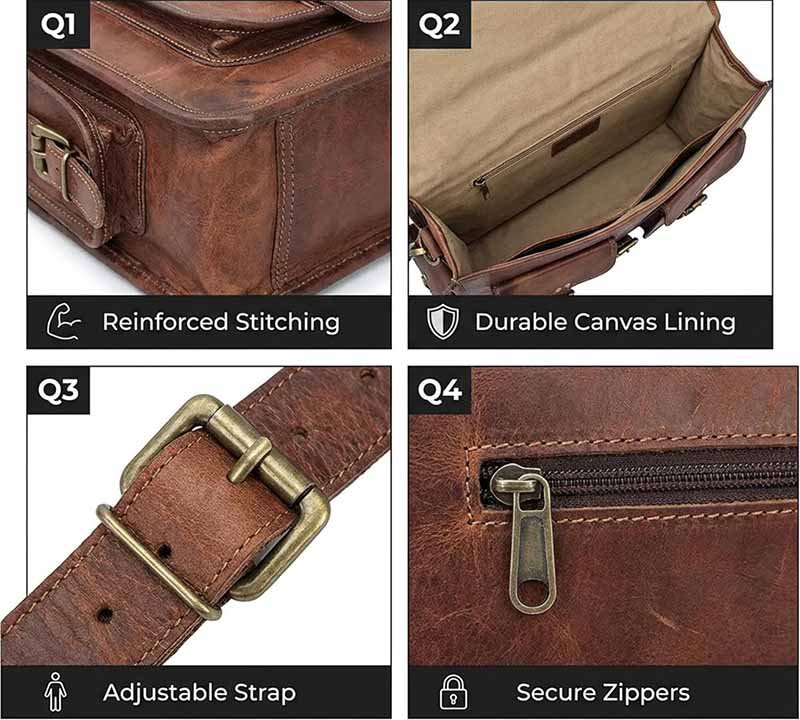
Materials decide how the strap looks, feels, stretches, ages, and supports weight. Leather type, thickness, lining, webbing, reinforcement, and edge finishing all affect strap quality. A good material plan should control stretching, cracking, sweat contact, edge wear, color transfer, and long-term comfort.
What leather works for strap systems?
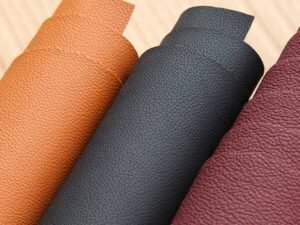
The best leather for strap systems depends on the bag’s positioning and expected use. Full-grain leather gives a premium surface, strong natural texture, and excellent aging potential. Top-grain leather offers a cleaner look and more consistent bulk production. Corrected-grain leather can reduce cost and improve color consistency, but it may not have the same natural feel as higher-grade leather.
For messenger bag straps, leather needs enough strength but also enough flexibility. If the leather is too soft, the strap may stretch and lose shape. If it is too stiff, the strap may feel uncomfortable and resist adjustment through the buckle. Many leather straps use material around 1.8–2.5 mm per layer, but the final thickness depends on whether the strap is folded, stitched, bonded, lined, or reinforced.
Different leather choices create different user experiences:
| Leather Type | Main Strength | Main Concern | Best Use |
|---|---|---|---|
| Full-grain leather | Premium surface, strong aging | Higher cost, natural variation | Luxury messenger bags |
| Top-grain leather | Clean look, stable quality | Less natural texture | Business bags |
| Vegetable-tanned leather | Firm, classic, develops patina | Longer break-in time | Vintage and premium bags |
| Chrome-tanned leather | Softer, flexible, comfortable | Needs colorfastness control | Daily messenger bags |
| Pull-up leather | Rich color movement | Scratches more visibly | Casual and heritage styles |
| Split leather backing | Cost control, inner support | Not ideal as main surface | Strap lining or reinforcement |
Leather selection should not be based only on surface beauty. Brands should ask how the leather behaves under bending, sweat contact, friction, and weight. A strap moves more than many other parts of the bag. It bends through buckles, rubs against clothing, touches skin, and carries load every day.
Before bulk production, strap leather should be checked for:
- Tensile strength.
- Flexing resistance.
- Surface cracking after bending.
- Color transfer under dry and wet rubbing.
- Thickness consistency.
- Edge finishing performance.
- Reaction to heat, humidity, and sweat.
- Stretch behavior after loaded hanging.
A leather messenger bag can use beautiful leather on the body, but the strap may need a slightly different leather specification for better performance. This is normal in professional product development.
Which lining keeps straps stable?
Strap lining keeps the strap stable, controls stretching, improves hand feel, and protects the leather structure during daily use. Many customers only see the outer leather, but the hidden inner layer often decides how the strap performs after months of use.
A full leather strap without lining may look clean, but it can stretch under weight if the leather is soft. This is especially risky for laptop messenger bags. A user may start with the strap adjusted at waist level, then notice after months that the bag hangs lower. This is usually caused by leather elongation, weak reinforcement, or poor material matching.
Common lining and support materials include:
| Lining Material | Main Benefit | Main Concern | Best Use |
|---|---|---|---|
| Nylon webbing | Strong, flexible, high load support | More technical feel if exposed | Laptop and travel bags |
| Polyester webbing | Stable, moisture resistant | Slightly firmer hand feel | Work and commuter bags |
| Microfiber | Smooth, consistent, comfortable | Needs abrasion testing | Premium daily bags |
| Canvas | Natural feel, good stability | May absorb moisture | Casual messenger bags |
| Split leather | Leather look, cost control | Quality varies by grade | Business and fashion bags |
| Reinforcement tape | Hidden strength | Must be well bonded | Stress areas and buckle zones |
The best lining should match the strap purpose. A luxury office messenger bag may use soft microfiber or split leather backing for a clean look. A laptop messenger bag may need webbing reinforcement to control stretch. A travel messenger bag may need stronger synthetic backing for load stability.
Lining also affects clothing contact. If the backing is too rough, it may damage wool coats, cotton shirts, or knitwear. If it is too smooth, the strap may slide off the shoulder. If it is not colorfast, dark leather may transfer color to light clothing. These are real customer concerns, especially in European, North American, Japanese, and Korean markets where users pay attention to long-term product finish.
For custom production, strap lining should be tested with the same leather, hardware, and stitch structure planned for bulk production. Changing one layer can change the whole carrying feel.
How does webbing support leather?
Webbing gives leather straps stronger internal support. Leather looks premium, but it is still a natural material. It can stretch, soften, and change under load. Webbing helps control those changes, especially in messenger bags designed for work, laptops, travel, or heavier daily carry.
Nylon webbing is strong and flexible. Polyester webbing has good shape stability and moisture resistance. Both can be used inside leather straps or on the underside of the strap. When webbing is hidden inside a folded leather strap, the customer sees leather but enjoys better load performance. When webbing is exposed on the underside, the design can look more modern and functional.
Webbing support is useful in these areas:
- Long adjustable straps that may stretch over time.
- Slider buckle areas where the strap bends repeatedly.
- Detachable hook ends where pulling force is concentrated.
- Laptop messenger bags carrying 3–6 kg.
- Travel bags used for long walking.
- Large messenger bags with heavy leather body construction.
- Products requiring consistent performance across repeat orders.
A leather-and-webbing strap can also improve bulk consistency. Leather varies from hide to hide. One batch may feel softer; another may feel firmer. A webbing core helps reduce the performance difference between leather lots. This matters for brands that reorder the same model season after season.
The challenge is making the strap still feel like a leather product. If the webbing is too visible, too rough, or poorly matched in color, it may lower the perceived value. A professional factory should match webbing color, texture, thickness, and edge finishing to the bag’s market positioning.
For many mid-to-high-end leather messenger bags, the best result is often not “pure leather only.” It is leather outside, engineered support inside.
Do reinforced edges matter?
Reinforced edges matter because strap edges receive constant friction. Users touch the strap, adjust the buckle, slide the shoulder pad, wear it over jackets, and place the bag on desks, seats, and luggage. Poor edge finishing can crack, peel, roughen, or expose inner layers, making the bag look old before the leather body has aged nicely.
Common strap edge methods include painted edges, folded edges, stitched edges, and burnished edges. Each creates a different look and performance level.
| Edge Method | Look | Main Benefit | Main Concern |
|---|---|---|---|
| Painted edge | Clean, modern | Smooth color match | May crack if poorly applied |
| Folded edge | Soft, premium | Covers raw edge well | Adds thickness |
| Stitched edge | Structured, strong | Holds layers together | Stitch tension must be controlled |
| Burnished edge | Natural, classic | Good for veg-tan leather | Less suitable for some soft leathers |
For adjustable strap systems, edge durability is especially important around buckle movement. The strap slides through metal hardware many times during adjustment. If the edge paint is too brittle, it may crack. If the edge is too soft, it may deform. If the buckle inner edge is sharp, even good leather can wear quickly.
Reinforcement is also needed at stress points. These areas should receive more attention than flat strap sections:
- D-ring leather tabs.
- Hook connection ends.
- Slider buckle fold-back areas.
- Strap holes if pin buckles are used.
- Shoulder pad contact area.
- Stitch start and end points.
- Corners where strap layers overlap.
Strong reinforcement methods may include extra leather layers, hidden webbing, backing tape, rivets, box stitching, bar-tack stitching, or wider stress distribution tabs. The choice depends on the bag style. A luxury business bag may avoid visible rivets for a cleaner look. A rugged travel messenger bag may use visible rivets as part of the design language.
Good edge and stress-point design protects both appearance and function. It helps the strap look cleaner after months of use and reduces the risk of structural complaints.
What Hardware Makes Straps Stronger?
Hardware makes the adjustable strap system work. Buckles control length, D-rings hold pulling force, hooks support movement, and sliders keep the strap in position. Good hardware should match strap width, leather thickness, bag weight, color finish, and market positioning. Weak hardware can make an expensive leather messenger bag feel unreliable.
Which buckles suit adjustable strap systems?
The buckle is the control center of an adjustable strap system. It decides how smoothly the strap moves, how firmly the length holds, and how clean the strap looks after repeated adjustment. For leather messenger bags, the most common buckle styles include slider buckles, roller buckles, pin buckles, ladder lock buckles, and custom metal adjusters.
Slider buckles are widely used because they allow continuous length adjustment. Users do not need fixed holes, so the strap can fit different heights and clothing layers more easily. For leather messenger bags, slider buckles work especially well with flat straps from 25 mm to 50 mm wide. The key is that the buckle must hold the strap firmly after adjustment. If the slider is too loose, the strap slips lower during use. If it is too tight, adjustment becomes difficult and may damage the leather surface.
Roller buckles are more common in classic leather straps. The roller reduces friction when the leather moves through the buckle. This is useful for thicker leather, vegetable-tanned leather, or vintage messenger styles. Pin buckles create a traditional belt-like look, but they need holes. The limitation is that adjustment is not continuous, and repeated pulling can stretch the holes over time.
A good buckle should be checked from several angles:
- Inner width must match the strap width closely.
- Edges should be smooth, not sharp.
- Metal thickness should suit the expected bag load.
- Finish should resist scratching from strap movement.
- Corners should not cut into painted leather edges.
- The buckle should hold length after loaded movement.
- The buckle should match other hardware on the bag.
For custom leather messenger bags, buckle selection should not be based only on appearance. A bright polished buckle may look good in photos but show scratches quickly. A thin buckle may reduce cost but feel weak when the user carries a laptop. A heavy buckle may look premium but add unnecessary weight to a smaller bag. The right buckle should match the product’s real use and price level.
| Buckle Type | Best For | Main Benefit | Main Concern |
|---|---|---|---|
| Slider buckle | Most messenger bags | Smooth length adjustment | Must prevent slipping |
| Roller buckle | Classic leather straps | Less friction on leather | Less flexible adjustment |
| Pin buckle | Vintage styles | Traditional leather look | Fixed holes may stretch |
| Ladder lock buckle | Casual or technical bags | Easy adjustment | Less premium look |
| Custom metal adjuster | Premium collections | Unique brand style | Higher tooling cost |
For brands planning a premium leather messenger bag collection, custom buckle development can also support brand identity. A buckle shape, engraved logo, matte finish, or exclusive metal color can make the strap system feel more complete. However, custom hardware usually requires higher MOQ, mold cost, longer sampling time, and additional finish testing.
Are D-rings or O-rings better?
D-rings and O-rings both connect the strap to the leather messenger bag, but they behave differently. D-rings are more stable because the flat side can sit closer to the leather tab. O-rings allow more rotation and movement, which can be useful for relaxed or vintage styles. The better choice depends on the strap angle, bag weight, hook type, and visual design.
D-rings are often used in work bags and laptop messenger bags because they control strap direction better. The straight side gives the leather tab a cleaner resting position, reducing unnecessary twisting. This is useful when the bag carries heavier items. D-rings also create a more structured look, which fits business messenger bags and premium briefcase-style bags.
O-rings create a softer, more casual feeling. They allow the hook and strap to rotate more freely, which can make the bag move naturally during walking. They are often seen in casual leather bags, vintage satchels, women’s messenger bags, and handmade-style products. The concern is that too much rotation may cause more swinging if the bag is heavy.
The ring material and thickness are more important than many brands realize. A thin ring may bend under long-term load. A ring with poor plating may lose color where the hook rubs repeatedly. A ring with a rough joint may scratch the hook or damage the strap end.
For most leather messenger bags, the ring should be evaluated by:
- Inner width matching hook size.
- Wire diameter suitable for loaded weight.
- Smooth welded or molded joint.
- Finish consistency with other metal parts.
- No sharp edges near leather tabs.
- No deformation after hanging load test.
- Proper movement without excessive noise.
| Ring Type | Stability | Movement | Best Use | Main Risk |
|---|---|---|---|---|
| D-ring | High | Controlled | Business, laptop, work bags | Can look rigid on soft bags |
| O-ring | Medium | Flexible | Casual, vintage, fashion bags | More swing under load |
| Square ring | High | Structured | Modern, minimal bags | Corners may create wear |
| Half-round ring | Medium-high | Smooth | Premium messenger bags | Needs accurate hook matching |
| Custom ring | Depends on design | Brand-specific | High-end collections | Tooling and testing needed |
For laptop messenger bags, D-rings are usually safer because they help control the pull direction. For softer casual styles, O-rings can make the bag feel more relaxed. The final choice should be tested with the actual strap, actual leather tab, and actual loaded bag, not only selected from a hardware catalog.
How should metal colors match the bag?
Metal color affects the whole product feeling. The same leather messenger bag can look classic with antique brass, modern with matte black, premium with brushed nickel, or fashion-forward with gunmetal. Hardware color should match the leather color, stitching, zipper, logo plate, button snaps, and brand positioning.
Common hardware finishes include antique brass, light gold, brushed gold, nickel, brushed nickel, gunmetal, matte black, dark bronze, and stainless steel finish. Each creates a different visual message.
| Hardware Finish | Visual Feeling | Suitable Leather Colors | Common Use |
|---|---|---|---|
| Antique brass | Vintage, warm, classic | Brown, tan, olive, burgundy | Heritage messenger bags |
| Nickel | Clean, bright, modern | Black, navy, grey, dark brown | Business bags |
| Brushed nickel | Refined, less shiny | Black, taupe, charcoal | Premium office bags |
| Gunmetal | Modern, masculine | Black, dark brown, navy | Urban commuter bags |
| Matte black | Minimal, technical | Black, grey, olive | Modern travel bags |
| Light gold | Elegant, fashion-led | Cream, tan, burgundy | Women’s leather bags |
| Dark bronze | Rich, understated | Coffee, chestnut, dark green | Vintage luxury styles |
The finish should not only look good when new. It must survive friction, sweat, humidity, and repeated movement. Strap hardware receives more wear than decorative hardware because hooks, rings, and buckles rub against each other every day. Poor plating may fade at contact points, leaving silver base metal visible.
For mid-to-high-end leather messenger bags, hardware finish testing is important. Brands should ask about:
- Salt spray resistance for corrosion control.
- Abrasion resistance for plated surfaces.
- Color consistency across buckles, hooks, rings, and zipper pulls.
- Finish matching under natural light and studio lighting.
- Resistance to hand sweat and moisture.
- Plating thickness and base metal quality.
- Packaging protection during shipping.
A common mistake is choosing hardware color only from a small swatch. In real production, a bag may have 8–20 metal parts. If the buckle, hook, zipper pull, rivet, and logo plate are slightly different in tone, the finished product looks less refined. SzoneierLeather can help brands align hardware color across the full product, including strap system, zippers, magnetic snaps, rivets, logo plates, and packaging details.
Do swivel hooks improve movement?
Swivel hooks improve movement because they allow the strap to rotate instead of twisting. This is helpful for crossbody leather messenger bags, especially when users move quickly, take the bag on and off often, or carry the bag while traveling. A swivel hook can reduce strap twisting and make the bag feel more natural during use.
However, swivel hooks are not always better. They add a moving part, which means they must be stronger and better tested. A poor swivel hook may loosen, squeak, rotate unevenly, or lose plating at the joint. For a premium leather messenger bag, that small noise or looseness can damage the user’s impression.
Swivel hooks work best when:
- The strap is removable.
- The bag supports crossbody carry.
- The user needs flexible movement.
- The bag has top handles and a detachable strap.
- The strap is wide enough to twist without a swivel.
- The bag is used for travel or commuting.
- The design needs a more functional carrying feel.
For small fashion messenger bags, simple snap hooks may be enough. For laptop messenger bags, swivel hooks are useful but must be selected carefully. The hook opening should not release easily when the bag is loaded. The spring should feel firm. The rotating joint should move smoothly without wobbling. The hook should match the D-ring thickness so it does not bind or make noise.
A good swivel hook should be checked in these areas:
- Spring strength.
- Hook opening gap.
- Rotation smoothness.
- Load-bearing capacity.
- Plating wear at the swivel joint.
- Noise during walking.
- Compatibility with D-ring or O-ring.
- Ease of use with one hand.
For custom production, it is better to test swivel hooks on a loaded sample rather than only reviewing hardware photos. The same hook can feel fine on a small bag but weak on a laptop messenger bag. Real testing avoids expensive problems after bulk production.
How Are Strap Systems Tested?
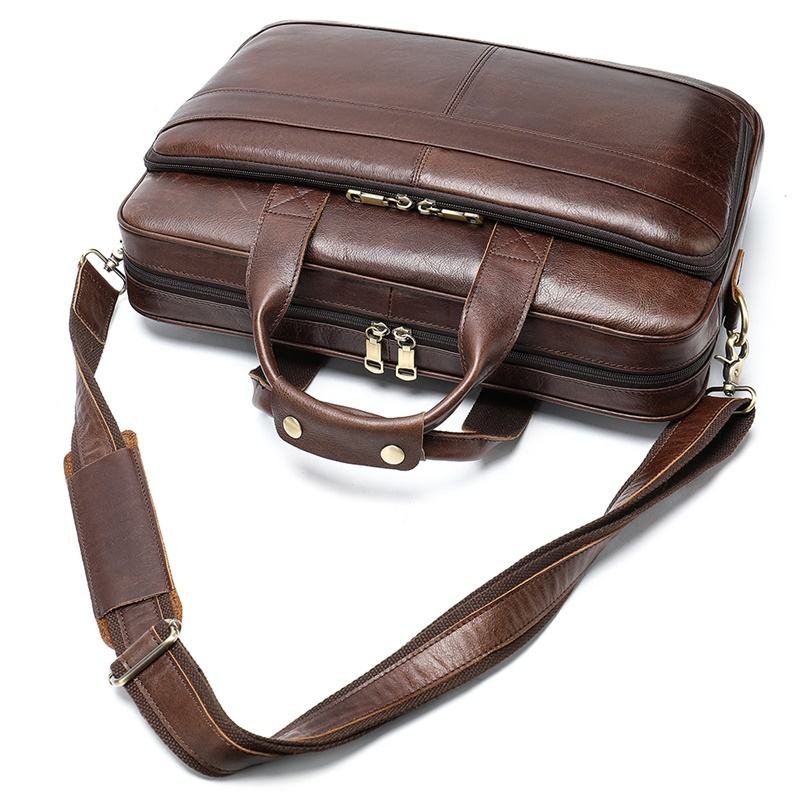
Strap systems should be tested for load strength, stitching security, hardware durability, buckle slip, edge wear, colorfastness, and real carrying comfort. A leather messenger bag may look finished after sampling, but testing shows whether the strap can survive daily use, repeated adjustment, laptop weight, and long-term movement.
How much weight can straps carry?
The required strap strength depends on the bag’s intended use. A small leather messenger bag for phone and wallet carry does not need the same strength as a laptop messenger bag. A travel messenger bag may need even higher load performance because users often pack more than expected.
A common development mistake is testing the strap only at the expected normal weight. In real life, users overload bags. Someone may add a bottle, umbrella, power bank, documents, camera, or small gifts. A bag designed for 4 kg may sometimes carry 6 kg or more. Professional product development should leave enough safety margin.
For leather messenger bags, practical load planning can follow this logic:
| Bag Use | Expected Daily Load | Recommended Test Load | Strap Focus |
|---|---|---|---|
| Small fashion messenger | 1–2 kg | 4–5 kg | Appearance and light comfort |
| Daily messenger bag | 2–4 kg | 6–8 kg | Adjustment stability |
| Laptop messenger bag | 3–6 kg | 8–12 kg | Stress-point strength |
| Travel messenger bag | 4–7 kg | 10–15 kg | Hardware and stitching |
| Camera-style messenger | 4–8 kg | 12–16 kg | Shoulder pad and shock stability |
The goal is not to make every bag carry extreme weight. The goal is to match testing with real use. A premium leather messenger bag should not fail when used slightly above normal load. Strap tabs, buckles, hooks, rings, and stitching must work together.
Load testing can include static hanging, dynamic pulling, repeated lifting, walking simulation, and buckle slip checks. Static hanging shows whether the structure can hold weight. Dynamic movement shows whether stitching and hardware can handle real motion. A strap that survives hanging may still fail when pulled repeatedly at an angle.
SzoneierLeather can develop test points according to the product type, including:
- Loaded hanging test.
- Strap pull test.
- Buckle slip test.
- Hook opening check.
- D-ring deformation check.
- Shoulder pad compression check.
- Stitching tension review.
- Reinforcement tab inspection.
For brands, these tests help confirm whether the product is ready for real customer use before bulk order approval.
How are stress points checked?
Stress points are the areas where pulling force concentrates. In leather messenger bags, the main stress points are usually the strap connection tabs, D-ring areas, hook ends, buckle fold-back areas, shoulder pad openings, and stitch endpoints. These areas should be checked more carefully than flat leather panels because they carry repeated force every day.
The D-ring tab area is especially important. When a bag is loaded, the strap pulls upward while the bag body pulls downward. This creates tension at the leather tab. If the tab is only stitched onto the surface without enough backing, it may loosen over time. For laptop bags, the tab should usually be connected into a reinforced body seam or backed by hidden support material.
Stress-point review should include:
- Leather thickness at the tab.
- Number of leather layers.
- Internal reinforcement material.
- Stitch pattern and stitch density.
- Distance between stitch line and leather edge.
- Ring width and wire thickness.
- Pull direction during crossbody carry.
- Compatibility between hook and ring.
- Wear after repeated movement.
Common reinforcement methods include:
| Reinforcement Method | Benefit | Best Use |
|---|---|---|
| Extra leather layer | Adds strength and structure | Visible tab areas |
| Hidden webbing | Controls stretching | Laptop and travel bags |
| Reinforcement tape | Stabilizes stitch zones | Folded strap ends |
| Box stitching | Spreads load across a larger area | D-ring tabs |
| Bar-tack stitching | Adds concentrated strength | High-pull points |
| Rivets | Adds mechanical support | Rugged or casual bags |
| Seam-integrated tab | Stronger body connection | Heavy messenger bags |
The distance between stitches and leather edge also matters. If stitches are too close to the edge, the leather may tear. If stitches are too far inward, the tab may look bulky or bend poorly. Stitch length, thread thickness, needle size, and leather softness all need to be coordinated.
A strong strap system should not rely on one method only. For heavier messenger bags, the best result often comes from combining hidden reinforcement, proper stitch pattern, quality hardware, and correct tab geometry.
Do stitches affect strap strength?
Stitches affect strap strength directly. They hold leather layers together, secure the strap ends, reinforce hardware tabs, and prevent separation under load. Even when leather and hardware are strong, poor stitching can make the strap fail.
For leather messenger bags, stitch quality is judged by both appearance and structure. Clean, even stitches make the bag look premium. Correct stitch density and thread selection make the bag durable. If stitches are too loose, the strap may separate. If they are too tight, the leather may pucker or weaken near the holes. If the needle is too large, the holes may create tear points.
Common stitch structures for strap systems include straight stitching, double-row stitching, box stitching, X-box stitching, bar-tack stitching, and reinforced end stitching.
| Stitch Type | Strength Level | Visual Style | Common Use |
|---|---|---|---|
| Single straight stitch | Light to medium | Clean and simple | Small straps |
| Double-row stitch | Medium to strong | More structured | Work bags |
| Box stitch | Strong | Functional and neat | Strap tabs |
| X-box stitch | Very strong | Rugged, technical | Heavy-load tabs |
| Bar-tack stitch | Very strong at small points | Functional | High-stress areas |
| Decorative stitch | Depends on structure | Premium or fashion | Visible strap details |
Thread choice also matters. Polyester thread is commonly used because it offers strength, color stability, and good abrasion resistance. Nylon thread is strong and flexible but may behave differently under heat and UV exposure. Thread thickness should match leather thickness and product style. A luxury leather messenger bag may need refined stitching, while a travel messenger bag may need heavier thread.
For brands, stitch inspection should include:
- Even stitch spacing.
- No skipped stitches.
- No loose thread ends.
- Clean backstitching.
- No leather tearing near holes.
- Correct thread tension.
- Matching thread color.
- Strong stitch structure at stress points.
- No sharp thread or melted edge touching clothing.
Stitching is often where factory skill becomes visible. A strong strap system is not only about materials. It depends on how carefully the strap is cut, folded, glued, stitched, pressed, and inspected.
How can brands avoid strap failure?
Brands can avoid strap failure by defining real use conditions before sampling. The factory needs to know what the bag will carry, who will use it, what market it targets, and what price level it should reach. Without these details, strap decisions may be made based only on appearance.
Before developing a leather messenger bag strap system, brands should confirm:
- Bag size and target capacity.
- Laptop or tablet size, if any.
- Expected daily load.
- Shoulder carry, crossbody carry, or both.
- Fixed strap or removable strap.
- Strap width and length range.
- Hardware color and finish.
- Leather type and strap backing.
- Shoulder pad requirement.
- Target market and price range.
- Packaging method.
- Branding position.
Several practical decisions can reduce strap failure risk:
- Use wider straps for heavier bags.
- Add webbing or hidden reinforcement for laptop bags.
- Match hook, ring, and buckle size accurately.
- Avoid sharp hardware edges.
- Reinforce D-ring tabs from inside the bag body.
- Test buckle slip under loaded conditions.
- Use shoulder pads for bags above 3 kg expected load.
- Test colorfastness on strap backing.
- Inspect edge paint around buckle areas.
- Run pre-production testing before bulk cutting.
A useful development rule is: the heavier the bag, the less decorative the strap system can be. Fashion details are still important, but structure must come first. A leather messenger bag with poor strap strength may create complaints even if the leather body, lining, and packaging are excellent.
SzoneierLeather supports this stage through material review, hardware matching, structure development, prototype sampling, stress-point improvement, and quality inspection. For brands that already have drawings, samples, or reference bags, the strap system can be adjusted based on the expected market and product positioning. For brands starting from an idea, the factory can recommend a practical strap structure before sampling begins.
How Can Brands Customize Strap Systems?
Brands can customize adjustable strap systems through strap length, width, leather type, backing material, hardware finish, shoulder pad, logo method, detachable structure, stitching style, and reinforcement design. Good customization should improve real use, not only decoration. The best strap system matches the customer group, bag size, market price, and daily carrying scene.
Can strap length be customized?
Strap length can be customized based on body size, carrying style, bag height, and target market. A leather messenger bag sold mainly for shoulder carry does not need the same strap range as a crossbody commuter bag. A men’s business messenger bag may need a longer strap than a compact women’s fashion messenger. A travel messenger bag may need more adjustment for winter coats and layered clothing.
Common adjustable strap ranges include:
| Bag Style | Common Adjustable Range | Carrying Style |
|---|---|---|
| Small leather messenger | 85–125 cm | Shoulder or high crossbody |
| Medium messenger bag | 95–140 cm | Shoulder and crossbody |
| Laptop messenger bag | 100–150 cm | Crossbody and work carry |
| Travel messenger bag | 105–160 cm | Long crossbody carry |
| Briefcase messenger | 90–135 cm | Shoulder carry and hand carry |
These are not fixed rules. Final length should be adjusted based on bag height, strap attachment position, user group, and market. A tall user may find a 130 cm maximum strap too short for crossbody carry. A shorter user may find an oversized strap with too much extra tail unattractive. The tail management also matters. If the extra strap end hangs too long, it can look messy and affect product photos.
Brands can choose several strap end management methods:
- Leather keeper loop.
- Metal loop holder.
- Hidden elastic keeper.
- Stitched fixed keeper.
- Sliding keeper.
- Fold-back strap structure.
- Shorter market-specific strap length.
For global brands, it may be useful to design one adjustable range that fits most markets. For niche brands, strap length can be developed for a specific customer group, such as office commuters, cyclists, photographers, students, or business travelers.
Can logos be added to straps?
Logos can be added to leather messenger bag straps in several ways, including embossing, debossing, foil stamping, woven labels, metal logo plates, jacquard webbing, rubber patches, and custom hardware engraving. The right method depends on brand style, strap material, order quantity, and price level.
For leather straps, debossing and embossing are common because they look clean and premium. The logo can be placed near the strap end, on the shoulder pad, or on a leather keeper. Foil stamping adds stronger visibility but may wear faster if placed in a high-friction area. For premium products, subtle logo placement often feels more refined than large branding.
For webbing-supported straps, jacquard weaving can create a strong brand identity. This is common for modern, streetwear, travel, and lifestyle leather bags. However, custom jacquard webbing may require higher MOQ and more development time. Printed logos on webbing can be lower cost but should be tested for abrasion.
Common strap logo options include:
| Logo Method | Best Surface | Visual Style | Main Concern |
|---|---|---|---|
| Debossed logo | Leather | Subtle, premium | Needs suitable leather firmness |
| Embossed logo | Leather | Raised, tactile | Tooling required |
| Foil stamping | Leather | More visible | Wear risk at friction points |
| Metal logo plate | Leather pad or keeper | Luxury, strong | Adds weight and cost |
| Engraved hardware | Buckle or hook | Refined, custom | Mold or engraving cost |
| Woven label | Strap or pad | Casual, clear | Less luxury feeling |
| Jacquard webbing | Webbing strap | Strong brand identity | Higher MOQ |
| Rubber patch | Technical strap | Sporty, modern | May not suit formal bags |
Logo placement should avoid areas that bend sharply or rub against hardware. A logo placed near a slider buckle may wear quickly. A logo on the shoulder pad may be visible in use, but it must not irritate the user’s shoulder. A logo on the strap end can look clean in product photos and reduce friction risk.
For brand programs, SzoneierLeather can help compare logo methods during sampling. This is useful because logo effect changes depending on leather type, color, thickness, grain, and finish. A debossed logo that looks sharp on smooth top-grain leather may be less visible on heavy pebbled leather. Testing prevents disappointment after bulk production.
Can straps fit laptops or travel use?
Straps can be developed specifically for laptop or travel use. These bags need stronger structure because they carry more weight and stay on the shoulder longer. A laptop messenger bag should not use the same strap system as a small casual leather bag. The strap must support heavier contents while keeping the bag comfortable and stable.
For laptop messenger bags, several strap decisions become important:
- Strap width should usually be 38–45 mm.
- Adjustable length should allow comfortable crossbody carry.
- Shoulder pad should be added for better pressure distribution.
- D-ring tabs should be reinforced from inside the bag body.
- Hardware should handle repeated loaded movement.
- Strap backing should control stretching.
- Buckle should not slip under daily laptop load.
- Stitching should be reinforced at all connection points.
For travel messenger bags, the strap may need even more flexibility. Users may wear the bag over thick jackets, carry it through airports, place it on luggage, and lift it repeatedly. Hardware noise, strap twisting, and shoulder pressure become more noticeable during travel.
A travel-focused strap system may include:
- Wider strap from 40–50 mm.
- Longer adjustable range up to 150–160 cm.
- Detachable swivel hooks.
- Padded shoulder section.
- Anti-slip backing.
- Stronger webbing reinforcement.
- Abrasion-resistant edge finishing.
- Darker hardware finishes that hide wear better.
- Replaceable strap option.
Laptop and travel users are less forgiving about strap problems because they feel the weight every day. If a customer carries a bag for 40 minutes on a commute, a small strap issue becomes a daily irritation. Better strap development can directly improve product reviews and repeat purchase potential.
How does SzoneierLeather develop custom straps?
SzoneierLeather develops custom strap systems by combining material selection, structure engineering, hardware matching, sampling, testing, and production control. The goal is not only to make a strap that looks similar to a reference image, but to build a strap system that fits the product’s real use and target market.
A custom strap project usually starts with product information. The brand may provide a design drawing, sample bag, reference photo, material requirement, logo file, or target price. If the brand does not have a complete design, SzoneierLeather can recommend strap structure based on bag type, capacity, leather style, and use scenario.
The development process may include:
| Step | Main Work | Why It Matters |
|---|---|---|
| Requirement review | Bag size, use, load, market, price | Avoids wrong strap structure |
| Material selection | Leather, backing, lining, reinforcement | Controls comfort and durability |
| Hardware matching | Buckle, hook, ring, finish | Ensures strength and visual consistency |
| Structure design | Width, length, pad, detachable parts | Improves fit and daily use |
| Logo method | Embossing, metal logo, woven label | Supports brand identity |
| Prototype sampling | Physical sample testing | Finds problems before bulk order |
| Adjustment review | Comfort, slip, strength, appearance | Improves final product |
| Bulk production control | Cutting, stitching, assembly, QC | Keeps quality consistent |
SzoneierLeather’s advantage comes from its leather product development background and raw material supply chain. With over 18 years of leather goods manufacturing experience, the factory can support custom bags, wallets, belts, straps, accessories, and leather boxes. This broader leather goods experience helps when developing messenger bag straps because the team understands leather behavior, hardware matching, edge finishing, and product structure across different categories.
For brands and custom wholesale clients, this means fewer blind decisions. Strap width, leather thickness, hardware type, reinforcement method, and logo placement can be discussed before sampling. This helps reduce unnecessary sample rounds and improves the chance of reaching a production-ready design faster.
What Makes a Good Adjustable Strap System?
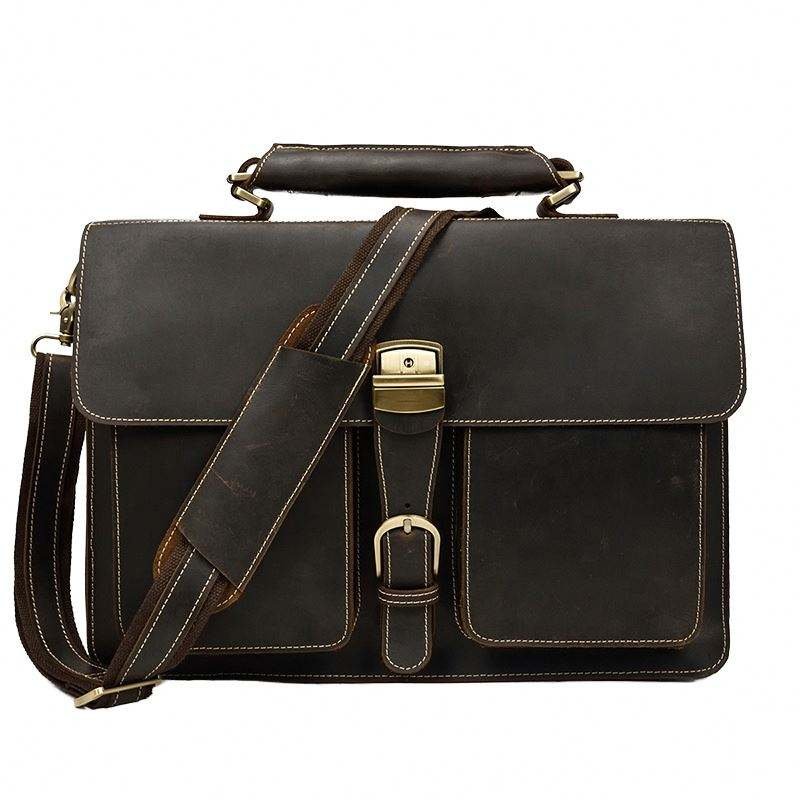
A good adjustable strap system should feel comfortable, hold its position, match the leather messenger bag’s style, and support real daily weight without stretching, slipping, twisting, or damaging clothing. It should look natural on the bag, but also work quietly in the background every time the user carries it.
What should brands check before production?
Before production, brands should check the strap system with the same seriousness as the leather body, lining, zipper, and packaging. The strap is not a small side detail. It is one of the most touched and most stressed parts of a leather messenger bag. If the strap fails, the whole product feels unreliable.
A strong pre-production check should cover appearance, comfort, structure, and real use. Many strap problems are not obvious in flat product photos. A strap may look good on a table but twist when worn. A buckle may look premium but slip after loading. A shoulder pad may look thick but feel stiff after 30 minutes. A D-ring tab may look neat but lack internal reinforcement.
Brands should review these points before approving bulk production:
- Does the strap length fit both shoulder carry and crossbody carry?
- Does the adjustment range suit the target market?
- Does the strap width match the bag size and expected load?
- Does the buckle adjust smoothly without scratching the leather?
- Does the buckle hold position after loading the bag?
- Does the shoulder pad stay near the shoulder contact area?
- Does the strap twist near the hook, ring, or buckle?
- Are D-ring tabs reinforced inside the bag body?
- Is the hardware finish consistent across all metal parts?
- Does the strap backing rub, slide, or transfer color to clothing?
- Are strap edges smooth, sealed, and resistant to cracking?
- Are stitches even, tight, and reinforced at stress points?
- Does the strap still look clean after repeated adjustment?
- Can the strap be packed without causing crease marks?
- Does the final strap design match the brand’s price level?
A simple but useful method is loaded wear testing. Put realistic items inside the bag: laptop, charger, notebook, phone, wallet, keys, and water bottle. Then wear the bag for at least 20–30 minutes. Walk, sit, stand, adjust the strap, remove it, wear it again, and check how the strap behaves. This test often reveals problems that drawing review cannot show.
| Check Area | What to Review | Common Problem | Better Solution |
|---|---|---|---|
| Strap length | Adjustment range and tail length | Too short for crossbody carry | Extend range or redesign keeper |
| Strap width | Pressure on shoulder | Strap cuts into shoulder | Use wider strap or shoulder pad |
| Buckle | Slip and adjustment smoothness | Strap slides under weight | Change buckle structure or strap thickness |
| Hardware | Hook, ring, and finish quality | Noise, scratches, plating loss | Upgrade finish and match hardware size |
| Stress point | D-ring tab and stitch area | Tearing after loaded use | Add hidden backing and stronger stitch |
| Edge finish | Painted or folded edges | Cracking near buckle area | Improve edge process or adjust hardware |
| Shoulder pad | Position and softness | Slides away or feels stiff | Change backing, length, or foam density |
| Strap backing | Clothing contact | Color transfer or roughness | Test backing material and dye fastness |
For premium leather messenger bags, the customer expects the strap to feel natural from the first use. They should not need to “fight” with the buckle, readjust the shoulder pad every few minutes, or worry whether the hook can hold the bag. Good strap design makes the user forget the strap is even there.
How can better strap systems improve leather messenger bags?
A better strap system improves the whole leather messenger bag because it affects comfort, trust, visual value, and product life. Customers may first notice the leather color or bag shape, but their long-term opinion often comes from daily carrying experience. If the strap feels secure and comfortable, the bag feels more expensive. If the strap slips, digs into the shoulder, or twists, the bag feels cheaper than it looks.
For leather goods brands, strap improvement can create value in several direct ways:
- Better user comfort during commuting and travel.
- Higher product rating from daily-use customers.
- Fewer complaints about slipping, shoulder pain, or hardware failure.
- More suitable fit for different markets and body heights.
- Stronger positioning for laptop and business messenger bags.
- More visible product differentiation from low-cost competitors.
- Better repeat order potential for wholesale and retail channels.
- Easier brand storytelling around comfort, durability, and craftsmanship.
A strong strap system can also support higher pricing. Customers can feel the difference when a strap is stable, smooth, and comfortable. A 38 mm leather strap with hidden reinforcement, matte hardware, smooth edge finishing, and a well-shaped shoulder pad feels very different from a thin strap with weak hardware. This difference is hard to explain in one product photo, but very easy to understand once the customer carries the bag.
For product development, strap systems also give brands more design flexibility. One messenger bag body can be paired with different strap options for different markets. For example, a business version may use a slim leather strap with brushed nickel hardware. A travel version may use a wider padded strap with swivel hooks. A casual version may use leather-backed webbing with antique brass hardware. This allows brands to build a product series without completely redesigning the main bag body.
| Product Goal | Strap System Choice | Customer Benefit |
|---|---|---|
| Premium business look | Full leather strap, brushed hardware, slim pad | Clean and professional daily carry |
| Better laptop comfort | 38–45 mm reinforced strap, padded shoulder section | Less shoulder pressure under load |
| Travel flexibility | Detachable strap, swivel hooks, longer length range | Easier airport and crossbody use |
| Casual vintage style | Pull-up leather strap, antique brass hardware | Warm, classic leather character |
| Modern urban style | Leather + webbing strap, matte black hardware | Stronger, cleaner, more functional feel |
| Brand identity | Custom logo on pad, buckle, or keeper | More recognizable product detail |
The strap system is one of the few parts of a leather messenger bag that combines engineering and emotion. It must be strong, but it must also feel good. It must carry weight, but it must also look natural. It must support daily use, but it should still match the customer’s style. This balance is where thoughtful manufacturing makes a visible difference.
What Should Brands Ask a Leather Bag Factory?
Brands should ask a leather bag factory about strap length, strap width, material structure, hardware strength, reinforcement, edge finishing, testing, logo options, and bulk quality control. These questions help avoid weak strap systems, uncomfortable carrying, inconsistent production, and unnecessary sample revisions.
What questions matter most?
When developing leather messenger bags, many brands start by asking about price, MOQ, leather type, and sample time. These are important, but strap-specific questions are just as necessary. A factory that understands strap systems should be able to explain not only what it can make, but why a certain strap structure is suitable for the product.
Useful questions include:
- What strap width do you recommend for this bag size?
- What adjustable length range fits our target users?
- Should we use full leather, webbing-backed leather, or hybrid strap construction?
- Which hardware material is suitable for our expected load?
- Should we use fixed straps or detachable straps?
- Do we need swivel hooks for crossbody movement?
- How will the D-ring tabs be reinforced?
- What stitch structure will be used at the strap ends?
- Can the shoulder pad be moved, fixed, or removable?
- What edge finishing method works best for this leather?
- Will the strap backing cause color transfer on light clothing?
- Can we customize the buckle, hook, or metal finish?
- Can we add logo embossing or metal branding to the strap?
- How will the strap be tested before bulk production?
- How will bulk quality be checked?
A professional factory should not give the same answer for every leather messenger bag. A small fashion messenger, a 15-inch laptop messenger, and a travel messenger need different strap systems. If every answer is “yes, we can do it,” without explaining material, structure, and load, the brand may not receive enough development support.
A better conversation sounds more specific. For example, if the bag is designed for 14-inch laptop carry, the factory may suggest a 38 mm strap, webbing reinforcement, detachable swivel hooks, reinforced D-ring tabs, and a slim shoulder pad. If the bag is a compact fashion style, the factory may suggest a narrower leather strap and cleaner hardware to keep the product elegant.
Good questions lead to better samples. Better samples reduce wasted time.
What details should be included in an inquiry?
A clear inquiry helps the factory recommend the right strap system faster. If the brand only sends one reference photo, the factory can copy the look, but it may not fully understand the use. If the brand provides size, load, leather preference, hardware style, and target customer details, the factory can develop a much more accurate solution.
A strong inquiry for a custom leather messenger bag should include:
| Inquiry Detail | Why It Helps |
|---|---|
| Bag size | Determines strap length and load structure |
| Target use | Work, travel, fashion, laptop, school, business |
| Laptop size | Helps decide strap width and reinforcement |
| Target market | Different markets may prefer different fit and style |
| Leather preference | Affects strap softness, thickness, and edge method |
| Hardware color | Helps match buckle, hook, ring, zipper, and logo parts |
| Carrying method | Shoulder carry, crossbody carry, or both |
| Strap type | Fixed, removable, padded, leather, webbing-backed |
| Logo method | Embossing, metal logo, woven label, engraved hardware |
| Expected order quantity | Affects hardware sourcing and custom part feasibility |
| Price position | Helps balance cost, structure, and premium details |
| Reference sample | Makes appearance and hand feel easier to match |
For brands that do not yet have technical drawings, a reference bag or concept photo can still be useful. SzoneierLeather can review the reference and suggest improvements for production, such as adjusting strap width, changing hardware thickness, improving D-ring reinforcement, or adding a shoulder pad.
If the project is still early, brands can describe the user scene instead of technical details. For example:
“Our customer is an office commuter carrying a 14-inch laptop and documents every day. The bag should look premium, not too sporty. The strap should support crossbody carry and feel comfortable for 30–60 minutes.”
This kind of description gives the factory enough context to recommend materials and structure. It also helps avoid overbuilding or underbuilding the strap system.
How does sampling reduce risk?
Sampling reduces risk because the strap system can be touched, worn, adjusted, loaded, and tested before bulk production. For leather messenger bags, many problems only appear after a physical sample is made. A drawing cannot fully show shoulder pressure, buckle smoothness, leather stretch, hardware noise, or strap twisting.
During sample review, brands should test the strap like a real customer, not only inspect it visually. The bag should be loaded with realistic items. The strap should be adjusted several times. The bag should be worn as shoulder carry and crossbody carry. The user should walk, sit, stand, and remove the bag repeatedly.
During sampling, brands can check:
- Whether the maximum strap length is enough.
- Whether the minimum strap length looks clean.
- Whether the extra strap tail is too long.
- Whether the buckle scratches or compresses the leather.
- Whether the shoulder pad position feels natural.
- Whether the hardware creates noise while walking.
- Whether the strap twists at the connection points.
- Whether the bag hangs at the right angle.
- Whether the D-ring tabs pull smoothly under weight.
- Whether the strap feels too stiff or too soft.
- Whether the overall look matches the target price level.
A first sample does not need to be perfect. Its job is to reveal what should be improved. Common adjustments after first sampling include changing strap length, increasing strap width, softening the shoulder pad, changing the hook type, improving edge paint, adding webbing reinforcement, or moving the D-ring position slightly.
For leather messenger bags, one or two smart sample revisions are better than rushing into production with unclear details. Once leather, hardware, and reinforcement are cut in bulk, changes become expensive. Sampling protects both the brand and the factory.
What quality control should be used?
Quality control for adjustable strap systems should cover incoming materials, cutting, stitching, hardware assembly, edge finishing, functional testing, and final inspection. A strap may fail because of one small issue: wrong buckle size, weak stitch tension, uneven edge paint, poor hardware plating, or missing reinforcement. Good QC catches these problems before shipment.
A practical QC process for leather messenger bag straps may include:
| QC Stage | Inspection Focus |
|---|---|
| Material inspection | Leather thickness, color, grain, defects, stretch |
| Hardware inspection | Finish, size, spring strength, sharp edges, plating |
| Cutting inspection | Strap width, length, edge accuracy |
| Assembly inspection | Layer alignment, glue quality, reinforcement placement |
| Stitching inspection | Stitch spacing, tension, thread ends, skipped stitches |
| Edge inspection | Smoothness, paint coverage, cracking, roughness |
| Functional check | Buckle adjustment, hook rotation, strap slip |
| Load check | Pull strength, D-ring tab security, strap stability |
| Final inspection | Appearance, logo position, color matching, packaging |
For bulk production, consistency matters. The first approved sample becomes the standard. Every production batch should be compared against it. Strap length should not vary randomly. Hardware color should not change between lots. Shoulder pads should not shift in size. Edge finishing should stay clean. Stitching should remain even.
Brands should also pay attention to packaging. Leather straps can crease, deform, or leave pressure marks if packed poorly. Detachable straps should be wrapped or positioned inside the bag carefully. Metal hooks should be protected from scratching the leather body during shipping. Shoulder pads should not be pressed in a way that leaves permanent marks.
For higher-end products, SzoneierLeather can support detailed inspection standards based on the approved sample, including measurement checks, appearance checks, functional checks, and packaging review. This gives brands more confidence before shipment.
FAQ About Adjustable Strap Systems in Leather Messenger Bags
A well-designed FAQ section can help customers understand strap choices faster. It also answers common questions before inquiry, making communication easier between brands and factory teams.
Are adjustable straps better than fixed straps?
Adjustable straps are better for most leather messenger bags because they fit more users and more carrying styles. A fixed strap may look clean, but it limits comfort. Adjustable straps allow shoulder carry, crossbody carry, higher carry, lower carry, and better fit over different clothing layers. Fixed straps are still suitable for small fashion bags or vintage styles where simplicity matters more than flexibility.
What strap width is best for a leather messenger bag?
For most leather messenger bags, 30–38 mm is a balanced strap width. It looks clean while giving enough comfort for daily carry. For laptop messenger bags, 38–45 mm is usually better because the bag carries more weight. Small fashion messenger bags may use 20–25 mm straps, but they are not ideal for heavy contents.
Should leather messenger bags have padded straps?
Padded straps are recommended when the bag carries a laptop, camera, documents, or travel items. A shoulder pad spreads pressure and makes the bag more comfortable during longer use. For smaller leather messenger bags, a pad may not be necessary. For business and laptop styles, a slim leather shoulder pad can improve comfort without making the bag look too bulky.
Are detachable straps strong enough?
Detachable straps can be strong enough if the hook, ring, leather tab, stitching, and internal reinforcement are properly designed. The strength does not depend only on the hook. The whole connection system must be tested together. For laptop messenger bags, detachable straps should use stronger hooks, reinforced D-ring tabs, and secure stitching.
What hardware is best for premium leather messenger bags?
Premium leather messenger bags often use zinc alloy, brass, stainless steel, or high-grade plated metal hardware depending on design and cost. Antique brass works well for vintage styles. Brushed nickel or gunmetal suits business and urban bags. Matte black fits modern minimalist designs. The finish should match all hardware on the bag, not only the strap buckle.
Can the strap system be customized with a logo?
Yes. Logos can be added through debossing, embossing, foil stamping, metal logo plates, engraved buckles, custom hooks, woven labels, or jacquard webbing. For leather messenger bags, subtle debossing on the shoulder pad or strap keeper is often clean and premium. Logo placement should avoid high-friction areas.
How can brands prevent strap stretching?
Brands can prevent strap stretching by choosing suitable leather thickness, adding webbing or reinforcement, using stable lining materials, and testing the strap under load before bulk production. Full leather straps look premium but may stretch if the leather is too soft. Laptop messenger bags often benefit from hidden webbing support.
What is the best strap length for crossbody messenger bags?
A common adjustable range for crossbody messenger bags is around 95–150 cm, depending on bag size and user group. Travel bags may need up to 160 cm. Smaller bags may use shorter ranges. The final length should be tested with real body fit, especially if the product targets international markets.
Work With SzoneierLeather on Custom Leather Messenger Bags
Adjustable strap systems may look like one small part of a leather messenger bag, but they influence comfort, durability, customer satisfaction, and brand value every day. A strong strap system helps the bag sit better, carry better, last longer, and feel more premium in real use. For brands developing leather messenger bags, this is not a detail to leave until the final sample. It should be part of the product plan from the beginning.
SzoneierLeather is a leather goods development and manufacturing factory with over 18 years of experience in leather bags, wallets, belts, straps, accessories, leather boxes, and related custom leather products. The company supports material sourcing, leather development, product design, sampling, production, packaging design, packaging quality inspection, and bulk manufacturing for brands and custom wholesale clients.
For leather messenger bag projects, SzoneierLeather can help develop adjustable strap systems based on your target market, price level, product size, load requirement, and brand style. Whether you need a premium full leather strap, a reinforced laptop strap, a detachable crossbody strap, a padded travel strap, or a custom logo strap system, the team can support the development from idea to production.
If you are developing a leather messenger bag collection, share your design drawing, reference sample, target size, leather preference, expected load, logo requirement, and order plan with SzoneierLeather. The team can review your concept and recommend a strap structure that looks right, feels comfortable, and performs well in daily use.
A leather messenger bag becomes truly valuable when customers carry it often, not only when they admire it once. A better adjustable strap system helps make that happen.