Many leather goods projects begin with an attractive reference image and a simple request: “Can you make this with our logo?” The difficult decisions appear later. The buyer discovers that the selected leather changes the product’s structure, custom hardware has a separate minimum order, a deeper pocket requires a new pattern, and the word “private label” means something different to every manufacturer. A project that initially looked straightforward can quickly become expensive, slow, and difficult to control.
Private label leather goods usually begin with an existing or adaptable product platform that a brand personalizes through leather, color, hardware, lining, logo, labels, and packaging. Custom leather goods begin with the brand’s own concept, sample, sketch, or technical specifications and require original pattern, structure, prototype, and production development. Private label generally favors speed and lower development risk, while custom manufacturing provides greater design control, exclusivity, and differentiation.
Neither model is automatically more professional or more profitable. The right choice depends on what customers must notice, what the brand must control, how quickly the product needs to reach the market, and how much technical development the company is prepared to manage. One business may build a successful collection around well-selected private-label wallets, while another may depend on a proprietary travel bag that cannot be created from a standard factory pattern. The difference becomes much clearer when both routes are followed from the first product idea to repeat bulk production.
What Are Private Label Leather Goods?
Private label leather goods are manufactured by a third-party factory and sold under the purchasing company’s brand. They usually begin with an existing or adaptable design, while selected elements such as leather, color, hardware, lining, logo, labels, and packaging are changed. Because manufacturers define private label differently, buyers should confirm the exact customization scope before comparing quotations.
What Private Label Really Means
Private label describes the commercial identity of a product more than its technical manufacturing method. A factory produces the item, but the purchasing company controls the name under which it is sold, its retail positioning, packaging, marketing, distribution, and customer relationship. The end customer normally interacts only with the brand and may never know which factory cut, stitched, finished, and packed the product.
At the simplest level, a brand selects an existing wallet, belt, card holder, passport cover, tote bag, crossbody bag, or cosmetic pouch and adds its logo. A more flexible manufacturer may allow the customer to change the leather type, color, lining, stitching, edge paint, zipper, buckle, dimensions, pockets, and packaging. Both arrangements may be described as private label, even though the amount of development work is very different.
This inconsistent terminology is why two private-label quotations may not be directly comparable. One supplier may be pricing a catalog product with logo embossing, while another includes leather sourcing, pattern adjustment, prototype development, branded hardware, custom packaging, and production testing. The service name alone does not reveal which option provides more control or which quotation includes more work.
Buyers should define the project in operational terms. They need to ask whether the base pattern already exists, whether it is offered to other customers, which dimensions can be changed, whether structural modifications require a new sample, and whether any exclusivity applies. These answers are more useful than a supplier’s broad statement that it offers “complete private-label service.”
What Can Be Customized
The most common private-label changes create visible brand differentiation without rebuilding the complete structure. Brands can often select leather type, grain, thickness, surface finish, color, hardware tone, thread, lining, edge paint, logo treatment, product labels, and packaging while retaining the manufacturer’s original cutting pattern and basic assembly method.
Logo applications may include blind embossing, debossing, foil stamping, screen printing, metal badges, woven labels, engraved zipper pullers, custom snap buttons, and branded hardware plates. A relatively familiar wallet can still feel distinctive when it combines a signature leather color, contrasting edge finish, branded lining, controlled logo placement, and packaging that matches the wider visual identity of the brand.
Packaging is particularly valuable because it influences customer perception without changing the product structure. A leather accessory packed in a dust bag, rigid gift box, tissue wrap, care booklet, barcode label, and retail sleeve creates a very different experience from the same product delivered in a clear polybag. Packaging also affects carton dimensions, shipping cost, warehouse handling, and retail presentation.
Every additional customization creates manufacturing consequences. A custom leather color may require a larger material purchase. A special buckle may need a mold. A printed lining can carry its own textile minimum. Adding a pocket changes the pattern and sewing sequence, while increasing the depth of a bag affects the gusset, lining, reinforcement, zipper length, leather consumption, and carton size.
Private-label projects work most efficiently when the selected base product is already close to the intended result. When the buyer wants to change the shape, dimensions, opening, internal structure, strap, hardware, and material behavior at the same time, the project may be better managed as full custom development rather than an extensively modified private-label order.
Private Label and White Label
White-label leather goods are generally standardized products that several companies can purchase and sell under different brand names. Customization is commonly limited to the logo, product label, packaging, or selection from a small group of available colors. The same underlying wallet, pouch, belt, or bag structure may therefore appear in several markets under unrelated brands.
Private-label programs often allow broader product control. A factory may reserve a specific leather combination, modify selected dimensions, change the lining, develop exclusive packaging, or adjust functional details. However, there is no universally enforced industry definition that guarantees private-label products are more exclusive than white-label products.
A buyer should never assume that the term private label provides ownership of the design. Exclusivity may apply only to the customer’s logo, artwork, packaging, custom hardware, or a specific combination of materials. The base pattern may remain in the factory’s product library and may be offered to other customers in different colors or with different branding.
The agreement should therefore explain whether the pattern is shared, whether custom molds can be reused, whether the factory may photograph or display the product, and whether market or territory restrictions apply. It should also state how long exclusivity remains valid and whether minimum annual purchasing commitments are required to maintain it.
Clear written terms prevent a brand from paying for differentiation that was never technically or contractually protected. They also help the factory distinguish between ordinary production knowledge and product elements that must remain confidential.
Private Label and OEM
Private label and OEM describe different parts of the commercial relationship. Private label explains whose brand appears on the finished product, while OEM explains how the factory manufactures according to the customer’s requirements. A private-label product can therefore be produced through an OEM, ODM, semi-custom, or catalog-based process.
In an OEM arrangement, the buyer normally provides a physical sample, technical drawing, material specification, measurement sheet, artwork, or complete tech pack. The manufacturer evaluates feasibility, sources matching materials, develops or verifies the pattern, creates a sample, and manufactures the approved product under the buyer’s branding.
ODM involves more development input from the manufacturer. The buyer may provide a reference image, intended use, target customer, preferred material, desired price position, or rough concept. The factory helps translate this information into practical dimensions, structure, materials, hardware, sampling requirements, and production specifications.
The distinction becomes especially important when a buyer compares suppliers. One manufacturer may include product development in its private-label service, while another expects the buyer to provide finished technical files. Buyers need to confirm who is responsible for design decisions, pattern development, material selection, testing, sample revisions, and production documentation.
The terminology matters less than the actual deliverables. A reliable proposal should explain what the customer provides, what the manufacturer develops, which files and samples will be approved, and how changes are documented before bulk production begins.
What Are Custom Leather Goods?
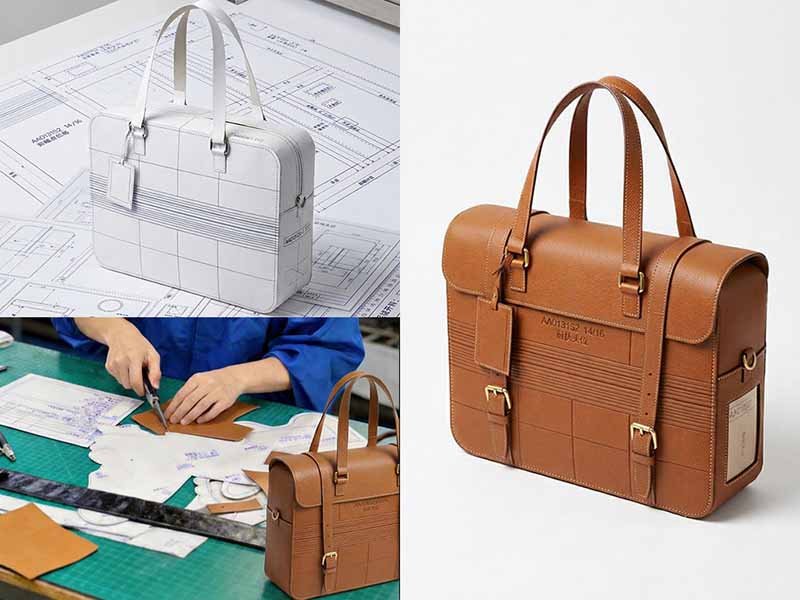
Custom leather goods are developed around a brand’s original product requirements rather than selected mainly from a finished catalog. The project may involve new dimensions, cutting patterns, structures, leather specifications, hardware, functions, and packaging. Full customization normally requires feasibility review, prototype development, revisions, production testing, and an approved reference sample before bulk manufacturing begins.
What Makes a Product Custom
A product becomes meaningfully custom when its important technical and visual characteristics are developed for a particular brand, customer group, or use case. Adding a logo to an existing wallet does not make its construction fully custom. Developing a new silhouette, opening method, pocket system, handle attachment, hardware component, reinforcement plan, or internal layout does.
Consider a leather work bag designed to carry a 16-inch laptop, documents, charging cables, a bottle, headphones, and travel accessories while remaining visually slim. The required contents influence the external dimensions, gusset depth, base reinforcement, zipper opening, pocket positions, weight distribution, handle strength, and shoulder strap attachment. These elements must be engineered as one connected product rather than selected independently.
Fully custom development may involve original product dimensions, new cutting patterns, special leather combinations, proprietary internal organization, custom-molded hardware, unique edge construction, specialized reinforcement, branded lining, original packaging, and market-specific testing. Each decision influences cost, lead time, production repeatability, and customer experience.
The strongest custom products do not add features merely to appear different. Every feature should improve usability, durability, brand recognition, retail value, or emotional appeal. Unnecessary construction increases leather consumption, labor time, defect risk, product weight, and sampling cycles without guaranteeing that the customer will notice or value the difference.
Experienced product developers normally focus on a limited number of signature elements. A recognizable handle shape, specific pocket arrangement, distinctive hardware profile, unusual closure, or consistent edge treatment may create more brand value than modifying every small component.
How Development Starts
A custom leather project can begin with a complete tech pack, but many successful projects start with less formal information. A manufacturer may receive a physical reference sample, annotated photographs, sketches, competitor products, material swatches, customer reviews, a target retail price, or a description of the situations in which the product will be used.
The first stage is not immediately producing a sample. It is clarifying the product requirement. The buyer and manufacturer must define the product category, expected load, dimensions, target customer, preferred leather, lining, hardware, opening method, internal organization, logo, quantity, packaging, quality level, target market, and required delivery date.
A practical development process normally includes requirement review, material assessment, preliminary costing, pattern development, first prototype construction, internal evaluation, customer review, pattern and material revisions, final sample approval, and pre-production specification confirmation. Complex products may require more than one complete prototype before the construction becomes suitable for repeat production.
The first sample should be treated as a working engineering model rather than a final sales sample. It may reveal that the strap stretches, the opening restricts access, the leather is too thick for a fold, the product becomes bulky when filled, or the hardware pulls the panel out of shape.
Discovering these issues during development is useful. They can be corrected with a revised pattern, different reinforcement, alternative leather thickness, adjusted hardware, or modified seam construction. Finding them after hundreds of units have been assembled is much more expensive.
Patterns and Production Samples
The cutting pattern is the technical foundation of a leather product. It controls the shape, dimensions, folds, seam allowances, reinforcement positions, component alignment, leather consumption, lining fit, zipper installation, edge length, and final product balance.
Small differences can create significant functional problems. A variation of only a few millimeters may affect whether a card pocket can be used comfortably, whether two leather edges align, whether a zipper lies flat, or whether a flap closes without tension. A handmade prototype may hide these issues because an experienced sample maker can make adjustments during assembly.
Bulk manufacturing requires a design that can be repeated by multiple operators using controlled methods. The final sample should confirm finished dimensions, tolerance limits, leather type, thickness, color, lining, reinforcement, hardware, thread, stitch length, edge treatment, logo position, functionality, packaging, and acceptable natural leather variation.
A physical approval sample should be supported by written records. Photographs cannot accurately communicate leather hand feel, thickness, surface firmness, edge hardness, hardware weight, zipper resistance, or the pressure required to operate a closure. Written specifications and approved material swatches reduce misunderstandings between the sample room, production team, quality inspectors, and buyer.
Before production begins, everyone should know which sample version is final. Any change to leather, dimensions, hardware, construction, or packaging should require a controlled update rather than an informal instruction that can be forgotten or misunderstood.
Design Ownership
Design ownership should be discussed before patterns, molds, and prototypes are developed. Paying for a sample does not automatically establish who owns the cutting pattern, technical drawing, hardware mold, artwork, or production knowledge used to create the finished product.
The agreement should separate the buyer’s intellectual property from the manufacturer’s general technical expertise. A brand may own its logo, artwork, original tech pack, proprietary silhouette, custom pocket layout, surface pattern, or specially designed buckle. The factory normally retains its general knowledge of stitching, reinforcement, folding, edge painting, skiving, lining, and ordinary product construction.
Important ownership terms include the use of drawings and tech packs, ownership of patterns and molds, storage of custom hardware, protection of unreleased products, showroom display rights, product photography, territory restrictions, channel exclusivity, and procedures for returning or destroying confidential samples.
Complete exclusivity can increase cost because the manufacturer loses the opportunity to reuse tools or development work. It may also require a purchasing commitment, minimum annual volume, or defined exclusivity period. A brand asking for worldwide permanent exclusivity on a common wallet structure may not receive a commercially realistic agreement.
The most workable approach is to identify specific proprietary elements that require protection. A distinctive buckle, protected artwork, original silhouette, or unique compartment system can be defined clearly, while ordinary manufacturing techniques remain part of the factory’s general capability.
How Do the Two Models Differ?
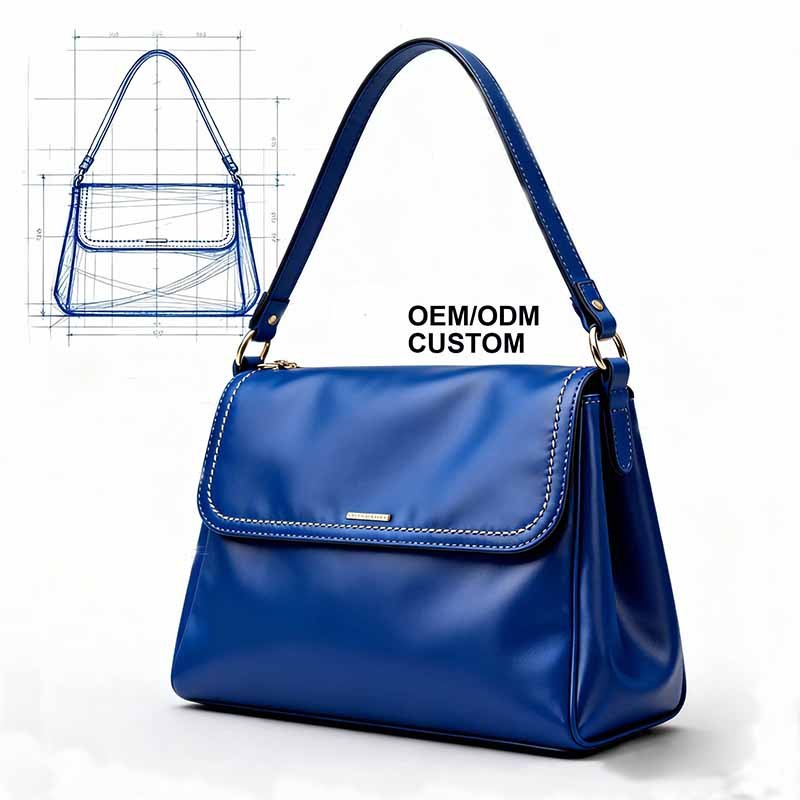
Private label and custom leather goods differ in their starting point, design control, technical workload, exclusivity, development risk, and speed to market. Private label usually adapts a proven product platform, while custom manufacturing develops around original requirements. The better option depends on what the brand must control and which risks its team is prepared to manage.
Starting Point and Control
A private-label project normally begins with a product the manufacturer has already developed or produced. The cutting pattern, material consumption, assembly sequence, sewing difficulty, hardware fit, and packing method may already be understood. The buyer can focus on selected changes rather than resolving every structural detail.
A custom project begins with requirements that have not yet been completely validated. Even when the buyer provides a physical sample, modifications to leather, size, structure, pockets, hardware, or intended use may require new patterns and prototypes. The number of open decisions is therefore significantly higher.
| Decision Area | Private Label | Custom Leather Goods |
|---|---|---|
| Base pattern | Existing or adapted | Newly developed |
| Product dimensions | Fixed or moderately adjustable | Controlled by the brand |
| Leather selection | Usually selected from available options | Standard, specially sourced, or custom developed |
| Internal structure | Limited to moderate changes | Fully configurable |
| Hardware | Standard or semi-custom | Standard, modified, or custom molded |
| Logo and packaging | Usually customizable | Integrated into the complete design |
| Technical input | Low to moderate | Moderate to high |
| Common sample rounds | Approximately 1–2 | Approximately 2–4 or more |
| Production history | Often established | Created during development |
| Launch speed | Usually faster | Usually longer |
More design control creates more responsibility. A buyer must approve dimensions, leather behavior, hardware, edge treatment, internal structure, workmanship, packaging, and tolerance standards. When these decisions are not documented clearly, full customization can become less controlled rather than more controlled.
Private label is not necessarily a compromise. It can be a disciplined decision to use an established structure where originality is not commercially important. Custom development is valuable when the product’s structure, function, and visual language are essential to the brand’s competitive position.
Product Differentiation
Private-label products can still appear highly distinctive. A coordinated combination of leather, color, hardware finish, edge paint, lining, stitching, logo treatment, packaging, and photography can create a strong identity even when the underlying structure is familiar.
This approach works well when customers choose the product because of brand trust, styling, retail presentation, gifting experience, price, availability, service, or community rather than proprietary product engineering. Many commercially successful leather accessories use established structures because customers already understand how those products should function.
Custom development provides more opportunity for structural differentiation. A brand can create recognizable proportions, closures, handles, pocket systems, hardware, stitching patterns, or edge details. These features can be repeated across bags, wallets, belts, pouches, and travel accessories to establish a consistent design language.
The commercial value of a custom feature should be tested carefully. A hidden construction change that increases unit cost by 12% or 15% but does not improve appearance, use, strength, or customer understanding may not support a higher selling price. A redesigned opening that makes a bag easier to pack can provide a clearer customer benefit.
Effective differentiation is usually visible, useful, memorable, or difficult to substitute. The goal is not to create the largest possible number of unique details. It is to select the details that make the product easier to recognize, easier to explain, and more valuable to the intended customer.
Exclusivity and Ownership
Private-label products frequently provide brand exclusivity without complete design exclusivity. The customer owns its logo, packaging, artwork, and brand identity, while the base product structure may remain available to other buyers.
A manufacturer may agree not to offer a specific combination of leather, hardware, lining, and packaging to a direct competitor. It may also reserve custom molds or product details for one buyer. These arrangements must be confirmed in writing because they are not automatically created by placing a private-label order.
Custom products normally provide a stronger basis for ownership, particularly when the buyer supplies original drawings or pays for unique patterns, molds, and hardware development. Nevertheless, a product containing common features such as card slots, zipper openings, rolled handles, or edge paint cannot realistically prevent all future products from using similar construction.
Practical exclusivity should focus on clearly identifiable elements, including a proprietary hardware shape, distinctive external silhouette, unique compartment system, protected surface artwork, specific material combination, or defined territory and sales channel.
Ownership should also include access to technical records. A brand may legally own a design but still face difficulty moving production if it does not have approved samples, measurements, component codes, mold information, packaging files, and quality standards. These records are important supply-chain assets.
Risk and Scalability
Private label reduces technical risk because the product has already been developed. Material usage, cutting requirements, hardware behavior, assembly methods, and packing are more predictable. Production operators may already understand the difficult steps, and the factory may have records from previous orders.
The main private-label risk is commercial similarity. If several brands use comparable products, the customer may have difficulty understanding why one version deserves a higher price. Branding, materials, packaging, service, and distribution must then create most of the differentiation.
Custom development changes the risk profile. It gives the brand more control but introduces unknowns related to weight, leather behavior, access, reinforcement, hardware balance, edge durability, assembly time, and manufacturing variation.
Scalability should be evaluated during sampling. A highly skilled sample maker may produce one beautiful prototype using slow adjustments and manual corrections that cannot be repeated efficiently in a 1,000-piece or 5,000-piece order. Production-ready designs require repeatable operations, available materials, clear tolerances, stable components, and measurable inspection standards.
The right question is not which model has fewer risks. It is which risks the business can manage. A seasonal retailer may prioritize predictable production, while a design-led brand may accept more development work because product originality supports its identity and pricing.
Which Model Is Right for Your Brand?
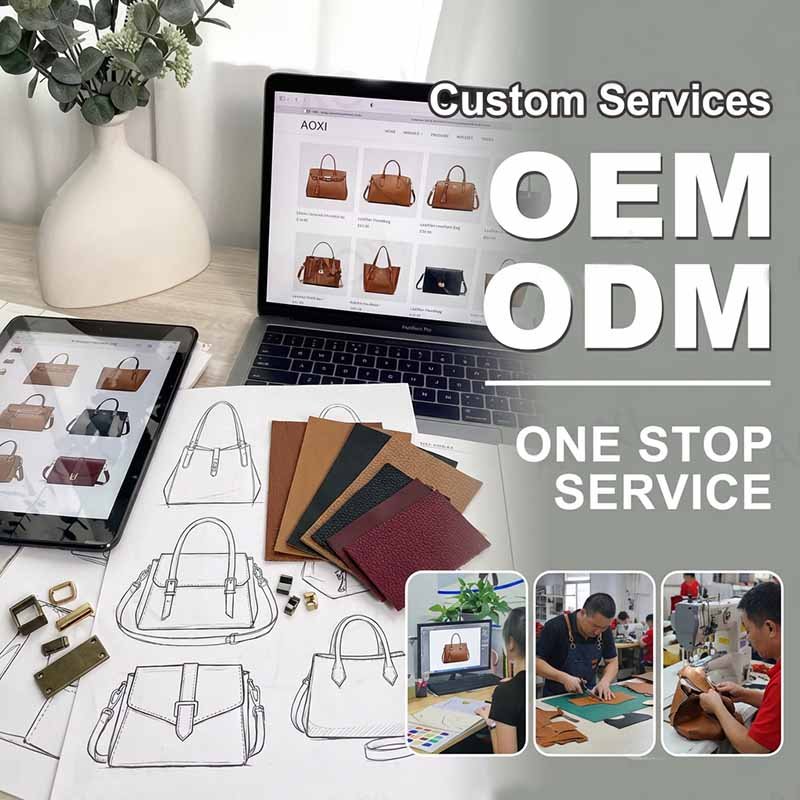
Private label is generally suitable for faster launches, controlled investment, market testing, and products where branding matters more than proprietary construction. Custom development is more suitable when original function, signature design, precise specifications, or exclusivity are central to the product. Many experienced companies combine both models within the same collection.
Faster Market Entry
Private label often provides the shortest route to a market-ready leather product because the basic pattern and construction have already been developed. The project can focus on the visible and commercially important details rather than solving the entire structure from the beginning.
This model is suitable for companies entering leather goods for the first time, adding accessories to an existing product line, preparing corporate gifts, testing a new sales channel, responding to a seasonal opportunity, or working with a fixed delivery date.
Speed still depends on customization. A catalog card holder using available leather and standard packaging may move through development relatively quickly. The same product can require substantially more time when it uses custom-dyed leather, a molded metal logo, printed lining, unusual edge paint, and a rigid gift box.
Private label works best when the selected base product already satisfies most functional requirements. When a buyer wants to change the dimensions, opening, pockets, strap, base construction, hardware, and leather thickness, the project is no longer a simple fast-launch program.
Reducing unnecessary changes is generally more reliable than asking a manufacturer to compress material sourcing, sampling, approvals, and production into an unrealistic schedule. Fast development still requires an approved sample and clear specifications.
Stronger Brand Identity
Custom development is usually the stronger choice when the product itself must communicate a recognizable brand position. This is common for premium handbags, specialist travel products, professional cases, luxury accessories, and leather goods designed around a specific user problem.
A custom product may use distinctive proportions, hardware, stitching, handle construction, pocket placement, edge details, or opening mechanisms. These elements can become recognizable across several SKUs and support a coherent product collection.
| Business Situation | Recommended Starting Model | Main Reason |
|---|---|---|
| First leather accessory launch | Private label | Lower development complexity |
| Corporate gift program | Private label | Branding is the main requirement |
| Seasonal retail collection | Private label | Faster product preparation |
| Signature premium handbag | Custom | Original design is central |
| Specialized travel organizer | Custom | Function determines the structure |
| Retail category test | Private label | Lower inventory and development risk |
| Established design-led brand | Custom | Greater control and exclusivity |
| Multi-price product range | Hybrid | Balances speed and originality |
Custom does not automatically mean premium. Leather quality, pattern accuracy, reinforcement, stitching, edge finishing, hardware, and production control still determine whether the product feels valuable.
A poorly resolved original design can be more expensive, heavier, more difficult to manufacture, and less convenient to use than a well-selected private-label product. Originality must be supported by disciplined product engineering.
New and Established Brands
A company entering leather goods for the first time may benefit from private label because it can learn what customers value before making a larger development investment. Sales data can reveal preferred colors, materials, sizes, price points, packaging formats, and product features.
The first production cycle also teaches practical lessons about natural leather variation, sample approval, packaging dimensions, inspection, international freight, inventory planning, and customer returns. These lessons can later support a more focused custom product.
Established brands may require greater control because they already have material standards, recognizable design details, packaging guidelines, testing requirements, retail calendars, and repeat-order expectations. Custom development can help new products fit an existing collection rather than appearing to come from an unrelated supplier catalog.
Company size alone does not determine the correct model. A major retailer may intentionally use private-label structures for basic accessories because speed, price architecture, and dependable replenishment matter most. A smaller design brand may need full customization because one distinctive product is the foundation of its business.
The choice should depend on the product’s role. Supporting accessories can often use proven structures, while flagship products may justify original patterns, custom hardware, and stronger intellectual-property protection.
Using a Hybrid Strategy
Many successful product collections combine private-label, semi-custom, and fully custom goods. This allows the brand to invest heavily where originality creates the greatest commercial return while using established structures for supporting products.
A travel brand might develop a proprietary leather weekender and matching backpack while adapting existing designs for passport covers, luggage tags, cable organizers, card cases, and small pouches. The hero products establish recognition, while the supporting accessories expand the collection, create gifting opportunities, and increase average order value.
A hybrid strategy can also be used over time. A company may launch a private-label product, gather customer reviews and return data, and then develop a custom second generation. Real customer information can guide changes to dimensions, pocket layout, leather, hardware, reinforcement, packaging, and price positioning.
The opposite route is also possible. A design-led brand may begin with one custom flagship item and later add simpler private-label accessories at more accessible prices.
Products developed through different models should still share a coordinated material palette, hardware finish, edge treatment, logo system, packaging language, photography style, and quality level. Customers should experience one consistent collection rather than an assortment of unrelated factory products.
How Do Cost, MOQ, and Lead Time Compare?
Private-label projects usually involve lower development cost, fewer prototype rounds, and shorter preparation because a base pattern already exists. Custom products require pattern work, material decisions, prototypes, revisions, and sometimes tooling. MOQ and lead time depend more on leather, colors, hardware, packaging, complexity, and order structure than on the manufacturing label alone.
Development and Unit Cost
Leather goods pricing includes much more than the amount of leather visible in the finished product. It reflects leather grade, usable cutting yield, labor time, construction complexity, lining, reinforcement, hardware, thread, edge finishing, logo application, packaging, inspection requirements, and order quantity.
Natural hides contain grain variation, scars, color differences, loose areas, and sections unsuitable for prominent panels. A product requiring large, clean front and back pieces may consume more usable hide than its dimensions suggest. Cutting yield can change significantly depending on leather quality, product shape, panel size, and the buyer’s acceptance standard.
Custom development may add one-time costs for pattern making, prototype construction, sample leather, hardware molds, logo dies, cutting dies, custom color development, printed lining setup, packaging prototypes, testing, additional revisions, and international courier delivery.
Brands should separate development cost, unit production cost, and total landed cost. Landed cost includes inspection, packaging, freight, duties, warehousing, and the financial effect of defects, delays, rework, or returns.
A quotation that appears 5% lower may not represent the lower-cost option when it uses thinner reinforcement, less suitable leather, lighter hardware, weaker edge treatment, or inadequate packaging. Quotations should be compared against the same technical specification rather than compared only by unit price.
MOQ is usually the combined result of several supply-chain minimums rather than a single arbitrary factory rule. The sewing facility may accept a relatively small production run, while the tannery, hardware supplier, lining printer, or packaging company requires a larger material order.
MOQ Drivers
| Project Factor | Lower-Complexity Situation | Higher-Complexity Effect |
|---|---|---|
| Leather color | Available or regularly produced colors | Custom colors may require larger material commitments |
| Hardware | Standard buckles, zippers, and snaps | Custom molds can require 500–2,000 or more components |
| Product colors | One or two colors simplify production | Several colors divide quantity and increase setup work |
| Logo method | Embossing has relatively low unit complexity | Custom metal logos require tooling and supplier minimums |
| Packaging | Standard bags or boxes are more flexible | Printed rigid boxes may require 500–1,000 or more units |
| Pattern | Existing construction reduces setup | New patterns require sampling and validation |
| Typical style quantity | Often 200–500 pieces | Special components may increase the effective MOQ |
These figures are practical planning references, not fixed industry rules. Actual minimums vary according to the manufacturer, leather supplier, hardware factory, packaging producer, product dimensions, color distribution, and long-term order potential.
Brands can sometimes reduce the commercial burden by using one leather across several related products, keeping the same hardware finish, limiting the first collection to one or two colors, or using standard packaging with product-specific labels.
The objective should not be the lowest possible MOQ. It should be a quantity that supports stable materials, efficient production, realistic pricing, manageable inventory, and consistent repeat orders.
Sampling Time
Private-label sampling is generally faster because the manufacturer already has the base pattern and understands the assembly method. A straightforward adaptation using available leather and standard hardware may require approximately one to three weeks, depending on workload and material availability.
A fully custom leather product commonly requires two to six weeks for the first development cycle. Complex bags, custom hardware, special leather colors, several internal functions, unusual reinforcement, or multiple materials may extend the schedule.
Revision time must also be included. A change to logo size or thread color may require only a partial sample or revised component. A structural change to dimensions, gusset, opening, handle, or pocket layout can require a new pattern and complete prototype.
Buyers frequently focus on factory timing while overlooking their own approval delays. A project may lose several weeks while teams debate colors, artwork, packaging, materials, or sample feedback. Every decision should have a responsible owner and an approval deadline.
Each sample round should have a defined purpose. The first prototype may test dimensions and structure. The second may confirm leather, hardware, and appearance. The final sample should establish the production standard. Consolidated feedback is more efficient than sending separate instructions over several days.
Production Lead Time
Bulk manufacturing begins after the final sample, material specification, quantities, colors, packaging, and commercial terms are approved. A production schedule cannot be considered reliable while these details remain open.
Straightforward private-label leather goods may require approximately 30–60 days for bulk production, while more complex custom programs may require around 45–90 days. These are general planning ranges rather than guaranteed timelines, and they can extend during peak seasons or when special leather, hardware, testing, or packaging is required.
Production timing normally includes leather and component purchasing, incoming inspection, cutting preparation, logo processing, sewing, assembly, edge painting, drying, in-line inspection, final inspection, packaging, and shipment preparation.
Edge finishing can require several applications, polishing stages, and drying periods. Custom-dyed leather may take longer than stocked colors. A molded buckle, branded zipper puller, or rigid gift box can become the critical path even when the leather item itself is not difficult to sew.
A complete launch schedule should include buyer approvals, freight, customs clearance, warehouse receiving, photography, retail preparation, and channel setup. The factory completion date is only one milestone in the wider commercial plan.
How Do You Choose the Right Manufacturer?
Choose a leather goods manufacturer by examining how clearly it defines services, evaluates materials, develops patterns, controls samples, documents specifications, manages quality, and supports repeat production. A reliable factory should explain what is standard, what can be changed, what requires new development, how MOQ is calculated, and how the approved sample will be reproduced during bulk manufacturing.
Service Clarity
A credible manufacturer should provide specific answers rather than relying on general claims such as “full customization,” “premium quality,” or “any design accepted.” These statements are easy to make and difficult to evaluate unless they are supported by a defined manufacturing process.
Buyers should ask whether the quotation is based on an existing pattern, a modified pattern, or a new development. They should confirm whether the leather is stocked, sourced from a regular tannery, or specially colored. Standard hardware should be separated from components that require custom tooling.
A useful quotation should define the product dimensions, leather category, thickness, lining, reinforcement, hardware finish, thread, edge treatment, logo process, packaging, sample fee, tooling, MOQ, production quantity, trade terms, lead time, inspection basis, and quote validity.
A supplier that cannot clearly define the product specification is unlikely to reproduce it consistently. Vague quotations also make price comparisons misleading because two suppliers may be pricing different leather grades, reinforcement methods, hardware weights, edge processes, or packaging standards.
Experienced manufacturers should also explain when a requested detail creates unnecessary cost, technical risk, or manufacturing difficulty. Constructive disagreement can be valuable when it is based on material behavior, production experience, and customer use rather than an attempt to simplify every project.
Sample and Material Control
Leather quality should be evaluated before cutting. Important factors include leather type, grade, thickness, surface finish, finish adhesion, color consistency, grain, hand feel, stretch, visible defects, and suitability for the intended construction.
The approved sample should become a measurable production standard rather than simply an attractive object. The manufacturer should record dimensions, leather, lining, reinforcement, hardware, thread, stitching, edge finish, logo position, function, packaging, and tolerance limits.
A strong pre-production process normally includes an approved leather swatch, confirmed hardware sample, final pattern version, approved production sample, measurement chart, workmanship requirements, packaging specification, and inspection criteria.
Natural leather does not look mechanically identical across every piece. A realistic quality standard distinguishes acceptable grain and shade variation from defects such as deep scars, severe loose grain, peeling finish, major color mismatch, cracked edges, skipped stitches, distorted panels, loose hardware, or contaminated surfaces.
Experienced leather goods teams also understand panel placement. The front panel of a premium handbag may require stricter grain selection than an internal reinforcement or hidden component. Quality control should reflect where the leather appears and how customers will handle the product.
Quality and Repeatability
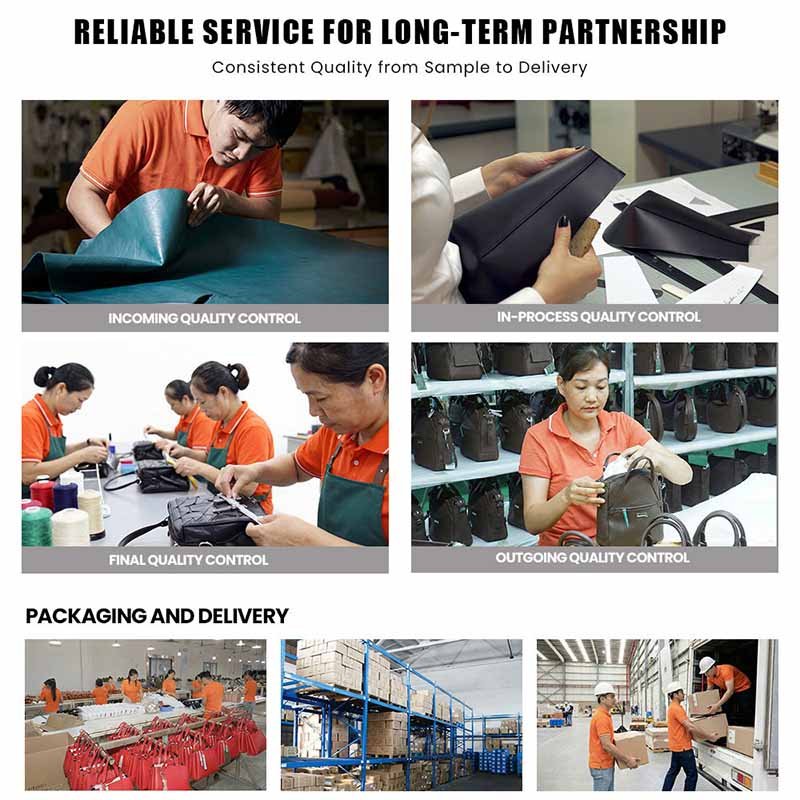
Quality control should cover the complete manufacturing process rather than relying only on inspection after the product has been assembled. A material or cutting problem is usually easier and less expensive to correct before stitching and edge finishing.
| Control Stage | Practical Inspection Focus |
|---|---|
| Incoming material | Leather type, thickness, shade, defects, hardware finish |
| Cutting | Grain direction, panel placement, dimensions, shade grouping |
| Logo processing | Size, position, pressure, color, adhesion |
| Sewing and assembly | Stitching, alignment, reinforcement, zipper operation |
| Edge finishing | Coverage, smoothness, adhesion, cracking |
| Semi-finished inspection | Shape, pocket location, component fit |
| Final inspection | Appearance, dimensions, function, cleanliness |
| Packaging | Protection, labels, quantities, carton strength |
| Shipment release | Inspection result, carton data, packing documents |
Repeatability becomes especially important during reorders. The manufacturer should retain patterns, approved samples, material codes, leather references, hardware specifications, packaging files, and quality records.
The first order demonstrates that a supplier can produce the product once. The second and third orders reveal whether the supplier can maintain consistency when leather batches, production workers, component suppliers, schedules, and quantities change.
Buyers should ask how revisions are recorded. An instruction discussed only through a chat message can be forgotten or interpreted differently by another department. Updated drawings, specification versions, signed samples, and written change records provide stronger control.
Preparing an RFQ
A detailed request for quotation allows a manufacturer to provide a more accurate feasibility review, MOQ, unit price, sample plan, and timeline. A short request for “a leather bag with our logo” forces the supplier to guess most of the project.
A useful RFQ should include product photographs, sketches, reference links, physical sample information, dimensions, intended use, target customer, preferred leather, colors, hardware finish, logo artwork, lining, internal structure, packaging, quantity by color, target market, testing needs, delivery country, launch date, and target price range when available.
Buyers should also identify which requirements are fixed and which are open to recommendations. The factory may be able to suggest a different leather thickness, reinforcement, zipper, edge process, or packaging method that improves manufacturability without weakening the design.
For long-term projects, buyers should ask how the manufacturer stores patterns, approved samples, component codes, packaging files, quality requirements, and revision history. These records are essential when the product is reordered several months later.
Szoneier has more than 18 years of experience supporting custom bags, leather goods, material sourcing, sampling, bulk production, quality inspection, packaging, and global delivery. Buyers can submit product images, physical samples, sketches, technical packs, leather preferences, logo files, quantities, packaging requirements, target markets, and delivery countries for an initial project evaluation.
Private label and custom leather goods are not opposing definitions of quality. They are different development tools. Private label helps brands reach the market faster by adapting proven products, while custom manufacturing provides greater control over function, appearance, ownership, and long-term product differentiation.
The most useful decision begins with a practical question: which product elements must be unique for customers to choose the brand, and which elements can remain standard without reducing customer value?
When market testing, predictable development, and controlled investment matter most, private label or semi-custom manufacturing may be the better commercial route. When the product itself must become recognizable, protectable, and difficult to replace, full custom development may justify the additional time, technical work, and investment.
To discuss a private-label leather accessory, a fully custom leather bag, or a coordinated leather goods collection, send Szoneier your product images, sketches, reference sample, tech pack, leather preferences, logo artwork, order quantity, packaging requirements, target market, and delivery country. The team can review the product structure, material options, customization scope, sampling plan, MOQ factors, quality requirements, production feasibility, and estimated delivery schedule before preparing a detailed quotation.