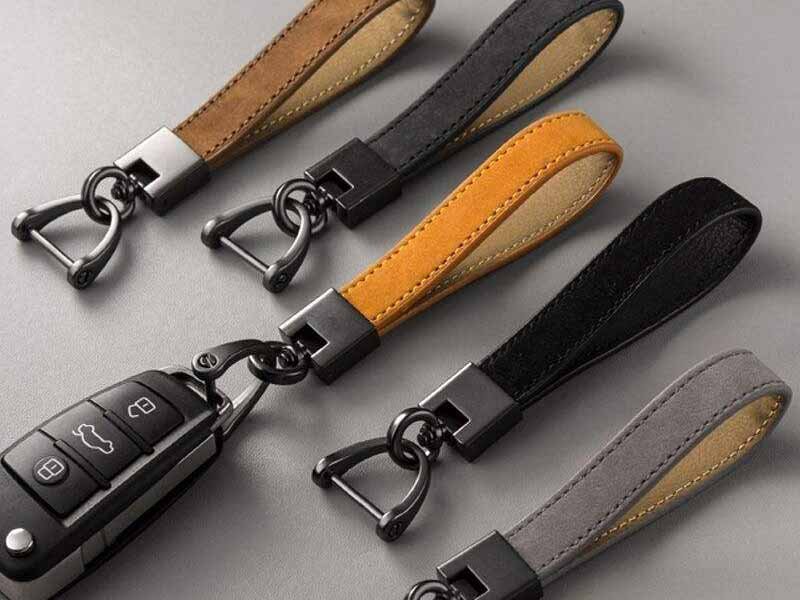
A leather key holder may occupy less space than a wallet, but its design has to manage several demanding functions at the same time. Keys have sharp teeth, uneven heads, different lengths, irregular holes, and hard metal surfaces. Car fobs are thicker, heavier, and often unsuitable for the same internal structure. Add daily pocket pressure, repeated opening, humidity, hand oils, and thousands of key rotations, and a simple-looking accessory quickly becomes a serious product-development project.
A compact leather key holder creates secure storage by controlling how keys are arranged, limiting uncontrolled metal movement, protecting nearby items, and allowing one key to be accessed without releasing the rest. The design must balance key capacity, total thickness, pivot tension, leather strength, hardware security, pocket comfort, and access speed. A smaller outside size alone does not guarantee better storage.
For sourcing teams and product developers, the most important question is not, “How small can the key holder be?” A more useful question is, “How much daily function can fit into a compact shape without creating inconvenience?”
A key holder may look elegant in a product photograph while remaining difficult to operate with one hand. Another may carry six keys but become too thick for a trouser pocket. A third may use beautiful leather but stretch around the screw post after several months.
Good compact design removes those failures before production begins. It starts with real keys, real hand movements, and real carrying conditions. The details hidden inside the product often determine whether customers use it every day or leave it in a drawer after one week.
What Is a Compact Leather Key Holder?
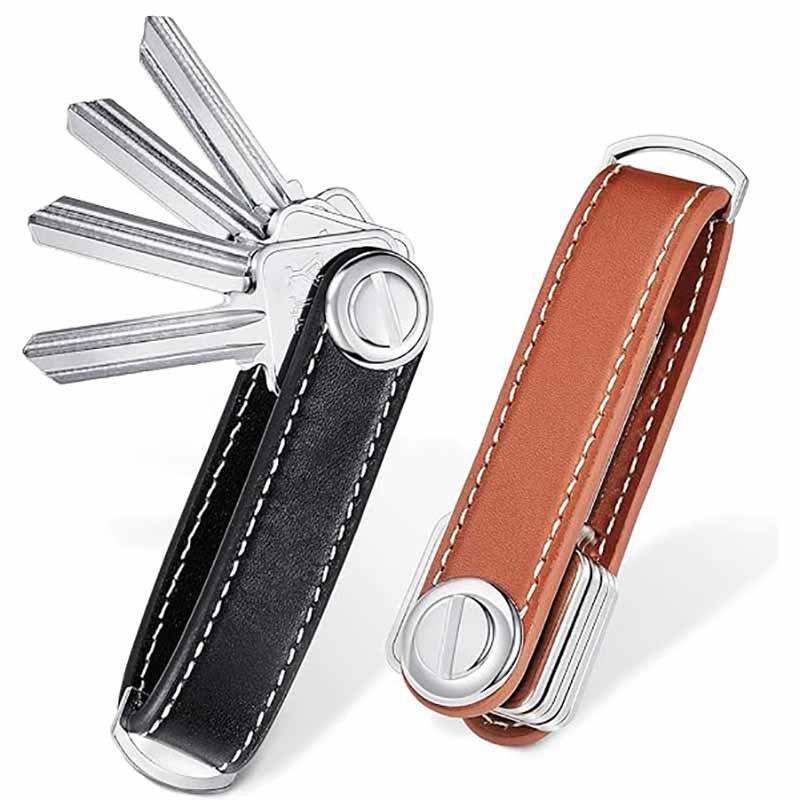
A compact leather key holder is a controlled storage system for keys, fobs, and small access items. It reduces loose movement, protects nearby belongings, and creates a more organized carrying shape. Depending on the structure, keys may rotate around a central post, hang from internal hooks, attach to detachable rings, or remain enclosed inside a zippered or snap-closure case.
What Problems Does It Solve?
Loose keys create more problems than noise alone. They move independently, spread across a bag, press against the body inside a pocket, and damage items stored nearby. A well-developed leather key holder addresses several of those problems at once.
Key noise is reduced by limiting how far metal parts can swing and strike each other. In a pivot organizer, keys remain in a controlled stack. In an enclosed case, leather surrounds most or all of the metal surfaces. Washers, spacers, and interior dividers can further reduce direct contact between key heads.
Scratch protection is another major reason customers choose a key case. Loose keys can damage:
- Mobile phone screens and camera lenses
- Eyeglass cases
- Coated wallets and card holders
- Painted car surfaces near the door handle
- Laptop shells and tablet covers
- Cosmetic packaging
- Bag linings
- Other leather accessories
The level of protection depends on how much of the key remains covered. A narrow folding organizer may cover the key teeth while leaving an external fob exposed. A zippered key pouch offers more complete separation but takes longer to open. Product claims should match the real coverage provided by the structure.
Pocket comfort also matters. Loose keys create several pressure points because each key sits at a different angle. A compact organizer aligns them into a more predictable shape. However, alignment does not automatically create comfort. Poorly positioned screws, large rings, thick folded edges, or protruding fobs can still create hard points.
A practical design review should examine the following areas:
| Daily Problem | Design Response | Detail to Check |
|---|---|---|
| Keys jingle while walking | Controlled stack or enclosed body | Movement between keys |
| Key teeth scratch other items | Leather coverage around metal edges | Exposed tip length |
| Keys are difficult to find | Fixed storage position | One-hand identification |
| Key set feels bulky | Shared pivot axis | Loaded thickness |
| Car fob pulls keys sideways | Separate fob attachment | Hanging balance |
| Key ring catches pocket lining | Rounded body and protected hardware | Sharp corners and burrs |
| Keys open accidentally | Controlled pivot tension or closure | Retention after repeated use |
| One key needs to be shared | Detachable ring or clip | Release security |
Good design should solve the problems customers actually experience rather than adding decorative features that make the product heavier or more complicated.
A useful development brief should identify the top three customer complaints before any material or hardware is selected. For example:
- “My keys scratch my phone.”
- “My key set is too noisy.”
- “The car fob makes everything bulky.”
- “I cannot find the correct key quickly.”
- “The key ring damages my pocket.”
- “I need to remove one office key every day.”
Each complaint points toward a different structure. Scratch protection may require fuller enclosure. Fast access may require an exposed pivot. Frequent key removal may require a detachable ring. Compact leather goods perform best when the problem is defined before the appearance is finalized.
Is It Better Than a Key Ring?
A leather key holder is often better than a split ring for controlled storage, reduced noise, improved pocket comfort, and surface protection. A conventional key ring remains useful when the key set changes frequently or includes many irregular objects.
Neither structure is perfect for every user. The decision should be based on key shape, access frequency, carrying position, and expected capacity.
| Comparison Area | Leather Key Holder | Standard Split Ring |
|---|---|---|
| Key movement | Controlled | Unrestricted |
| Noise level | Lower when properly fitted | Higher with several metal items |
| Scratch protection | Moderate to high | Very limited |
| Pocket shape | More organized | Irregular |
| Key capacity | Defined by structure | Easy to expand |
| Large fob compatibility | Usually requires external ring | Easy to attach |
| Key replacement | May require opening hardware | Simple but sometimes difficult |
| Appearance | Refined and coordinated | Functional and basic |
| Branding area | Leather surface supports logos | Limited |
| Product complexity | Higher | Low |
A folding leather organizer performs especially well with flat metal keys that share similar hole positions. House keys, office keys, mailbox keys, cabinet keys, and some padlock keys can often sit neatly around one pivot.
Problems appear when the product tries to store too many incompatible objects inside the same space. Thick plastic-headed keys, access tags, folding car keys, USB tools, bottle openers, and electronic fobs create uneven layers. The organizer may still close, but its shape becomes distorted.
A compact product should not be judged only by how many items can physically fit. It should also be judged by:
- Whether each key can rotate smoothly
- Whether the user can select one key without moving the others
- Whether the leather closes naturally
- Whether hardware pressure remains even
- Whether key teeth stay covered
- Whether the loaded product remains comfortable in a pocket
- Whether the shape returns after keys are removed
- Whether the post remains secure after repeated movement
For product developers, a split ring may be included as a secondary attachment rather than treated as a competing structure. The folding post can hold flat keys, while the ring carries a car fob or oversized key. Such a mixed system often provides a better daily result than forcing every item into a single stack.
Who Should Use One?
Compact leather key holders suit customers who carry a stable set of keys and value organization, reduced noise, pocket comfort, or a more polished appearance.
The strongest user groups are not defined by age or fashion preference alone. They are defined by carrying habits.
| User Group | Common Key Set | Main Requirement | Suitable Structure |
|---|---|---|---|
| Office commuter | Home, office, mailbox, car fob | Slim daily carry | Pivot organizer with fob ring |
| Property manager | Multiple room and cabinet keys | Fast identification | Hook case or detachable rings |
| Hotel staff | Room, service, storage keys | Quick access and durability | Reinforced hook system |
| Retail employee | Store, cabinet, locker keys | Secure retention | Snap-flap key case |
| Driver | Car fob plus one or two keys | Fob separation | Compact organizer with D-ring |
| Handbag user | Keys near phone and cosmetics | Full scratch protection | Zippered key pouch |
| Corporate gift customer | Two to four daily keys | Appearance and logo display | Debossed leather organizer |
| Travel user | Luggage lock and temporary keys | Easy removal | Detachable mini-ring system |
| Maintenance staff | Mixed keys and small tools | Capacity and strength | Reinforced multi-ring case |
| Premium accessory customer | Small stable key set | Material quality and detail | Full-grain leather organizer |
A product designed for office commuters should not copy the structure of a maintenance key case. Their carrying patterns are different.
An office commuter may care about:
- A slim profile in fitted trousers
- Quiet movement in shared working spaces
- A separate position for a car fob
- One-hand access to a building key
- A refined leather finish
- A small logo or monogram
A property or facility user may care about:
- Key identification
- Detachable groups
- Strong internal hooks
- Replaceable labels
- Reinforced stitching
- Higher pull resistance
- Fast key transfer between staff
A gift collection may focus on:
- Consistent leather grain
- Logo position
- Edge color
- Hardware finish
- Presentation box
- Personalization area
- Matching wallet or card holder
Trying to serve every user with one universal design usually weakens the product. A more effective range may include two or three related structures:
- A slim pivot organizer for daily flat keys
- A snap-closure key case with internal hooks
- A zippered key pouch for full protection
The materials, hardware color, logo method, and packaging can remain coordinated across the range. Customers then receive a clear choice without losing collection consistency.
Before sampling begins, product teams should define the intended customer in practical terms:
- Where will the key holder be carried?
- How many keys will be loaded?
- What is the longest key?
- Are the key heads flat or plastic-covered?
- Is a car fob included?
- How often will keys be removed?
- Is one-hand access important?
- Does full scratch protection matter?
- Will the product be sold individually or as a gift set?
- What retail price and quality level must the product support?
Clear answers reduce unnecessary revisions and help the factory select a structure that matches the intended use.
Which Storage Structure Works Best?
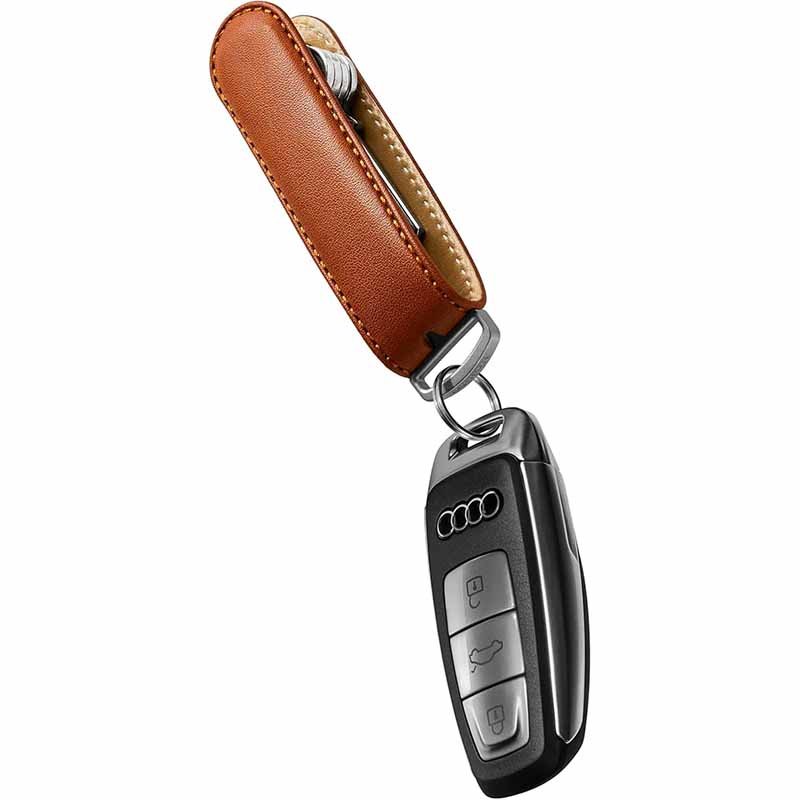
The best storage structure depends on the key set, daily access pattern, desired protection, and acceptable product thickness. Pivot organizers are well suited to flat keys. Hook cases improve visibility. Detachable rings support frequent removal. Zippered pouches provide fuller enclosure. Mixed structures often handle car fobs and irregular keys more effectively.
How Many Keys Should It Hold?
Key capacity should be based on comfortable use, not the highest number that can be squeezed onto a long post.
Every additional key changes:
- Total thickness
- Pivot friction
- Required post length
- Leather wrap angle
- Pressure around the fixing hole
- Weight
- Opening force
- Pocket comfort
- Closure alignment
A compact folding organizer generally works best when the capacity range is narrow and clearly defined. A product marked for two to six keys should remain functional at both ends of the range. A design that works well with six keys but leaves a loose, unstable post with two keys needs adjustment.
The loaded thickness can be estimated during development:
Loaded width is influenced by the combined thickness of the keys, spacing washers, leather layers, reinforcement, and hardware heads.
For example, a six-key organizer may contain:
- Six keys at approximately 2.0 to 2.5 mm each at the head
- Five spacing points between keys
- One or two outer washers
- Two leather walls
- One reinforcement layer near the post
- Exterior screw or cap heads
The measured result may be much thicker than the key count suggests. Key teeth are often thinner than key heads, so the side profile can also taper unevenly.
A practical capacity plan can be divided into three levels:
| Key Capacity | Product Direction | Main Advantages | Main Risks |
|---|---|---|---|
| 2–3 flat keys | Minimal organizer | Slim, light, easy to carry | Post may feel oversized when lightly loaded |
| 4–5 flat keys | Daily-use organizer | Good balance of function and size | Requires controlled spacing |
| 6–7 flat keys | Expanded organizer | Supports larger daily sets | Increased thickness and turning resistance |
| 8+ flat keys | High-capacity format | More storage | Reduced pocket comfort and higher leverage |
These ranges are development references rather than universal limits. Actual results depend on key-head thickness, washer design, post diameter, and leather construction.
Testing should cover three conditions:
Minimum load checks whether hardware remains secure with fewer keys.
Target load checks the configuration expected for most customers.
Maximum load checks whether the product still closes, rotates, and feels comfortable at the stated upper capacity.
The team should measure and record:
- Closed width
- Closed length
- Empty thickness
- Loaded thickness
- Total weight
- Key opening force
- Post movement
- Leather deformation
- Key-tip exposure
- Fob hanging angle
Capacity claims should be honest. A product may technically hold eight keys, but six may be the highest comfortable working capacity. Using the lower, realistic figure can reduce complaints and improve long-term satisfaction.
Which Layout Fits Flat Keys?
Flat keys usually fit best in a pivot layout because several keys can share one central axis. Each key rotates outward when needed and folds back into the leather body after use.
The pivot layout appears simple, but several dimensions must align:
- Key-hole diameter must fit the post
- Key shoulder must clear the leather edge
- Key head must not block neighboring keys
- Key teeth must remain covered when folded
- The leather body must provide enough grip
- The post must remain far enough from the edge
- The selected key must rotate without opening the full stack
A useful key-measurement sheet should include:
| Key Measurement | Why It Matters |
|---|---|
| Overall length | Determines leather body length |
| Head width | Affects organizer width |
| Head thickness | Affects loaded capacity |
| Hole diameter | Determines post compatibility |
| Hole position | Affects key alignment |
| Shoulder shape | Influences opening clearance |
| Tooth width | Influences coverage |
| Surface finish | Influences friction and marking |
The development team should avoid testing only one standard house key. A stronger sample evaluation uses a mixed set:
- One long door key
- One wide-headed office key
- One short mailbox key
- One narrow cabinet key
- One key with a small attachment hole
- One key with a slightly thicker head
Such a mixed set reveals interference problems much earlier.
Spacer selection also affects performance. Thin flat washers reduce direct metal contact but add width. Wave washers can help maintain tension. Polymer spacers may create smoother movement and reduce noise, but they need sufficient wear resistance. Metal washers feel more durable but may leave marks on soft or light-colored leather.
The sequence of keys matters as well. Wider keys may need to sit on the outside of the stack. Short keys may become difficult to grip when placed between two larger heads. Product instructions can recommend an assembly order, especially for adjustable organizers sold directly to consumers.
A well-developed pivot organizer should allow the customer to:
- Select one key with the thumb
- Rotate it without moving the full stack
- Hold the leather body as a handle
- Apply turning force without twisting the product
- Fold the key back without pinching the finger
- Keep unused keys enclosed during operation
The leather body should not be cut too narrowly. A very slim strip may look clean in photographs but provide poor grip at a stiff lock. A slightly wider hand-contact area often improves control with little impact on pocket size.
How Are Car Fobs Stored?
Car fobs are usually better stored outside the central key stack because they are thicker, heavier, and less geometrically consistent than flat keys.
Common attachment options include:
- Fixed D-ring
- Split ring
- Swivel snap hook
- Short leather loop
- Detachable mini-ring
- Screw-lock connector
- Spring clip
- Hidden loop under a flap
Each option changes the way the fob hangs.
A fixed D-ring provides a stable and clean appearance. It works well when the fob remains attached for long periods.
A swivel hook reduces twisting but adds more metal, weight, and movement.
A detachable ring helps when a driver regularly separates the car key from house keys.
A leather loop creates a softer appearance but requires reinforcement because the fob load pulls repeatedly at the fold and stitching.
The attachment point should be evaluated for both static and moving loads. A car fob may not be heavy, but walking, running, dropping, and pulling create repeated shock. The connection area can fail gradually even when the hardware itself remains intact.
During internal development, the factory may apply a pull load several times higher than the expected hanging weight to identify weak tabs, loose rivets, deformed rings, or stretching holes. Such internal testing is a product-development benchmark rather than a legal or certification requirement.
Important inspection points include:
- Distance between the ring hole and leather edge
- Reinforcement inside the attachment tab
- Rivet or screw diameter
- Stitching position
- Hardware opening gap
- Plating coverage
- Sharp edges
- Ring deformation
- Leather stretch after repeated pulling
- Balance when carried in a pocket
Fob position also affects pocket comfort. A bottom-mounted ring allows the fob to hang in line with the organizer. A side-mounted ring makes access faster but may create an uneven silhouette. A long chain increases flexibility while also increasing movement and noise.
The final structure should reflect how customers use modern car fobs. Many smart fobs stay inside a pocket or bag because the vehicle detects them automatically. For those users, secure retention and low movement may matter more than rapid removal.
Are Detachable Key Rings Useful?
Detachable key rings are valuable when one key must be removed often without taking apart the entire organizer.
Common situations include:
- Giving a valet key to another person
- Sharing an office or storage-room key
- Removing a bicycle key while riding
- Separating a luggage key during travel
- Handing over a property key
- Using one cabinet key several times per day
- Detaching a car key from house keys
- Moving an access key between staff members
The release system should match the removal frequency.
| Detachable System | Access Speed | Security Level | Suitable Use |
|---|---|---|---|
| Small split ring | Slow | High | Keys rarely removed |
| Spring snap hook | Fast | Medium | Daily removal |
| Screw-lock connector | Medium | High | Secure occasional removal |
| Bayonet fitting | Fast | Medium to high | Repeated daily access |
| Magnetic connector | Very fast | Depends on structure | Light-duty convenience |
| Leather tab with snap | Fast | Medium | Fashion-oriented key cases |
| Mini carabiner | Fast | Medium | Utility-focused products |
Fast-release hardware should not open under sideways pressure inside a bag. The action should be deliberate enough to prevent accidental release but simple enough for one-hand use.
A useful evaluation sequence includes:
- Straight pull
- Side pull
- Twisting
- Repeated opening
- Repeated closing
- Operation with one hand
- Operation with long fingernails
- Operation while wearing light gloves
- Pocket compression
- Drop testing with the key attached
Hardware edges must also be inspected carefully. A small burr can slowly cut a leather tab. A narrow contact area can concentrate load and stretch the attachment point. A spring clip can remain functional while its plating wears through at the hinge.
For a premium custom key holder, detachable hardware should feel integrated into the overall design. It should match the main hardware color, maintain the product’s proportions, and support the expected duty cycle.
SzoneierLeather can review key capacity, intended customer use, fob type, removal frequency, leather structure, and packaging requirements before sample development. Such review helps determine whether a pivot organizer, hook case, detachable-ring system, zippered pouch, or mixed structure offers the strongest result for the planned collection.
How Do Materials Affect the Design?
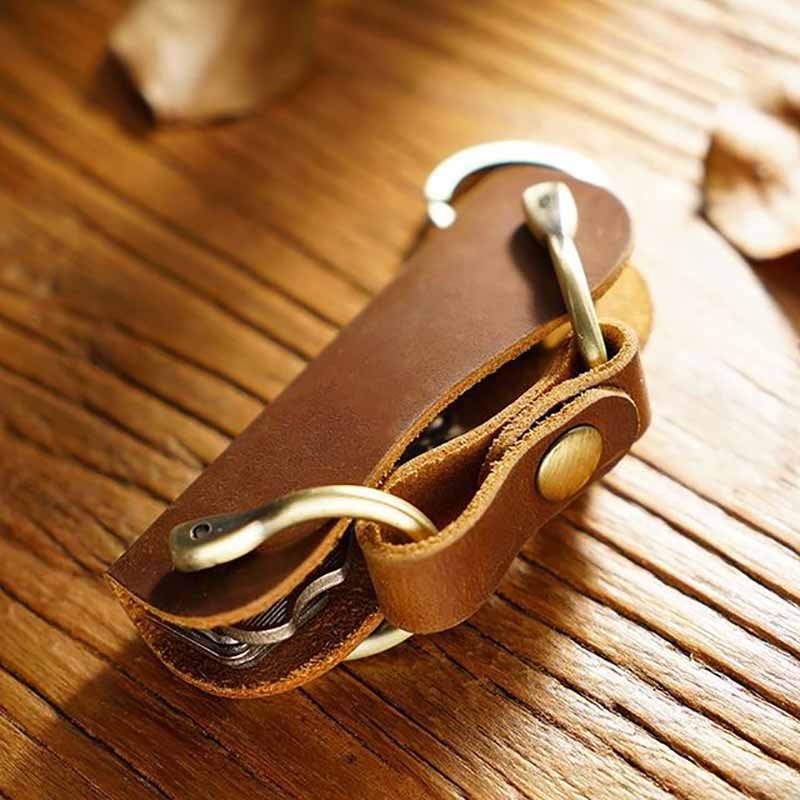
Materials affect almost every part of a leather key holder, including its thickness, flexibility, durability, appearance, hardware stability, edge quality, and long-term shape. Leather type alone is not enough to determine suitability. The factory must also evaluate temper, fiber density, stretch, surface finish, thickness consistency, colorfastness, and folding performance under repeated use.
A leather that looks attractive as a flat swatch may behave very differently after it is folded around six metal keys. It may stretch near the post, wrinkle around the closure, show pressure marks from the hardware, or become too soft to hold its shape.
For this reason, material selection should begin with the intended construction and customer use rather than with color alone.
A slim pivot organizer, a zippered key pouch, and a structured hook case may all use leather, but they require different material behavior.
A pivot organizer needs enough firmness to support the post and hold the key stack in a controlled shape.
A zippered pouch needs better flexibility around the zipper curve and enough softness to open comfortably.
A structured hook case may require a layered construction so the case remains flat and neat even when several keys are hanging inside.
Which Leather Is Best?
There is no single best leather for every key holder. The most suitable choice depends on the desired appearance, retail position, construction, handling feel, and expected wear.
The main leather options include:
- Full-grain cow leather
- Top-grain cow leather
- Corrected-grain leather
- Vegetable-tanned leather
- Chrome-tanned leather
- Combination-tanned leather
- Nappa leather
- Pull-up leather
- Split leather with coating
- Suede or nubuck for selected decorative areas
Each option creates a different result.
Full-grain leather is often chosen for premium key holders because it retains the natural grain surface. It can develop visible character as it ages, especially when used with oil, wax, or aniline finishes. However, natural grain variation means the cutting standard must be clearly defined. Marks, pores, grain difference, and color variation may be acceptable within a natural leather range, but customers should approve this appearance before production.
Top-grain leather provides a more controlled surface. It can offer cleaner color consistency and is easier to use for collections that require a uniform retail presentation. It is suitable for debossed logos, foil logos, and smooth edge finishing.
Vegetable-tanned leather is often firmer and works well for structured key organizers. It can hold a clean shape and usually responds well to burnished edges, embossing, and natural aging. The main concerns are stiffness, water spotting, color variation, and possible cracking if the folding zone is too sharp or the leather is too dry.
Chrome-tanned leather is generally softer and more flexible. It works well for pouch-style key cases, softer key wallets, and folded constructions. It can also provide a wider color range. However, very soft leather may need backing or reinforcement near the post, snap, or ring attachment.
Nappa leather offers a soft and refined hand feel. It suits gift products and coordinated small-leather-goods collections, but it is not always strong enough as a single unsupported layer. A thin Nappa outer layer may be combined with a microfiber, textile, or leather reinforcement.
Pull-up leather gives a more casual and natural appearance. When the leather bends, oils and waxes move within the surface, creating lighter color changes. This can make the product feel more distinctive, but the development team should confirm that the customer accepts visible tone changes and surface marks.
The selection process should evaluate more than the leather name.
| Leather Property | Why It Matters | Possible Risk |
|---|---|---|
| Temper | Controls firmness and folding behavior | Too soft may collapse |
| Fiber density | Supports hardware and stitching | Loose fibers may stretch |
| Surface finish | Affects scratch resistance and appearance | Heavy coating may crack |
| Thickness consistency | Controls assembly and closure | Variation changes loaded size |
| Colorfastness | Reduces transfer to pockets and hands | Dark colors may rub off |
| Water resistance | Supports daily carrying conditions | Untreated leather may stain |
| Flex resistance | Affects folds and repeated opening | Finish may crack |
| Edge quality | Influences burnishing or edge paint | Loose fibers create rough edges |
| Grain consistency | Affects visual uniformity | Large variation can reduce yield |
| Adhesive compatibility | Matters in laminated structures | Poor bonding causes separation |
For custom development, the best material is the leather that performs correctly after cutting, folding, stitching, hardware installation, loading, and repeated use.
How Should Leather Temper Be Selected?
Temper describes how firm or soft the leather feels and how strongly it holds its shape.
A firm temper works well when the key holder must remain flat and structured. It can improve the visual shape of a pivot organizer and reduce twisting around the post. However, overly firm leather may feel uncomfortable in a pocket and may resist folding around a thick key stack.
A medium temper is often a practical choice for daily-use organizers. It provides enough support while still allowing the leather to flex during opening and closing.
A soft temper creates a comfortable hand feel and can suit a pouch or wrap-style product. However, soft leather may show the outline of keys more clearly and can stretch under hardware pressure.
The temper should be tested in the final thickness. A 1.2 mm firm leather may behave more rigidly than a 1.8 mm soft leather.
Developers should also examine how the leather changes after use. Some materials soften quickly during the first few weeks. Others remain stiff for a long time. A product that feels perfect when new may become too loose after repeated handling if the leather relaxes significantly.
A practical evaluation can include:
- Initial bending resistance
- Fold recovery
- Shape retention after loading
- Post-hole stretch
- Surface wrinkling
- Edge distortion
- Hand feel after repeated flexing
- Change after exposure to heat and humidity
- Change after hand oil contact
- Shape after keys are removed
The approved leather should be tested under the same construction as the final product.
How Thick Should the Leather Be?
Leather thickness has a direct effect on pocket comfort, durability, appearance, and hardware support.
A thicker leather is not automatically better. It may provide strength, but it can also make the product bulky, stiff, and difficult to close. Thin leather creates a cleaner profile but may stretch or tear if it is not reinforced properly.
For many compact leather key holders, the outer leather may begin within the following development ranges:
| Construction Type | Outer Leather Range | Additional Support |
|---|---|---|
| Single-layer pivot organizer | 1.3–1.8 mm | Local reinforcement if needed |
| Double-layer pivot organizer | 0.8–1.2 mm per layer | Adhesive and edge finishing |
| Soft lined key wallet | 0.9–1.3 mm | 0.5–0.8 mm lining |
| Structured hook case | 0.9–1.4 mm | Board, microfiber, or leather support |
| Zippered key pouch | 0.8–1.2 mm | Textile or microfiber lining |
| Heavy-duty utility key case | 1.4–2.0 mm | Reinforced ring and hook areas |
These values are starting references. The final choice depends on temper, fiber density, seam construction, edge method, and key capacity.
A double-layer structure can look more refined because both the outside and inside surfaces are finished. It also allows reinforcement to be hidden between layers. However, the total build-up near folded edges can become much thicker than expected.
For example, a two-layer organizer may contain:
- 1.0 mm outer leather
- 0.8 mm inner leather
- Adhesive layer
- Reinforcement patch
- Folded edge or edge paint
- Metal washer
- Fastener head
At the post area, the combined thickness may exceed the visual estimate made from a flat material sample.
Thickness should be measured at several points because natural leather is not perfectly uniform. A specification may allow a controlled tolerance, such as ±0.1 mm or ±0.2 mm, depending on the leather type and construction.
The factory should also confirm whether the leather will be split to a precise thickness before cutting. Splitting improves consistency, especially for lined or laminated products.
Which Areas Need Reinforcement?
Not every part of a key holder needs the same strength.
The highest-stress areas are usually:
- Pivot post holes
- Snap installation points
- D-ring tabs
- Hook attachment panels
- Zipper ends
- Detachable ring tabs
- Handle or strap connections
- Fold lines
- Thin corners near hardware
- Logo badge attachment points
Reinforcement can be added with:
- Thin leather patches
- Microfiber support
- Non-woven backing
- Woven textile
- Synthetic fiber sheets
- Thin plastic support
- Metal washers
- Folded leather tabs
- Double stitching
- Wider hardware bases
The reinforcement should spread the load over a larger area. It should not create a hard edge that becomes visible on the outside.
A local patch near the screw post can reduce stretching. A woven textile insert can improve tear resistance while adding little thickness. A folded leather tab can strengthen a ring attachment, but the fold must remain smooth and properly bonded.
The reinforcement material must also be compatible with the adhesive, leather finish, and production process. Some supports shrink under heat. Others absorb too much adhesive or create visible surface marks.
A strong product often looks simple because reinforcement is hidden inside the construction.
Which Hardware Is More Secure?
Hardware security depends on the material, shape, installation method, fit, and interaction with the leather.
Common hardware includes:
- Screw posts
- Chicago screws
- Riveted pivot systems
- Snap fasteners
- Split rings
- D-rings
- Swivel hooks
- Spring clips
- Internal key hooks
- Magnetic connectors
- Threaded connectors
- Decorative metal badges
For pivot organizers, screw-post systems are widely used because customers can add or remove keys. The post must be long enough for the intended load but not so long that the keys remain loose.
A secure post system may include:
- Male and female screw parts
- Flat washer
- Wave washer
- Polymer spacer
- Thread-locking patch
- Recessed screw head
- Tool-assisted tightening
- Tool-free tension control
The product team should decide whether the customer is expected to adjust the post.
A tool-free system is convenient but may require more complex hardware and tighter tolerances.
A standard screw system is simpler but should include clear assembly instructions.
A post that loosens during key rotation creates a serious risk. The fastener may fall apart, causing keys to be lost.
The team should test:
- Initial tightening
- Rotation under load
- Vibration
- Repeated opening
- Side pressure
- Drop impact
- Temperature change
- Sweat exposure
- Corrosion resistance
- Final removal torque
For ring attachments, the concern is different. The ring must resist opening and deformation.
A split ring should have:
- Consistent spring tension
- Smooth edges
- Closed coil alignment
- Controlled wire diameter
- No plating cracks
- No sharp opening point
A D-ring should be checked for:
- Weld quality
- Shape consistency
- Surface smoothness
- Opening gap
- Plating coverage
- Pull strength
- Compatibility with the leather tab
Internal key hooks require close attention because they can release keys if the spring or closing shape is weak.
Which Hardware Material Should Be Used?
Hardware material affects strength, weight, corrosion resistance, cost, and appearance.
| Hardware Material | Advantages | Main Concerns |
|---|---|---|
| Stainless steel | Strong, corrosion resistant | Higher cost and weight |
| Solid brass | Premium appearance, durable | Can oxidize and darken |
| Zinc alloy | Flexible shapes, cost-efficient | Strength depends on design |
| Aluminum | Lightweight | Lower strength for some parts |
| Iron or steel | Strong and economical | Requires reliable plating |
| Plastic engineering parts | Lightweight, quiet | Appearance and aging must be checked |
Solid brass hardware can work well with vegetable-tanned and heritage-style leather. Stainless steel suits modern or technical designs. Zinc alloy is useful for custom-shaped logos and hooks, but thin sections should be avoided.
Plating options may include:
- Nickel
- Black nickel
- Gunmetal
- Antique brass
- Light gold
- Rose gold
- Matte silver
- Matte black
- Electrophoretic coating
- Painted finish
The selected finish should match the expected use. Dark plating may show wear at friction points. Light-colored plating may reveal scratches more quickly. Antique finishes may vary slightly between production lots.
The product specification should include an approved hardware sample rather than only a color name.
How Should Hardware Finish Be Tested?
Hardware finish is exposed to hand oils, sweat, friction, moisture, and contact with keys.
A practical internal test program may include:
- Dry cloth rubbing
- Wet cloth rubbing
- Artificial sweat exposure
- Salt spray testing where required
- Repeated ring movement
- Key-to-hardware friction
- Adhesive tape test
- Drop testing
- Humidity exposure
- Visual comparison after cycles
The test level should match the market and price position.
A corporate gift product may require strong visual consistency across a large order.
A premium retail accessory may require stricter surface inspection.
A utility key case may accept minor surface wear but needs stronger mechanical performance.
The factory and customer should agree on acceptable appearance standards before production.
Do Linings Improve Protection?
Linings can improve appearance, durability, interior cleanliness, and structural control. They are useful when the leather flesh side is rough, when reinforcement needs to be hidden, or when the inner surface will be highly visible.
Common lining options include:
- Thin leather
- Microfiber leather
- Polyester fabric
- Cotton twill
- Suede-like microfiber
- Nylon fabric
- Non-woven material
- Synthetic woven support
A leather lining creates a refined interior and supports premium positioning. However, it adds cost and thickness.
Microfiber lining provides a smooth surface and can help control stretch.
Textile lining works well in zippered pouches and larger key wallets because it reduces bulk.
A soft suede-like lining can protect polished keys or small electronic items, but it may trap dust.
The decision should be based on function.
A single-layer pivot organizer may not need a lining if the leather flesh side is clean and sealed.
A key wallet with internal hooks may benefit from lining because the interior is opened frequently.
A zippered pouch often needs lining to cover seams and protect the inside surface from key teeth.
How Should Linings Be Constructed?
A lining must move with the outer leather. Poor construction can cause bubbling, wrinkling, delamination, and edge distortion.
Important points include:
- Adhesive coverage
- Drying time
- Lamination pressure
- Material grain direction
- Fold allowance
- Edge trimming
- Stitching distance
- Heat resistance
- Moisture resistance
- Compatibility with edge paint
The lining should not be stretched during bonding. Stretching can cause the finished product to curl after the adhesive relaxes.
At folds, the inner layer may need to be shorter than the outer layer to prevent wrinkling.
Around the post hole, the lining should be cleanly punched and fully bonded.
At zipper openings, the lining must not interfere with the slider.
The development team should inspect the product both empty and loaded. Some lining problems appear only when the key holder is folded around keys.
How Is Compact Access Designed?
Compact access means the user can identify, open, use, and return the correct key with minimal effort. Good access design reduces wasted movement without weakening security.
A product can be visually compact but functionally inconvenient.
Common access problems include:
- Keys are too tightly packed
- The correct key is difficult to identify
- Short keys disappear between larger keys
- The closure blocks the key path
- The post is too tight
- The key teeth remain exposed
- The user needs both hands
- The leather twists while turning a lock
- The fob blocks access
- Keys open accidentally inside the pocket
The design team should study the complete movement, from carrying to unlocking.
How Do Folding Keys Work?
Folding keys rotate around a shared post. When closed, the keys sit inside or between the leather walls. When needed, one key rotates outward and the leather body acts as a handle.
For smooth operation, the pivot system must maintain balanced friction.
The required friction should be high enough to keep unused keys closed but low enough for one-handed opening.
If the pivot is too loose:
- Keys swing out while walking
- The stack feels unstable
- The post may continue loosening
- Metal surfaces strike each other
- Key tips may become exposed
If the pivot is too tight:
- The user needs two hands
- Keys scratch each other
- Washers deform
- Leather compresses around the post
- Short keys become difficult to select
The correct tension depends on:
- Key count
- Key-head thickness
- Washer type
- Post diameter
- Post material
- Leather compression
- Reinforcement
- Surface friction
- Assembly torque
The pivot should be tested after repeated use because leather compresses slightly around the hardware.
A sample that feels tight on the first day may become comfortable after several hundred movements. A sample that already feels loose when new may become unstable quickly.
How Should Key Spacing Be Designed?
Spacing allows each key to move independently.
Without enough spacing, keys rub against each other and can move as a group.
With too much spacing, the organizer becomes thick and loose.
Common spacing methods include:
- Flat metal washers
- Wave washers
- Polymer washers
- Nylon spacers
- Thin leather separators
- Molded internal guides
- Staggered key positions
Flat washers create consistent separation.
Wave washers help maintain tension by applying spring pressure.
Polymer washers can reduce noise and friction.
Leather separators create a softer appearance but may wear or compress.
The ideal system may combine one wave washer for tension with flat spacers between selected keys.
The development team should not assume all keys need equal spacing. A thick key head may require more room than a thin key.
A short key may need a spacer to keep its head accessible.
How Can Users Identify the Correct Key?
Identification is often overlooked in minimalist designs.
When all keys are stacked tightly, the user may have difficulty selecting the right one.
Several design solutions can improve identification:
- Staggered key positions
- Colored washers
- Numbered spacers
- Small leather tabs
- Engraved labels
- Different key orientation
- External index marks
- Separate key groups
- Clear internal hook order
Colored washers can help users remember key positions, but the colors should remain visible after assembly.
Engraved labels work well for professional or property use.
A hook case allows keys to hang separately, making identification easier than in a pivot stack.
For retail products, instructions may recommend an assembly order. The most-used key can be placed on the outside for faster access.
Which Closure Is Easier to Use?
Closure choice affects access speed, protection, product thickness, and appearance.
The main options include:
- No secondary closure
- Snap button
- Magnetic closure
- Zipper
- Hook-and-loop tape
- Elastic loop
- Leather strap
- Turn lock
- Push lock
- Fold-over flap
A pivot organizer usually relies on post tension and does not need another closure.
A hook case often uses a snap or zipper.
A key wallet may use two snaps so it can close at different capacities.
A zippered pouch provides strong enclosure but requires more hand movement.
| Closure Type | Access Speed | Protection | Thickness | Main Concern |
|---|---|---|---|---|
| No closure | Fastest | Moderate | Low | Depends on pivot security |
| Snap | Fast | Good | Medium | Alignment and wear |
| Magnet | Fast | Good | Medium | Strength and placement |
| Zipper | Slower | High | Higher | Slider and corner quality |
| Elastic loop | Fast | Moderate | Low | Elastic aging |
| Leather strap | Medium | Good | Medium | Stretch and handling |
| Turn lock | Medium | High | Higher | Added hardware weight |
A snap should open with deliberate pressure but should not require excessive force.
A weak snap may open inside a bag.
A strong snap may distort the leather or become difficult for some users.
Magnetic closures create a smooth action, but the magnets need secure internal installation. The team should also confirm suitability for the intended contents and accessories.
Zippers need careful corner design. Tight curves can make the slider difficult to operate.
How Should One-Hand Access Be Tested?
One-hand access should be evaluated under real conditions rather than on a clean worktable.
The user may be:
- Standing at a door
- Carrying a shopping bag
- Holding a phone
- Wearing gloves
- Sitting in a car
- Walking in low light
- Using the product with wet hands
- Reaching into a crowded bag
A practical one-hand test may include:
- Remove the key holder from a pocket.
- Identify the correct key by touch.
- Open the key or closure.
- Hold the product securely.
- Insert the key into the lock.
- Turn the lock.
- Fold or return the key.
- Put the key holder away.
The team should record where the movement becomes slow or awkward.
For example:
- The snap requires two hands.
- The short key is hidden.
- The leather body is too narrow to grip.
- The fob strikes the hand.
- The key cannot rotate fully.
- The post head catches the finger.
- The product twists under lock resistance.
Small design changes can improve the sequence significantly.
How Is Grip Designed?
The leather body often becomes the handle when the key is in use.
The grip area must be wide and firm enough to transfer turning force.
A very narrow organizer can rotate in the hand.
A very soft organizer can fold under pressure.
A very short body may not provide enough leverage.
Grip design depends on:
- Body width
- Leather temper
- Edge shape
- Surface texture
- Key length
- Lock resistance
- User hand size
- Key position
Rounded edges usually feel more comfortable.
A lightly textured leather can improve grip.
A very smooth coated leather may feel slippery with wet hands.
The prototype should be tested with both easy and stiff locks.
How Are Noise and Scratches Reduced?
Noise reduction comes from controlling movement, reducing metal contact, and covering exposed surfaces.
The main sources of noise are:
- Keys hitting each other
- Keys hitting the post
- Fob hitting the ring
- Ring hitting the hardware body
- External accessories swinging
- Loose internal hooks
- Zipper pullers striking metal parts
Noise can be reduced by:
- Tightening key spacing
- Using polymer washers
- Shortening external chains
- Adding leather ring tabs
- Using covered zipper pullers
- Separating fobs from keys
- Adding soft internal dividers
- Controlling hook movement
- Improving closure fit
Scratch protection depends on the amount of coverage.
A pivot organizer protects the sides and teeth of flat keys when properly sized.
A snap key case covers more of the key set.
A zippered pouch provides the highest level of enclosure.
However, no design should claim complete protection if metal parts remain exposed.
The development team should inspect:
- Key-tip exposure
- External ring position
- Post-head protrusion
- Zipper pull movement
- Fob contact
- Hardware corners
- Interior rivet heads
- Metal badge edges
How Should Scratch Resistance Be Tested?
A practical internal test can simulate daily carrying.
The loaded key holder can be placed with sample surfaces such as:
- Coated metal panel
- Acrylic panel
- Phone-screen protector
- Painted plastic
- Leather swatch
- Bag-lining fabric
The items can then be moved repeatedly inside a test pouch or container.
After testing, inspect for:
- Visible scratches
- Pressure marks
- Color transfer
- Finish abrasion
- Exposed key contact
- Hardware damage
- Leather surface wear
This test does not replace formal laboratory testing where required. It helps identify obvious design weaknesses before production.
Do Different Key Shapes Fit?
Different key shapes require different storage solutions.
Standard flat keys usually fit a pivot post.
Plastic-headed keys may need an external ring.
Tubular keys often require a separate attachment.
Electronic access tags are usually too thick for the main stack.
Folding car keys need their own position.
Small cabinet keys may become difficult to grip.
Keys with very small holes may need adapters.
The product specification should define compatibility clearly.
Useful information may include:
- Maximum key length
- Maximum key-head width
- Recommended key-head thickness
- Minimum hole diameter
- Compatible key count
- External fob capacity
- Suggested washer sequence
- Recommended key order
| Key Type | Pivot Stack | Hook Case | External Ring | Zippered Pouch |
|---|---|---|---|---|
| Standard flat key | Excellent | Good | Good | Good |
| Plastic-headed key | Limited | Good | Excellent | Good |
| Car fob | Poor | Limited | Excellent | Excellent |
| Tubular key | Poor | Good | Good | Excellent |
| Access tag | Poor | Good | Excellent | Excellent |
| Short cabinet key | Good with spacer | Excellent | Good | Good |
| Folding vehicle key | Poor | Limited | Excellent | Excellent |
Compatibility claims should be based on physical samples.
How Can Adapters Improve Compatibility?
Adapters allow unusual keys to connect to a standard post or ring.
Possible adapter formats include:
- Slim metal eyelet plates
- Small leather loops
- Wire loops
- Mini split rings
- Polymer key-hole adapters
- Screw-on tabs
- Detachable clips
An adapter should not create more bulk than the key itself.
It should also resist twisting and repeated pulling.
The connection point must remain smooth to avoid damaging the leather.
For a product sold with adapters, the package should include clear installation guidance.
Should Tracker Storage Be Added?
Tracker storage can be useful for customers who want to locate lost keys.
The tracker may be attached through:
- External leather sleeve
- Hidden pocket
- Snap tab
- Ring attachment
- Integrated molded holder
- Detachable pouch
An external sleeve is easy to update if tracker dimensions change.
A hidden pocket creates a cleaner appearance but adds thickness.
An integrated holder provides a precise fit but may become outdated when electronic products change.
The design should consider:
- Tracker diameter
- Tracker thickness
- Signal exposure
- Battery access
- Removal method
- Added weight
- Pocket balance
- Compatibility with future versions
A detachable tracker holder often provides better long-term flexibility for custom collections.
SzoneierLeather can combine leather selection, thickness control, reinforcement, hardware development, lining construction, access testing, fob storage, tracker integration, and packaging into one coordinated sampling process. The goal is to develop a key holder that remains compact after it is fully loaded, not only while it is empty.
How Do Brands Develop Custom Key Holders?
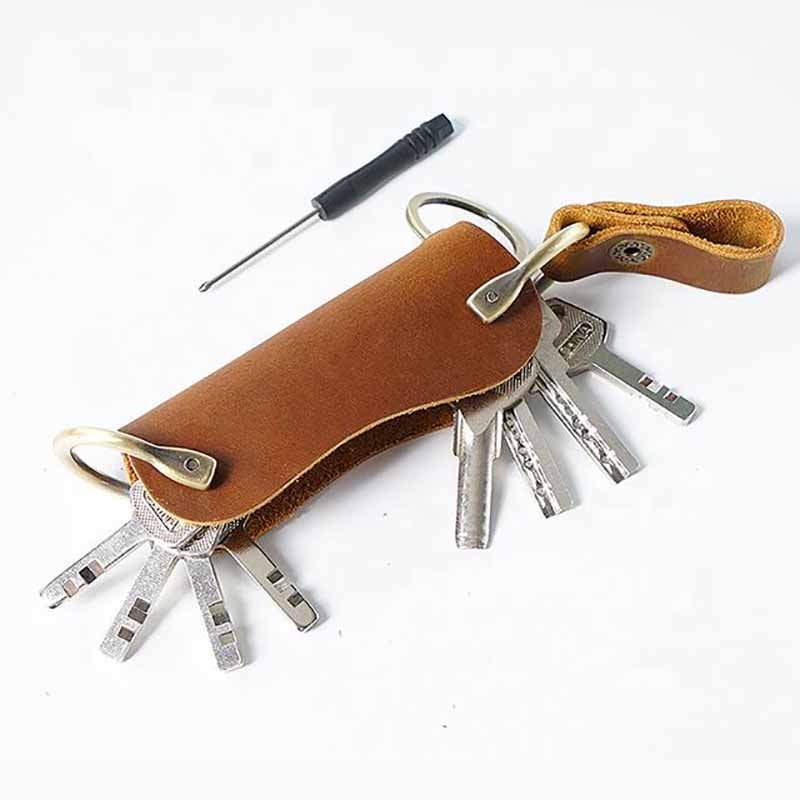
Custom leather key holder development should begin with the keys, carrying habits, and sales position rather than with a finished reference photo alone. A visually attractive sample may not suit the customer’s key dimensions, car fob, preferred capacity, packaging, or expected retail quality.
A complete development process connects product structure, leather, reinforcement, hardware, logo application, assembly, testing, packaging, and inspection. Each decision affects the others. A thicker leather may require a longer post. A larger logo may need a wider body. A heavy fob may require additional reinforcement. A presentation box may need an insert that prevents the hardware from pressing into the leather during shipment.
The most reliable approach is to define measurable product requirements before drawing the first pattern.
What Should Be Included in the Product Brief?
A detailed product brief allows the development team to understand what the finished key holder must do, not only how it should look.
The brief should include:
- Intended product type
- Target customer profile
- Number of keys
- Key shapes and dimensions
- Car fob dimensions and weight
- Required access method
- Preferred leather type
- Leather color
- Hardware color
- Logo method
- Packaging type
- Expected order quantity
- Target price range
- Sales market
- Retail positioning
- Required testing
- Delivery schedule
- Reference products
- Features that must not be changed
Photographs alone are rarely sufficient. Two products can look almost identical while using different leather thicknesses, internal reinforcement, hardware materials, and assembly methods.
For a folding key organizer, the brief should state whether the main goal is:
- Minimum pocket thickness
- Higher key capacity
- Fast one-hand access
- Car fob separation
- Quiet carrying
- Scratch protection
- Adjustable hardware
- Premium hand feel
- Personalized gifting
- Coordinated collection development
A product cannot maximize every goal at the same time. Increasing capacity usually increases thickness. Adding lining improves interior appearance but adds layers. Stronger hardware may add weight. A full zipper provides better enclosure but slows access.
The brief should rank the three most important goals. This helps the development team make informed decisions when two requirements conflict.
What Dimensions Should Be Tested?
Dimensions should be based on the complete loaded product rather than the empty leather shell.
The most important measurements include:
- Closed length
- Closed width
- Empty thickness
- Loaded thickness
- Pivot-post diameter
- Usable post length
- Hardware-head diameter
- Distance from post to leather edge
- Maximum covered key length
- Internal opening width
- Fob-ring opening
- Attachment-tab width
- Attachment-tab thickness
- Snap position
- Zipper opening length
- Logo area
- Stitching distance from edge
- Packaging cavity size
A dimension sheet should also record measurement tolerances. Leather is a natural material, and small variations occur between hides and different areas of the same hide.
| Measurement Area | Development Purpose | Common Failure When Incorrect |
|---|---|---|
| Closed length | Covers the longest intended key | Key teeth remain exposed |
| Body width | Supports grip and key-head size | Product twists during use |
| Post length | Controls capacity | Keys remain loose or cannot fit |
| Post diameter | Matches key holes | Some keys cannot be installed |
| Edge distance | Prevents tearing | Leather splits around hardware |
| Loaded thickness | Confirms pocket comfort | Product becomes too bulky |
| Fob-tab width | Supports fob load | Tab stretches or twists |
| Snap position | Maintains closure alignment | Case cannot close when loaded |
| Zipper opening | Controls access | Keys are difficult to remove |
| Logo area | Maintains clear decoration | Logo falls into a fold or seam |
Closed length should be based on the longest intended key plus enough allowance for hardware, movement, and edge protection.
For example, if the longest key is 65 mm from the center of its hole to the tip, the leather body should not be designed at exactly 65 mm. The structure needs additional space for:
- Pivot clearance
- Leather edge
- Key rotation
- Manufacturing tolerance
- Tip protection
- Visual balance
A small design may use every millimeter efficiently, but it should not place the key tip directly against the finished edge. Repeated impact can create visible pressure marks.
How Should Loaded Thickness Be Calculated?
Loaded thickness should be estimated before the prototype is made and measured again after physical assembly.
The total thickness may include:
- Key heads
- Flat washers
- Wave washers
- Polymer spacers
- Outer leather
- Inner leather
- Reinforcement
- Adhesive
- Hardware caps
- Surface padding
- Stitching build-up
Suppose a folding organizer is designed for five flat keys.
A simplified development estimate may include:
| Component | Estimated Thickness |
|---|---|
| Five key heads | 10.0–12.5 mm |
| Four internal spacers | 1.2–2.0 mm |
| Two outer washers | 0.6–1.0 mm |
| Two leather walls | 2.4–3.2 mm |
| Hidden reinforcement | 0.3–0.6 mm |
| Hardware-head projection | 1.0–2.0 mm |
The finished product may reach approximately 15.5–21.3 mm at its thickest point, depending on the keys and construction.
This estimate shows why a product advertised as holding many keys may not remain slim in actual use. Capacity should be validated with representative key sets rather than calculated from post length alone.
The development team should measure:
- Thickness with no keys
- Thickness at minimum capacity
- Thickness at intended capacity
- Thickness at maximum capacity
- Thickness at the hardware head
- Thickness at the folded edge
A digital caliper can provide repeatable measurements. The results should be recorded in the sample review report.
How Should Key Compatibility Be Confirmed?
Key compatibility should be confirmed with physical samples or detailed measurements.
A useful compatibility set includes:
- Standard house key
- Wide office key
- Short cabinet key
- Narrow mailbox key
- Plastic-headed key
- Small-hole key
- Thick security key
- Access tag
- Car fob
- Small utility tool
Each item should be checked for:
- Post-hole fit
- Rotation clearance
- Head interference
- Tooth coverage
- Access by thumb
- Position in the stack
- Movement against neighboring keys
- Loaded shape
- Removal method
The project team should define which keys must fit inside the main structure and which should remain on an external ring.
Trying to support every possible key shape often creates an oversized product. A clearer compatibility statement gives customers better expectations.
For example:
- Main pivot: two to six flat keys
- Maximum key length: 70 mm from hole center to tip
- Minimum key-hole diameter: 4 mm
- External ring: one car fob or oversized key
- Not recommended for thick folding vehicle keys inside the main stack
Clear compatibility information reduces returns and incorrect installation.
Which Features Can Be Customized?
A custom leather key holder can be changed in both visible appearance and internal function.
Common customization areas include:
- Product structure
- Overall dimensions
- Key capacity
- Leather type
- Leather grain
- Leather thickness
- Color
- Edge method
- Stitching color
- Thread thickness
- Hardware material
- Hardware finish
- Closure
- Fob attachment
- Detachable system
- Key hooks
- Lining
- Reinforcement
- Logo method
- Personalization
- Tracker storage
- Packaging
- Insert card
- Barcode label
- Care instructions
The most valuable customization is not always the most visible.
A hidden washer system may improve access more than a decorative metal plate.
A wider reinforcement patch may extend service life more than a thicker outer leather.
A shorter fob chain may reduce noise more effectively than adding another closure.
Product teams should separate customization into three levels.
| Customization Level | Examples | Development Impact |
|---|---|---|
| Surface | Color, stitching, logo, edge color | Lower structural impact |
| Functional | Capacity, ring, closure, tracker tab | Requires performance review |
| Structural | Dimensions, pattern, hardware system, internal layout | Requires full sampling and testing |
Surface customization can often use an existing structure.
Functional customization may require adjustments to reinforcement or assembly.
Structural customization usually requires a new pattern, new prototype, and repeated testing.
Which Logo Method Works Best?
The logo method should suit the leather surface, design style, order quantity, and expected wear.
Common methods include:
- Blind debossing
- Foil stamping
- Screen printing
- Heat transfer
- Laser marking
- Metal badge
- Engraved hardware
- Embossed patch
- Woven label
- Printed lining
- Personalized initials
Blind debossing presses the logo into the leather without adding color. It works well for understated products and natural leather surfaces.
Foil stamping adds contrast and can support gift or fashion collections. Foil color, adhesion, temperature, pressure, and leather coating must be tested together.
Screen printing provides stronger color options. It works better on stable, smooth surfaces than on heavily textured leather.
Laser marking creates a precise result on selected leathers. The final tone depends on leather color, finish, and laser settings.
A metal badge creates a stronger visual presence but adds weight, thickness, and attachment points. Hidden prongs, screws, or rivets may require interior reinforcement or lining.
Engraved hardware creates a refined effect without increasing the leather logo area. It is suitable for custom screw heads, rings, clips, or metal plates.
| Logo Method | Best Use | Main Control Point |
|---|---|---|
| Blind debossing | Minimal and premium appearance | Depth and edge clarity |
| Foil stamping | Gift and fashion products | Foil adhesion |
| Screen printing | Strong color contrast | Ink durability |
| Laser marking | Detailed artwork | Burn depth and tone |
| Metal badge | High visual impact | Attachment security |
| Hardware engraving | Refined custom detail | Engraving consistency |
| Initial personalization | Gift programs | Position and character accuracy |
Logo samples should be approved on the actual production leather. A logo that looks clear on paper may disappear on deep-grain leather or spread on soft leather.
The logo should also remain outside major folds, stitch lines, snap pressure zones, and high-abrasion areas.
How Should Edge Finishing Be Selected?
Edge finishing affects appearance, comfort, moisture resistance, and durability.
Common methods include:
- Raw cut edge
- Burnished edge
- Edge paint
- Folded edge
- Turned edge
- Bound edge
Burnishing works well on firm vegetable-tanned leather with dense fibers. The edge is smoothed, treated, and polished.
Edge paint provides a clean, controlled color and works with many top-grain and lined constructions. It usually requires several operations:
- Edge trimming
- Sanding
- Base coating
- Drying
- Additional coating
- Fine sanding
- Final coating
- Curing
- Inspection
A thick paint layer may crack at sharp folds. A thin layer may fail to cover the fibers. Flexible edge paint should be selected for areas that bend repeatedly.
Folded edges hide the cut edge and create a soft appearance. They add thickness and require skiving.
Turned edges are common in wallets and structured cases. They require accurate skiving, adhesive application, folding, and stitching.
| Edge Method | Appearance | Suitable Construction | Main Risk |
|---|---|---|---|
| Raw cut | Natural and simple | Firm dense leather | Rough fibers |
| Burnished | Traditional and polished | Vegetable-tanned leather | Uneven color |
| Edge paint | Clean and modern | Layered leather goods | Cracking at folds |
| Folded edge | Soft and refined | Thin leather | Excessive thickness |
| Bound edge | Durable and visible | Utility cases | Added bulk |
The edge method should be tested through flexing and abrasion. The key-holder fold may bend thousands of times during use.
How Should Stitching Be Designed?
Stitching supports both construction and appearance.
Important variables include:
- Thread material
- Thread thickness
- Stitch length
- Needle size
- Stitching distance from edge
- Reinforcement stitches
- Backstitching
- Corner shape
- Thread color
- Seam tension
Polyester thread is often selected for strength and color stability. Nylon thread may provide high strength and flexibility. The final choice should match the leather thickness and product style.
A heavy thread can create a strong visual line but may look oversized on a compact key holder.
A very fine thread may suit a refined design but require tighter control during sewing.
Stitch spacing should remain consistent, especially around curves. Uneven stitch length is highly visible on small leather goods because the product is viewed closely.
Stress areas may require:
- Double stitching
- Box stitching
- Triangular reinforcement
- Backstitching
- Bar tacking where suitable
- Wider seam allowance
- Hidden reinforcement
The stitching should not sit too close to a post hole or ring slot. A short distance between the stitch line and hardware opening can create a tear path.
How Is a Prototype Evaluated?
A prototype should be treated as a working object that must perform under repeated daily use.
Visual inspection is only one part of the review.
The sample should be evaluated for:
- Overall proportions
- Leather feel
- Key capacity
- Hardware fit
- Key rotation
- One-hand access
- Fob position
- Pocket comfort
- Closure alignment
- Loaded thickness
- Edge durability
- Stitch consistency
- Logo clarity
- Color match
- Packaging fit
A structured review creates clearer revisions.
| Review Area | Question |
|---|---|
| Size | Does the product cover the intended keys? |
| Capacity | Does it work at minimum and maximum load? |
| Access | Can one key be selected quickly? |
| Grip | Can the leather body turn a stiff lock? |
| Hardware | Does the post remain secure? |
| Closure | Does it close without excessive force? |
| Fob attachment | Does the fob hang comfortably? |
| Leather | Does the material keep its shape? |
| Edge | Does the finish remain intact after flexing? |
| Logo | Is the mark clear and correctly positioned? |
| Packaging | Does the package prevent pressure marks? |
Comments should be measurable and actionable.
Weak comments:
- Make it better.
- It feels strange.
- The key is difficult.
- The leather is too soft.
Stronger comments:
- Increase body width by 3 mm to improve grip.
- Reduce usable post length by 1.5 mm for the four-key version.
- Move the snap 4 mm outward so the case closes at maximum load.
- Add reinforcement around the D-ring tab.
- Reduce edge-paint thickness at the main fold.
- Increase the logo depth by 0.2 mm.
- Shorten the external chain by 15 mm to reduce movement.
Specific revision notes reduce misunderstanding and speed up sample improvement.
Which Prototype Stages Are Needed?
A custom development program may use several sample stages.
Structure Sample
The first structure sample checks:
- Size
- Pattern
- Capacity
- Hardware position
- Key movement
- Closure
- Fob storage
It may use available leather and hardware if the final materials are not ready.
The goal is to confirm function before investing in all decorative details.
Material Sample
The material sample checks:
- Leather color
- Grain
- Temper
- Thickness
- Lining
- Edge finish
- Stitching
- Hardware color
- Logo effect
Several leather options may be compared side by side.
Revised Sample
The revised sample incorporates structural and visual changes.
It should be tested with the intended key set and packaging.
Pre-Production Sample
The pre-production sample should represent the approved mass-production standard.
It should use:
- Approved leather
- Approved hardware
- Approved logo
- Approved thread
- Approved edge finish
- Approved lining
- Approved packaging
- Approved labels
The pre-production sample becomes an important reference for manufacturing and final inspection.
How Should Wear Testing Be Conducted?
Wear testing should reflect the expected use.
A compact key holder experiences:
- Repeated folding
- Repeated key rotation
- Pocket compression
- Bag movement
- Hand oils
- Sweat
- Temperature change
- Moisture
- Friction
- Dropping
- Pulling
- Twisting
A practical internal test plan may include:
| Test | Purpose | Observation |
|---|---|---|
| Key rotation cycles | Checks pivot durability | Loosening and wear |
| Fold cycles | Checks leather and edge finish | Cracking and delamination |
| Snap cycles | Checks closure life | Force and alignment |
| Pull test | Checks ring and tab strength | Stretching and failure |
| Drop test | Checks impact security | Hardware release |
| Abrasion test | Checks surface durability | Finish wear |
| Color rub test | Checks transfer | Dry and wet staining |
| Humidity exposure | Checks material stability | Warping and corrosion |
| Loaded storage test | Checks shape retention | Permanent deformation |
| Packaging compression | Checks shipment protection | Hardware marks |
The test method should be agreed according to the product level and destination market.
Cycle counts can be set as internal development standards. For example:
- 1,000–3,000 key rotations for an early comparison
- 3,000–5,000 fold cycles for edge and leather review
- 500–1,000 snap operations for closure screening
- Repeated pull loads for ring attachment review
- Multiple drop directions for hardware retention
These figures should not be presented as certified performance unless they are supported by the required test method and documentation. They are useful for comparing samples and identifying weak constructions.
How Should Pivot Security Be Tested?
The pivot system should remain stable after repeated operation.
The test should evaluate:
- Initial tightening torque
- Key movement
- Post rotation
- Screw loosening
- Washer deformation
- Leather compression
- Hole enlargement
- Final removal torque
The organizer can be assembled at minimum, intended, and maximum capacity.
After repeated key rotation, the technician should check:
- Whether the post has moved
- Whether the key stack has become loose
- Whether the leather has stretched
- Whether the washer remains centered
- Whether the screw can still be adjusted
- Whether keys rotate evenly
A post that remains secure at six keys may behave differently at two keys. Both conditions should be tested.
How Should Ring Attachments Be Tested?
Ring attachments experience straight and angled forces.
A useful review includes:
- Straight downward pull
- Sideways pull
- Twisting
- Repeated swinging
- Ring opening
- Leather-tab stretch
- Rivet movement
- Stitch movement
- Hardware deformation
The fob or test weight should be positioned at different angles. A strong straight pull result does not guarantee resistance to repeated side loading.
After testing, inspect:
- Hole elongation
- Stitch damage
- Edge cracking
- Leather thinning
- Rivet rotation
- D-ring opening
- Plating wear
- Reinforcement movement
A narrow attachment tab can fail even when the metal ring remains strong. The entire connection should be reviewed as one system.
How Should Leather Color Be Controlled?
Leather color can vary because of hide structure, dye absorption, finishing, and production conditions.
Color control should include:
- Approved physical swatch
- Approved sample
- Lighting condition
- Acceptable range
- Surface gloss
- Grain appearance
- Color rub performance
- Lot comparison
Digital screens are not reliable enough for final color approval.
The approved range should reflect the leather type.
A heavily corrected leather can usually achieve tighter visual consistency.
An aniline or pull-up leather naturally shows more variation.
The team should also inspect color at:
- Flat areas
- Folded areas
- Skived edges
- Stretched areas
- Debossed logo
- Edge paint
- Stitching
- Hardware combination
Some leathers become lighter when bent. Pull-up leather may show strong tone changes around folds. This should be accepted intentionally rather than treated as a surprise during inspection.
How Is Mass Production Controlled?
Mass production should follow an approved specification and reference sample.
The main control stages include:
- Incoming material inspection
- Leather sorting
- Thickness checking
- Color matching
- Pattern cutting
- Skiving
- Reinforcement placement
- Lamination
- Edge preparation
- Stitching
- Hardware installation
- Logo application
- Assembly
- Cleaning
- Functional testing
- Final inspection
- Packaging inspection
Leather Sorting
Leather should be sorted by:
- Color
- Grain
- Thickness
- Stretch
- Surface marks
- Cutting area
- Direction
Visible parts should use leather that matches the approved appearance. Less visible areas may allow different natural characteristics within the agreed standard.
Cutting
Patterns should be placed according to leather stretch direction.
Poor placement can cause one side of the product to stretch more than the other.
Cutting dies or digital cutting systems should maintain:
- Shape consistency
- Hole position
- Edge quality
- Logo position
- Hardware-slot accuracy
Skiving
Skiving reduces thickness at folds and layered areas.
The operator should control:
- Skiving width
- Remaining thickness
- Transition smoothness
- Corner consistency
- Risk of cutting through
Over-skiving weakens the leather.
Under-skiving creates bulky folds.
Bonding
Adhesive should be applied evenly.
Too little adhesive creates separation.
Too much adhesive may spread onto visible surfaces or create hard areas.
The bonded parts should be pressed under controlled conditions.
Stitching
Stitching should be checked for:
- Straightness
- Stitch length
- Thread tension
- Corner shape
- Backstitching
- Skipped stitches
- Loose thread
- Needle marks
- Distance from edge
Hardware Installation
Hardware installation should control:
- Position
- Pressure
- Alignment
- Washer sequence
- Screw engagement
- Rivet deformation
- Snap action
- Ring opening
- Plating protection
Excessive installation pressure can mark or cut the leather.
Insufficient pressure can allow hardware to move.
Functional Inspection
Each key holder should be checked for:
- Opening and closing
- Pivot movement
- Snap operation
- Zipper operation
- Ring security
- Hook closing
- Detachable system
- Logo position
- Edge finish
- Loaded shape where required
The level of inspection may vary by product and order, but critical functions should receive strong control.
Which Defects Should Be Rejected?
Defect standards should be agreed before production.
Critical defects may include:
- Hardware releases unexpectedly
- Sharp metal edge can injure the user
- Key post separates
- Snap cannot close
- Zipper fails
- Ring is open
- Leather tears around hardware
- Wrong material
- Wrong logo
- Missing component
Major defects may include:
- Incorrect dimensions affecting use
- Loose stitching
- Severe edge-paint cracking
- Strong color mismatch
- Misaligned hardware
- Visible adhesive
- Logo positioned incorrectly
- Significant leather damage
- Packaging that marks the product
Minor defects may include:
- Small surface variation within the agreed natural leather standard
- Slight stitch variation that does not affect strength
- Small internal finish differences
- Minor packaging marks that do not reach the product
Natural leather characteristics should be defined separately from manufacturing defects.
Possible accepted natural characteristics may include:
- Fine pores
- Small healed marks
- Moderate grain variation
- Slight color variation
- Natural growth lines
Unacceptable issues may include:
- Open cuts
- Weak areas
- Large deep scars in visible positions
- Finish peeling
- Uncontrolled color patches
- Strong surface contamination
How Should Packaging Be Designed?
Packaging should protect the leather, prevent hardware pressure, support presentation, and communicate product use.
Common packaging options include:
- Paper sleeve
- Folding carton
- Rigid box
- Drawer box
- Kraft box
- Fabric pouch
- Recycled paper wrap
- Hanging card
- Blister-free paper structure
- Gift set box
A compact key holder may not need a large box, but the package should provide enough clearance for the hardware.
Important packaging controls include:
- Product position
- Hardware separation
- Moisture protection
- Surface protection
- Insert stability
- Logo visibility
- Barcode position
- Instruction card
- Material information
- Care information
- Shipping efficiency
A rigid box can improve gift presentation but increases volume and freight cost.
A folding carton reduces storage and shipping volume.
A paper sleeve is economical but provides less compression protection.
A fabric pouch can be reused but may require an outer carton for retail display.
| Packaging Type | Protection | Presentation | Shipping Volume |
|---|---|---|---|
| Paper sleeve | Low | Clean and simple | Very low |
| Folding carton | Medium | Good | Low |
| Rigid box | High | Premium | High |
| Drawer box | High | Premium | High |
| Fabric pouch | Medium | Reusable | Medium |
| Kraft box | Medium | Natural appearance | Medium |
Packaging should be tested with the actual product, instruction card, labels, and protective materials.
How Can Packaging Prevent Leather Marks?
Hardware can press into leather during storage and transportation.
Protection methods include:
- Tissue wrapping
- Thin foam sheet
- Paper separator
- Molded paper insert
- Cardboard support
- Hardware cover
- Individual soft pouch
- Separate fob-ring position
- Controlled box cavity
The insert should prevent:
- Ring pressing into leather
- Screw head marking the surface
- Snap imprinting the opposite side
- Metal badge rubbing
- Zipper pull scratching
- Product movement in the box
A compression test can place packed products under stacked-carton pressure for a defined period. After unpacking, inspect for:
- Pressure marks
- Edge deformation
- Leather creasing
- Hardware transfer
- Logo damage
- Box collapse
What Information Should Be Included in the Package?
The package may include:
- Product name
- Material description
- Capacity guidance
- Installation steps
- Key compatibility
- Care instructions
- Warning about overloading
- Hardware adjustment instructions
- Origin information
- Barcode
- SKU
- Color code
- Logo
- Website
- Customer service contact
- Recycling information
For adjustable pivot organizers, installation instructions are especially important.
The instructions should explain:
- Open the screw post.
- Arrange keys and washers.
- Keep frequently used keys near the outside.
- Tighten the post.
- Check key movement.
- Re-tighten when necessary.
- Do not exceed the stated capacity.
A small illustrated card can reduce incorrect assembly and customer complaints.
How Should Leather Key Holders Be Cared For?
Care instructions should match the leather finish.
General guidance may include:
- Keep away from prolonged water exposure.
- Wipe light dirt with a soft dry cloth.
- Allow damp leather to dry naturally.
- Avoid direct heat.
- Do not use strong household chemicals.
- Keep sharp objects away from the finished surface.
- Check adjustable hardware periodically.
- Do not overload the post or ring.
- Store in a dry, ventilated place.
- Use a suitable leather conditioner only when recommended.
Aniline, pull-up, suede, coated, and vegetable-tanned leathers require different care. The package should avoid one universal instruction if the collection uses several leather finishes.
How Can a Collection Be Developed?
A leather key holder can become part of a coordinated small-leather-goods collection.
Related products may include:
- Card holder
- Bifold wallet
- Coin pouch
- Luggage tag
- AirTag holder
- Cable organizer
- Key strap
- Wrist strap
- Belt loop holder
- Passport holder
- Glasses case
- Leather tray
- Gift box
Collection consistency can be created through:
- Same leather
- Same hardware finish
- Same stitching
- Same edge color
- Same logo scale
- Same lining
- Same packaging
- Same design language
The key holder may use the same leather article as the wallet, but its thickness and reinforcement may need to differ.
A material suitable for a wallet panel may be too soft around a key-holder post. The visual match can remain while the internal construction changes.
What Information Is Needed for a Quotation?
A clear quotation request should include:
- Product photo or drawing
- Intended structure
- Dimensions
- Key capacity
- Leather preference
- Leather color
- Hardware material
- Hardware finish
- Logo artwork
- Logo method
- Lining requirement
- Packaging requirement
- Order quantity
- Number of colors
- Destination country
- Testing needs
- Target schedule
For a new custom structure, it is also helpful to provide:
- Physical key samples
- Key measurement sheet
- Car fob dimensions
- Expected retail price
- Existing product problems
- Target customer use
- Competing product references
- Required improvements
The more specific the input, the more accurately the factory can evaluate materials, hardware, construction, sample cost, production process, and packaging.
How Can SzoneierLeather Support Custom Development?
SzoneierLeather is a leather-goods research, development, and manufacturing factory with more than 18 years of industry experience. Its product scope includes leather bags, wallets, belts, straps, accessories, key holders, and leather boxes.
The factory supports custom development through:
- Raw-material sourcing
- Leather selection
- Material testing
- Product engineering
- Pattern development
- Structural improvement
- Hardware sourcing
- Custom hardware development
- Logo sampling
- Prototype production
- Sample revision
- Manufacturing
- Packaging design
- Packaging inspection
- Final product inspection
How Does Material Sourcing Support Development?
A strong material supply chain allows the product team to compare several leather directions rather than forcing one material into every design.
Material development may evaluate:
- Cow leather
- Full-grain leather
- Top-grain leather
- Vegetable-tanned leather
- Chrome-tanned leather
- Nappa leather
- Pull-up leather
- Split leather
- Microfiber leather
- Textile lining
- Metal hardware
- Custom packaging materials
The factory can review color, grain, thickness, temper, finish, stretch, and expected use before preparing the first sample.
This reduces the risk of approving a beautiful leather that cannot support the selected structure.
How Does Product Engineering Improve the Result?
Product engineering focuses on the relationship between the key set and the finished construction.
The engineering review may examine:
- Pivot position
- Key clearance
- Loaded thickness
- Grip width
- Leather wrap
- Fob balance
- Ring reinforcement
- Closure position
- Stitch path
- Edge method
- Logo location
- Packaging pressure
A reference product can be used as a starting point, but the final design should be adjusted according to the intended key capacity, leather, hardware, and market.
How Does Sampling Reduce Production Risk?
Sampling allows structural problems to be corrected before mass production.
The sample process can verify:
- Dimensions
- Material
- Color
- Hardware
- Capacity
- Access
- Logo
- Stitching
- Edge finish
- Lining
- Packaging
A sample should be used with real keys. It should not remain an untouched display item.
Feedback from the sourcing, design, sales, and quality teams can be combined into one revision list.
A controlled sample approval process helps prevent late changes after materials have been purchased.
How Does Packaging Development Add Value?
Packaging can support retail presentation, gifting, transport protection, and customer education.
SzoneierLeather can coordinate:
- Folding cartons
- Rigid boxes
- Drawer boxes
- Sleeves
- Inserts
- Tissue paper
- Protective pouches
- Instruction cards
- Care cards
- Labels
- Barcodes
- Outer cartons
Packaging should be developed together with the product because changes in ring size, product thickness, or hardware position can affect the insert.
What Makes a Compact Key Holder Successful?
A successful compact leather key holder does not simply look small. It remains controlled after keys are installed, comfortable after hours of carrying, secure after repeated movement, and easy to use in ordinary situations.
The strongest designs usually achieve the following:
- Key capacity matches real use.
- The leather supports the hardware.
- The key teeth remain protected.
- The post maintains controlled tension.
- The fob has a separate secure position.
- The product can be operated with one hand.
- The body provides enough grip.
- The loaded thickness remains reasonable.
- The edge finish survives repeated folding.
- The logo remains clear.
- Packaging prevents surface marks.
- Instructions explain installation and care.
Compactness should be measured through use, not only through outside dimensions.
A product that is 5 mm shorter but difficult to grip may not be an improvement.
A product that carries eight keys but feels uncomfortable may not meet customer expectations.
A product with thick leather but weak reinforcement may still fail around the hardware.
The final design should balance structure, material, capacity, access, protection, appearance, and production consistency.
Request a Custom Leather Key Holder Quote
A custom leather key holder project can begin with a reference image, technical drawing, existing sample, or description of the customer problem you want to solve.
The SzoneierLeather development team can review the key-storage structure, recommend suitable leather and hardware, prepare samples, improve the construction, and coordinate packaging before production.
Whether you are developing a slim folding organizer, a snap-closure key case, a zippered key pouch, a detachable fob holder, or a coordinated leather gift set, the project should begin with real use requirements and measurable specifications.
Contact SzoneierLeather for a custom quotation and sample-development discussion. A well-engineered key holder can remain compact, secure, comfortable, and visually consistent from the first approved sample to the final packed order.