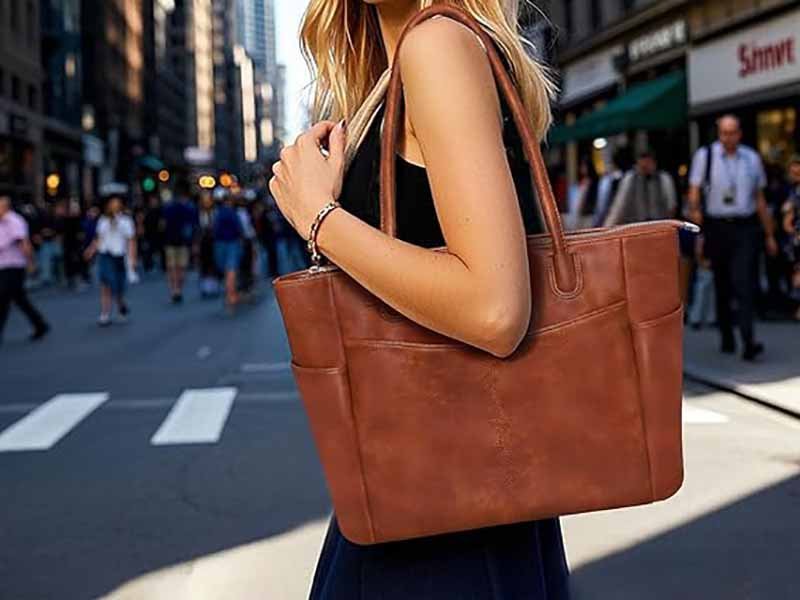
A leather tote bag is often judged by its first impression: the leather surface, the handle shape, the shine of the hardware, the stitching line, and the way it sits on a shelf. But after purchase, the real test starts inside the bag. A customer may love the outside, yet still stop using the tote if her laptop slides around, her keys disappear at the bottom, her phone pocket is too tight, or the lining feels cheap after a few weeks of use. That is why interior organization design in leather tote bags is no longer a small detail. It has become one of the strongest factors behind product reviews, repeat orders, and long-term brand trust.
A good interior organization design in leather tote bags gives every high-frequency item a clear place. It helps users separate laptops, phones, wallets, documents, cosmetics, bottles, chargers, cards, and keys without making the tote heavy or bulky. The best design balances storage, comfort, structure, leather thickness, lining strength, stitching method, and production cost.
For leather brands and custom wholesale clients, the inside of a tote bag should be developed as seriously as the outside. The customer does not always say, “I need better internal engineering.” She says, “I wish I could find my phone faster,” “My laptop needs more protection,” or “This bag looks nice but feels messy.” Those everyday complaints are where smart product development begins.
What Is Interior Organization Design?
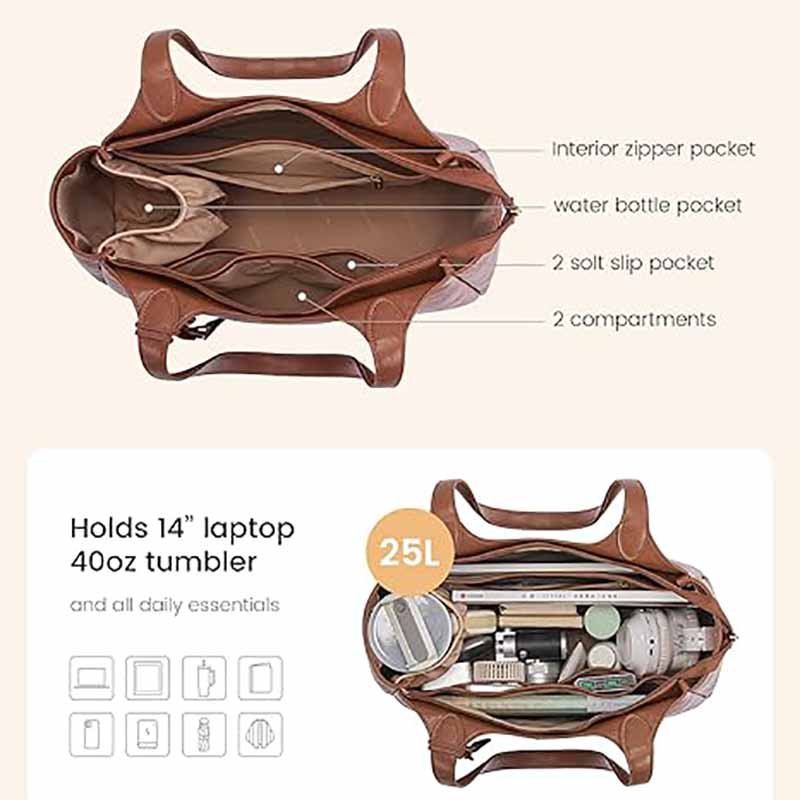
Interior organization design in leather tote bags is the planning of inner pockets, compartments, lining, reinforcement, dividers, closures, and access space. It decides how easily users can store, find, protect, and carry daily items. A strong interior design keeps the tote beautiful outside while making the inside more useful, clean, and reliable.
Interior organization design basics
Interior organization design is the hidden structure that makes a leather tote bag work in daily life. It is not only about adding one zipper pocket or two slip pockets. It includes how deep each pocket should be, where each pocket should sit, how much space should remain open, how the lining connects with the leather body, and how the bag performs when loaded with real items.
For a leather tote bag, the inside usually needs to solve five daily problems:
- Items fall into one large empty space.
- Small essentials are hard to find.
- Laptops and tablets move around during walking.
- Bottles, umbrellas, and cosmetics stain or press against other items.
- The leather body loses shape after repeated loading.
A well-planned interior layout gives different items their own zones. Large items such as laptops and documents need flat, stable sections. Small items such as cards, keys, lipstick, and earbuds need shallow, easy-reach pockets. Valuable items such as passports, cash, and jewelry need zipper protection. Wet or heavy items such as bottles and umbrellas need side placement or removable storage.
In many custom leather tote projects, the best result does not come from the highest pocket count. It comes from the most logical pocket placement. A tote with four well-designed pockets can feel better than a tote with ten pockets that make the bag stiff, crowded, and difficult to use.
Why leather tote bags need structure
Leather tote bags need inner structure because leather has weight, flexibility, and movement. A soft leather tote may feel luxurious, but without inner support, the base can sag, the side panels can collapse, and the opening can become uneven after daily use. A structured interior helps the tote hold its shape, spread weight more evenly, and protect the outside appearance.
Structure is especially important for larger tote bags. Once the bag width reaches around 35–42 cm, the main body starts carrying more load. If the interior is only a plain lining with no support, the bag may look beautiful when empty but lose shape when filled with a laptop, wallet, bottle, notebook, and cosmetics pouch.
Several design details can improve structure:
- Bottom reinforcement helps the tote stand better.
- Side panel support reduces collapse.
- Padded laptop sections add internal stability.
- Bonded lining makes the inner wall cleaner and firmer.
- Reinforced pocket openings prevent stretching.
- Strong seam allowance prevents pocket tearing under repeated use.
For premium leather totes, structure also affects perceived value. When users open the bag and see neat lining, straight pocket edges, flat compartments, and stable inner walls, the product feels more expensive. They may not know the technical terms, but they can feel the difference.
SzoneierLeather has over 18 years of experience in leather goods development and manufacturing, covering raw material sourcing, leather selection, product design, sampling, production, packaging, and quality inspection. For custom tote projects, internal structure can be adjusted according to target price, leather type, retail positioning, and daily carrying weight.
What users notice first
When a user opens a leather tote bag, she usually reacts to three things within a few seconds: whether the inside looks clean, whether important items have a place, and whether the bag feels easy to use. The outside attracts attention, but the inside decides comfort.
Common first impressions include:
- Is the lining smooth or rough?
- Can the phone fit into the pocket?
- Is there a safe zipper pocket?
- Can a laptop stand securely?
- Are the pockets easy to reach?
- Does the bag feel too heavy before loading?
- Does the inner color make items easy to see?
- Are the stitches straight and clean?
For daily-use leather tote bags, users often prefer a clean layout with enough organization but not too much bulk. A practical inner structure may include one laptop sleeve, one zipper pocket, two slip pockets, and one key leash. For a more fashion-driven tote, the structure may be lighter: one hanging zipper pocket, one phone pocket, and a soft lining.
Pocket depth is a small detail with a big effect. If a phone pocket is only 10 cm deep, many large smartphones may slip out. If it is 18 cm deep, the phone may sit too low and become hard to grab. For modern smartphones, a practical phone pocket often sits around 9–10 cm wide and 14–16 cm deep, depending on the design market. A card pocket can be shallower, while a power bank pocket may need stronger stitching and more depth.
Is an open tote enough?
An open leather tote can be enough for certain product lines, especially fashion totes, shopping totes, beach totes, and minimalist daily bags. Open interiors feel flexible, lightweight, and easy to produce. They also allow users to carry larger items without being restricted by dividers. However, for work, travel, commuting, and premium daily use, a fully open tote often creates problems.
The issue is not whether an open tote is “good” or “bad.” The issue is whether the interior matches the user’s real routine. A customer who carries only a wallet, phone, sunglasses, and makeup pouch may enjoy a simple open tote. A customer carrying a laptop, tablet, notebook, charger, water bottle, passport, and documents needs more organization.
A plain open tote may create these complaints:
- Small items sink to the bottom.
- Laptop edges press against cosmetics or bottles.
- Wallet and passport feel less secure.
- The tote becomes messy during travel.
- The base may sag under uneven weight.
- The bag feels spacious but not convenient.
A better solution is often a controlled open layout. This means keeping one large main space while adding useful inner zones. For example, a tote can remain visually clean but still include a laptop wall pocket, an inner zipper pocket, two slip pockets, and a key leash. This layout keeps flexibility while improving daily function.
| Tote Style | Interior Design Direction | Suggested Details | Best Use |
|---|---|---|---|
| Minimal fashion tote | Light organization | Hanging zipper pocket, soft lining, one phone pocket | Casual daily use, retail fashion |
| Work leather tote | Stronger organization | Laptop sleeve, document zone, zipper pocket, slip pockets | Office, meetings, commuting |
| Travel tote | Security-focused layout | Top zipper, hidden pocket, passport pocket, bottle area | Airport, weekend travel |
| Premium daily tote | Balanced layout | Large main space, zipper pocket, phone pocket, key leash | Daily carry, shopping, city use |
| Custom wholesale tote | Cost-controlled structure | Standard pocket set, reinforced base, clean lining | Bulk orders, private label programs |
Which Layout Works Best?
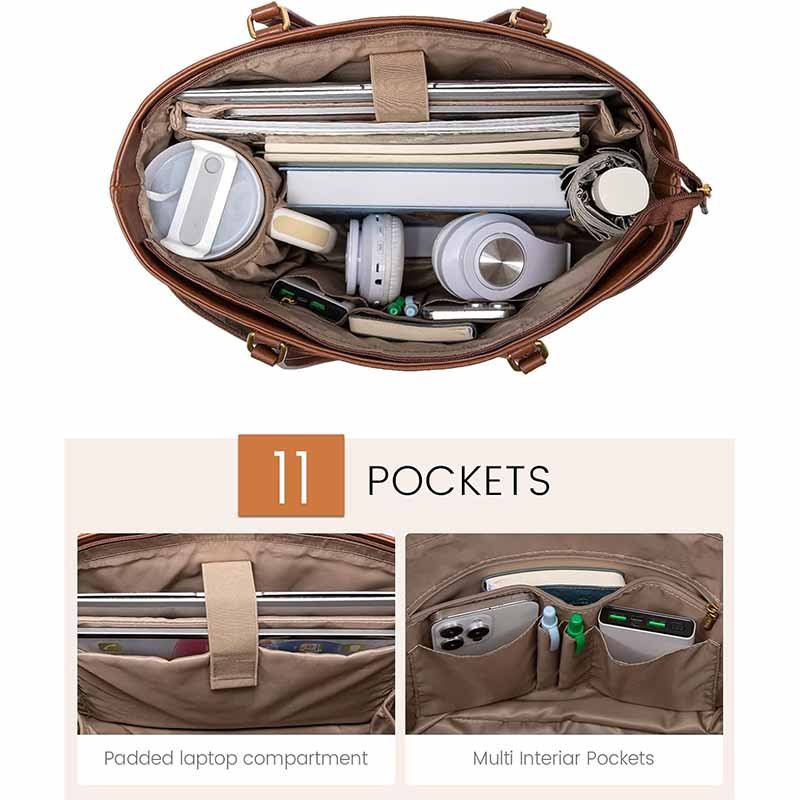
The best layout for interior organization design in leather tote bags depends on how the tote will be used. A work tote needs laptop protection and document space. A travel tote needs secure pockets and fast access. A daily tote needs simple, light, easy storage. The right layout should support use, price, comfort, and production efficiency.
Interior organization design for work
A work leather tote has to look polished while carrying practical office items. This is harder than it sounds. Many users want one bag that can hold a laptop, tablet, notebook, charger, wallet, makeup pouch, phone, keys, water bottle, and documents without looking like a bulky computer bag. The interior layout must protect devices and still keep the leather tote elegant.
A strong work tote layout often includes:
- One padded laptop sleeve.
- One document compartment.
- One inner zipper pocket.
- Two slip pockets for phone and small items.
- One key leash or D-ring.
- One reinforced base panel.
- Optional pen slot or card slot.
Laptop sleeve size should match the target market. For a 13-inch laptop, the inner compartment often needs around 33–35 cm width. For a 14-inch laptop, 35–37 cm is safer. For a 15-inch laptop, many tote bodies need 39–41 cm width, depending on laptop thickness and sleeve padding. Padding commonly ranges from 3 mm to 6 mm. Thicker padding gives better protection but adds volume and weight.
The laptop sleeve should not make the tote lean to one side. If the laptop is placed against one wall, the opposite side may need stronger base support. A central divider can balance weight better, but it reduces the flexible main space. For high-end work totes, the layout should be tested with real devices during sampling, not only checked on paper.
| Laptop Size | Suggested Tote Body Width | Sleeve Padding | Design Note |
|---|---|---|---|
| 13-inch laptop | 34–36 cm | 3–5 mm | Good for slim office totes |
| 14-inch laptop | 36–38 cm | 4–5 mm | Balanced for daily work use |
| 15-inch laptop | 39–42 cm | 5–6 mm | Needs stronger base support |
| Tablet only | 27–31 cm | 2–4 mm | Suitable for lightweight fashion-work totes |
For SzoneierLeather clients developing work tote collections, the key is not to turn a leather tote into a laptop backpack. The goal is to keep the tote refined while adding enough inner support for real office use.
Interior organization design for travel
A travel leather tote needs better access and better security. Travel users move through airports, hotels, taxis, train stations, restaurants, and meetings. They open and close the bag many times a day. The interior must help them reach important items quickly while keeping valuables protected.
A travel-focused leather tote usually needs:
- Full top zipper or recessed zipper.
- Hidden inner zipper pocket.
- Passport pocket.
- Tablet section.
- Bottle or umbrella zone.
- Quick-access phone pocket.
- Stronger bottom support.
- Lining that resists dirt and repeated friction.
For travel totes, closure design is closely connected to interior organization. An open top feels elegant and easy, but it may not feel safe in crowded places. A magnetic closure looks clean, but small items may still fall out if the bag tips over. A full zipper gives more security, but it changes the opening shape and may add cost. A recessed zipper is often a good middle choice for premium leather totes because it protects contents while keeping the outer appearance clean.
Interior pocket height matters during travel. A passport pocket should be easy to reach, but not so exposed that it feels unsafe. A hidden zipper pocket can sit on the back wall. A phone pocket should be near the top opening, because users may need boarding passes, payment apps, or messages quickly. A bottle pocket should sit on the side and be reinforced, especially if the tote is made from soft leather.
Travel also puts more pressure on lining. Light-colored lining looks elegant, but it may show stains faster. Dark lining hides marks but can make small items harder to see. A mid-tone lining often gives a good balance. For bulk production, lining choice should be tested for rubbing, peeling, color transfer, seam strength, and cleaning performance.
Interior organization design for daily use
Daily-use leather tote bags need simple organization that does not slow the user down. Most people do not want too many compartments for everyday carry. They want enough order to find essentials quickly, while still having open space for flexible items like a scarf, book, lunch box, pouch, or small purchase.
A practical daily tote layout can include:
- One main open compartment.
- One zipper pocket for wallet or valuables.
- One phone pocket.
- One small pocket for cards, lipstick, or earbuds.
- One key leash.
- Optional bottle sleeve.
- Light bottom support.
The biggest mistake in daily tote design is over-dividing the interior. Too many pockets make the bag feel smaller. They also increase production time and create more seams that need inspection. For leather tote bags, every extra pocket affects thickness, stitch density, lining tension, and final weight.
Weight is an important customer concern. A leather tote that weighs more than 1.1–1.3 kg before loading may feel heavy for daily use, especially for women’s work and city commuting markets. Interior parts can add weight quickly. A padded sleeve, zipper divider, reinforced panels, metal hardware, and thick lining may improve function, but they also increase carrying burden. The best daily tote finds the middle point between function and lightness.
A useful daily layout should follow the “fast reach” rule:
- Phone should be reachable within one hand movement.
- Keys should not fall to the bottom.
- Wallet should have a secure area.
- Cosmetics should not rub directly against laptop or documents.
- Small items should stay visible or easy to locate.
- Main space should remain open enough for flexible use.
For brands selling daily leather totes, customer satisfaction often depends on these small moments. A person standing at a metro gate, a café counter, a school pickup area, or a meeting room does not want to fight with her bag.
Interior organization design for brands
For leather goods brands, interior organization design should match the product’s market level, customer lifestyle, and retail price. A low-complexity layout may be right for a clean fashion tote. A stronger layout may be right for a premium work tote. A removable insert may be right for a giftable lifestyle tote. There is no single best layout for every product.
Before confirming a design, brands should think through these questions:
- What does the target customer carry every day?
- Is the tote mainly for work, travel, shopping, or lifestyle use?
- Does the design need to fit a laptop?
- Should the tote feel structured or soft?
- What retail price does the product need to support?
- How much added weight can the customer accept?
- How many pockets can production handle consistently?
- Should the interior feel luxurious, sporty, practical, or minimalist?
Interior design also affects manufacturing cost. More pockets require more pattern pieces, more cutting, more stitching, more lining handling, more quality checks, and more time during assembly. A complicated layout may look impressive in a drawing but become difficult to control in bulk production. This is why experienced factories review both appearance and production feasibility during the development stage.
SzoneierLeather works with leather brands and custom wholesale clients that need professional product development, not only simple logo placement. With raw material supply chain support, leather product R&D, product design, sampling, manufacturing, packaging design, and quality inspection capabilities, SzoneierLeather can help turn a tote concept into a production-ready product.
| Design Level | Pocket Setup | Production Complexity | Suitable Client Direction |
|---|---|---|---|
| Basic | 1 zipper pocket + 1 slip pocket | Low | Entry leather tote, simple retail line |
| Standard | Zipper pocket + 2 slip pockets + key leash | Medium | Daily leather tote, private label line |
| Work | Laptop sleeve + zipper pocket + slip pockets | Medium-high | Office tote, professional collection |
| Travel | Top zipper + hidden pocket + bottle zone | High | Travel tote, premium daily carry |
| Modular | Removable insert + base support | High | Multi-use tote, giftable product line |
A good interior layout does more than organize items. It helps a leather tote feel considered, comfortable, and worth its price. For brands, this detail can become a quiet but powerful reason customers choose the bag again.
What Pockets Matter Most?
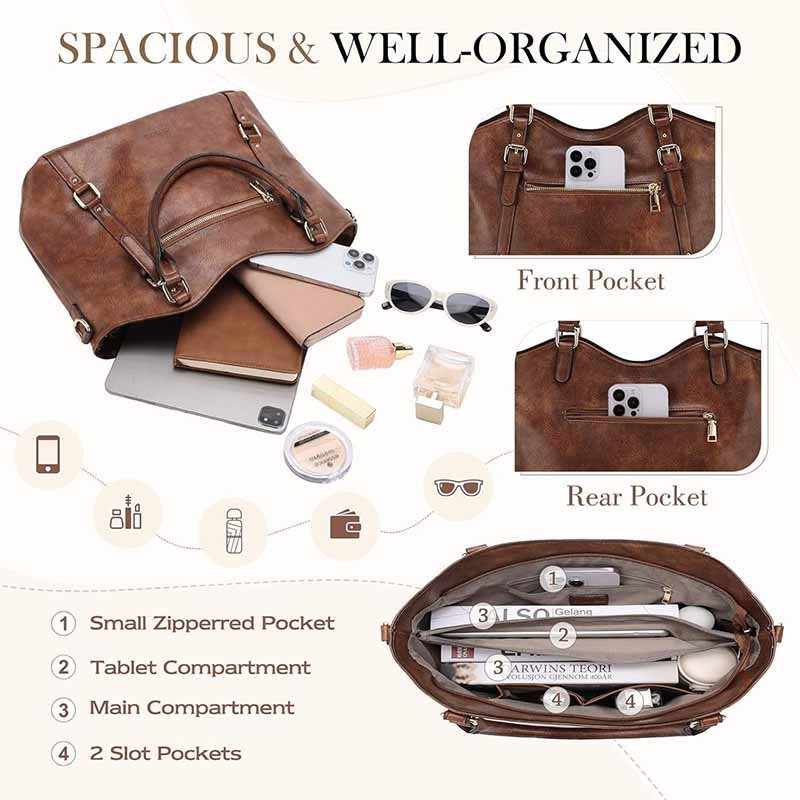
The most useful pockets in leather tote bags are not always the most complicated ones. Phone pockets, zipper pockets, laptop sleeves, card slots, key leashes, and bottle spaces solve the problems users feel every day. Good interior organization design should make small items easy to find, protect valuables, and keep the tote clean without adding unnecessary weight.
Laptop pocket design
A laptop pocket is one of the most important details in modern leather tote bags, especially for work, commuting, business travel, and university markets. Many customers choose leather totes because they want something more polished than a backpack but still need reliable space for a laptop. If the laptop pocket is poorly designed, the tote may look premium but fail in daily use.
A good laptop pocket should solve four problems:
- It should hold the laptop in a stable position.
- It should protect the laptop from direct impact.
- It should not make the tote lean or collapse.
- It should allow smooth access without scratching the device.
For most leather tote projects, laptop pocket design starts from size. A 13-inch laptop sleeve is not the same as a 15-inch laptop sleeve. The sleeve should include enough allowance for laptop thickness, protective shell, and easy removal. If the sleeve is too tight, users struggle every time they insert the device. If it is too loose, the laptop moves around and hits other items.
| Laptop Fit | Common Device Width | Suggested Sleeve Width | Suggested Sleeve Height | Padding Direction |
|---|---|---|---|---|
| 13-inch | 30–31 cm | 33–35 cm | 23–25 cm | Light to medium padding |
| 14-inch | 32–33 cm | 35–37 cm | 24–26 cm | Medium padding |
| 15-inch | 35–36 cm | 39–41 cm | 26–28 cm | Medium to stronger padding |
| Tablet | 24–28 cm | 28–32 cm | 20–23 cm | Light padding |
Padding is another important part. A work tote does not always need backpack-level protection, but it should still reduce pressure from keys, chargers, pens, and hard accessories. In many leather tote designs, 3–6 mm padding is enough for daily office use. Thicker padding offers more protection but increases volume and may make the bag look bulky. A luxury-style work tote usually needs slim protection rather than heavy padding.
Placement also affects balance. A laptop sleeve against the back wall keeps the main space open, but the bag may lean backward when loaded. A center sleeve can improve weight balance but reduces open space. A removable laptop insert gives flexibility but needs precise sizing so it does not shift inside the tote. During sampling, the pocket should be tested with real laptops, chargers, notebooks, and personal items, not only empty measurements.
For custom leather tote development, brands should confirm the laptop size target before sampling. A tote promoted as “fits laptop” must be clear about whether it fits 13-inch, 14-inch, or 15-inch devices. Vague sizing often leads to customer complaints after launch.
Phone pocket design
A phone pocket looks simple, but it is one of the most frequently used interior details in leather tote bags. Many users reach for their phones dozens of times a day. If the pocket is too small, too deep, too loose, or placed too low, the whole bag feels inconvenient.
A useful phone pocket should be designed around today’s larger smartphones. Many modern phones with protective cases are wider and thicker than older devices. A pocket that worked five years ago may now feel tight. For many tote designs, a phone pocket around 9–10 cm wide and 14–16 cm deep works well for common large phones, but the exact size should depend on the target market and phone case allowance.
The best phone pocket position is usually near the upper side wall, close enough to reach quickly but not so exposed that the phone falls out. If the pocket sits too deep inside the bag, users still need to search. If it sits too close to the top edge without proper tension, the phone may slip out when the tote is placed on a car seat or under a desk.
Phone pocket design should consider:
- Phone size with protective case.
- One-hand access.
- Pocket opening tension.
- Lining friction.
- Pocket depth.
- Stitch strength at both side edges.
- Whether the phone should sit vertical or slightly angled.
For leather tote bags aimed at office or commuting customers, a phone pocket is almost expected. For high-end fashion totes, the phone pocket can be hidden within a clean lining panel to keep the interior elegant. For travel totes, the phone pocket may need to sit closer to the top opening for fast access during airport checks, taxi rides, or payment moments.
Some brands also choose a double slip pocket design. One side holds the phone, and the other holds earbuds, lipstick, access cards, or a small power bank. This layout is simple, cost-efficient, and useful for many daily tote lines. The pocket stitching should be reinforced at the upper corners because these areas receive repeated pulling.
Zipper pocket design
The inner zipper pocket is usually the security center of a leather tote bag. Even users who enjoy open tote designs often want at least one zipped pocket for cash, cards, passport, jewelry, medicine, or private items. A zipper pocket gives users peace of mind without changing the full appearance of the tote.
A good zipper pocket should be wide enough for real valuables but not so large that it becomes a loose pouch inside the bag. For many medium and large leather totes, an inner zipper pocket around 18–24 cm wide and 12–16 cm deep works well. For travel or work totes, the pocket may be larger to fit passports, small wallets, or important documents.
The zipper itself also matters. A cheap zipper can damage the perceived quality of the whole bag. A rough zipper pull, uneven tape, weak stitching, or wavy zipper opening makes the interior feel poorly made. For premium leather totes, zipper movement should be smooth, the pocket edge should be flat, and the puller should match the hardware tone of the bag.
Zipper pocket design should focus on:
- Smooth opening and closing.
- Proper pocket depth.
- Strong stitching at zipper ends.
- Clean lining around the zipper tape.
- Matching hardware color.
- Enough pocket width for wallet or passport.
- No sharp edges touching phones or leather surfaces.
There are several zipper pocket styles. A wall zipper pocket is sewn into the lining and keeps the interior clean. A hanging zipper pocket creates extra separation but may swing when the bag moves. A center zipper divider separates the tote into two sections and improves organization, but it adds weight and production complexity.
| Zipper Pocket Type | Main Benefit | Possible Issue | Best For |
|---|---|---|---|
| Wall zipper pocket | Clean, secure, lightweight | Limited capacity | Daily leather totes |
| Hanging zipper pocket | More flexible storage | May move inside bag | Fashion and casual totes |
| Center zipper divider | Strong separation | Adds weight and cost | Work totes, travel totes |
| Hidden zipper pocket | Better privacy | Harder to access quickly | Travel and premium lines |
For SzoneierLeather custom projects, zipper pocket development can be adjusted by pocket size, zipper type, puller shape, lining material, stitching method, and hardware color. This helps brands align the inside details with the full product positioning.
Card and key storage
Small-item storage is where many leather tote bags succeed or fail. A tote may have a beautiful large space, but if keys scratch the phone, cards disappear under cosmetics, or earbuds get tangled with chargers, users quickly feel frustrated. Card and key storage solves these small but repeated problems.
A card pocket can be simple, but it needs correct sizing. Standard cards are about 85.6 mm × 53.98 mm, so the pocket must allow easy insertion and removal. If the pocket is too tight, users avoid using it. If it is too loose, cards may slide out. For leather totes, card slots can be placed inside a slip pocket, on a small inner panel, or as part of a detachable pouch.
Key storage is often more useful than customers expect. A key leash or D-ring helps users avoid digging through the whole tote. It can be made with leather, webbing, chain, or cord, depending on the product style. A leather key leash feels more premium, while webbing may be lighter and more flexible. The attachment point must be reinforced because users pull keys repeatedly.
Useful small-item storage options include:
- Card slot for access card or bank card.
- Small slip pocket for earbuds.
- Pen slot for work totes.
- Lipstick pocket for women’s daily totes.
- Key leash with metal hook.
- D-ring for small pouch attachment.
- Detachable mini pouch for coins or jewelry.
The key is moderation. Too many small pockets can make the interior look crowded and increase production time. For most leather tote designs, two to four small-item storage points are enough. Work totes may need more. Minimal fashion totes may need fewer. Travel totes may benefit from a detachable pouch because users often move valuables between hotel, airport, and daily activities.
For custom brand development, card and key storage can also become a nice selling point. Small details are easy to photograph, easy to explain on product pages, and useful for customer reviews. A well-placed key leash is not expensive compared with the total product cost, but it can greatly improve daily convenience.
Bottle and umbrella space
Bottle and umbrella storage is becoming more important in leather tote bag design because many users carry water bottles, coffee tumblers, compact umbrellas, or small thermos cups every day. However, this is also one of the trickier details for leather totes. Bottles can add weight, moisture, and pressure. Umbrellas can bring dirt and water. If the interior is not planned well, these items can damage the lining or affect the bag shape.
A bottle pocket can be fixed or removable. A fixed side pocket keeps the bottle upright and easy to reach. It is useful for commuter totes, travel totes, and lifestyle totes. But it must be reinforced because a filled bottle may weigh 300–800 g. A weak side pocket can tear, stretch, or pull the lining out of shape.
A removable bottle sleeve gives more flexibility. Users can take it out when they do not need it. Brands can also offer it as an upgrade detail. This is especially useful for premium totes that need a clean interior but still want functional options.
Bottle and umbrella storage should consider:
- Bottle diameter, usually around 6.5–8 cm for common daily bottles.
- Bottle height, often 16–24 cm.
- Moisture resistance of lining.
- Side panel strength.
- Bottom support.
- Whether the pocket can collapse when empty.
- Whether the pocket affects the main storage space.
For leather tote bags, waterproof lining is not always necessary, but the bottle area should at least be easy to clean and resistant to light moisture. If the tote targets travel, parenting, or outdoor city use, stronger lining or a removable sleeve may be a better choice.
| Item | Suggested Storage Detail | Design Risk | Better Solution |
|---|---|---|---|
| Water bottle | Side pocket or sleeve | Weight pulls lining | Reinforced side seam |
| Coffee tumbler | Upright holder | Stain and smell | Easy-clean lining area |
| Compact umbrella | Narrow side zone | Wet fabric touches items | Removable sleeve |
| Baby bottle | Wider pocket | Bulk and moisture | Washable lining option |
| Thermos cup | Strong holder | Heavy pressure | Bottom-supported pocket |
A leather tote does not need to become a diaper bag or sports bag, but modern users appreciate thoughtful storage. The challenge is making these functions feel elegant, not overly technical.
How Should Leather Tote Bags Feel Inside?
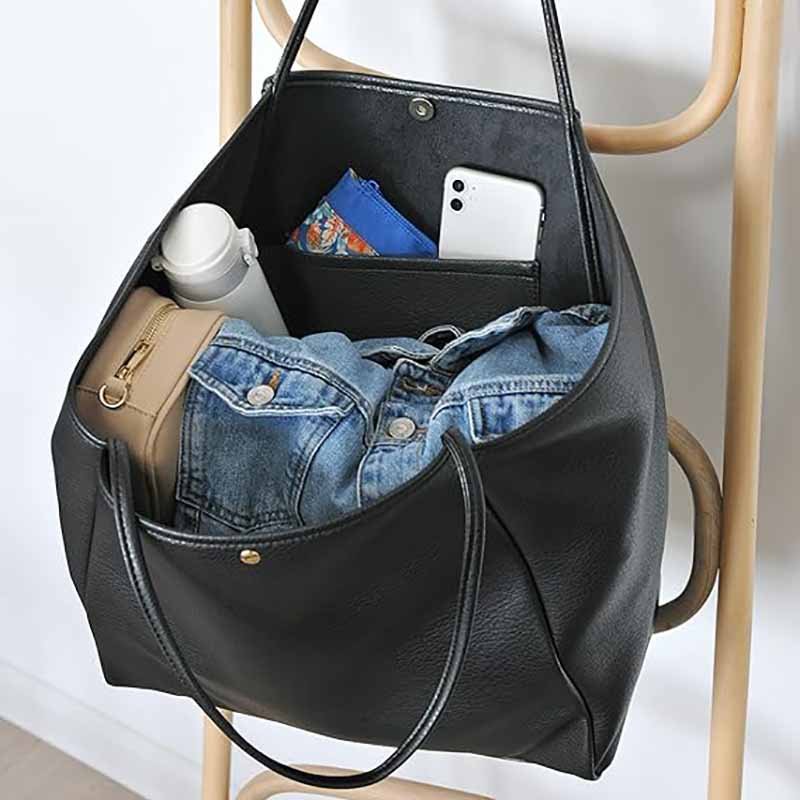
The inside of a leather tote bag should feel clean, smooth, stable, and easy to use. Interior organization design is not only about pocket layout. It also depends on lining touch, weight, stitching, reinforcement, opening shape, and how easily users can reach their items. A good interior feels quiet, polished, and natural in the hand.
Soft lining or firm lining
Lining choice strongly affects how a leather tote bag feels inside. A soft lining gives a relaxed, premium touch. A firm lining helps the bag hold shape and keeps pockets cleaner. The right choice depends on the leather type, tote size, target price, and product use.
Common lining options for leather tote bags include polyester, cotton blend, microfiber, suede-like material, canvas, nylon, and synthetic leather. Each material has different performance in weight, touch, durability, cost, and cleaning.
| Lining Material | Feel | Strength | Cleaning | Best For |
|---|---|---|---|---|
| Polyester | Smooth, light | Medium | Easy | Standard daily totes |
| Cotton blend | Natural, soft | Medium | Medium | Casual leather totes |
| Microfiber | Soft, premium | Good | Medium | Premium leather totes |
| Suede-like lining | Luxury feel | Medium | Harder | High-end fashion totes |
| Nylon | Smooth, practical | Good | Easy | Travel and work totes |
| Canvas | Firm, textured | Strong | Medium | Structured casual totes |
A soft lining works well for fashion totes, where hand feel and visual warmth matter. But if the tote needs to carry laptops, documents, bottles, and daily tools, a slightly firmer lining may perform better. Firm lining helps pockets stay open, reduces wrinkling, and supports the shape of the inner walls.
Color is another practical issue. Light lining looks clean and high-end, but it can show makeup stains, pen marks, and dirt more easily. Black lining hides stains but makes small items harder to see. Mid-tone colors such as beige, taupe, grey, coffee, or dark khaki often create a good balance between elegance and usability.
For custom projects, SzoneierLeather can help clients compare lining samples by touch, thickness, color, friction, folding, and stitching performance. This matters because lining that looks good as a swatch may behave differently once sewn into a large leather tote.
Lightweight inner structure
A leather tote bag should feel substantial but not tiring. This balance is not easy. Leather itself already adds weight, and every interior feature adds more. Laptop padding, zipper dividers, reinforced panels, metal hooks, thick lining, and bottom boards can make a tote more functional but also heavier.
For daily leather tote bags, the finished weight is often a major customer concern. Many users prefer a tote that stays under around 1.0–1.2 kg before loading, especially for women’s work bags and commuting totes. Larger structured leather totes may go above that range, but the design must justify the extra weight through better function and durability.
Weight control should be considered from the beginning, not after the sample is finished. Several choices affect weight:
- Leather thickness.
- Lining material.
- Padding thickness.
- Hardware size.
- Zipper length.
- Number of pockets.
- Reinforcement material.
- Bottom board thickness.
- Handle construction.
A lightweight inner structure does not mean weak construction. It means using the right material in the right place. For example, the laptop section may need padding, but the phone pocket does not. The base may need reinforcement, but the full side wall may not need heavy stiffener. The zipper pocket needs strong stitching, but it does not always need thick lining.
| Design Element | Adds Function | Adds Weight | Weight-Control Method |
|---|---|---|---|
| Laptop padding | Device protection | Medium | Use 3–5 mm padding for slim work totes |
| Bottom board | Shape support | Medium | Choose moderate thickness |
| Metal hardware | Premium feel | Medium-high | Use only where needed |
| Zipper divider | Better separation | Medium | Use lighter lining and smooth zipper |
| Extra pockets | Better storage | Low-medium | Keep pocket count focused |
| Thick lining | Stronger hand feel | Medium | Use firm but not overly heavy material |
For brands, weight can affect product reviews. A tote that photographs beautifully but feels heavy after 20 minutes may lose daily-use appeal. SzoneierLeather can adjust material choices during sampling to reach a better balance between structure and comfort.
Clean stitching details
Stitching inside a leather tote bag is not just a production detail. It affects strength, appearance, and trust. When a customer opens the tote, messy stitching immediately lowers the product value. Uneven pocket edges, loose thread, wavy zipper lines, and weak bar-tacks make the inside feel unfinished.
Interior stitching should be clean because pockets receive repeated stress. Users pull phones in and out, open zipper pockets, insert laptops, clip keys, and push wallets into small compartments. If stitches are weak, the pocket corners may tear. If the seam allowance is too narrow, the lining may split. If the thread tension is poor, the pocket edge may wrinkle.
Important stitching points include:
- Pocket opening edges.
- Zipper ends.
- Laptop sleeve corners.
- Key leash attachment.
- Divider panel connection.
- Bottom lining seams.
- Handle connection areas near the body.
- Side seam intersections.
For stronger interior pockets, reinforcement stitches or bar-tacks can be added at stress points. However, they should be placed neatly. A functional reinforcement should not make the bag look rough. Thread color also matters. Matching thread gives a clean, quiet look. Contrast thread can look stylish but exposes every sewing mistake, so it needs higher production control.
For custom leather tote production, interior stitching should be checked during sampling and bulk production. The sample may look good with careful hand handling, but bulk production needs stable standards. SzoneierLeather’s quality inspection process can cover stitch length, thread trimming, pocket alignment, zipper flatness, lining cleanliness, and pull-strength areas.
Smooth hand feel
The inside of a leather tote bag should feel pleasant when the user reaches in. This sounds simple, but it involves many details: lining texture, seam finishing, pocket edge smoothness, zipper pull placement, hardware position, and opening width. If the user’s hand catches on rough stitching, sharp zipper teeth, stiff pocket edges, or loose lining, the product feels lower in quality.
Smooth hand feel is especially important for premium leather totes. A customer paying for a leather product expects more than storage. She expects a certain calm, polished experience. The hand should move naturally from the opening to the pocket. The phone should slide in easily. The zipper should not scratch the hand. The lining should not feel noisy, plastic-like, or loose.
Several design details help improve hand feel:
- Use smooth lining with suitable thickness.
- Keep zipper ends covered or neatly finished.
- Avoid sharp hardware inside the main space.
- Make slip pocket openings slightly firm but not tight.
- Keep seam allowances flat.
- Use clean edge binding where needed.
- Avoid bulky intersections at pocket corners.
- Test access with real items during sampling.
The opening shape also matters. A tote with a narrow opening may look elegant but can make the interior hard to use. A tote with a wide opening offers better access but may need better closure or side support. The best design depends on the product style. A luxury fashion tote can have a softer opening, while a work tote should allow easier access to laptop and documents.
Smooth hand feel is one reason factory experience matters. The same pocket drawing can feel very different depending on lining choice, seam finish, sewing accuracy, and material tension. SzoneierLeather can adjust these technical details during sample development so the final tote feels better in real use.
Easy item access
Easy item access is the core of interior organization design. A tote can have many compartments, but if users cannot reach them quickly, the design fails. The inside should support natural movement. Phone, keys, wallet, and card should be easy to reach. Laptop and documents should slide in smoothly. Valuables should stay secure but not be difficult to remove.
A good access flow usually follows item frequency:
- Most-used items should sit near the top opening.
- Valuable items should sit in secure zipper areas.
- Heavy items should sit close to the body or bottom.
- Flat items should sit in wall pockets or sleeves.
- Wet or dirty items should sit in side zones or removable pockets.
- Small items should not mix with large items.
Designers and factories should think about how the user moves through a day. In the morning, she may pack a laptop, charger, notebook, wallet, keys, cosmetics, and bottle. On the way to work, she may need her phone and transit card quickly. During a meeting, she may pull out documents. At lunch, she may reach for wallet and lipstick. At night, she may need keys at the door. The tote interior should support these moments without friction.
A useful test during sampling is the “30-second use test.” Put common items into the sample and check whether a user can find each one within 30 seconds without looking too hard. If the user keeps digging, the pocket layout needs adjustment.
| Item | Access Priority | Best Position | Design Note |
|---|---|---|---|
| Phone | Very high | Upper slip pocket | One-hand reach |
| Keys | Very high | Key leash near opening | Avoid bottom searching |
| Wallet | High | Zipper pocket or secure zone | Balance security and access |
| Laptop | Medium | Padded sleeve | Easy vertical removal |
| Charger | Medium | Slip or pouch pocket | Avoid cable tangling |
| Bottle | Medium | Side holder | Keep upright |
| Passport | High during travel | Hidden zipper pocket | Safe but reachable |
| Cosmetics | Medium | Small pocket or pouch | Avoid staining lining |
Easy access does not happen by accident. It comes from measuring real items, testing real movements, and adjusting the interior before bulk production. For brands building long-term leather tote collections, this type of detail can turn a basic product into a daily favorite.
How Does Design Affect Production?
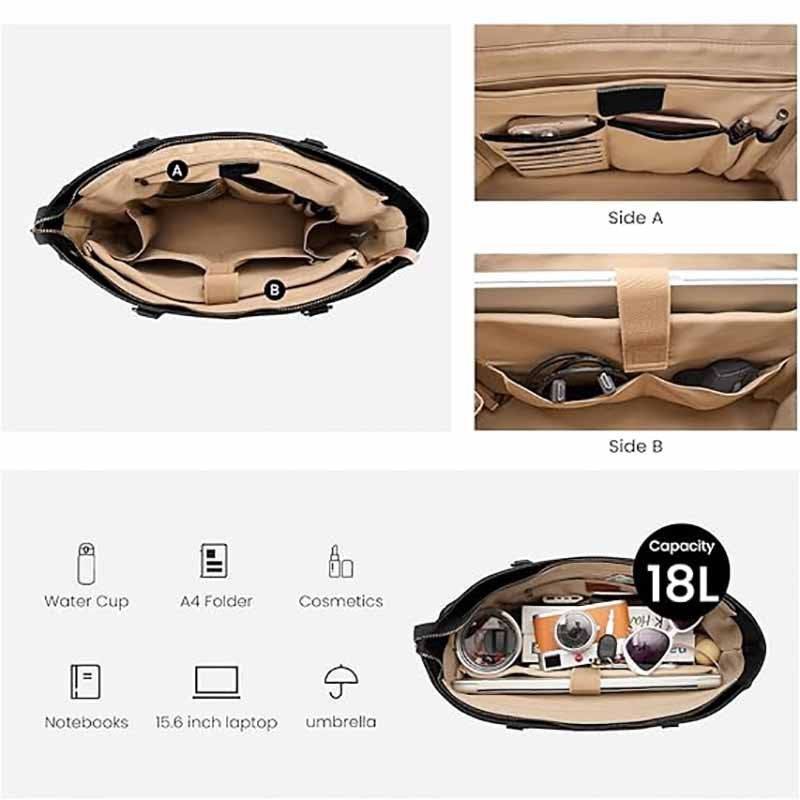
Interior organization design in leather tote bags directly affects pattern making, cutting, sewing time, material usage, weight, cost, and quality control. More compartments can improve function, but they also create more production steps. A smart design should be easy to use, attractive to customers, and stable enough for repeat bulk manufacturing.
Pattern making for inner pockets
Interior pockets may look small, but they can strongly affect the full pattern structure of a leather tote bag. Every pocket needs its own panel size, seam allowance, folding method, reinforcement area, and sewing sequence. If the inner pattern is not planned correctly, the finished tote may look uneven, feel bulky, or lose usable space.
For leather tote bags, pattern making usually starts from the outer body size. Once the main body width, height, depth, and handle drop are confirmed, the interior layout can be developed around real storage needs. A work tote with a laptop sleeve needs more precise measurement than a casual open tote. A travel tote with hidden pockets and zipper closure needs more pattern pieces and more sewing steps.
Key pattern decisions include:
- Main compartment width and depth.
- Pocket opening size.
- Pocket depth.
- Pocket placement height.
- Lining panel size.
- Seam allowance.
- Reinforcement placement.
- Zipper pocket construction.
- Laptop sleeve allowance.
- Bottom support size.
A common mistake is designing pockets based only on appearance. A pocket may look balanced on a drawing, but after sewing, it may become too tight, too low, or too difficult to reach. Leather and lining also behave differently. Leather has thickness and tension. Lining may stretch, wrinkle, or shift during sewing. That is why a factory must check both the paper pattern and the physical sample.
For example, if a phone pocket is designed at 9 cm wide on paper, the finished usable width may become closer to 8 cm after seam allowance and lining thickness. If the customer uses a phone with a thick protective case, the pocket may feel too tight. A professional factory will leave enough tolerance according to the target item and material behavior.
| Interior Part | Pattern Concern | Common Risk | Better Development Method |
|---|---|---|---|
| Phone pocket | Finished usable width | Too tight after sewing | Add case allowance |
| Laptop sleeve | Width, height, padding | Device hard to insert | Test with real laptop |
| Zipper pocket | Opening length | Wavy zipper line | Reinforce zipper edge |
| Bottle holder | Diameter and height | Bottle pulls lining | Add side support |
| Divider panel | Height and stability | Bag feels crowded | Balance open space |
| Key leash | Attachment point | Tearing after pulling | Reinforce stress area |
For SzoneierLeather custom projects, pattern development is not only about copying a client sketch. The team can help review whether the interior design is realistic for the selected leather, lining, target price, and order quantity. This step can reduce sample revisions and make bulk production more stable.
Reinforcement for tote shape
A leather tote bag often needs reinforcement because the interior is asked to carry many different weights: laptop, documents, wallet, cosmetics, bottle, power bank, books, or samples. Without the right reinforcement, the tote may look nice when empty but collapse after loading.
Reinforcement can be added in several areas:
- Bottom panel.
- Side walls.
- Laptop sleeve.
- Pocket openings.
- Handle connection area.
- Zipper pocket edge.
- Divider panel.
- Top opening.
The goal is not to make every part stiff. Too much reinforcement can make the bag heavy, rigid, and uncomfortable. The better method is targeted reinforcement. The parts that carry weight or receive repeated movement should be stronger. The parts that need softness and flexibility should stay lighter.
For example, a laptop sleeve needs padding and stable side support, but a lipstick pocket does not need heavy reinforcement. A bottom panel needs support because it carries weight, while the upper lining can remain softer for a better hand feel. A key leash attachment should be reinforced because users pull it repeatedly, while a decorative logo patch may only need clean stitching.
The reinforcement material should match the leather type. Soft full-grain leather may need more body support to hold a tote shape. Split leather or corrected-grain leather may already have more firmness depending on finish and backing. Thicker leather can provide structure but also increases weight. For large tote bags, a structured base and controlled lining tension are often more important than using very thick leather everywhere.
| Tote Area | Reinforcement Level | Reason | Customer Benefit |
|---|---|---|---|
| Bottom panel | Medium to strong | Supports full load | Bag stands better |
| Laptop sleeve | Medium | Protects device | Laptop stays stable |
| Pocket opening | Light to medium | Prevents stretching | Pockets last longer |
| Handle base | Strong | Carries full weight | Less risk of tearing |
| Side wall | Light to medium | Controls shape | Cleaner silhouette |
| Top opening | Light | Keeps line neat | Easier access |
Reinforcement also affects packaging and shipping. A highly structured tote may need more protective packing to avoid deformation during transportation. A softer tote may pack more easily but needs proper stuffing to maintain shape. For brands planning wholesale or e-commerce shipping, packaging design should be considered along with interior structure.
SzoneierLeather’s leather goods development experience can support this balance. The factory can suggest different reinforcement combinations based on product use, price point, and order volume, helping brands avoid bags that are either too soft to function or too stiff to feel comfortable.
Stitching for daily load
Stitching is one of the most important production details in leather tote bags because it connects the interior organization to real daily use. Pockets are constantly pulled, opened, loaded, and pressed. If the stitching is weak, even a beautiful layout can fail.
Interior stitching must handle repeated stress in several areas:
- Laptop sleeve corners.
- Zipper pocket ends.
- Slip pocket side seams.
- Key leash attachment.
- Bottle holder seams.
- Divider panel base.
- Bottom lining connection.
- Handle attachment points.
A leather tote used for work may carry 2–5 kg of daily items. A laptop alone can weigh 1.2–2 kg. Add a charger, water bottle, notebook, wallet, and cosmetics, and the total load increases quickly. Interior pockets must be sewn with this load in mind.
Pocket corners are especially important. When users insert and remove items, the corner points receive repeated tension. Reinforcement stitching or bar-tack stitching can help. For premium leather totes, reinforcement should be clean and controlled, not bulky or messy. The goal is strength without damaging the inside appearance.
Thread choice also matters. Strong polyester thread is commonly used because it offers good durability and stability. Thread thickness should match the leather and lining. Heavy thread may look strong but can feel rough inside. Thin thread may look clean but may not provide enough strength for stress points.
Stitch density affects both appearance and function. Too few stitches may reduce strength. Too many stitches can perforate leather or create tension problems. For leather goods, the correct stitch spacing depends on leather thickness, seam position, and design style.
| Stitching Area | Risk If Weak | Suggested Control Point |
|---|---|---|
| Laptop sleeve corner | Sleeve tears under device weight | Reinforced corner stitching |
| Zipper pocket end | Zipper pulls loose | Strong end locking |
| Slip pocket side | Pocket opens after repeated use | Bar-tack or double stitch |
| Key leash point | Attachment tears | Reinforced backing |
| Bottle pocket seam | Lining stretches or tears | Strong side seam support |
| Bottom seam | Lining separates | Clean seam allowance |
For bulk production, stitching consistency is just as important as sample quality. A perfect sample does not guarantee perfect mass production. SzoneierLeather can support quality checks on stitch length, seam alignment, thread trimming, pocket strength, zipper flatness, and internal cleanliness before shipment.
Sampling the interior layout
Sampling is where a leather tote bag interior becomes real. A drawing can show pocket positions, but only a physical sample can reveal whether the layout works in daily use. The sample should be tested with real items, real hands, and real movements.
During sampling, brands should check more than appearance. They should test the full use experience:
- Can the phone be inserted and removed easily?
- Does the laptop sleeve fit the target device?
- Does the tote stand when loaded?
- Does the zipper pocket open smoothly?
- Does the lining wrinkle after filling the bag?
- Is the bag too heavy when empty?
- Are pocket openings easy to reach?
- Does the bottle holder affect the main space?
- Does the interior match the target retail price?
- Does the structure look the same after carrying?
A sample should be tested both empty and loaded. Many tote bags look beautiful empty but become awkward when filled. The laptop may tilt. The bottle may pull one side down. The zipper divider may make the main space too narrow. The lining may wrinkle under pressure. These issues are easier to fix during sampling than after bulk production.
A practical sample test can include a daily loading set:
| Test Item | Suggested Weight or Size | Test Purpose |
|---|---|---|
| Laptop | 13–15 inch, 1.2–2 kg | Sleeve fit and balance |
| Water bottle | 500–750 ml | Side pocket strength |
| Wallet | Standard long or short wallet | Zipper pocket usability |
| Phone | Large smartphone with case | Slip pocket sizing |
| Notebook | A5 or A4 | Document space |
| Charger | 150–300 g | Small-item storage |
| Cosmetics pouch | 15–20 cm width | Main compartment flexibility |
For custom leather tote projects, the first sample should not be treated as the final answer. It is a working model. Small adjustments to pocket width, lining thickness, zipper position, or bottom support can greatly improve the final product. SzoneierLeather can help clients refine the sample based on actual use feedback, target market needs, and production feasibility.
Checking pocket size and fit
Pocket size and fit must be checked carefully because customers judge a tote by whether their items actually fit. A pocket that is only slightly wrong can cause repeated frustration. A phone pocket that is 1 cm too narrow, a laptop sleeve that is 1 cm too short, or a zipper pocket that cannot fit a passport can lead to poor product reviews.
Pocket checking should include three measurements:
- Pattern measurement before cutting.
- Finished measurement after sewing.
- Usable measurement after lining, padding, and seam allowance.
The usable measurement is the most important. A pocket may be 10 cm wide on the pattern, but after sewing, padding, folding, and lining thickness, the usable space may be smaller. For laptop sleeves, this difference can be even more obvious.
Brands should confirm pocket requirements based on real target items. For example:
- Large smartphone with case.
- Passport.
- A5 notebook.
- A4 documents.
- 13-inch laptop.
- 14-inch laptop.
- 15-inch laptop.
- Standard long wallet.
- 500 ml bottle.
- Compact umbrella.
A good pocket fit should be secure but not tight. Users should be able to insert and remove items smoothly. If the pocket requires force, it will not be used. If the pocket is too loose, the item may fall out or move around.
| Item | Practical Pocket Direction | Fit Requirement |
|---|---|---|
| Large phone | Upper slip pocket | Easy one-hand access |
| Passport | Zipper or hidden pocket | Secure but quick to reach |
| Laptop | Padded sleeve | Stable with slight allowance |
| Long wallet | Zipper pocket or main space | No bending or force |
| Bottle | Side sleeve | Upright and supported |
| Keys | Key leash | Easy to pull and return |
| Charger | Small slip pocket or pouch | Avoid cable tangling |
For leather tote bags, pocket fit is not only a function issue. It is also a brand promise issue. If a product page says the tote fits a 14-inch laptop, the physical product must do that comfortably. SzoneierLeather can help clients test samples with target item sizes before moving into bulk production.
How Can Brands Customize It?
Brands can customize interior organization design in leather tote bags through pocket layout, lining material, laptop sleeve size, zipper structure, removable inserts, logo placement, hardware color, and packaging. Custom development should match the target customer, retail price, and product use, not simply add more features.
Custom interior organization design
Custom interior organization design allows a leather tote bag to serve a clear customer group. A fashion tote, work tote, travel tote, business tote, and lifestyle tote should not all share the same inside structure. The outside may look similar, but the user’s daily needs are different.
For a work tote, the interior may focus on laptop protection, document space, and clean business storage. For a travel tote, the design may focus on zipper security, passport access, and bottle storage. For a fashion tote, the goal may be a clean, light, beautiful lining with discreet pockets. For a boutique brand, custom lining color and logo details may be more important than a complex pocket system.
Custom interior options can include:
- One main open compartment.
- Two-section layout.
- Three-section layout.
- Center zipper divider.
- Laptop sleeve.
- Tablet pocket.
- Inner zipper pocket.
- Hidden back-wall pocket.
- Phone pocket.
- Card slot.
- Pen slot.
- Bottle holder.
- Key leash.
- Removable insert.
- Detachable pouch.
The best custom design starts with a clear product direction. Brands should not begin with “how many pockets can we add?” A better question is “what does our customer carry every day?” Once the customer use scenario is clear, the pocket structure becomes much easier to plan.
SzoneierLeather can help clients turn reference images, sketches, size ideas, or existing product samples into a more complete development plan. Because the company has capabilities in raw material supply, product design, sampling, manufacturing, packaging, and quality inspection, the interior structure can be developed together with the full leather tote design.
Custom leather tote bag pockets
Custom pockets can make a leather tote more useful and more memorable. However, each pocket should have a clear job. A pocket that does not solve a real problem only adds cost and weight.
The most requested custom pocket types include:
- Laptop sleeve.
- Tablet sleeve.
- Phone pocket.
- Zipper pocket.
- Hidden pocket.
- Passport pocket.
- Bottle pocket.
- Pen pocket.
- Card pocket.
- Sunglasses pocket.
- Makeup pocket.
- Key leash pocket.
- Charger pocket.
- Detachable pouch.
Pocket design should also match the product’s style. A luxury leather tote may use a clean wall pocket with minimal visible stitching. A business tote may use more structured compartments. A travel tote may use security-focused zipper pockets. A young fashion brand may prefer colorful lining and simple slip pockets for daily items.
Pocket position is just as important as pocket type. A phone pocket should be easy to reach. A laptop sleeve should not make the tote unbalanced. A passport pocket should feel secure. A bottle holder should not occupy too much main space. A card pocket should not be so deep that cards become hard to remove.
| Pocket Type | Main Use | Recommended Product Direction |
|---|---|---|
| Laptop sleeve | Device protection | Work tote, business tote |
| Phone pocket | Fast access | Daily tote, commuter tote |
| Zipper pocket | Secure storage | All premium tote styles |
| Hidden pocket | Private valuables | Travel tote, city tote |
| Bottle holder | Upright storage | Travel, lifestyle, parenting tote |
| Card slot | Quick access | Work tote, compact daily tote |
| Key leash | Easy key finding | Daily tote, travel tote |
| Detachable pouch | Flexible storage | Giftable tote, premium tote |
For custom development, pocket dimensions should be confirmed before sampling. SzoneierLeather can help adjust pocket size based on real item measurements and the selected leather/lining structure.
Logo details inside
Interior logo details can strengthen brand identity without making the outside too busy. Many leather brands prefer clean exterior designs, so the inside becomes a good place to add subtle branding. A well-placed inner logo can make the product feel more complete and premium.
Common interior logo options include:
- Embossed leather logo patch.
- Debossed logo on inner pocket.
- Woven label.
- Metal logo plate.
- Printed lining logo.
- Custom zipper pull logo.
- Branded key leash.
- Branded detachable pouch.
- Care label with brand story.
For premium leather tote bags, an embossed or debossed leather logo patch often looks more refined than a large printed label. For fashion or lifestyle brands, custom lining print can create a stronger visual effect. For corporate gifts or wholesale programs, a woven label may be cost-efficient and easy to scale.
Logo placement should not interfere with function. A logo patch placed too close to a phone pocket may rub against devices. A metal plate inside the main compartment may scratch items if not positioned carefully. A printed lining logo should be tested for color fastness and abrasion.
Interior branding should support the product story. For example, a work tote may use a small leather logo patch on the zipper pocket. A travel tote may use a branded passport pocket. A boutique fashion tote may use contrast lining with a subtle woven label. These details make the interior feel designed, not generic.
SzoneierLeather can support different logo techniques depending on leather type, lining material, order volume, and brand positioning. The logo method should be confirmed during sampling so the final effect matches the client’s visual standard.
Removable insert options
A removable insert can make a leather tote bag more flexible. It allows users to organize items inside the tote while keeping the main bag open and clean. Some users like inserts because they can move items between bags. Some brands use inserts as a premium upgrade or functional selling point.
A removable insert can include:
- Laptop sleeve.
- Zipper compartment.
- Slip pockets.
- Bottle holder.
- Key leash.
- Small pouch.
- Divider panels.
- Snap or hook attachment points.
The biggest advantage of a removable insert is flexibility. A customer can use the tote with the insert for work and remove it for shopping or travel. Brands can also offer different insert versions for different product lines. For example, one insert can be designed for office users, while another can be designed for travel or parenting.
However, removable inserts need careful development. If the insert is too small, it shifts inside the bag. If it is too large, it becomes hard to remove. If it is too heavy, the tote becomes uncomfortable. If the insert material is too soft, it collapses and loses function.
| Insert Type | Advantage | Development Concern |
|---|---|---|
| Soft fabric insert | Lightweight, flexible | Less structure |
| Structured insert | Better organization | Adds weight |
| Laptop insert | Protects devices | Needs precise sizing |
| Travel insert | More compartments | Can feel bulky |
| Removable pouch | Easy transfer | Limited capacity |
For leather tote brands, a removable insert can also reduce the need to overbuild the main lining. The tote can stay elegant and open, while the insert provides extra function. This is useful for brands that want a clean exterior and flexible interior.
SzoneierLeather can help develop removable inserts as part of a full tote project, including size testing, pocket layout, material selection, attachment method, and packaging.
Packaging for brand presentation
Interior organization design does not stop at the bag itself. Packaging also affects how customers understand the product. A well-designed leather tote with smart interior features should be packed in a way that protects its shape and shows its value.
Leather tote packaging may include:
- Dust bag.
- Shape-support stuffing.
- Handle wrapping.
- Hardware protection.
- Tissue paper.
- Care card.
- Product tag.
- Brand card.
- Custom box.
- Shipping carton protection.
For structured tote bags, packaging must prevent deformation. The bottom and side walls should be supported during transport. The handles should not press into the leather surface. Metal hardware should be wrapped to avoid scratches. If the tote includes a removable insert, the insert should be placed neatly inside or packed separately according to the presentation style.
Packaging can also explain interior features. A small card can show laptop fit, pocket function, leather care, or brand story. This is useful for e-commerce brands because customers may not immediately notice every interior detail. Clear presentation helps customers understand why the tote is more valuable than a basic open bag.
| Packaging Element | Purpose | Brand Value |
|---|---|---|
| Dust bag | Protects leather | Premium feeling |
| Care card | Explains maintenance | Builds trust |
| Shape support | Prevents deformation | Better unboxing |
| Hardware wrap | Avoids scratches | Cleaner product arrival |
| Custom box | Improves gift value | Stronger brand image |
| Feature card | Explains interior layout | Helps customer understand function |
SzoneierLeather can support packaging design and packaging quality inspection for custom leather tote projects. This is important for brands selling through e-commerce, boutiques, corporate channels, or premium retail. The customer’s first physical contact with the product starts before she even opens the tote.
Start Your Custom Leather Tote Project with SzoneierLeather
Interior organization design in leather tote bags is one of the most important details behind real product satisfaction. A tote may attract attention with leather color, shape, and hardware, but the inside decides whether customers use it every day. Phone pockets, laptop sleeves, zipper compartments, bottle holders, lining choice, stitching strength, and access flow all affect how the bag feels in real life.
For brands, custom wholesalers, private label clients, and leather goods companies, a strong tote project should not stop at a beautiful exterior. The interior should match the target user, the selling price, the market channel, and the daily carrying scene. A work tote, travel tote, fashion tote, and lifestyle tote each need a different internal structure.
SzoneierLeather is a leather goods R&D and manufacturing factory with more than 18 years of experience. The company supports leather bags, wallets, belts, straps, accessories, leather boxes, and other custom leather products. With raw material supply chain resources, product design, sampling, manufacturing, packaging design, and quality inspection capabilities, SzoneierLeather can help clients develop leather tote bags from concept to bulk production.
If you are developing a leather tote bag collection and want the inside to work as well as the outside looks, SzoneierLeather can help review the structure, improve the pocket layout, create samples, and support stable production. Send your design idea, reference sample, or product requirement to SzoneierLeather and start building a leather tote that customers can actually enjoy using every day.