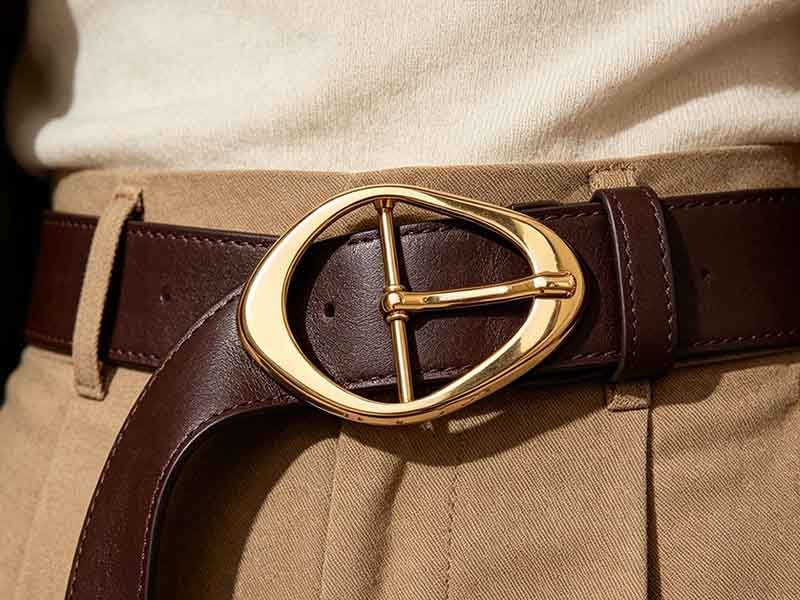
A leather belt is one of those products that looks simple until you start developing it seriously. From a distance, customers see leather color, buckle shape, and maybe a logo. But once the belt is in their hands, the judgment becomes much sharper. They feel the buckle weight. They check whether the prong moves smoothly. They bend the strap near the fold. They look at the holes, edge paint, stitching, keeper loop, and plating color. A belt may only have a few visible components, but every one of them affects how the final product feels, sells, and performs after months of wear.
Leather belt hardware should be selected by matching buckle type, hardware material, plating finish, leather thickness, belt width, logo method, target price, and usage scene. A formal belt needs clean, refined, and balanced hardware. A casual belt can accept stronger and heavier buckles. A luxury belt needs better surface finishing, tighter color control, and stronger custom identity.
For brands, retailers, distributors, and custom wholesale clients, choosing belt hardware is not only a design decision. It affects production cost, sample approval speed, customer reviews, return rate, packaging value, and repeat-order stability. A nice leather strap with weak hardware will still feel cheap. A well-designed buckle with poor plating can create complaints after sweat, humidity, or friction. And a buckle that looks beautiful in a catalog may fail if it does not match the leather thickness or belt structure.
That is why experienced leather goods factories do not treat buckles as small accessories. They treat them as a core part of the product engineering. In this guide, we will look at leather belt hardware options, buckle types, material choices, finish standards, customization methods, and quality testing points that matter before mass production.
What Are Leather Belt Hardware Options?
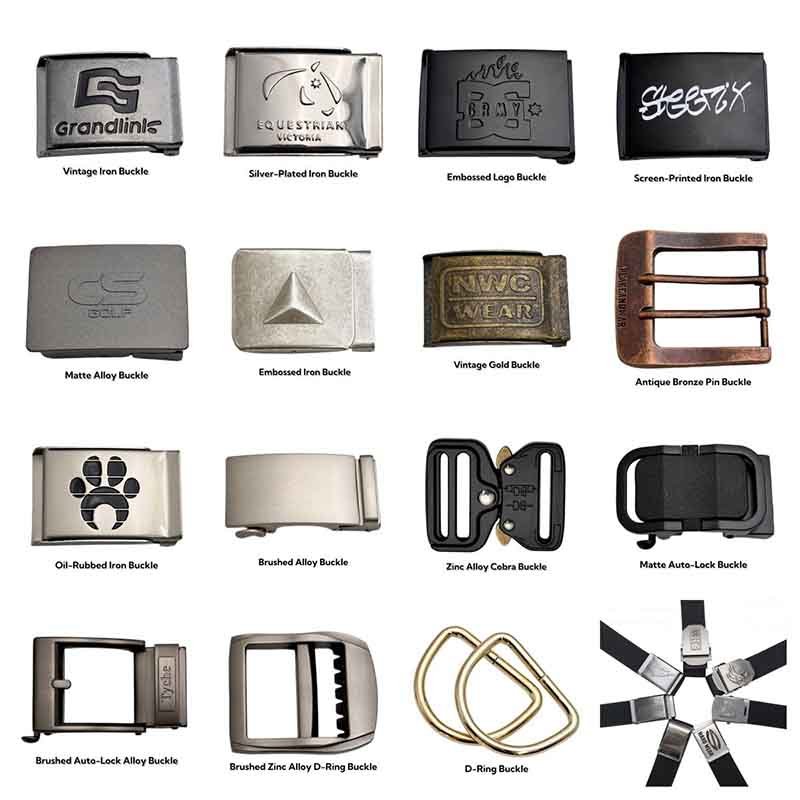
Leather belt hardware includes the buckle, prong, frame, keeper, rivets, screws, snap buttons, logo plates, end tips, adjustment tracks, and decorative metal parts. The correct choice depends on belt width, leather thickness, product positioning, wearing frequency, logo requirements, and quality expectations. Good hardware should look right, function smoothly, resist corrosion, and stay consistent across bulk production.
What hardware parts does a leather belt need?
A standard leather belt usually needs more than just a buckle. Even a clean formal belt may include a buckle frame, buckle prong, leather keeper, metal rivets or screws, punched holes, and a reinforced fold area. More advanced designs may include a removable buckle, reversible rotation joint, automatic ratchet track, metal logo plate, metal end tip, decorative studs, or snap-button opening system.
The hardware system should be decided at the same time as the leather structure. If the buckle is confirmed first but the leather thickness changes later, the frame opening may become too narrow. If the leather is selected first but the buckle weight is too heavy, the belt may feel unbalanced when worn. If the logo method is confirmed too late, the buckle mold, engraving area, or plating process may need to be revised.
For production planning, belt hardware can be divided into four groups:
| Hardware Part | Main Function | Common Options | Key Risk If Poorly Chosen |
|---|---|---|---|
| Buckle frame | Locks and shapes the belt front | Pin, automatic, roller, plate, reversible, double-ring | Wrong size, poor balance, uncomfortable weight |
| Prong or mechanism | Holds the belt in position | Single prong, double prong, ratchet lock, clamp system | Slipping, bending, difficult adjustment |
| Fastening parts | Connect buckle and leather strap | Rivets, Chicago screws, stitching, snap buttons | Loose buckle, weak fold area, hard repair |
| Decorative parts | Improve appearance and branding | Logo plate, studs, end tip, engraved metal piece | Extra weight, plating mismatch, higher defect rate |
A simple belt line may use only standard pin buckles and leather keepers. A more premium line may require custom buckle molds, engraved logos, brass or stainless steel hardware, matching metal end tips, and branded gift packaging. There is no single correct setup. The right structure should match how the product will be sold and used.
For example, a men’s office belt sold as a daily essential should focus on smooth edges, stable buckle movement, clean plating, and leather comfort. A fashion belt may need stronger visual design, special buckle shapes, and seasonal colors. A leather belt gift set may need a reversible buckle, extra strap, polished surface, and packaging that makes the product feel complete.
One mistake many companies make is selecting hardware based only on appearance photos. In real production, the factory must check actual width, inner frame opening, prong length, prong angle, plating thickness, edge polishing, and strap compatibility. A buckle that looks suitable in a photo may scratch the leather, sit at a poor angle, or create pressure marks near the fold after repeated use.
What materials are used for belt hardware?
Belt hardware can be made from zinc alloy, brass, stainless steel, iron, aluminum alloy, and engineered plastic. Each material has a different balance of weight, cost, strength, surface finish, molding flexibility, and corrosion resistance.
Zinc alloy is widely used for fashion belts, private label belts, and custom logo buckles because it can be cast into many shapes. It is suitable for raised logos, special buckle frames, plate buckles, and decorative hardware. Its cost is usually more controlled than brass, and it supports many plating colors. The main concern is plating quality. If the polishing, cleaning, and plating process is weak, zinc alloy hardware may show bubbles, rough spots, color variation, or peeling.
Brass is often chosen for premium leather belts, heritage belts, luxury casual belts, and vintage designs. It has a solid hand feel and ages in a way that many leather customers appreciate. Brass hardware can be polished, brushed, antique-finished, or left with a more natural character. It usually costs more than zinc alloy and iron, but it can improve perceived product value. For brands building a long-term premium leather goods line, brass can be a strong choice when the target retail price supports it.
Stainless steel is clean, strong, and corrosion-resistant. It is suitable for modern belts, minimalist belts, business belts, and products that need better resistance to sweat or humidity. It can feel less warm than brass but more technical and durable. Stainless steel is not always ideal for highly complex decorative shapes, but it works well for refined buckles with simple lines.
Iron is often used in lower-cost or mid-range hardware, especially when the shape is simple. It can perform acceptably when plating is well controlled, but rust prevention must be taken seriously. If the belt will be shipped to humid regions, sold as outdoor wear, or stored for long periods, low-grade iron hardware can create risk.
Aluminum alloy is lighter than many other metal options. It is useful for travel belts, lightweight utility belts, sports-inspired belts, or products where comfort matters more than heavy luxury feel. However, some customers may associate very light hardware with lower value, so the product positioning needs to be clear.
Engineered plastic, POM, or nylon hardware is used in sports belts, children’s belts, outdoor casual belts, and some utility styles. It can reduce weight, avoid metal corrosion, and control cost. But it is usually not the first choice for leather belts positioned as premium, formal, or luxury products.
| Material | Approx. Weight Feel | Cost Level | Shape Flexibility | Corrosion Resistance | Best Product Use |
|---|---|---|---|---|---|
| Zinc alloy | Medium to heavy | Medium | High | Depends on plating | Fashion belts, logo buckles, custom molds |
| Brass | Heavy and solid | High | Medium | Good with proper finish | Premium belts, heritage leather belts |
| Stainless steel | Medium to heavy | Medium to high | Medium | Very good | Modern, formal, and durable belts |
| Iron | Medium | Low | Medium | Needs strong plating | Cost-controlled simple belts |
| Aluminum alloy | Light | Medium | Medium | Good | Travel, outdoor, lightweight belts |
| POM / nylon | Very light | Low to medium | Medium | No rust risk | Sports, kids, and utility belts |
For a practical sourcing decision, the material should be chosen according to three questions:
- What retail price does the final belt need to support?
A belt planned for a premium retail price usually needs hardware with better surface finishing, stable weight, and stronger visual identity. Saving a small amount on the buckle may reduce the perceived value of the whole product.
- What environment will the belt face?
Daily office wear, tropical climate, outdoor use, and warehouse storage all create different hardware risks. Sweat, humidity, friction, and packaging moisture can expose weak plating quickly.
- Does the design need a custom logo or special shape?
If the buckle needs a raised logo or special contour, zinc alloy casting may be more practical. If the design needs classic luxury character, brass may be better. If the product needs clean durability, stainless steel may work well.
For SzoneierLeather belt projects, hardware material is usually reviewed together with leather type, belt thickness, finishing method, order quantity, target price, and packaging level. This prevents one of the most common problems in belt development: a beautiful buckle that does not match the real product structure.
What finishes are common for buckles?
Buckle finish is one of the first things customers notice. It affects the belt’s style, price perception, color harmony, and long-term appearance. Common buckle finishes include polished nickel, brushed nickel, chrome, gunmetal, antique brass, polished brass, matte black, brushed black, gold, rose gold, vintage silver, and custom color plating.
A polished finish looks brighter and more formal, but it can show fingerprints and scratches more easily. A brushed finish is softer and often feels more modern. Antique finishes work well with textured leather, pull-up leather, crazy horse leather, waxed leather, and vintage-style belts. Matte black works well for urban, outdoor, tactical-inspired, and minimalist belts. Gold and rose gold can add strong fashion value, but the plating quality must be controlled carefully because color inconsistency is easy to notice.
The finish should also match the leather color and surface texture. Smooth black leather with polished nickel creates a formal look. Brown full grain leather with antique brass feels warmer and more casual. Pebbled black leather with gunmetal feels modern and premium. Suede with bright gold can work for women’s fashion belts, but it may feel too decorative for men’s daily belts.
| Buckle Finish | Visual Effect | Good Leather Match | Product Direction | Quality Control Focus |
|---|---|---|---|---|
| Polished nickel | Bright, clean, formal | Black, navy, dark brown | Office belts, dress belts | Scratch marks, plating shine |
| Brushed nickel | Soft, modern, refined | Black, tan, grey, brown | Minimalist belts | Brush direction, color consistency |
| Gunmetal | Dark, premium, low-key | Black, charcoal, navy | Business casual, men’s belts | Color stability, surface stains |
| Antique brass | Warm, vintage, rugged | Brown, cognac, olive, pull-up leather | Heritage and casual belts | Antique effect consistency |
| Matte black | Clean, urban, strong | Black, grey, dark brown | Outdoor, streetwear, utility belts | Edge wear, coating adhesion |
| Polished gold | Luxury, decorative | Black, white, burgundy | Fashion belts, gift belts | Color control, anti-fading |
| Rose gold | Soft, fashionable | Beige, cream, pink, white | Women’s belts | Color matching, plating uniformity |
| Vintage silver | Aged, relaxed, textured | Suede, distressed leather, dark brown | Casual and western styles | Oxidation effect balance |
A good plating finish should not only look attractive when new. It should also survive real use. For belts, the buckle repeatedly touches clothing, hands, tables, belt loops, packaging inserts, and the leather strap itself. This creates surface friction. If the plating layer is weak, the buckle may fade, peel, or show base metal too quickly.
Important finish checks before production include:
- Surface smoothness
The buckle should not have obvious pits, bubbles, rough polishing marks, black spots, water stains, or sharp residues. Poor polishing before plating often creates defects that cannot be hidden later.
- Color consistency
Bulk hardware should match the approved sample. Gold, rose gold, gunmetal, and antique finishes need extra control because small color differences are highly visible.
- Edge safety
Inner frame edges and prong edges must be smooth. Sharp edges can scratch leather during assembly or wear.
- Plating adhesion
The finish should not peel easily under tape testing, bending contact, or light abrasion checks.
- Corrosion resistance
Salt spray testing is commonly used for metal hardware. A 24-hour test may be enough for some basic products, while more demanding projects may request 48 hours, 72 hours, or more depending on the market and quality agreement.
- Packaging compatibility
Some packaging materials, glues, moisture, or anti-mold chemicals may affect plated hardware during long storage or sea shipment. For premium belt packaging, the factory should test how the buckle sits inside the box or dust bag.
For brands selling through retail stores, online shops, or distributors, plating complaints can damage trust quickly because customers can see the problem immediately. The buckle is right at the front of the product. This is why SzoneierLeather normally recommends confirming finish swatches, approved hardware samples, and test requirements before mass production instead of relying only on digital photos.
Which Buckle Types Are Most Popular?
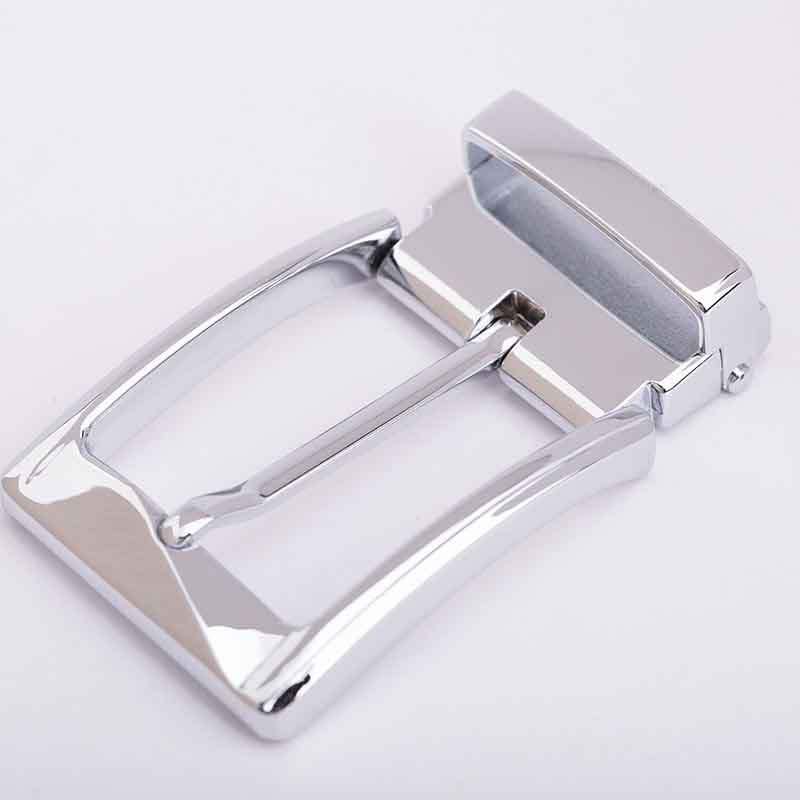
The most used leather belt buckle types include pin buckles, automatic buckles, reversible buckles, double-ring buckles, roller buckles, center-bar buckles, plate buckles, and clamp buckles. Pin buckles are the most classic option. Automatic and reversible buckles are common for modern business belts. Roller, double-ring, and plate buckles are often used for casual, fashion, and lifestyle designs.
What is a pin buckle?
A pin buckle is the classic belt buckle structure. It has a metal frame and a prong that passes through punched holes in the leather strap. This design has been used for decades because it is simple, reliable, easy to understand, and suitable for many belt categories.
For men’s dress belts, a pin buckle usually has a clean rectangular frame, controlled thickness, and polished or brushed finish. For casual belts, the pin buckle may be larger, heavier, rounded, antique-finished, or combined with a roller. For women’s belts, pin buckles may be slimmer, oval-shaped, decorative, or finished in gold, rose gold, or light nickel.
The main advantages of pin buckles are:
- Easy customer acceptance
Most customers already know how to use a pin buckle. There is no need to explain the mechanism.
- Stable cost control
Standard pin buckles are available in many sizes, materials, and finishes. This helps with sampling speed and order planning.
- Wide leather compatibility
Pin buckles can work with full grain leather, top grain leather, split leather, suede, PU leather, recycled leather, and coated leather, as long as thickness and hole strength are controlled.
- Simple repair or replacement
A belt with screws or snap buttons can sometimes allow the buckle to be changed or replaced.
The main risks are prong bending, hole stretching, poor edge polishing, incorrect prong length, and buckle-frame mismatch. If the prong is too short, it may not hold securely. If it is too long, it may press awkwardly or scratch the leather. If the buckle frame is too narrow for the strap thickness, the leather fold becomes bulky and uncomfortable.
For a standard leather belt using a pin buckle, the factory should check these points before production:
| Check Point | Recommended Review |
|---|---|
| Belt width vs buckle inner width | Strap should pass smoothly without excessive gap |
| Leather thickness at fold | Folded area should not become too bulky |
| Prong length and angle | Prong should enter holes cleanly |
| Hole reinforcement | Holes should resist tearing and stretching |
| Edge polishing | No sharp parts touching leather |
| Plating surface | No bubbles, scratches, stains, or color drift |
| Keeper position | Should hold strap tail naturally |
Pin buckles remain one of the safest choices for many belt programs. They are especially suitable when the product needs broad acceptance, controlled production risk, and a classic leather goods feeling.
What is an automatic buckle?
An automatic buckle uses a ratchet, sliding lock, or track system instead of traditional punched holes. The strap usually has a hidden track on the back side, and the buckle locks into the track at small adjustment intervals. This allows customers to adjust the belt more precisely than a standard hole belt.
Automatic buckles are popular for business belts, gift sets, travel belts, and modern men’s accessories. The front surface looks clean because there are no visible adjustment holes. This gives the belt a smooth and polished appearance, especially when paired with black or brown leather.
The main selling points of automatic buckles are:
- Cleaner appearance
No visible holes on the front side of the belt. This helps the product look more modern and refined.
- More precise fit
The ratchet system allows smaller adjustment steps than normal belt holes. This can improve wearing comfort after meals, travel, or long office days.
- Strong gift value
Automatic belts often feel more mechanical and special when customers open the box and test the mechanism.
- Easy sizing
Many automatic belts can be trimmed from the buckle end, which helps with inventory planning and customer fit.
The main concern is mechanism quality. A low-grade automatic buckle may slip, jam, make noise, or fail after repeated use. The release button must feel smooth, not loose. The ratchet teeth must hold firmly without damaging the track. The buckle body must close tightly around the strap without creating pressure marks.
For automatic belt development, several technical details matter:
| Technical Item | Why It Matters |
|---|---|
| Track material | Affects locking strength and long-term durability |
| Tooth spacing | Controls adjustment precision |
| Release button strength | Affects daily user experience |
| Buckle clamp pressure | Too weak causes slipping; too strong damages leather |
| Strap backing | Must hold the ratchet track without peeling |
| Leather flexibility | Too stiff affects comfort; too soft affects mechanism support |
| Cycle testing | Confirms repeated locking and release performance |
Automatic buckles are attractive, but they are less forgiving than pin buckles. A pin buckle can still work if the structure is slightly imperfect. An automatic buckle depends on many small parts working together. For this reason, it is better to sample and test the exact buckle, track, and leather structure before confirming bulk production.
What is a reversible buckle?
A reversible buckle allows the strap to rotate so the belt can be worn on two sides. A common design is black leather on one side and brown leather on the other. This makes the belt convenient for travel, office wear, gift sets, and customers who want one product for multiple outfits.
A reversible belt looks simple, but production control is more demanding than many people expect. Both sides of the strap must look good because both sides are visible during use. The edge finishing must be clean and even. The bonding between two leather layers must be strong. The buckle rotation system must be stable but easy to turn.
The value of reversible belts comes from practicality. Customers can wear one belt with black shoes and brown shoes. Retailers can promote it as a two-in-one product. Online stores can show two styling options in one listing. Gift sets can feel more useful without adding too many accessories.
However, reversible belts have several risk points:
- Loose rotation
If the buckle rotates too freely, the product feels unstable and cheap.
- Thick strap body
Two-sided construction can make the belt too thick, especially near the buckle fold.
- Poor edge appearance
The edge must look clean from both sides. Uneven paint or rough trimming becomes more visible.
- Leather mismatch
If one side stretches more than the other, the belt may twist or curl over time.
- Weak bonding
If the leather layers separate, the product becomes a serious quality problem.
| Reversible Belt Requirement | Development Focus |
|---|---|
| Two usable leather surfaces | Color, grain, and finish must both meet standard |
| Controlled total thickness | Avoid bulky fold and poor buckle fit |
| Strong bonding | Prevent delamination during bending |
| Stable rotation mechanism | Smooth turning without wobbling |
| Clean edge paint | Even color and no cracking on both sides |
| Good packaging explanation | Show customers the two-sided benefit clearly |
A reversible buckle is a strong option when convenience is part of the product value. It works especially well for business gift belts, travel belts, men’s office belts, and mid-to-premium private label collections. But it should be tested carefully because the mechanism and two-sided leather structure increase development complexity.
What are double-ring buckles?
Double-ring buckles use two rings to hold the strap through friction. The strap passes through both rings, then folds back through one ring to lock in place. This design is simple, relaxed, and often used for casual belts, women’s belts, children’s belts, fabric belts, and soft leather belts.
Double-ring belts do not need punched holes, which allows more flexible adjustment. They can feel comfortable and casual, especially with soft leather, suede, canvas, or mixed-material straps. The design is also useful for fashion collections because the rings can be round, D-shaped, oval, flat, thick, slim, polished, matte, or antique-finished.
The biggest issue is grip. The belt stays in place because of friction, so the strap material and ring shape must work together. If the leather is too smooth, the belt may slip. If the leather is too thick, it may be hard to pull through the rings. If the rings are too thin, they may bend. If they are too heavy, the front of the belt may feel unbalanced.
Double-ring buckles are best for products where comfort, softness, and relaxed styling are more important than formal structure. They are not usually the best option for premium business belts, heavy men’s belts, or products that need a very secure locked fit.
| Strap Material | Double-Ring Suitability | Notes |
|---|---|---|
| Soft cowhide | Good | Comfortable and flexible |
| Suede | Good | Higher friction, casual appearance |
| Smooth coated leather | Medium | May slip if surface is too slick |
| Thick full grain leather | Medium to low | May be hard to adjust |
| Canvas-leather mix | Good | Strong casual and lifestyle look |
| PU leather | Depends on backing | Must test slipping and surface wear |
For double-ring belt development, the factory should test actual wearing tension, not only appearance. The strap should pull smoothly through the rings, hold securely under normal waist tension, and avoid leaving deep pressure marks too quickly. Ring thickness, ring gap, strap thickness, and surface friction must be reviewed together.
What other buckle types should brands consider?
Beyond pin, automatic, reversible, and double-ring buckles, several other buckle structures are useful for specific belt styles.
Roller buckles have a small rotating roller on the buckle frame. The leather strap moves over the roller when tightened, reducing friction at the fold area. This makes roller buckles useful for thicker casual belts, workwear belts, western belts, and rugged leather styles. The roller must rotate smoothly and remain firmly attached.
Plate buckles have a larger front plate, often used for western, fashion, streetwear, motorcycle, or logo-heavy designs. They provide strong visual identity, but weight and plating quality must be controlled carefully. A large plate buckle can look impressive, but if it is too heavy, it may reduce wearing comfort.
Center-bar buckles have a bar across the middle of the frame. They are used in casual belts, utility belts, bag straps, and leather accessories. They can distribute force well and offer a clean structure, but the strap folding method must be designed properly.
Clamp buckles hold the strap without holes. They can create a modern, minimal look and allow more flexible sizing. However, clamp pressure must be controlled. Too little pressure causes slipping. Too much pressure leaves marks or damages leather.
| Buckle Type | Best Use | Main Advantage | Main Risk |
|---|---|---|---|
| Roller buckle | Thick casual belts, rugged belts | Reduces leather friction | Roller looseness |
| Plate buckle | Fashion, western, logo belts | Strong visual identity | Heavy weight, plating defects |
| Center-bar buckle | Casual and utility belts | Strong structure | Fold design must be accurate |
| Clamp buckle | Minimalist belts | No holes needed | Slipping or pressure marks |
| Double-prong buckle | Workwear, statement belts | Stronger hold and bold look | More holes, less formal appearance |
The best buckle type is the one that makes the belt easier to wear, easier to sell, and easier to produce consistently. A beautiful buckle that creates assembly problems, customer discomfort, or high defect rates is not a good commercial choice. A simple buckle that fits the product, supports the price, and performs well after daily use is often the smarter decision.
How Do Buckles Affect Belt Design?
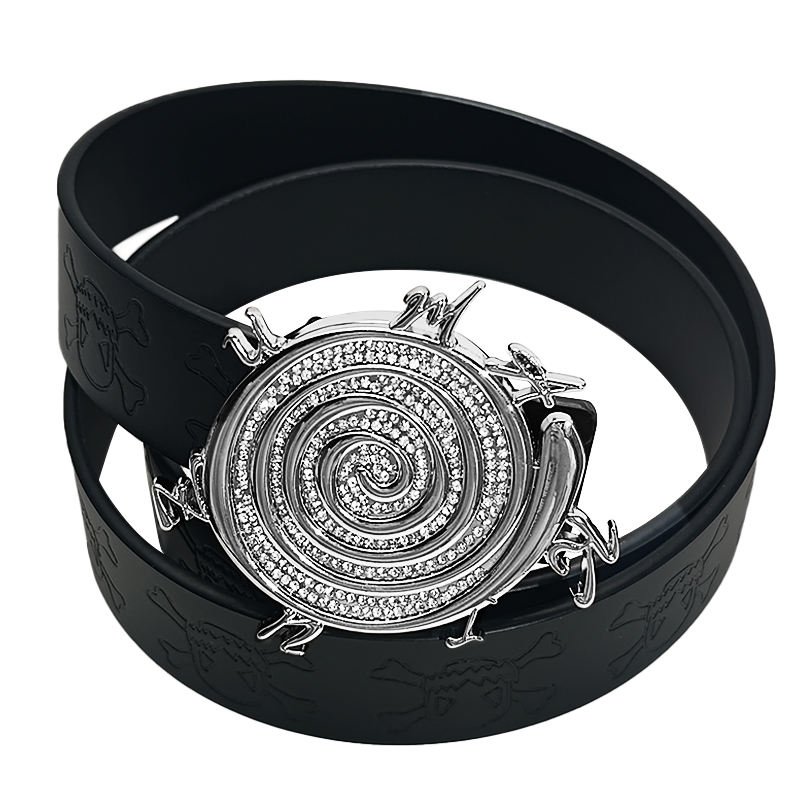
Buckles affect leather belt design through shape, width, weight, mechanism, finish, leather compatibility, and wearing comfort. A buckle is not only a closure part. It controls the front visual balance, the way the strap bends, the customer’s first-touch impression, and the long-term stress points of the belt. A good buckle should match the belt’s leather thickness, target use, retail positioning, and customer style.
How does buckle shape change style?
Buckle shape has a direct effect on how customers understand the belt before they even touch it. A rectangular buckle feels classic, formal, and safe. A rounded buckle feels softer and more casual. A square buckle feels modern and slightly stronger. A plate buckle feels bold and visual. A double-ring buckle feels relaxed and lifestyle-oriented. An automatic buckle feels clean, practical, and business-like.
For leather belt development, buckle shape should not be selected only from a hardware catalog. It should be reviewed together with belt width, leather color, leather grain, edge finish, stitching, and packaging. A polished rectangular buckle may look perfect on a black office belt, but too plain for a western-style brown pull-up leather belt. An antique brass roller buckle may look strong on a thick casual belt, but too rough for a slim dress belt.
The buckle shape also changes how the belt sits on the body. A very large buckle can become the visual center of the outfit. This may be useful for fashion belts, western belts, or logo belts. But for office belts, school belts, uniform belts, or minimalist accessories, a large buckle may feel too loud. A slim buckle looks elegant, but if the leather strap is too thick, the folded area may become bulky and uncomfortable.
Brands should also consider how the buckle shape looks in product photos. Online customers often decide based on front-view images. A buckle with a clean outline, balanced proportions, and good surface reflection usually performs better visually. However, a buckle that looks attractive in a flat photo may not always feel good when worn. The factory still needs to check real samples, hand feel, weight, rotation, and strap movement.
A practical way to judge buckle shape is to ask four questions:
- Does the buckle match the customer’s clothing style?
A formal customer needs clean and understated shapes. A streetwear customer may accept stronger shapes. A luxury customer may prefer simple but refined hardware. A vintage customer may want antique or heavier shapes.
- Does the buckle match the leather texture?
Smooth leather usually works better with cleaner buckles. Pebbled leather can support slightly stronger hardware. Pull-up leather, waxed leather, and distressed leather often match antique or roller buckles.
- Does the buckle match the belt width?
A narrow 20 mm belt should not use a large heavy frame. A 40 mm casual belt usually needs a stronger buckle to look balanced.
- Does the buckle support brand recognition?
If the brand wants a quiet premium look, a small engraved logo may be enough. If the brand wants a strong visual signature, a custom buckle shape or front logo may be necessary.
| Buckle Shape | Style Feeling | Better For | Less Suitable For |
|---|---|---|---|
| Slim rectangular | Formal, clean, classic | Office belts, dress belts, uniform belts | Heavy casual belts |
| Rounded frame | Soft, casual, flexible | Women’s belts, lifestyle belts | Strict formal belts |
| Square frame | Modern, structured | Minimalist belts, fashion belts | Very narrow straps |
| Roller buckle | Rugged, practical | Thick leather belts, casual belts | Slim formal belts |
| Plate buckle | Bold, decorative, branded | Western belts, fashion belts, logo belts | Conservative office belts |
| Double-ring | Relaxed, adjustable | Soft leather belts, casual belts | Heavy belts needing firm lock |
| Automatic buckle | Clean, modern, convenient | Business belts, gift belts | Vintage or handmade-style belts |
Good buckle shape selection makes the belt feel intentional. Poor shape selection makes the belt feel like random parts assembled together. For brands building a collection, it is often better to create a consistent buckle language across several belt styles instead of using unrelated hardware for every design.
How does buckle weight affect comfort?
Buckle weight is one of the most underestimated details in leather belt development. Many customers associate weight with quality when they first hold the belt. A buckle that feels too light may create a cheap impression. However, a buckle that is too heavy may become uncomfortable during daily wear. The best buckle weight depends on belt width, leather thickness, user gender, style category, and expected wearing time.
For men’s casual belts, a heavier buckle can feel strong and durable. For men’s formal belts, the buckle should feel solid but not bulky. For women’s belts, especially narrow fashion belts, too much buckle weight can pull the belt downward or make the front area uncomfortable. For travel belts, lightweight comfort may be more important than a heavy premium feel.
Weight also affects how the belt hangs when displayed. In retail stores, a heavy buckle can pull the belt awkwardly if packaging or hanging design is weak. In e-commerce shipping, heavier buckles may require better protective wrapping to avoid scratching the leather surface. In gift boxes, heavy hardware can improve the opening experience, but the box insert must hold the buckle securely.
Approximate buckle weight ranges can help brands make better early decisions:
| Belt Category | Common Belt Width | Suggested Buckle Weight Range | Product Feeling |
|---|---|---|---|
| Slim women’s belt | 15–25 mm | 15–45 g | Light, decorative, easy to wear |
| Women’s fashion belt | 25–35 mm | 35–75 g | Balanced, stylish, visible |
| Men’s dress belt | 30–35 mm | 45–90 g | Refined, stable, formal |
| Men’s casual belt | 35–40 mm | 70–130 g | Strong, durable, substantial |
| Heavy casual belt | 38–45 mm | 100–180 g | Rugged, bold, statement |
| Plate buckle belt | 35–45 mm | 120–250 g | Decorative, western, logo-focused |
| Automatic belt | 30–35 mm | 90–160 g | Mechanical, modern, giftable |
These figures are not fixed standards, but they are useful for product planning. A luxury belt does not always need the heaviest buckle. In many premium designs, balance is more important than raw weight. The buckle should feel solid in the hand but not pull against the body during wear.
There are several practical problems caused by unsuitable buckle weight:
- Front-heavy wearing experience
If the buckle is too heavy compared with the strap, the belt may feel uncomfortable or sit unevenly on the waist.
- Leather fold stress
Heavy buckles create more pulling force at the folded buckle area. If the leather is weak, split, over-skived, or poorly reinforced, this area may deform faster.
- Packaging pressure marks
A heavy buckle can press into the leather during shipping if the belt is packed too tightly.
- Higher shipping weight
For large-volume orders, heavier buckles can slightly increase total shipment weight, especially for boxed belt sets.
- Different customer expectations
Some markets prefer solid and heavy hardware. Other markets prefer lightweight comfort. A belt for North American casual wear may accept heavier hardware than a slim fashion belt for European boutique collections.
A professional factory should check not only the buckle weight itself but also how that weight works with the leather strap. The buckle and leather should feel like one product. If the buckle feels stronger than the leather, the belt feels unbalanced. If the leather feels premium but the buckle feels hollow, the product loses value.
How does leather thickness affect buckle choice?
Leather thickness affects buckle choice more than many brands realize. The buckle opening, prong length, fold structure, hole strength, and overall comfort all depend on the thickness of the strap. If the strap is too thick for the buckle, the leather will not move smoothly. If the strap is too thin, the buckle may feel oversized, unstable, or cheap.
Most leather belts use strap thickness between about 2.5 mm and 4.5 mm. Some lightweight fashion belts may be thinner. Some rugged casual belts or heavy-duty leather belts may be thicker. The final thickness may come from one solid leather layer, leather plus lining, bonded layers, reinforcement material, or reversible two-sided construction.
Formal belts usually use a cleaner and slimmer structure. A common men’s dress belt may use leather around 2.8–3.5 mm thick. This thickness gives enough body without looking bulky. Casual belts can often use 3.5–4.5 mm leather, especially when paired with denim or heavier clothing. Reversible belts may feel thicker because two finished surfaces are bonded together. Automatic belts need enough structure to hold the ratchet track, but they should not become too stiff.
| Belt Type | Common Thickness | Suitable Hardware | Main Development Focus |
|---|---|---|---|
| Men’s formal belt | 2.8–3.5 mm | Slim pin, automatic, reversible | Clean fold, smooth edge, refined buckle |
| Men’s casual belt | 3.5–4.5 mm | Pin, roller, center-bar, plate | Strength, balance, hole durability |
| Women’s slim belt | 1.8–2.8 mm | Small pin, decorative buckle | Lightweight hardware, delicate edge |
| Women’s fashion belt | 2.2–3.2 mm | Oval, ring, decorative, custom buckle | Shape, color, comfort |
| Reversible belt | 3.2–4.2 mm | Rotating buckle, automatic | Bonding, rotation, edge finish |
| Heavy utility belt | 4.0–5.0 mm | Heavy pin, roller, clamp | Load strength, fold reinforcement |
| Luxury belt | 3.0–4.2 mm | Custom buckle, brass, stainless steel | Surface finish, structure, brand feel |
The buckle fold area needs special attention. When leather wraps around the buckle bar, the thickness may double. A 3.5 mm leather strap can become around 7 mm at the fold if not skived or structured properly. That can make the belt front too bulky, especially for dress belts. Factories may reduce thickness near the fold through controlled skiving, lining adjustment, or construction planning.
The punched holes also depend on leather thickness. Thin leather holes may stretch if the leather is weak or the prong edge is sharp. Thick leather holes may be hard to punch cleanly if the die is poor. For long-term wear, the hole area should resist tearing, cracking, and deformation. This is especially important for belts made from softer leather, split leather, bonded leather, or PU-coated material.
For automatic buckles, thickness control is even more important because the track must stay fixed to the back side of the strap. If the strap is too soft, the buckle may not lock firmly. If it is too thick, the buckle clamp may not close properly. If bonding is weak, the track can separate from the strap after repeated adjustment.
For reversible belts, thickness balance is critical. Both sides must look finished, but the total body cannot become too bulky. The two leather surfaces must bond evenly and bend naturally. If one side is stiffer than the other, the belt may curve or twist after wear.
A strong factory will check buckle choice with actual leather thickness, not estimated thickness. During sampling, the team should measure the strap body, fold area, hole area, and edge-painted area. Small thickness differences can change the final fit of the buckle.
How does belt width affect buckle selection?
Belt width is another key factor in buckle selection. Width affects style category, customer use, hardware size, comfort, and packaging. A 20 mm fashion belt and a 40 mm casual belt cannot use the same buckle logic. Even if the buckle material and finish are the same, the proportion must change.
Common men’s dress belts often use 30 mm or 35 mm width. These sizes fit most formal trousers and office wear. Men’s casual belts often use 35 mm, 38 mm, or 40 mm. Heavy casual belts may use 40 mm or 45 mm depending on the market. Women’s belts vary more widely, from slim 10–15 mm decorative belts to 30–40 mm waist belts. The buckle must be designed around the actual strap width.
If the buckle inner width is too tight, the strap may rub against the frame and damage edge paint. If it is too loose, the belt may shift side to side and look poorly fitted. For a clean product, the inner frame width usually needs a small allowance beyond the strap width, but not so much that the belt moves excessively.
| Strap Width | Common Use | Hardware Direction |
|---|---|---|
| 10–15 mm | Thin women’s fashion belts | Small decorative buckles, light metal |
| 18–25 mm | Women’s dress and waist belts | Oval, slim pin, small logo buckle |
| 30 mm | Formal belts, women’s structured belts | Slim frame, polished or brushed finish |
| 35 mm | Men’s dress and business casual belts | Pin, automatic, reversible buckle |
| 38 mm | Casual leather belts | Strong pin, roller, center-bar |
| 40 mm | Jeans belts, rugged casual belts | Heavy pin, roller, plate buckle |
| 45 mm and above | Utility or statement belts | Heavy-duty buckle, custom structure |
Belt width also affects logo visibility. A small buckle on a narrow belt may not have enough space for a readable logo. A larger buckle can carry a front logo, but it may change the belt from refined to bold. For luxury belts, the logo size must be carefully controlled. Too small may be invisible. Too large may feel less premium.
Retail channel also matters. Belts sold online need strong product photos, so the buckle should be visible and attractive in images. Belts sold in stores need good hand feel and display balance. Belts sold as corporate gifts may need enough buckle area for logo marking. Belts sold to fashion brands may need a distinctive buckle silhouette that supports collection identity.
How does buckle finish affect leather color?
The relationship between buckle finish and leather color can make or break the final look. Many belt projects fail not because the hardware is poor, but because the hardware finish does not match the leather tone. Brown leather with the wrong gold can look cheap. Black leather with the wrong silver can feel too cold. Tan leather with a very shiny buckle may look unbalanced.
Hardware finish should be reviewed under real lighting. Factory lighting, office lighting, retail lighting, and outdoor daylight can all make metal color look different. Gold plating is especially sensitive. One supplier’s gold may look yellow. Another may look pale. Rose gold can shift toward copper or pink. Gunmetal can look blue, black, or grey depending on plating control.
| Leather Color | Suitable Hardware Finish | Product Feeling |
|---|---|---|
| Black smooth leather | Nickel, gunmetal, matte black, gold | Formal, modern, luxury |
| Black pebbled leather | Gunmetal, brushed nickel, matte black | Premium casual, urban |
| Dark brown leather | Antique brass, dark nickel, vintage silver | Heritage, mature, classic |
| Cognac leather | Antique brass, brushed brass, nickel | Warm, premium, lifestyle |
| Tan leather | Brushed nickel, antique brass, light gold | Casual, natural, clean |
| Burgundy leather | Gold, gunmetal, antique brass | Luxury, fashion, vintage |
| White leather | Gold, rose gold, polished nickel | Fashion, elegant, decorative |
| Suede leather | Vintage silver, antique brass, matte finish | Soft, relaxed, handmade feeling |
For brands building several colorways, hardware consistency becomes important. Should every belt color use the same buckle finish? Or should black belts use nickel while brown belts use antique brass? Both approaches can work.
Using one hardware finish across all colors simplifies inventory and production. It creates a consistent collection look. However, it may not be the best visual match for every leather color. Using different hardware finishes by colorway improves product harmony but increases sourcing, inventory, and quality control complexity.
A practical approach is to divide the collection into finish families. For example:
- Business collection
Black leather with polished nickel, dark brown leather with brushed nickel, navy leather with gunmetal.
- Heritage collection
Cognac, brown, olive, and dark tan leather with antique brass or vintage silver.
- Fashion collection
White, cream, burgundy, and pastel leather with gold or rose gold.
- Urban collection
Black, grey, and dark brown leather with matte black or gunmetal.
For bulk production, the approved hardware finish should be locked before mass leather cutting when possible. If the finish changes later, the leather color, stitching color, edge paint, logo color, and packaging may also need adjustment.
How does buckle structure affect belt lifespan?
Buckle structure affects the lifespan of a leather belt because most stress is concentrated near the buckle area. Every time the belt is tightened, loosened, removed, or hung, force passes through the buckle, fold, holes, prong, stitching, rivets, or screws. If this area is weak, the belt may fail even if the rest of the leather strap is good.
The highest-stress areas are usually:
- Buckle fold
This area bends around the buckle bar and carries repeated movement.
- Prong holes
These holes receive pulling force every time the belt is worn.
- Buckle bar contact point
The leather rubs against metal during tightening and loosening.
- Rivet or screw area
Fastening parts hold the buckle to the strap. Weak assembly can loosen over time.
- Edge paint near fold
This area bends frequently and may crack if the finish is too rigid.
- Ratchet track area
For automatic belts, the hidden track receives repeated locking pressure.
Different buckle structures create different stress patterns. A roller buckle reduces friction when the strap is pulled, which can help thicker leather last longer near the fold. A standard pin buckle creates stress around the most-used hole. An automatic buckle spreads adjustment across a track but depends heavily on mechanism quality. A clamp buckle avoids holes but creates pressure where the clamp grips the strap.
| Buckle Structure | Main Stress Area | Lifespan Risk | Factory Control Method |
|---|---|---|---|
| Pin buckle | Holes and fold | Hole stretching, prong marks | Clean punching, good prong edge, leather strength |
| Roller buckle | Fold and roller bar | Loose roller, bulky fold | Roller rotation test, fold thickness control |
| Automatic buckle | Track and clamp | Slipping, track separation | Lock test, clamp pressure test, backing strength |
| Reversible buckle | Rotation joint and edge | Loose rotation, delamination | Rotation cycle test, bonding control |
| Double-ring buckle | Strap surface friction | Slipping, pressure marks | Strap friction test, ring thickness check |
| Clamp buckle | Clamp contact point | Leather indentation, slipping | Clamp force control, surface wear test |
For quality belt production, the factory should not only inspect the buckle before assembly. It should inspect the complete belt after assembly. The real product test is how the buckle, leather, holes, fold, and fastening parts work together.
Useful belt lifespan checks include:
- Repeated bending at buckle fold
This checks whether leather cracks, edge paint splits, or bonding separates.
- Hole pull test
This checks whether the most-used hole stretches or tears under force.
- Buckle movement test
This checks whether prong, roller, automatic release, or reversible rotation works smoothly.
- Fastener looseness check
This checks whether rivets, screws, or snap buttons remain secure.
- Wearing simulation
This checks how the belt behaves when pulled, tightened, loosened, and curved around the waist.
- Surface friction check
This checks whether buckle edges scratch leather or damage coating.
A belt with good leather but poor buckle structure may still fail quickly. A belt with moderate leather but excellent buckle compatibility can sometimes perform much better in real use. This is why hardware design should be treated as product engineering, not decoration.
How should brands balance appearance and function?
Appearance attracts customers, but function keeps them satisfied. A belt can win attention with a unique buckle, but if the buckle is uncomfortable, noisy, too heavy, too sharp, or unstable, the customer will not buy again. The best belt hardware balances visual value with daily usability.
For fashion brands, appearance may carry more weight. Special buckle shapes, gold finishes, logo plates, and seasonal hardware colors can help the belt match a collection. But even fashion belts need basic comfort and safe edges.
For office and business belts, function usually matters more. Customers expect the belt to fit smoothly, adjust easily, and look refined for a long time. A loud buckle or poor mechanism may hurt the product’s credibility.
For luxury belts, both appearance and function must be strong. Customers expect clean finishing, precise logo placement, smooth movement, solid weight, and a buckle that feels premium without being annoying.
For wholesale and distributor belts, consistency is extremely important. The product may not need the most expensive hardware, but every piece in the shipment should match the approved sample. Color difference, rough edges, loose buckles, and mechanism defects can create serious after-sales pressure.
| Product Positioning | Appearance Priority | Function Priority | Recommended Focus |
|---|---|---|---|
| Basic daily belt | Medium | High | Durable standard buckle, stable plating |
| Office belt | Medium to high | High | Refined shape, smooth function, clean finish |
| Fashion belt | High | Medium | Unique shape, seasonal finish, comfortable weight |
| Luxury belt | Very high | Very high | Custom hardware, strict finishing, strong testing |
| Outdoor casual belt | Medium | Very high | Strong structure, anti-rust finish, secure lock |
| Gift belt set | High | High | Good unboxing, reversible or automatic buckle |
| Distributor belt line | Medium | High | Consistency, cost control, low defect rate |
A strong belt development process usually starts with a simple decision: what should the customer feel in the first five seconds? Should the belt feel elegant, rugged, practical, luxurious, fashionable, or giftable? Once that answer is clear, hardware selection becomes much more accurate.
For example, if the target feeling is “quiet luxury,” the buckle may need a clean shape, brushed finish, subtle logo, solid weight, and excellent polishing. If the target feeling is “rugged outdoor,” the buckle may need antique finish, roller structure, thicker frame, and stronger corrosion resistance. If the target feeling is “modern business,” an automatic buckle with smooth release and clean front surface may work better.
Good hardware design is not about adding more metal. It is about making every metal part serve the final product. The buckle should help the leather look better, the belt wear better, and the brand sell better.
How Should Brands Choose Belt Hardware?
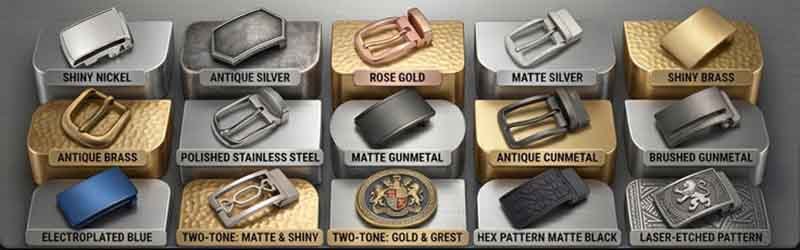
Brands should choose belt hardware by reviewing product positioning, leather type, belt width, buckle structure, finish quality, logo method, expected retail price, and target market. The right hardware should support the product story while staying practical for production. A good choice improves appearance, comfort, durability, packaging value, and repeat-order stability.
Which buckle fits formal belts?
Formal belts usually need clean, slim, and refined buckle designs. The buckle should not dominate the belt. It should support a polished appearance that works with suits, trousers, uniforms, business shoes, and office clothing. For men’s formal belts, common widths are 30 mm and 35 mm. For women’s formal belts, widths may range from slim 15 mm styles to 30 mm structured designs.
The most suitable buckle options for formal belts include slim pin buckles, polished frame buckles, brushed frame buckles, automatic buckles, and reversible buckles. A simple rectangular pin buckle is one of the safest choices. It is classic, easy to wear, and widely accepted across markets. An automatic buckle can make the belt look cleaner because there are no visible holes. A reversible buckle adds practical value, especially for business travelers or gift customers.
Formal belt hardware should avoid excessive decoration unless the brand has a strong fashion direction. Large plate buckles, thick roller buckles, heavy antique finishes, and oversized logos are usually less suitable for traditional office belts. The product should feel elegant, reliable, and easy to match.
Important details for formal belt hardware include:
- Controlled buckle thickness
The buckle should not create a bulky front shape under shirts, jackets, or tailored trousers.
- Smooth surface finish
Polished nickel, brushed nickel, gunmetal, and refined dark silver are common choices.
- Safe inner edges
Sharp frame edges can damage smooth leather, especially black or high-gloss leather.
- Balanced weight
The buckle should feel solid but not heavy enough to pull the belt downward.
- Quiet movement
A rattling prong or loose buckle frame can make the belt feel low-end.
- Subtle logo placement
For formal belts, logo engraving on the back, side, or inner buckle area often feels more premium than a large front logo.
| Formal Belt Requirement | Hardware Recommendation |
|---|---|
| Clean office look | Slim rectangular pin buckle |
| Business gift value | Automatic buckle or reversible buckle |
| Conservative market | Polished nickel or brushed nickel |
| Premium understated style | Gunmetal or brushed dark nickel |
| Smooth leather strap | Rounded and polished buckle edges |
| Higher retail price | Better plating, engraved logo, refined weight |
For formal belts, customers often care about whether the belt looks appropriate in professional settings. This means the buckle must be refined, not distracting. If the product is sold online, front-view product photos should show clean proportions. If sold in stores, the buckle should feel smooth and reliable when customers touch it.
Which buckle fits casual belts?
Casual belts can use a much wider range of buckles because they are worn with jeans, chinos, workwear, outdoor clothing, relaxed fashion, and lifestyle outfits. The buckle can be larger, heavier, more textured, or more decorative than a formal belt buckle. Common choices include standard pin buckles, roller buckles, center-bar buckles, double-prong buckles, double-ring buckles, antique buckles, and plate buckles.
A casual belt often allows the leather to show more character. Full grain leather, pull-up leather, waxed leather, pebbled leather, crazy horse leather, and distressed leather all work well in this category. The buckle should match that character. Antique brass looks natural with brown pull-up leather. Matte black looks strong with black pebbled leather. Vintage silver works well with distressed or western-style leather. Brushed nickel can make a casual belt feel cleaner and more modern.
Roller buckles are especially useful for thicker casual belts because the roller reduces friction when the strap is pulled. This can help protect the leather near the buckle fold. Double-prong buckles create a stronger and more rugged appearance, but they require two rows of holes and may not suit all customers. Plate buckles create strong identity but can become too heavy if not controlled.
Casual belt hardware should be checked for daily wear strength. Customers may wear these belts with denim, carry keys, sit for long hours, work outdoors, or expose the belt to more friction than a formal belt. The buckle finish should resist scratches, sweat, and humidity better than purely decorative hardware.
| Casual Belt Style | Recommended Buckle | Recommended Finish | Leather Match |
|---|---|---|---|
| Jeans belt | Strong pin, roller buckle | Antique brass, vintage silver | Thick full grain, pull-up leather |
| Urban casual belt | Center-bar, matte pin buckle | Gunmetal, matte black | Pebbled or smooth black leather |
| Outdoor casual belt | Roller, double-prong, clamp | Matte black, dark nickel | Thick cowhide, waxed leather |
| Vintage belt | Roller, plate, classic pin | Antique brass, vintage silver | Distressed leather, crazy horse leather |
| Soft lifestyle belt | Double-ring, oval buckle | Brushed nickel, antique finish | Soft cowhide, suede |
| Streetwear belt | Plate, custom logo buckle | Matte black, polished silver | Smooth leather, coated leather |
Casual belts are a good opportunity for brands to create a stronger visual identity. However, function still matters. A heavy buckle should be tested for comfort. An antique finish should be checked for color consistency. A roller should rotate smoothly. A plate buckle should not scratch the leather or clothing. The best casual belt hardware feels strong without becoming uncomfortable.
Which hardware suits luxury belts?
Luxury belt hardware needs precision. It does not always need to be flashy, but it must feel deliberate. Customers buying premium belts expect clean edges, stable weight, smooth mechanism, consistent color, clear logo detail, and surface finishing that does not look cheap after a few uses.
Suitable materials for luxury belts often include brass, stainless steel, high-grade zinc alloy, or specially developed custom hardware. Brass gives weight and a classic premium feel. Stainless steel gives clean durability and modern refinement. Zinc alloy can support custom shapes and raised logos when casting quality and plating are well controlled.
Luxury belt hardware usually needs stricter control in several areas:
- Surface polishing
The buckle should not show rough grinding lines, pits, black spots, or uneven shine.
- Plating consistency
Gold, gunmetal, brushed nickel, and PVD-style finishes must match the approved sample.
- Logo accuracy
Engraved, raised, or laser-marked logos should be clean, centered, and sharp.
- Edge finishing
All contact points must be smooth to avoid damaging expensive leather.
- Movement feel
Prong, rotation, release button, or clamp movement should feel controlled, not loose.
- Weight balance
The buckle should feel valuable without making the belt uncomfortable.
For luxury belts, the buckle is often part of the brand signature. A distinctive but tasteful buckle can make a belt recognizable. However, too much logo exposure can reduce elegance. Many high-end customers prefer hardware that shows quality through proportion and finish rather than oversized branding.
| Luxury Hardware Element | Better Practice |
|---|---|
| Material | Brass, stainless steel, high-grade zinc alloy |
| Finish | Brushed gold, polished nickel, gunmetal, custom plating |
| Logo | Engraving, mold logo, laser logo, subtle back logo |
| Surface standard | No visible pits, stains, rough edges, or plating waves |
| Testing | Salt spray, adhesion, pull, rotation, function cycle |
| Packaging | Buckle protection, anti-scratch wrapping, stable box insert |
Luxury belt projects should allow enough time for hardware development. If a custom buckle mold is required, the brand should expect design review, tooling, first sample, correction, finish testing, and final approval. Rushing this stage can create problems that become expensive later.
For premium belt collections, SzoneierLeather usually recommends confirming a full pre-production sample before bulk cutting. This sample should include final leather, final buckle, final plating, final logo, final edge finish, final stitching, and final packaging. Only then can the brand see the real product, not just separate components.
Which hardware suits private label and wholesale belts?
Private label and wholesale belt projects usually need a balance between appearance, cost, consistency, and delivery speed. The hardware should look good enough to support the selling price, but it also needs to remain stable across larger quantities. For many wholesale clients, the biggest risk is not choosing the most expensive buckle. The bigger risk is inconsistent hardware quality from one batch to another.
Standard pin buckles, automatic buckles, reversible buckles, and simple custom logo buckles are common for private label belts. These options can be adjusted by finish, logo method, leather choice, packaging, and strap style. A brand does not always need a completely new buckle mold to create a differentiated product. Sometimes a good standard buckle with the right finish, engraved logo, and strong packaging is enough.
Private label clients usually care about:
- Minimum order planning
Standard buckles usually support smaller development risk than custom molds. Custom hardware may need higher quantity to spread mold cost.
- Sample speed
Available hardware can shorten sample time. New buckle development takes longer.
- Unit cost control
Hardware can strongly affect final belt cost, especially when using brass, custom plating, or complex mechanisms.
- Repeat-order consistency
The same buckle finish and size should be available for future orders.
- Logo flexibility
Laser logo, engraving, debossed leather logo, or packaging logo may be used depending on quantity.
- Quality stability
Wholesale clients need fewer defects because they may resell to multiple channels.
| Project Type | Hardware Strategy | Advantage |
|---|---|---|
| Small custom wholesale order | Standard buckle with logo engraving | Faster sampling, lower risk |
| Growing private label line | Standard buckle plus custom finish | Better brand feel without mold cost |
| Premium private label belt | Custom buckle mold | Strong identity and higher perceived value |
| Distributor belt program | Proven buckle styles | Stable cost and consistent delivery |
| Gift set belt | Automatic or reversible buckle | Higher product value and easier selling |
| Fashion seasonal belt | Decorative buckle with special finish | Better collection appeal |
For private label and wholesale belts, it is helpful to create a hardware library. This can include approved buckle styles, available finishes, logo positions, matching leather types, and cost levels. A factory with strong sourcing and development ability can help clients build belt collections more efficiently by reusing stable hardware across different styles.
Which options support logo branding?
Logo branding can be applied to the buckle, leather strap, keeper loop, metal plate, lining, packaging, dust bag, hang tag, or gift box. For belt hardware, common logo methods include laser marking, engraving, embossing on metal, raised logo molding, debossed leather logo, metal logo plate, enamel filling, and custom buckle shape.
The best logo method depends on order quantity, price point, brand style, and target customer. A luxury belt may use a subtle engraved logo on the back of the buckle plus a debossed logo on the leather. A fashion belt may use a front metal logo buckle. A wholesale belt may use laser logo marking because it is efficient and cost-controlled. A gift set may use logo branding on both buckle and packaging.
| Logo Method | Best For | Visual Effect | Cost Level | Notes |
|---|---|---|---|---|
| Laser logo | Small to medium orders | Clean, flat, precise | Low to medium | Good for metal and some coated surfaces |
| Engraved logo | Premium belts | Refined, permanent | Medium | Needs enough metal thickness |
| Raised mold logo | Custom buckle | Strong brand identity | High at start | Requires mold cost |
| Debossed leather logo | Classic leather goods | Subtle, premium | Low to medium | Works well on strap or keeper |
| Metal logo plate | Fashion and luxury belts | Visible, decorative | Medium to high | Adds weight and assembly step |
| Enamel logo | Color branding | Bold, visual | Medium to high | Needs strict color control |
| Packaging logo | Gift and retail belts | Improves full product value | Low to medium | Strong for private label programs |
Logo placement needs careful judgment. A large logo on the buckle can create strong recognition, but it may also limit the product’s wearability. Some customers prefer discreet branding. Others want visible brand identity. The brand should decide whether the belt is meant to be a quiet wardrobe item or a visible fashion accessory.
For hardware logos, the factory should check:
- Logo file quality
Vector files are better for engraving, molding, and laser marking.
- Logo size
Very thin lines may disappear during casting or plating.
- Logo position
The logo should not be blocked by the belt strap or distorted by buckle curves.
- Plating impact
Deep engraving and raised logos may react differently after plating.
- Wear area
A logo placed on a high-friction area may fade faster.
- Brand consistency
The buckle logo should match leather logo, packaging logo, and product photography.
For serious belt collections, logo strategy should be planned before sampling. If the logo is added late, the buckle may not have enough space, the mold may need correction, or the final product may look forced. Good logo development makes the belt feel like a brand product instead of a generic belt with a logo added at the end.
How should brands control hardware cost?
Hardware cost is affected by material, size, weight, finish, mold complexity, logo method, testing requirement, and order quantity. A small buckle can sometimes cost more than a large buckle if it uses better material, complex plating, or custom tooling. Cost control should not mean choosing the cheapest buckle. It means choosing hardware that supports the product’s selling price without creating quality risk.
Main cost drivers include:
- Material
Brass and stainless steel usually cost more than iron or standard zinc alloy.
- Weight
Heavier buckles require more material and may increase shipping weight.
- Finish
Special plating, matte coating, antique effect, gold color, and PVD-style finishes may increase cost.
- Mold
Custom buckle shapes or raised logos require tooling cost.
- Mechanism
Automatic, reversible, and clamp systems usually cost more than simple pin buckles.
- Testing
Higher salt spray requirements, stronger function testing, or special compliance needs may add cost.
- Quantity
Higher quantity can reduce unit cost and spread mold cost more efficiently.
| Hardware Choice | Cost Impact | Best Use |
|---|---|---|
| Standard pin buckle | Low to medium | Basic, formal, casual belts |
| Standard buckle with laser logo | Low to medium | Private label belts |
| Custom finish on standard buckle | Medium | Better brand differentiation |
| Automatic buckle | Medium to high | Business and gift belts |
| Reversible buckle | Medium to high | Travel and office belts |
| Brass buckle | High | Premium and heritage belts |
| Custom mold buckle | Higher initial cost | Long-term brand collections |
| PVD or special plating | High | Luxury and high-margin belts |
A practical cost-control method is to separate what customers can feel from what they cannot. Customers can feel buckle weight, movement, surface smoothness, and plating quality. They can see logo clarity, finish color, and overall proportion. They usually do not care whether the buckle uses the most expensive material if the final product already feels good and performs well.
For many brands, a strong solution is to use a reliable zinc alloy buckle with good plating for mid-range belts, brass or stainless steel for premium lines, and custom molds only for styles that will repeat over multiple seasons. This avoids spending mold cost on designs that may not become long-term products.
Cost should always be reviewed together with defect risk. A cheaper buckle that causes plating complaints, slipping, rust, or returns can become more expensive than a better buckle. In leather belt manufacturing, the lowest hardware price is rarely the safest commercial choice.
How should brands prepare before sampling?
Before belt sampling, brands should prepare enough information for the factory to select suitable hardware quickly and accurately. The more precise the brief, the fewer rounds of sample correction are needed.
Useful information includes:
- Belt type
Formal belt, casual belt, women’s belt, reversible belt, automatic belt, gift set, luxury belt, outdoor belt, or fashion belt.
- Target customer
Men, women, office workers, fashion customers, outdoor users, gift buyers, distributors, boutique customers, or online retail customers.
- Belt width
Common widths include 20 mm, 25 mm, 30 mm, 35 mm, 38 mm, and 40 mm.
- Leather preference
Full grain leather, top grain leather, split leather, suede, PU leather, recycled leather, vegan leather, or special coated material.
- Target thickness
If unknown, the factory can recommend thickness based on belt style and buckle choice.
- Hardware finish
Nickel, gunmetal, antique brass, matte black, gold, rose gold, brushed finish, or custom color.
- Logo requirement
No logo, laser logo, engraved logo, debossed logo, raised buckle logo, metal plate, or packaging logo.
- Target price
This helps the factory avoid recommending hardware that is too expensive or too basic.
- Order quantity
Quantity affects hardware sourcing, mold decision, and unit cost.
- Market destination
Different markets may have different expectations for finish, durability, compliance, and packaging.
A clear sampling brief may look like this:
| Item | Example Requirement |
|---|---|
| Product | Men’s premium casual leather belt |
| Width | 38 mm |
| Leather | Brown full grain leather |
| Thickness | Around 3.8–4.2 mm |
| Buckle | Roller pin buckle |
| Finish | Antique brass |
| Logo | Debossed logo on leather keeper |
| Packaging | Branded kraft box |
| Target market | USA and Europe |
| Order plan | 500–2,000 pcs per style |
| Quality focus | Strong buckle, clean edge, anti-rust finish |
When a factory receives this kind of information, it can recommend more accurate hardware options, prepare better samples, and reduce unnecessary back-and-forth communication. This is especially important for brands that already have professional product knowledge and want a manufacturing partner, not just a supplier selling standard goods.
SzoneierLeather supports clients during this development stage by reviewing leather structure, buckle size, hardware finish, logo method, sampling process, packaging style, and quality requirements together. This helps the final belt become easier to approve, easier to produce, and easier to sell.
Are Custom Buckles Worth It?
Custom buckles are worth considering when a belt collection needs stronger identity, higher perceived value, better market separation, or long-term repeat production. They may increase tooling cost and development time, but they can turn a standard leather belt into a recognizable product. The real question is not whether custom buckles look better. The real question is whether they help the belt sell at the right price, perform reliably, and support the brand’s long-term product plan.
Do custom buckles improve brand value?
Custom buckles can improve brand value when they are designed with clear purpose. A belt with a standard buckle may still be high quality, but it is easier for customers to compare it with similar products in the market. A custom buckle changes that comparison. It gives the product a more specific identity, especially when the buckle shape, finish, logo position, and leather style work together.
For leather belt collections, the buckle is often the most visible metal part. Customers may not fully understand leather grades, tanning methods, lining materials, or edge paint formulas, but they can immediately see and feel the buckle. A custom buckle can create a stronger first impression in product photos, retail displays, unboxing videos, and gift packaging.
Custom buckles are especially useful for:
- Premium leather belt collections
A custom buckle helps support a higher retail price when combined with better leather, refined stitching, clean edge finishing, and quality packaging.
- Fashion accessory lines
Seasonal buckle shapes, unique metal colors, and visible logo details can help the belt match a wider fashion collection.
- Gift belt sets
A custom buckle can make a gift box feel more exclusive, especially when paired with branded packaging, dust bags, and care cards.
- Long-term private label programs
Once tooling is ready, the same buckle can be reused across multiple colors, leather types, and seasonal styles.
- Luxury or boutique products
A subtle custom buckle can create recognition without using oversized branding.
However, custom buckles do not automatically make a belt better. A poorly proportioned buckle can make the belt uncomfortable. A logo that is too large can reduce elegance. A buckle with too many details can increase plating defects. A shape that looks creative on a drawing may be hard to polish, cast, plate, or assemble consistently.
The best custom buckle is not always the most complicated one. In many strong leather belt collections, the custom detail is small but precise. It may be a special corner radius, a unique prong shape, a clean engraved logo, a custom brushed finish, or a buckle frame that perfectly matches the strap width. These details feel quiet but valuable.
| Custom Buckle Choice | Best Use | Main Benefit | Main Caution |
|---|---|---|---|
| Engraved logo buckle | Premium and formal belts | Clean identity without loud branding | Needs enough flat space |
| Raised logo buckle | Fashion and logo belts | Strong visual recognition | Logo detail may soften after plating |
| Custom frame shape | Luxury and boutique belts | Unique product silhouette | Tooling must be accurate |
| Custom plate buckle | Western, streetwear, fashion belts | Strong front visual impact | Weight and comfort must be controlled |
| Custom automatic buckle | Business and gift belts | Higher perceived function value | Mechanism testing is critical |
| Custom reversible buckle | Travel and gift belts | Two-sided use with brand identity | Rotation stability must be tested |
| Custom metal keeper | Premium belt sets | Small detail improves full product feel | Adds cost and assembly step |
For clients planning only one short-term belt design, custom tooling may not always be necessary. A high-quality standard buckle with the right finish and logo method can sometimes be smarter. For clients building a long-term belt program, custom buckles can become a valuable design asset. The tooling cost is then spread across repeat orders, new colors, and future collections.
How are custom buckles developed?
Custom buckle development starts before metal production. The process should begin with the belt concept, not only the buckle drawing. The factory needs to understand the target customer, belt width, leather thickness, leather color, expected finish, logo requirement, price level, and order quantity. Without these details, the buckle may look good as a separate part but fail as part of the finished belt.
A practical custom buckle development process usually includes several stages:
- Product direction review
The client shares reference images, belt style, leather type, target market, logo file, and expected price level. The factory checks whether the buckle idea matches the belt’s function and production requirements.
- Structure check
The factory reviews buckle size, inner frame width, bar thickness, prong position, rotation needs, automatic mechanism requirements, strap fold thickness, and assembly method.
- Material selection
The project team chooses zinc alloy, brass, stainless steel, iron, or aluminum alloy based on cost, strength, finish, and shape complexity.
- Drawing or 3D review
For new buckle shapes, a technical drawing or 3D file helps confirm proportions before tooling. This reduces the risk of opening a mold based only on a rough idea.
- Mold development
A mold is prepared for casting, stamping, or forming. Tooling cost and lead time depend on buckle complexity, size, material, and logo detail.
- First hardware sample
The first sample checks shape, size, weight, surface, logo position, prong movement, and assembly fit. At this stage, correction is still easier than after bulk production.
- Finish trial
The buckle is polished and plated in the selected finish, such as nickel, gunmetal, gold, matte black, antique brass, or brushed finish.
- Belt sample assembly
The hardware is assembled with the actual leather strap. This step is critical. A buckle cannot be approved only as loose metal hardware.
- Function and appearance test
The complete belt is checked for comfort, fold thickness, strap movement, prong fit, hole position, buckle balance, and plating appearance.
- Pre-production approval
After final confirmation, the factory keeps an approved sample for bulk comparison.
| Development Stage | What Should Be Confirmed | Common Problem If Ignored |
|---|---|---|
| Concept review | Style, market, price, leather type | Buckle looks unrelated to belt |
| Size check | Belt width, buckle opening, prong length | Strap does not pass smoothly |
| Material decision | Zinc alloy, brass, stainless steel, iron | Cost or finish does not match target |
| Logo review | File quality, size, position, depth | Logo becomes unclear after plating |
| Mold making | Shape, tolerance, surface detail | Bulk hardware differs from concept |
| Finish trial | Color, shine, plating coverage | Hardware color does not match leather |
| Belt assembly | Fold thickness, comfort, fastening | Good buckle fails on real belt |
| Production approval | Final sample, testing, packaging | Bulk order has uncontrolled variation |
Custom buckle development time depends on complexity. A simple logo engraving on an existing buckle can be much faster. A new custom mold may require more time because tooling, adjustment, plating, and belt assembly all need confirmation. A reversible or automatic custom buckle usually requires more testing because moving parts increase risk.
For belt projects with tight launch schedules, it is safer to decide early whether custom hardware is required. If the buckle is treated as a late-stage detail, delays can affect leather cutting, sample approval, packaging design, product photography, and sales planning.
How much do custom buckles affect cost?
Custom buckles affect cost through material, mold, weight, finish, logo method, mechanism, testing, and order quantity. A small buckle with complex structure can cost more than a large simple buckle. A standard buckle with custom plating may cost less than a fully custom molded buckle. A brass buckle may cost more than zinc alloy but may also support a higher retail price.
Cost is not only the unit price of the hardware. Clients should also consider mold cost, sample cost, correction cost, testing cost, defect risk, and future repeat-order value. A custom buckle that will be used for many seasons can be a good investment. A custom buckle used once for a small test order may not be cost-efficient.
Main cost factors include:
- Tooling cost
New buckle shapes, raised logos, special frames, or custom mechanisms require tooling. The cost depends on size and complexity.
- Material consumption
A heavier buckle uses more material. Brass and stainless steel usually cost more than standard zinc alloy or iron.
- Surface treatment
Special finishes such as matte black, brushed gold, antique brass, gunmetal, rose gold, or high-corrosion-resistance plating may increase cost.
- Logo process
Laser marking, engraving, raised molding, enamel filling, and logo plates all have different cost levels.
- Testing level
Higher corrosion resistance, stronger cycle testing, or stricter inspection standards may add cost but reduce after-sales risk.
- Defect tolerance
Complex shapes and mirror finishes may create higher rejection rates because scratches, pits, and plating marks are more visible.
- Quantity
A larger order spreads mold cost more efficiently and gives the factory more room to control hardware sourcing.
| Customization Level | Cost Impact | Good For | Practical Notes |
|---|---|---|---|
| Standard buckle, no logo | Low | Basic belt programs | Fastest sampling and lowest risk |
| Standard buckle with laser logo | Low to medium | Small private label orders | Good entry-level branding |
| Standard buckle with engraving | Medium | Premium private label belts | Cleaner and more durable logo feel |
| Standard buckle with custom finish | Medium | Collection differentiation | Needs color approval |
| New custom buckle mold | High initial cost | Long-term belt lines | Better for repeat production |
| Custom automatic buckle | High | Business gift belts | Mechanism testing is important |
| Brass custom buckle | High | Premium and heritage belts | Strong hand feel and value |
| Enamel or colored logo buckle | Medium to high | Fashion belts | Color matching must be controlled |
A useful commercial rule is to match hardware investment with product lifespan. For a short seasonal test, using approved standard hardware may be smarter. For a belt that will become a core product, custom hardware can protect identity and reduce direct price comparison.
How should buckle quality be tested?
Buckle quality should be tested as both a metal component and as part of the finished leather belt. Testing only the loose buckle is not enough. The real performance depends on how the buckle works with leather thickness, punched holes, fold structure, screws, rivets, stitching, edge paint, and packaging.
The most important tests include surface inspection, corrosion resistance, plating adhesion, pull strength, prong strength, function cycle testing, rotation testing, clamp testing, and complete belt fitting. Each buckle type has different failure risks, so the test plan should match the structure.
For pin buckles, prong strength and hole interaction are important. The prong should not bend easily, and the prong tip should not cut into the hole. The frame should be smooth enough to avoid scraping the leather during tightening.
For automatic buckles, the locking system is the key. The buckle should hold firmly without slipping. The release button should work smoothly after repeated use. The track should not peel or deform. A beautiful automatic buckle with a weak lock is a serious product risk.
For reversible buckles, rotation stability matters. The buckle should rotate smoothly but not feel loose. The turning part should not wobble or make the belt feel unstable.
For double-ring buckles, friction and grip must be tested. The strap should not slip too easily during wear. The rings should not bend, scratch, or damage the leather surface.
For plate buckles, weight, surface finish, and attachment strength are important. A large plate buckle can create strong visual value, but it must not scratch clothing, pull uncomfortably, or show plating defects too quickly.
| Test Item | Suitable Buckle Types | What It Checks | Why It Matters |
|---|---|---|---|
| Visual inspection | All buckles | Scratches, stains, pits, bubbles, color difference | Prevents obvious appearance complaints |
| Edge smoothness check | All buckles | Sharp edges, rough inner frame, prong tip | Protects leather and user comfort |
| Salt spray test | Metal buckles | Corrosion resistance | Important for humid markets and long shipping |
| Plating adhesion test | Plated buckles | Peeling or flaking risk | Reduces finish complaints |
| Pull strength test | Pin, automatic, clamp | Holding force under tension | Prevents slipping or breakage |
| Prong bending test | Pin buckles | Prong strength | Prevents functional failure |
| Rotation cycle test | Reversible buckles | Turning stability | Prevents wobbling and looseness |
| Locking cycle test | Automatic buckles | Release and lock performance | Confirms repeated daily use |
| Roller movement test | Roller buckles | Roller smoothness | Reduces leather friction |
| Assembly fit test | All buckles | Buckle and leather compatibility | Confirms complete belt performance |
For corrosion resistance, some projects may use 24-hour salt spray testing, while higher-demand projects may request 48 hours, 72 hours, or longer. The correct requirement depends on the market, retail price, finish type, and expected use. Matte black, gunmetal, gold, and antique finishes may need extra attention because visible finish damage can affect customer perception quickly.
For complete belt testing, the factory should check:
- Repeated fastening and unfastening
This reveals problems with prong movement, locking systems, holes, and track strength.
- Pulling under waist tension
This checks whether the buckle holds the strap securely during normal wear.
- Bending near the buckle fold
This checks whether the leather cracks, edge paint opens, or bonding separates.
- Surface friction
This checks whether buckle edges scratch leather, clothing, or packaging.
- Packaging pressure
This checks whether the buckle leaves marks on the strap during storage and shipment.
- Color comparison
This checks whether bulk hardware matches the approved sample under proper lighting.
Good testing is not about making the product complicated. It is about finding small problems before they become customer complaints. In leather belt production, hardware issues are often visible, easy to photograph, and hard to explain after delivery. Prevention is much cheaper than correction.
How can factories control hardware consistency?
Factories control hardware consistency through approved samples, supplier management, material checks, finish control, incoming inspection, in-process inspection, final inspection, and clear production records. Hardware consistency is especially important for belts because the buckle is highly visible. If the buckle color, weight, or surface finish changes from one batch to another, customers may immediately notice.
The first step is to keep an approved hardware sample. This sample should include the confirmed material, size, weight, surface finish, logo method, and function. For future orders, bulk hardware should be compared against this sample, not only against a written description.
The second step is to control the hardware supplier. A factory should not randomly change buckle suppliers during production unless the client approves the replacement. Two suppliers may both offer “gunmetal,” but their colors may be different. Two suppliers may both offer “antique brass,” but one may look warm and natural while another looks dark and uneven.
The third step is incoming inspection. Before buckles are assembled onto leather straps, the factory should check dimensions, color, finish, surface defects, sharp edges, function, and quantity. Finding hardware problems after the belts are assembled is much more expensive.
The fourth step is in-process control. During belt assembly, workers should check whether the buckle fits the strap smoothly, whether screws or rivets are secure, whether the leather fold is clean, and whether the buckle sits straight.
The fifth step is final inspection. Finished belts should be checked for hardware appearance, function, alignment, packaging protection, and consistency across cartons.
| Control Point | Factory Action | Problem Prevented |
|---|---|---|
| Approved sample | Keep final buckle sample for comparison | Color drift and wrong hardware use |
| Supplier control | Use approved hardware source | Unstable finish and size variation |
| Incoming inspection | Check hardware before assembly | Avoid rework after belt completion |
| Dimension check | Measure width, bar, prong, opening | Prevent poor strap fit |
| Finish check | Compare plating color and surface | Avoid mixed-color shipments |
| Edge check | Touch and inspect inner frame and prong | Prevent leather scratches |
| Function check | Test prong, lock, roller, rotation | Prevent mechanism failure |
| Assembly check | Confirm buckle sits straight | Avoid crooked front appearance |
| Final inspection | Check complete belt before packing | Reduce customer complaints |
| Packaging protection | Wrap buckle and separate leather contact | Prevent shipping scratches |
Hardware consistency also depends on communication. If the client wants antique brass, the factory should clarify the exact shade. If the client wants matte black, the factory should confirm whether it is plating, electrophoresis, powder coating, or another surface process. If the client wants gold, the factory should confirm whether the color should be pale gold, yellow gold, champagne gold, or brushed gold.
For repeat orders, factories should review previous production records. This includes buckle supplier, finish code, leather color, edge paint color, stitching thread, packaging method, and inspection result. Good recordkeeping helps the second order match the first order more closely.
What problems should clients avoid before bulk production?
Many belt hardware problems can be avoided before bulk production if the client and factory confirm the right details during sampling. Most issues happen when decisions are made from photos only, when hardware is selected separately from leather, or when the final sample is not tested as a complete product.
Common problems include:
- Buckle and strap width mismatch
If the buckle opening is too narrow, the strap rubs against the frame. If it is too wide, the strap shifts and looks loose.
- Leather too thick for buckle fold
The front area becomes bulky, uncomfortable, and hard to wear.
- Prong too sharp
The prong scratches the holes, damages leather coating, or creates tearing after use.
- Plating color not matching leather
The product looks less refined even if both materials are acceptable separately.
- Mechanism not tested
Automatic or reversible buckles may slip, jam, wobble, or feel unstable.
- Logo too small or too detailed
Fine logo lines may disappear after casting, polishing, or plating.
- Hardware too heavy
The belt feels strong in hand but uncomfortable when worn.
- Poor packaging protection
Buckles scratch leather during shipping because they are not wrapped or positioned properly.
- No approved sample
Bulk production becomes difficult to judge because there is no confirmed reference.
- Changing hardware after sample approval
Late hardware changes can affect fit, cost, packaging, and delivery time.
| Problem | Possible Result | Prevention Method |
|---|---|---|
| Wrong buckle size | Poor strap movement | Check actual strap and buckle together |
| Weak plating | Fading, peeling, rust | Confirm finish test and sample |
| Sharp prong | Hole damage | Polish and inspect prong tip |
| Heavy buckle | Wearing discomfort | Check full belt balance |
| Loose automatic lock | Belt slipping | Perform lock and pull tests |
| Loose reversible joint | Cheap hand feel | Rotation cycle test |
| Poor logo detail | Unclear brand mark | Review logo depth and size |
| No packaging test | Scratches during shipping | Test final packed belt |
| No bulk standard | Inconsistent shipment | Keep approved sample |
The safest approach is to approve a full pre-production belt sample before bulk production. This sample should include final leather, final buckle, final finish, final logo, final stitching, final edge paint, final keeper, final packaging, and final inspection standard. Approving separate materials is not enough because the final product depends on how all parts work together.
How Can SzoneierLeather Support Custom Belt Hardware Development?
SzoneierLeather supports custom belt projects by combining leather material development, hardware sourcing, buckle selection, product design, sampling, manufacturing, packaging design, and quality inspection. For clients developing leather belts, we help review not only how the buckle looks, but also how it works with the leather structure, target price, logo plan, and final market use.
What support can clients expect from SzoneierLeather?
SzoneierLeather is a leather goods R&D and manufacturing factory with more than 18 years of experience. Our product range includes leather bags, wallets, belts, straps, accessories, leather boxes, and other custom leather goods. For belt projects, our role is not only to assemble leather straps and buckles. We help clients make practical development decisions before production starts.
Clients can receive support in several areas:
- Hardware recommendation
We help compare pin buckles, automatic buckles, reversible buckles, roller buckles, double-ring buckles, plate buckles, clamp buckles, and custom buckle structures based on the belt concept.
- Material matching
We review whether the buckle material fits the product direction, such as zinc alloy for custom shapes, brass for premium belts, stainless steel for modern durability, or lighter hardware for travel and fashion belts.
- Leather structure planning
We recommend leather thickness, lining structure, fold treatment, hole reinforcement, edge finish, and keeper design based on the selected hardware.
- Logo solution
We help choose between laser logo, engraving, debossed leather logo, raised buckle logo, metal logo plate, packaging logo, or combined logo systems.
- Sample development
We produce samples so clients can review real hand feel, buckle weight, leather bending, strap fit, edge finish, and complete belt appearance.
- Packaging development
We can support belt packaging such as gift boxes, kraft boxes, drawer boxes, dust bags, hang tags, care cards, and custom inserts.
- Quality inspection
We check hardware surface, function, buckle fit, stitching, edge paint, logo position, packaging, and finished belt consistency before shipment.
| Client Requirement | SzoneierLeather Support |
|---|---|
| Need a formal belt line | Recommend slim buckle, refined finish, suitable leather thickness |
| Need a casual belt line | Match stronger buckle with thicker leather and durable finish |
| Need custom logo belt | Review logo method on buckle, leather, keeper, and packaging |
| Need premium belt set | Support custom hardware, packaging, and full product presentation |
| Need reversible belt | Check two-side leather structure and rotation buckle stability |
| Need automatic belt | Test ratchet track, lock strength, and release function |
| Need wholesale program | Balance cost, quality, repeatability, and delivery planning |
| Need new buckle design | Support design review, tooling, sampling, and testing |
A strong belt project needs both design sensitivity and factory experience. A design team may know what the product should look like. A factory team must know how to make it stable, comfortable, and repeatable. SzoneierLeather works between these two sides so clients can move from concept to production with fewer avoidable mistakes.
What information helps the factory quote accurately?
Accurate quoting depends on accurate project information. A belt may look simple, but small changes in buckle material, leather type, thickness, logo method, finish, packaging, and inspection level can change the cost. When clients provide clear details, the factory can quote faster and recommend better solutions.
Useful information includes:
- Product category
Men’s belt, women’s belt, formal belt, casual belt, reversible belt, automatic belt, fashion belt, gift belt set, luxury belt, or wholesale belt line.
- Belt size
Width, length range, hole quantity, hole spacing, strap thickness, buckle size, and keeper structure.
- Leather material
Full grain leather, top grain leather, split leather, suede, PU leather, recycled leather, vegan leather, or coated leather.
- Buckle requirement
Existing buckle style, custom buckle drawing, reference image, material preference, finish color, and mechanism type.
- Logo requirement
Logo file, logo size, logo position, and logo method.
- Packaging requirement
Polybag, paper sleeve, kraft box, gift box, drawer box, dust bag, hang tag, care card, barcode sticker, or retail-ready packaging.
- Quantity
Estimated quantity per style, per color, and per size.
- Target market
Different markets may have different expectations for durability, finish, packaging, and compliance.
- Target price
A realistic price range helps the factory recommend suitable materials and hardware instead of overbuilding or underbuilding the product.
- Quality requirement
Salt spray test, pull test, color fastness, inspection level, packaging test, or other special standards.
| Quotation Detail | Why It Matters |
|---|---|
| Belt width | Decides buckle size and leather consumption |
| Belt length | Affects material use and size grading |
| Leather type | Strong impact on cost and product feel |
| Leather thickness | Affects buckle fit and fold structure |
| Buckle material | Changes cost, weight, and finish |
| Buckle finish | Affects plating cost and quality control |
| Logo method | Changes tooling, labor, and sample process |
| Packaging | Can strongly affect final unit cost |
| Quantity | Affects sourcing, mold cost, and pricing |
| Testing requirement | Affects production control and inspection cost |
A clear quotation request helps avoid vague pricing. For example, “custom leather belt” is not enough. A better request would be:
Men’s 35 mm black leather dress belt, top grain leather, 3.2 mm thickness, polished nickel pin buckle, debossed logo on strap, engraved logo on buckle back, five holes, black edge paint, gift box packaging, 1,000 pcs, target market USA.
With this information, the factory can review material, hardware, labor, packaging, testing, and production feasibility more accurately.
What should clients confirm before placing an order?
Before placing a leather belt order, clients should confirm the complete product standard. This includes more than approving the design. It should cover leather, buckle, color, thickness, logo, size, stitching, edge finish, packaging, inspection, and shipment details.
Important confirmation points include:
- Final leather
Confirm leather type, color, grain, thickness, backing, lining, and surface finish.
- Final buckle
Confirm buckle type, material, finish, size, weight, mechanism, logo, and approved sample.
- Final belt size
Confirm width, length range, hole spacing, strap end shape, and buckle fit.
- Final logo
Confirm logo location, size, process, color, and approval standard.
- Final edge finish
Confirm edge paint color, number of coating layers if required, smoothness, and crack resistance expectation.
- Final stitching
Confirm thread color, stitch density, stitch position, and whether the belt needs stitching or a clean no-stitch look.
- Final keeper
Confirm leather keeper, metal keeper, fixed keeper, moving keeper, or double keeper structure.
- Final packaging
Confirm individual packaging, protective wrap, box, labels, barcodes, inserts, and carton method.
- Final inspection standard
Confirm appearance defects, function defects, measurement tolerance, packaging defects, and acceptable quality level.
- Final lead time and shipment
Confirm sample approval date, production schedule, inspection time, packing time, and shipping method.
| Order Confirmation Item | Check Before Bulk Production |
|---|---|
| Leather color | Match approved swatch |
| Leather thickness | Measure actual strap and fold area |
| Buckle finish | Compare with approved hardware sample |
| Buckle function | Test movement, lock, rotation, or prong |
| Logo | Check position, size, clarity, and durability |
| Edge paint | Check smoothness, color, and bending performance |
| Hole punching | Check spacing, cleanliness, and strength |
| Stitching | Check alignment and thread tension |
| Packaging | Check buckle protection and retail presentation |
| Carton packing | Check compression, moisture protection, and labeling |
A full pre-production sample is the best way to reduce misunderstanding. The approved sample becomes the standard for bulk production. For repeat orders, it also helps maintain consistency across seasons.
How does better hardware planning reduce after-sales problems?
Better hardware planning reduces after-sales problems because many belt complaints come from the buckle area. Customers may complain about fading, rust, slipping, loose buckles, scratched leather, weak holes, broken prongs, poor rotation, or damaged packaging. Most of these issues can be reduced before production through correct hardware selection and testing.
Common after-sales complaints include:
- The buckle color fades too quickly
This usually comes from weak plating, poor surface treatment, or unsuitable finish choice.
- The buckle scratches the leather
This may come from sharp inner edges, rough prong tips, or poor polishing.
- The belt slips
This may happen with automatic buckles, clamp buckles, or double-ring buckles if grip is not strong enough.
- The buckle feels loose
This may happen with low-quality reversible mechanisms, weak roller structures, or poorly assembled frames.
- The holes stretch or tear
This may come from soft leather, weak hole punching, sharp prong edges, or poor thickness planning.
- The buckle presses into the leather during shipping
This comes from poor packaging structure or lack of protective wrapping.
- The hardware color is inconsistent across pieces
This comes from poor supplier control, mixed batches, or lack of approved finish sample.
| After-Sales Issue | Likely Cause | Prevention |
|---|---|---|
| Plating fades | Weak finish or poor testing | Confirm plating and abrasion checks |
| Rust appears | Poor material or weak anti-rust treatment | Use better finish and salt spray testing |
| Belt slips | Weak lock or poor friction | Test automatic, clamp, or ring grip |
| Leather scratches | Sharp buckle edge | Edge polishing and assembly inspection |
| Prong bends | Weak metal or thin prong | Prong strength check |
| Holes tear | Poor leather strength or sharp prong | Hole pull test and leather review |
| Buckle wobbles | Weak joint or loose rotation | Cycle testing and tighter assembly control |
| Packaging marks | Buckle pressed against strap | Protective wrapping and box insert testing |
| Color difference | Mixed hardware batches | Approved sample and incoming inspection |
Reducing after-sales risk is not only about protecting the end customer. It also protects the client’s sales channel. Online product reviews, distributor relationships, retail returns, and brand reputation can all be affected by small hardware defects. A belt buckle is small, but when it fails, the customer sees the entire belt as poor quality.
Why work with an experienced leather goods factory?
Working with an experienced leather goods factory helps clients avoid mistakes that are not obvious during design. A design may look good on screen, but production requires practical judgment. The buckle must fit the leather. The leather must bend correctly. The edge finish must survive movement. The logo must remain clear after processing. The packaging must protect the buckle and strap during shipping.
An experienced factory can help answer questions such as:
- Is this buckle too heavy for the strap?
- Will this prong damage the holes after repeated wear?
- Can this logo be cast clearly at this size?
- Will this gold finish match the leather color?
- Is this leather too soft for an automatic buckle?
- Will this reversible belt become too thick?
- Should the buckle be fixed with stitching, screws, rivets, or snaps?
- Does the packaging protect the buckle from scratching the strap?
- Can this hardware source remain stable for repeat orders?
- Is the target price realistic for the required quality?
SzoneierLeather combines leather product development, hardware sourcing, sample making, manufacturing, packaging, and inspection in one process. This helps clients reduce communication gaps between design, sourcing, production, and quality control.
Final Thoughts: Better Belt Hardware Creates Better Leather Products
Leather belt hardware may look like a small detail, but it carries a large part of the product’s value. The buckle affects appearance, comfort, durability, customer trust, and selling price. A good buckle makes the leather look better. A poor buckle makes even good leather feel disappointing.
For clients developing leather belt collections, the best approach is to think about the complete product from the beginning. Start with the target customer. Decide whether the belt should feel formal, casual, rugged, fashionable, luxurious, giftable, or practical. Then choose the leather type, buckle structure, hardware material, finish color, logo method, thickness, stitching, edge finish, and packaging around that direction.
A strong belt is not created by one good material. It is created by good matching. The buckle must match the leather. The leather must match the customer. The logo must match the style. The finish must match the color. The packaging must match the selling price. When these details work together, the belt feels complete.
If you are developing leather belts, custom buckles, private label belt collections, or a new leather accessory line, SzoneierLeather can help you move from idea to finished product. With more than 18 years of leather goods development and manufacturing experience, we support clients with material sourcing, product design, sampling, buckle selection, custom hardware, logo development, packaging design, production, and quality inspection.
Send us your belt reference images, leather preference, buckle idea, logo file, target quantity, target market, and packaging requirement. SzoneierLeather will help you review the best hardware options, develop samples, control production details, and create leather belts that are ready for your customers and your sales channels.