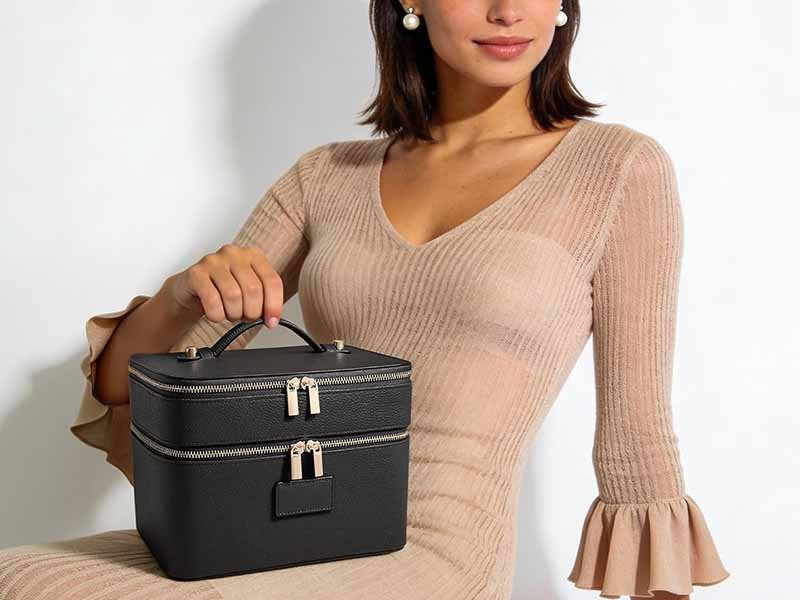
A leather makeup bag may look like a small and simple product, but for brands that actually develop and sell them, the material choice is rarely simple. Cosmetics are messy. Zippers are opened and closed every day. Bags are squeezed into handbags, dropped into suitcases, and exposed to oils, hand creams, alcohol-based cleaners, powder residue, and frequent friction. That means the leather used for a makeup bag has to do more than just look good under studio lighting. It needs to feel right in hand, hold its shape, resist surface damage, and still make sense within the target price range.
Split leather can be acceptable in leather makeup bags when the product is positioned correctly, the leather is finished properly, and the structure does not place too much stress on the material. It often works well for mid-range cosmetic bags, coated styles, and designs that prioritize a clean, uniform look. It is usually a poor choice for luxury leather makeup bags, high-stress structural areas, or products that rely on natural grain character as part of their value.
This is why the debate around split leather never really goes away. Some people dismiss it too quickly. Others use it carelessly just to reduce cost. In reality, the material itself is not the whole story. The real question is whether the leather grade matches the product design, brand position, customer expectation, and long-term usage pattern. A split leather makeup bag can perform well in one product line and create returns in another. That difference usually comes down to decisions made long before production starts. If you want to build a makeup bag collection that sells well and ages well, this is where the conversation has to begin.
What Is Split Leather in Leather Makeup Bags?
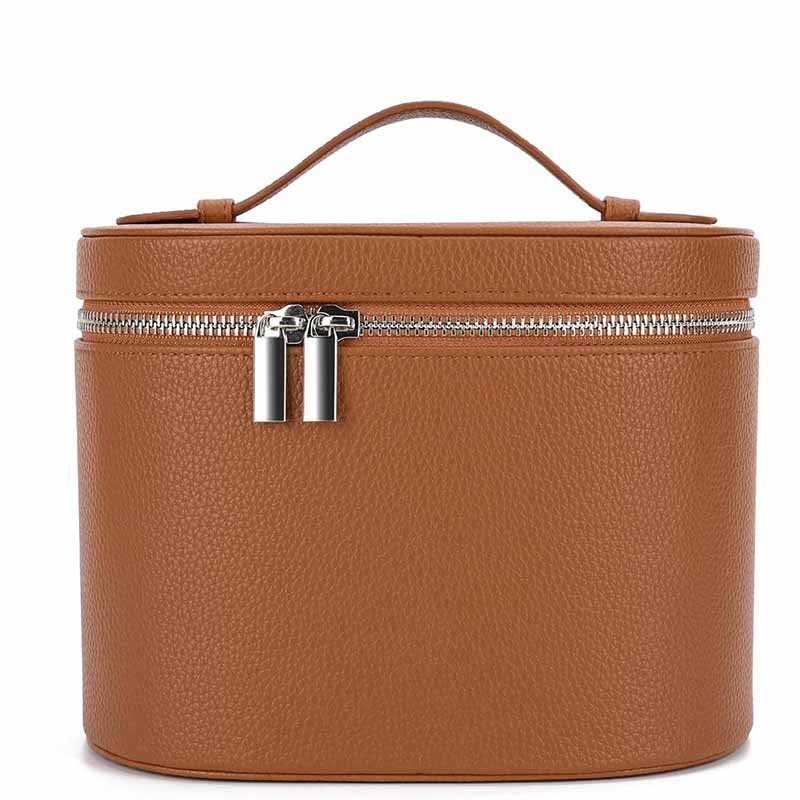
Split leather in leather makeup bags refers to the lower layer of a hide that remains after the upper grain layer has been separated during the leather splitting process. While it comes from the same hide as full-grain or top-grain leather, it does not include the natural grain surface. Because of this, split leather is usually finished with coatings, embossing, or protective films to create a usable and visually consistent surface for products like cosmetic bags.
In practical product development, split leather is widely used in the mid-range leather accessories market, including cosmetic pouches, travel makeup organizers, and toiletry bags. It allows manufacturers to control cost while still delivering the appearance of genuine leather. However, how the leather is processed, how thick it is cut, and how it is reinforced all determine whether the final bag performs well or begins to show wear too quickly.
How Split Leather Is Created from a Hide
A finished leather hide used for bag production typically starts at a thickness of 4–6 mm after tanning, which is too thick for most leather goods. Cosmetic bags usually require leather between 0.9 mm and 1.6 mm, depending on the structure of the product.
To reach this usable thickness, tanneries divide the hide horizontally using a splitting machine. This machine separates the hide into layers.
| Layer of Hide | Description | Common Use |
|---|---|---|
| Full Grain Layer | Top layer with natural grain surface | Premium bags and leather goods |
| Top Grain Layer | Slightly corrected upper layer | High-quality bags and accessories |
| Split Layer | Lower fibrous layer of the hide | Mid-range leather goods |
The split layer does not contain the dense outer grain structure that gives leather its natural durability and pattern. Because of this, manufacturers often apply surface treatments to improve its appearance and performance.
Surface Finishing for Split Leather
Without finishing treatment, split leather would appear rough and fibrous. To make it suitable for consumer products, factories apply finishing layers that create a smoother and more durable surface.
Several finishing methods are common in cosmetic bag production:
| Finishing Method | Result | Why It Works for Makeup Bags |
|---|---|---|
| PU Coating | Smooth, wipeable surface | Helps resist cosmetic stains |
| Embossed Grain | Simulated leather texture | Creates consistent visual appearance |
| Matte Finish | Soft, modern look | Popular in contemporary cosmetic brands |
| Protective Film | Added abrasion resistance | Helps prevent surface scratches |
These finishing systems allow split leather to perform reasonably well in products that are handled frequently but not heavily stressed.
For example, a cosmetic bag stored inside a handbag experiences friction and occasional pressure but rarely carries heavy loads. This makes it a suitable environment for well-finished split leather.
Thickness and Structure in Makeup Bag Development
Leather thickness plays an important role in cosmetic bag design. If the leather is too thin, the bag will collapse and lose its shape. If it is too thick, the bag becomes stiff and difficult to sew around curved edges.
Below are the most common thickness ranges used by manufacturers when developing leather makeup bags.
| Cosmetic Bag Type | Leather Thickness |
|---|---|
| Soft cosmetic pouch | 0.9–1.1 mm |
| Standard makeup bag | 1.1–1.4 mm |
| Structured cosmetic case | 1.3–1.6 mm |
Split leather is often used within these thickness ranges because it can be shaved and adjusted more easily during production.
However, leather alone does not determine the structure of the bag. Most cosmetic bags also include:
- fabric lining to protect cosmetics
- foam backing to maintain shape
- reinforced zipper panels to handle daily opening and closing
When these structural layers are combined correctly, split leather can provide a stable exterior surface without compromising the usability of the bag.
Real-World Performance Considerations
For brands developing cosmetic bags, the main concerns around split leather usually involve surface durability and coating performance rather than the leather fibers themselves.
The following performance factors are commonly evaluated during sampling.
| Performance Test | Why It Matters |
|---|---|
| Flex testing | Ensures coating does not crack during folding |
| Abrasion testing | Checks resistance to rubbing against other items |
| Stain resistance | Evaluates response to makeup oils and pigments |
| Adhesion testing | Ensures coating does not peel |
A well-finished split leather cosmetic bag can pass these tests and perform reliably under normal use conditions.
However, problems occur when finishing layers are too thin or poorly bonded. In those cases, the coating may begin to peel near fold lines or corners after extended use. This is one reason why experienced manufacturers pay close attention to finishing quality and material sourcing.
Why Split Leather Appears So Often in Cosmetic Bags
The widespread use of split leather in makeup bags is largely driven by product economics and production efficiency.
Material cost differences between leather grades can be significant.
| Leather Type | Relative Material Cost |
|---|---|
| Full grain leather | 100% baseline |
| Top grain leather | 80–90% |
| Split leather | 50–70% |
When a cosmetic bag program involves thousands of units, the difference between these materials can strongly affect retail pricing.
Many beauty brands sell cosmetic bags as accessories alongside skincare or makeup products. These bags must look attractive and feel premium, but they also need to stay within a controlled price range. Split leather helps achieve this balance when used carefully.
Still, cost should never be the only deciding factor. A cosmetic bag that feels cheap, cracks quickly, or peels after a few months can damage brand reputation far more than the savings from using lower-grade leather.
Key Takeaways for Product Developers
For brands planning leather makeup bag projects, several practical guidelines can help determine whether split leather is appropriate.
| Decision Factor | Recommendation |
|---|---|
| Product positioning | Use split leather mainly in mid-range cosmetic bags |
| Bag structure | Best suited for soft or lightly structured pouches |
| Surface finish | Choose durable coatings for stain resistance |
| Stress points | Reinforce zipper seams and corners |
| Brand image | Avoid split leather for luxury positioning |
In other words, split leather is not simply a “cheap alternative.” It is a material with specific strengths and limitations. When designers understand how those characteristics interact with product structure and customer expectations, split leather can become a practical part of a well-balanced cosmetic bag collection.
For manufacturers like SzoneierLeather, selecting the right leather grade is one of the first steps in developing a successful cosmetic bag program. By aligning leather type, finishing process, and bag structure, it becomes possible to deliver products that meet both performance expectations and commercial goals.
Which Leather Types Are Used for Leather Makeup Bags?
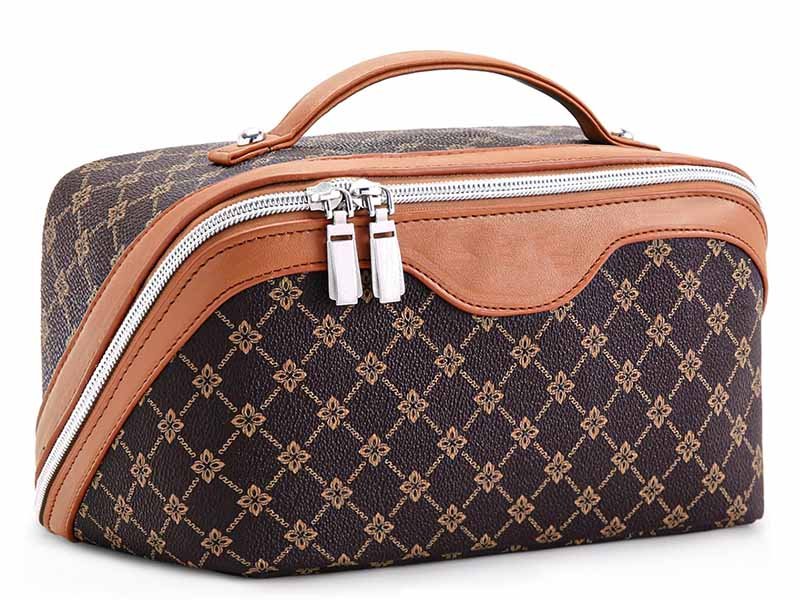
Leather makeup bags are produced using several different leather types, and the choice of material often depends on three practical factors: target price range, durability expectations, and visual style. While consumers often simply look for the word “leather,” product developers know that the grade of leather dramatically affects how the bag performs in daily use.
Cosmetic bags are exposed to conditions that are different from many other leather products. They are repeatedly opened and closed, squeezed inside handbags or luggage, exposed to cosmetics, oils, perfumes, and alcohol-based cleaners, and handled frequently. Because of this, the leather must not only look attractive but also resist stains, creasing, and surface wear.
Most leather makeup bags on the market today fall into three material categories: full grain leather, top grain leather, and split leather. Each type serves a different segment of the market.
Full Grain Leather for Leather Makeup Bags
Full grain leather is the highest-quality layer of the hide because it preserves the natural grain surface. This layer contains the densest fiber structure and the most natural strength. Products made from full grain leather typically develop a natural patina over time, which many customers associate with premium leather goods.
For cosmetic bags, full grain leather is commonly used in luxury beauty accessories, designer travel sets, and high-end retail collections. Brands that position themselves in the premium category often choose full grain leather because it communicates authenticity and long-term value.
However, full grain leather also introduces certain challenges for cosmetic bag production. The natural grain surface can vary significantly from hide to hide. Color tone, pore structure, and small natural marks may differ across panels. While this natural variation is valued in luxury leather goods, it can make large-scale production more complicated.
Below is a simplified overview of full grain leather characteristics in cosmetic bag development.
| Factor | Full Grain Leather |
|---|---|
| Surface appearance | Natural grain with visible pores |
| Durability | Very high |
| Aging behavior | Develops natural patina |
| Color consistency | Moderate variation |
| Cost level | High |
Full grain leather cosmetic bags typically fall into higher retail price ranges because of the material cost and the additional sorting required during production.
Top Grain Leather for Leather Makeup Bags
Top grain leather is the most widely used material for premium cosmetic bags. It is created by lightly sanding or correcting the natural grain surface to remove imperfections while keeping most of the leather’s structural strength.
Because the surface is slightly refined, top grain leather offers a smoother and more consistent appearance compared with full grain leather. This makes it easier to control color matching and surface uniformity in production.
For cosmetic bags, this balance between durability and appearance makes top grain leather a practical choice. It still feels like genuine leather and maintains good flexibility, but it is easier to process during manufacturing.
Many brands use top grain leather when they want their cosmetic bags to feel premium but still maintain production efficiency.
Here are some common properties of top grain leather used in makeup bag manufacturing.
| Factor | Top Grain Leather |
|---|---|
| Surface appearance | Smooth and refined |
| Durability | High |
| Aging behavior | Moderate patina development |
| Color consistency | Good |
| Cost level | Medium to high |
Top grain leather cosmetic bags often appear in travel accessories, luxury beauty kits, and branded promotional gift sets where both durability and consistent appearance are important.
Split Leather for Leather Makeup Bags
Split leather is produced from the lower layer of the hide after the grain layer has been removed. It does not contain the natural grain surface, so it is usually finished with coatings, embossing, or protective films to improve its appearance.
In cosmetic bag production, split leather is frequently used in mid-range product lines. It allows brands to maintain the appearance of leather while controlling production costs.
Another advantage of split leather is its ability to achieve very consistent surface finishing. Because the grain surface has been removed, manufacturers can apply controlled coatings that produce uniform textures and colors.
This consistency is especially useful for cosmetic bag collections that include multiple sizes or coordinated travel sets.
Below is a practical overview of split leather characteristics in cosmetic bags.
| Factor | Split Leather |
|---|---|
| Surface appearance | Coated or embossed |
| Durability | Medium (depends on finish quality) |
| Aging behavior | Limited patina development |
| Color consistency | Very consistent |
| Cost level | Medium |
Split leather cosmetic bags are commonly used in beauty accessory collections, travel kits, and mid-range retail cosmetic bags.
Other Leather Materials Sometimes Used
Although full grain, top grain, and split leather represent the most common materials, other leather options occasionally appear in cosmetic bag production.
Some brands choose suede or nubuck leather to create a softer aesthetic. However, these materials are less resistant to cosmetic stains and therefore are less common for products that may come into contact with makeup.
Other brands use reconstituted or bonded leather, which is made from leather fibers combined with adhesives. This material is generally used in lower-cost accessories because its durability is limited compared with natural leather layers.
A comparison of these additional materials helps illustrate their role in cosmetic bag development.
| Material | Appearance | Durability | Common Usage |
|---|---|---|---|
| Nubuck leather | Soft matte surface | Medium | Fashion cosmetic pouches |
| Suede leather | Velvety texture | Medium-low | Decorative bags |
| Bonded leather | Artificial surface | Low | Low-cost accessories |
Because cosmetic bags are often exposed to spills and stains, most professional manufacturers recommend materials with protective finishing layers.
How Leather Choice Affects Product Development
Choosing the right leather type is not only about material cost. It also affects product design, structure, and manufacturing complexity.
For example, thicker full grain leather may require stronger sewing equipment and reinforced seams. Split leather may require additional backing or coating layers to maintain durability.
Below are some common development considerations when selecting leather for makeup bags.
| Product Requirement | Material Consideration |
|---|---|
| Premium appearance | Full grain or top grain leather |
| Uniform surface | Split leather with coating |
| Easy cleaning | Coated leather finishes |
| Soft flexible structure | Top grain leather |
| Cost control | Split leather |
Experienced product developers usually test several leather options during the sampling phase before confirming the final material. This allows them to evaluate how each leather behaves when stitched, folded, and assembled into the final bag.
For manufacturers such as SzoneierLeather, selecting the appropriate leather type is one of the first steps in cosmetic bag development. Matching the material to the bag’s structure and market positioning ensures that the final product delivers both the expected quality and the correct price point.
When Is Split Leather Acceptable in Leather Makeup Bags?
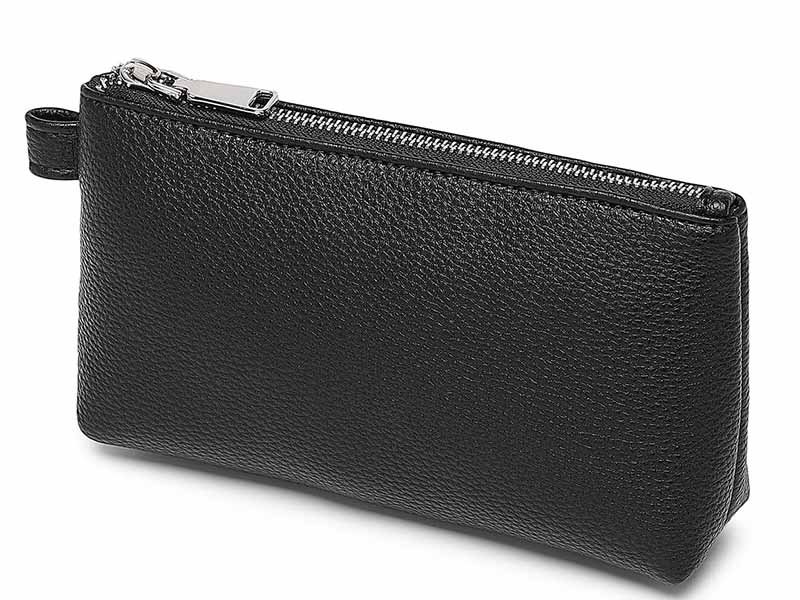
Split leather can be a practical and reliable material for leather makeup bags when the product design, price positioning, and structural demands are aligned with the material’s characteristics. Cosmetic bags are generally lighter-duty accessories compared with items like handbags, belts, or luggage, which means the leather is rarely subjected to heavy loads. When finished correctly and used in the right areas of the product, split leather can provide stable performance, a clean appearance, and controlled production cost.
However, the key is understanding where split leather works well and how to design around its limitations. Cosmetic bag developers often evaluate split leather through several practical criteria: structure, surface finishing, leather thickness, reinforcement design, and expected product lifespan.
Which Leather Makeup Bag Designs Fit Split Leather?
Split leather works best in cosmetic bags where the leather primarily functions as an outer shell rather than a structural load-bearing component. Flat cosmetic pouches, soft zip makeup bags, and travel toiletry organizers are good examples.
These designs rely more on lining, foam padding, and internal structure to maintain shape. The leather itself mainly contributes to appearance and surface durability.
Common cosmetic bag styles where split leather performs well include:
| Cosmetic Bag Style | Why Split Leather Works |
|---|---|
| Flat zip cosmetic pouch | Minimal structural stress |
| Travel makeup organizer | Internal lining supports structure |
| Cosmetic brush pouch | Flexible body design |
| Beauty gift set bags | Uniform surface appearance |
For example, a flat cosmetic pouch typically carries lightweight items such as lipstick, compact powder, and small brushes. The load on the leather panels is relatively low. In this scenario, split leather with a durable coating can perform just as well as more expensive leather grades while maintaining a polished look.
How Surface Finishing Improves Split Leather Performance
One of the most important factors that determines whether split leather works well in cosmetic bags is the quality of the finishing layer applied to the surface.
Because split leather does not contain the natural grain layer, finishing treatments are used to strengthen the surface and protect it from daily wear. High-quality finishing systems can dramatically improve stain resistance, abrasion resistance, and flexibility.
Common finishing systems used for cosmetic bag leather include:
| Finishing Type | Performance Benefit |
|---|---|
| Polyurethane (PU) coating | Smooth, wipeable surface |
| Embossed grain texture | Leather-like appearance |
| Protective lacquer layer | Improved scratch resistance |
| Matte protective coating | Modern visual finish |
For makeup bags, stain resistance is especially important. Cosmetic products often contain oils, pigments, and alcohol-based ingredients that can damage untreated leather. A well-applied coating helps prevent these substances from penetrating the leather fibers.
Many manufacturers perform abrasion tests and flex tests on finished split leather before approving it for cosmetic bag production. These tests simulate repeated folding and rubbing that occurs during daily use.
When Split Leather Works Well for Mid-Range Product Lines
Split leather is commonly used in cosmetic bags that fall into the mid-range price segment. These products are often sold as beauty accessories, travel items, or gift packaging for cosmetic brands.
In these situations, the goal is to create a product that looks premium but remains within a controlled price range.
Below is a simplified material cost comparison often used during product planning.
| Leather Type | Relative Material Cost |
|---|---|
| Full grain leather | 100% baseline |
| Top grain leather | 80–90% |
| Split leather | 50–70% |
For a cosmetic bag program producing several thousand units, this difference can significantly affect the final retail price.
For example, a beauty brand launching a seasonal cosmetic gift set might include a leather makeup pouch as part of the package. Using split leather allows the brand to offer a genuine leather accessory without pushing the product price beyond the intended market segment.
Why Consistent Appearance Matters in Cosmetic Bags
Another reason split leather is widely used in cosmetic bag collections is its visual consistency.
Natural grain leather often varies in texture, pore pattern, and color tone. While this variation is valued in luxury leather goods, it can create challenges when producing large batches of cosmetic bags where uniform appearance is important.
Split leather finishing allows manufacturers to create consistent surfaces across large production runs. This makes it easier to match colors and textures across multiple products within the same cosmetic line.
For example, many beauty brands release coordinated product sets that include:
- cosmetic bags
- travel pouches
- accessory organizers
Maintaining visual consistency across these items helps strengthen brand identity.
Structural Reinforcement Makes Split Leather More Reliable
When split leather is used in cosmetic bags, experienced manufacturers often combine it with additional reinforcement materials to improve durability.
Typical structural components include:
| Structural Component | Purpose |
|---|---|
| Fabric lining | Protects cosmetics and improves interior durability |
| Foam backing | Helps maintain bag shape |
| Reinforced zipper panels | Prevents seam stress |
| Edge reinforcement | Reduces corner wear |
These elements reduce stress on the leather panels and extend the product’s lifespan.
For example, many cosmetic bags include a thin foam layer between the leather and lining fabric. This not only helps the bag maintain its shape but also distributes pressure more evenly across the leather surface.
When Split Leather Is a Smart Choice
In practical product development, split leather becomes a smart choice when the following conditions apply:
| Condition | Reason |
|---|---|
| Mid-range retail pricing | Maintains balance between quality and cost |
| Soft cosmetic bag structure | Reduces stress on leather panels |
| Coated leather finish | Improves stain resistance |
| Reinforced internal structure | Supports durability |
When these factors are aligned, split leather can deliver a cosmetic bag that looks attractive, performs reliably, and remains economically viable for brands producing large quantities.
For experienced leather manufacturers such as SzoneierLeather, selecting the correct leather type is not just a material decision—it is part of a broader product development strategy that considers design structure, customer expectations, and long-term brand reputation.
When Should Split Leather Not Be Used in Leather Makeup Bags?
Split leather can work well in certain cosmetic bag designs, but there are situations where it should be avoided. The key issue is structural strength and long-term durability. Because split leather does not contain the dense grain layer of the hide, it relies heavily on surface finishing and internal reinforcement.
When a product design places continuous stress on the leather, the absence of the natural grain layer becomes more noticeable. Over time this can lead to stretching, surface cracking, or finish wear. For brands that want to avoid customer complaints and returns, it is important to recognize where split leather may create risks.
Which Parts of Leather Makeup Bags Need Stronger Leather?
Some areas of a makeup bag experience more stress than others. These areas benefit from stronger leather layers such as top grain or full grain leather.
High-stress areas often include zipper openings, corners, handles, and reinforced edges. These parts are repeatedly pulled, folded, or compressed during normal use.
The following table highlights the most common stress points in cosmetic bags.
| Bag Area | Stress Level | Recommended Leather |
|---|---|---|
| Zipper seam area | High | Top grain leather |
| Corner panels | Medium-high | Top grain or reinforced split |
| Handle attachments | High | Full grain or thick top grain |
| Flat body panels | Medium | Split leather acceptable |
Body panels of cosmetic bags usually carry less mechanical load, which is why split leather can perform well there. However, once a bag includes handles, rigid frames, or heavy internal compartments, stronger leather becomes more important.
Many professional leather manufacturers use hybrid construction, where stronger leather is used in stress areas and split leather is used in the main body panels to balance cost and durability.
Why Do Luxury Leather Makeup Bags Avoid Split Leather?
Luxury cosmetic bags often avoid split leather because the value of luxury products is closely connected to material authenticity and long-term aging behavior.
High-end customers usually expect natural grain leather that develops character over time. Full grain leather gradually forms a patina, becoming softer and more visually distinctive with use. Split leather, especially when heavily coated, tends to maintain a more static appearance.
Luxury brands also focus strongly on tactile experience. The way leather feels in the hand plays a major role in how customers perceive quality. Natural grain leather offers a depth and softness that coated split leather often cannot replicate.
Below is a simplified comparison from a luxury product development perspective.
| Product Expectation | Preferred Leather |
|---|---|
| Natural leather aging | Full grain |
| Premium tactile feel | Full grain |
| Luxury brand storytelling | Full grain |
| Consistent retail appearance | Top grain |
Luxury brands also tend to invest more heavily in long-term product durability. Because split leather can depend on surface coatings for durability, it is less predictable in extremely long product lifecycles.
For brands positioning themselves in the luxury segment, using higher-grade leather supports both product performance and brand image.
How Does Split Leather Affect Durability?
Durability concerns around split leather usually relate to the finish layer rather than the fiber structure itself. The base material still contains collagen fibers, but the protective surface often relies on coatings.
If the coating layer is thin or poorly bonded, it may wear down more quickly in areas of friction such as corners or fold lines. Over time this can expose the fibrous surface beneath the coating.
This does not mean that split leather products automatically fail quickly. In fact, many well-made split leather cosmetic bags last for years. The key factor is the quality of the finishing process.
Below are several durability factors that manufacturers monitor when developing split leather products.
| Durability Factor | What to Evaluate |
|---|---|
| Coating adhesion | Resistance to peeling |
| Flex performance | Resistance to cracking at folds |
| Abrasion resistance | Surface wear during friction |
| Edge finishing | Resistance to corner wear |
Factories often perform flex testing and abrasion testing during development to evaluate these risks. When coating systems are strong and thickness is well controlled, split leather can deliver acceptable durability for mid-range cosmetic bags.
However, for products expected to last many years or develop visible leather character over time, top grain or full grain leather remains the safer choice.
How Do Brands Choose Leather for Leather Makeup Bags?
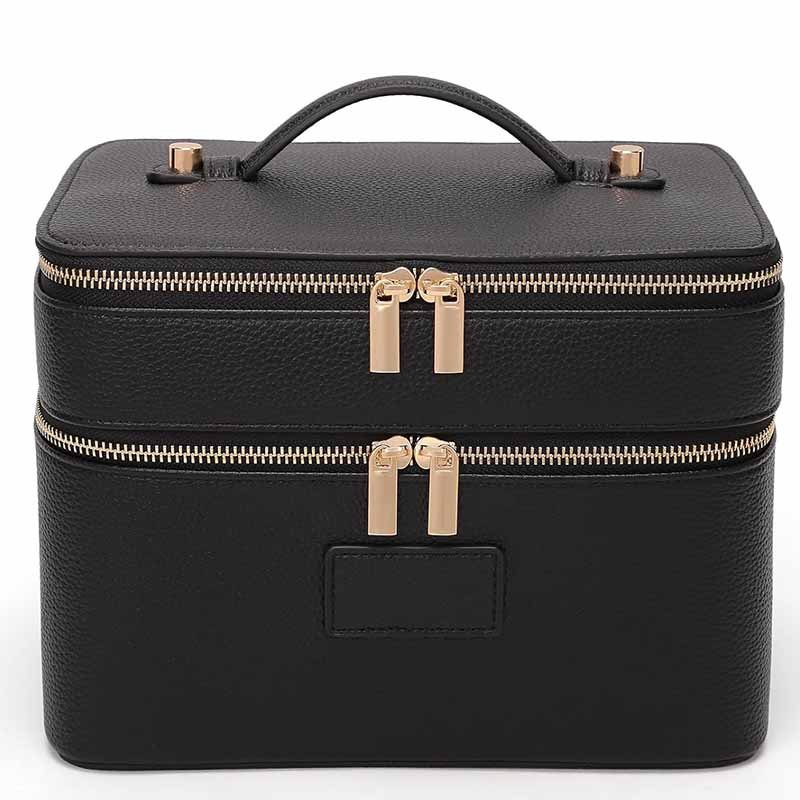
Choosing leather for cosmetic bag development is a balancing process. Brands must consider aesthetics, durability, cost, and customer expectations simultaneously. The correct decision rarely comes from material cost alone.
Experienced product developers usually evaluate leather materials through several criteria.
How Do You Balance Cost and Quality?
Cost pressure is unavoidable in consumer products. Cosmetic bags often appear in gift sets or beauty accessory lines where the target price is fixed.
Brands typically start by defining the expected retail price and working backward to determine material options.
The following simplified cost structure illustrates how material choice affects final pricing.
| Leather Type | Relative Material Cost | Typical Retail Position |
|---|---|---|
| Full grain leather | 100% baseline | Premium cosmetic accessories |
| Top grain leather | 75–90% | Premium travel cosmetic bags |
| Split leather | 50–70% | Mid-range cosmetic accessories |
| Synthetic leather | 20–40% | Entry-level cosmetic bags |
A good product developer does not simply choose the cheapest material. Instead, they evaluate whether the material supports the overall brand experience.
For example, a luxury cosmetics brand selling high-end skincare products would likely prefer top grain or full grain leather for packaging accessories. A travel accessories brand might focus more on durability and stain resistance.
Which Leather Thickness Works for Makeup Bags?
Leather thickness plays a critical role in cosmetic bag performance. If leather is too thin, the bag may feel fragile. If it is too thick, the bag becomes stiff and difficult to sew.
Most leather makeup bags fall within a narrow thickness range.
| Product Type | Recommended Thickness |
|---|---|
| Soft cosmetic pouch | 0.9–1.2 mm |
| Structured makeup bag | 1.2–1.6 mm |
| Reinforced travel cosmetic case | 1.4–1.8 mm |
Split leather is often easier to control within these thickness ranges because the splitting process allows precise thickness adjustment.
Factories frequently add foam backing or fabric lining to improve structure without increasing leather thickness too much.
How Do Factories Develop Custom Leather Makeup Bags?
Professional leather product development usually follows a clear step-by-step process. This ensures the final product meets both aesthetic and functional expectations.
Typical development stages include:
| Development Stage | Key Actions |
|---|---|
| Product concept | Define size, style, and brand positioning |
| Material selection | Choose leather grade and thickness |
| Prototype sampling | Build functional samples |
| Performance testing | Evaluate durability and usability |
| Design refinement | Adjust details before mass production |
Sampling is particularly important for leather products because leather behavior can vary depending on finishing methods and construction techniques.
Factories like SzoneierLeather work closely with clients during this stage to adjust leather thickness, reinforcement materials, zipper quality, and lining structure.
How SzoneierLeather Develops Custom Leather Makeup Bags
SzoneierLeather has more than 18 years of experience developing leather bags, wallets, belts, straps, accessories, and leather storage products. The company supports global brands and custom wholesale clients with full product development services.
Because the company maintains a strong leather supply chain, it can source and develop multiple leather grades depending on product positioning.
Integrated Leather Supply Chain
A reliable leather supply chain ensures stable product quality.
| Capability | Description |
|---|---|
| Leather sourcing | Access to multiple leather grades |
| Material development | Surface finishing customization |
| Product design | In-house bag design team |
| Sampling | Rapid prototype development |
| Manufacturing | Scalable production capacity |
This integrated structure allows SzoneierLeather to support both premium leather products and mid-range commercial product lines.
Sampling and Product Development
Sampling is one of the most critical phases in leather product development. It allows brands to evaluate real materials before committing to production.
Typical sampling timelines are as follows:
| Development Stage | Time Required |
|---|---|
| Design discussion | 1–2 days |
| Material preparation | 2–3 days |
| Sample production | 5–7 days |
| Shipping | 3–5 days |
Fast sampling allows brands to refine designs quickly and reduce product development risks.
Production and Quality Control
Quality control plays an important role in leather manufacturing.
SzoneierLeather performs multiple inspection stages during production.
| Inspection Stage | Purpose |
|---|---|
| Raw material inspection | Verify leather quality |
| Cutting inspection | Ensure consistent pattern accuracy |
| Assembly inspection | Check stitching and structure |
| Final inspection | Confirm appearance and functionality |
These processes help maintain consistent quality across large production batches.
Final Thoughts
Split leather in leather makeup bags is neither inherently good nor inherently bad. Its suitability depends on how the material is used, how it is finished, and how the product is designed.
When used in appropriate designs such as cosmetic pouches or mid-range travel makeup bags, split leather can provide a clean appearance, stain resistance, and cost efficiency. When used in luxury products or structural areas that require strong natural grain leather, higher-grade materials are often a better choice.
For brands developing leather cosmetic bags, the most important step is working with an experienced manufacturer who understands the relationship between leather grade, product structure, and long-term performance.
SzoneierLeather supports brands worldwide with custom leather makeup bag development, OEM manufacturing, and private label leather product production. With over 18 years of leather manufacturing experience, the company offers flexible MOQ, rapid sampling, and full product development support.
If you are planning to launch or expand your custom leather makeup bag collection, the SzoneierLeather team is ready to help turn your ideas into high-quality products. Feel free to reach out to discuss materials, design options, and manufacturing solutions for your next leather project.