 Skip to content
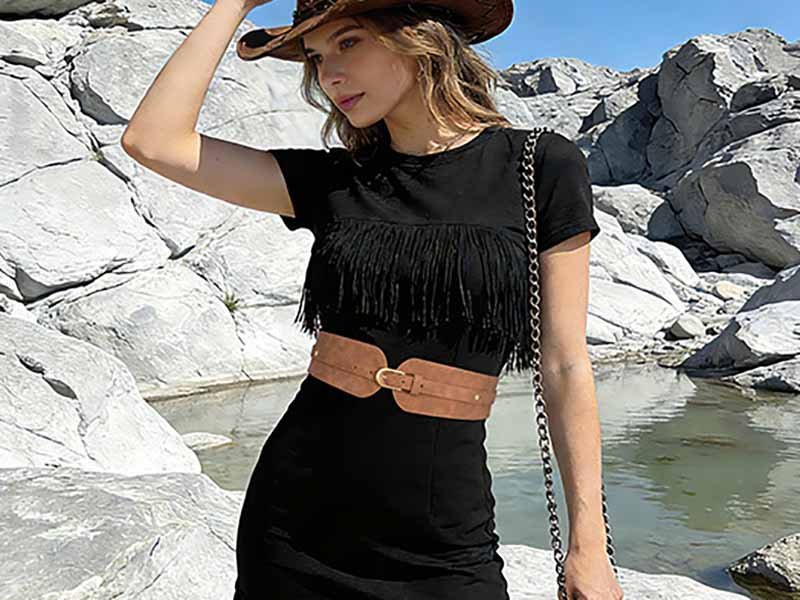
A women’s leather belt is one of those “small” items that can quietly ruin an outfit—or make it feel perfect. And the reason is often not the leather, not the buckle, not even the brand. It’s where the belt is worn. A belt that feels great at the waist can feel stiff and “too short” at the hips. A belt that sits effortlessly on the hips can look sloppy and overly long when pulled up to the waist. That’s not the customer being picky; it’s geometry.
Women’s waist vs hip wearing changes the belt’s required working length, the hole range that actually gets used, and how pressure is distributed on the body. If the belt wasn’t designed for the intended wearing position, even high-quality leather can feel uncomfortable, twist, slide, or crease early.
In the sections below, you’ll see exactly what changes (length, holes, buckle placement, widths), why returns happen, and what practical fit specs brands should lock in before sampling. A belt is simple—until you try to make it fit thousands of real bodies and outfits. Let’s make it fit on purpose.
What Is Women’s Waist vs Hip Wearing for Leather Belts?
Women’s waist wearing places a leather belt at the natural waist (usually above the navel), while hip wearing sits lower on the hips (around the hip bones). These positions need different fit specs: total length, “working length” (buckle-to-hole range), hole spacing, belt width, and leather stiffness. Designing without specifying waist vs hip is a common reason for discomfort, slipping, and wrong-size returns.
What is women’s waist wearing for leather belts?
Women’s waist wearing is the “high-control” fit zone. It’s narrower, more sensitive to movement (breathing, sitting), and customers notice small sizing errors fast.
What typically changes for a waist-worn women’s leather belt:
- Shorter target working length
- The waist circumference is usually smaller than hips by 6–18 cm for many body shapes (varies widely, but the gap is real in fit testing).
- Tighter adjustment accuracy
- A 1–2 cm mistake can feel like: “it digs in,” “it’s stiff,” or “it’s not my size.”
- Preferred belt widths (common market ranges)
- 20–30 mm is often more comfortable at the waist for everyday wear, especially with high-rise trousers and dresses.
- Leather “feel” matters more
- Too stiff = pinching when sitting
- Too soft = buckle tilts and belt rolls
Practical waist-wear spec habits brands use to cut returns:
- More usable holes centered around a realistic waist size range
- Slightly smaller buckle-to-first-hole distance (so the buckle doesn’t sit too far left/right)
- Cleaner tip length so the tail doesn’t look “extra long” when cinched at the waist
What is women’s hip wearing for leather belts?
Hip wearing is usually more forgiving, but it introduces a different set of failures: sliding, rotating, and buckle tilt. The hip area is wider and more stable than the waist, but pants loops and body curves change how the belt sits.
What typically changes for a hip-worn women’s leather belt:
- Longer working length
- Hip circumference is commonly larger than waist. If a waist belt is used on hips, customers often need the last hole (or can’t close it).
- More tolerance in comfort
- Hip-worn belts usually don’t compress the body as much, so customers can accept a bit more looseness.
- Common widths
- 28–38 mm is popular for jeans and casual trousers, but width must match belt loops.
- Leather flexibility often needs to be higher
- Too stiff at hips can cause gapping at the back and pressure points at the front.
What customers complain about when hip fit is wrong:
- “It slides down when I walk.”
- “The buckle sits up/tilts forward.”
- “The belt twists in the loops.”
- “It creases fast near the buckle.”
These aren’t “fashion issues.” They’re fit-spec issues.
Why does women’s waist vs hip belt fit matter?
Because the belt is a tension product: it’s meant to hold a position under load. If the belt is designed for the wrong wearing zone, customers experience predictable problems that look like quality defects.
Most common failure patterns we see across women’s belts:
- Wrong working length → belt uses only the last 1–2 holes (or can’t close)
- Hole range not centered → customer can close it, but tail length looks awkward
- Hole spacing not suitable → “one hole too tight, next hole too loose”
- Width mismatch → discomfort + twisting in loops
- Leather temper mismatch → rolling, buckle tilt, early creasing
Here’s the key: Waist vs hip is not a styling note. It’s a spec decision. Brands that define wearing position early typically see:
- fewer size exchanges,
- better comfort reviews,
- more repeat purchase behavior (because customers trust the fit).
| Spec Point | Women’s Waist Wearing | Women’s Hip Wearing | What Customers Notice |
|---|---|---|---|
| Wearing zone | Above navel | Hip bone area | “Feels tight vs feels relaxed” |
| Target belt width | 20–30 mm common | 28–38 mm common | “Comfort + looks right” |
| Working length need | Shorter | Longer | “Can I close it easily?” |
| Hole spacing preference | 2.0–2.5 cm | 2.5–3.0 cm | “Easy to fine-tune fit” |
| Stiffness preference | Medium-soft | Soft to medium | “No pinching / no sliding” |
| Common failure | Digging in when sitting | Sliding, buckle tilt | “Annoying all day” |
What Brands Should Lock Before Sampling
If your product is “women’s waist wearing leather belts,” confirm:
- Target outfit category: dresses / coats / high-rise pants
- Belt width target: 20 / 25 / 28 / 30 mm
- Hole spacing: 2.0–2.5 cm
- Center hole strategy: size label should match center hole, not last hole
- Leather temper: avoid overly stiff leather unless it’s purely decorative
If your product is “women’s hip wearing leather belts,” confirm:
- Target denim rise: mid-rise / low-rise / mixed
- Belt width target: 30 / 32 / 35 / 38 mm (must match loops)
- Hole spacing: 2.5–3.0 cm
- Anti-tilt buckle + keeper design (tail control matters more)
- Leather flexibility: enough to sit flat through loops without twisting
Which Measurements Matter for Women’s Waist vs Hip Leather Belts?
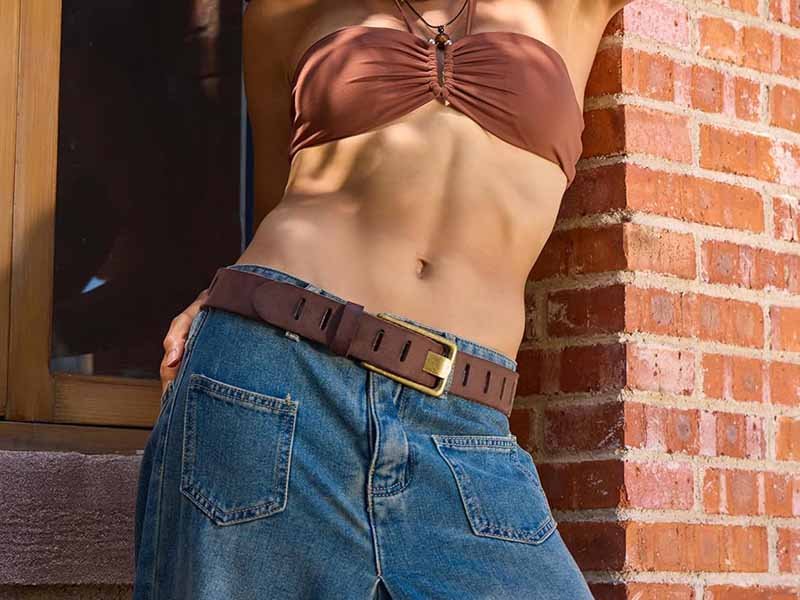
For women’s waist vs hip leather belts, the most critical measurements are body circumference at the wearing position, target hole position, working length, total belt length, and tail allowance. Measuring only “waist size” is not enough. Accurate belt fit depends on where the belt is worn, how much adjustment range is required, and how the belt interacts with clothing and movement.
Which body measurements should be taken for women’s waist vs hip leather belts?
The biggest mistake brands make is relying on a single body measurement. Women’s belts require at least three distinct reference points, and they differ between waist wearing and hip wearing.
Essential measurements to collect from customers or fit models:
- Actual wearing circumference
- Waist wearing: measure where the belt will sit, not the anatomical waist on a size chart.
- Hip wearing: measure over clothing, especially denim, not directly on the body.
- Preferred fit tension
- Some women prefer a snug waist belt.
- Hip belts are often worn looser for comfort and styling.
- Outfit thickness
- Dresses vs jeans can add 1–4 cm to effective circumference.
A simple rule factories use during sampling:
- If you don’t know where the customer plans to wear the belt, the size will be wrong—even if the number looks correct.
Common measurement errors we see:
- Measuring the waist, but wearing the belt on the hips
- Measuring without pants, but wearing with thick denim
- Using jeans size (e.g., W28) as a belt size reference
Those shortcuts lead directly to returns.
How do waist vs hip measurements change women’s leather belt length?
This is where many brands underestimate the impact of wearing position.
Key concept:
Belt length is not the same as body circumference.
What actually matters is working length, not total length.
Working length = distance from buckle pin to the hole the customer uses most often
Typical differences seen in fitting sessions:
| Fit Type | Avg. Body Circumference | Typical Working Length | Difference |
|---|---|---|---|
| Waist wearing | 68–76 cm | 75–83 cm | +7–9 cm |
| Hip wearing | 84–94 cm | 92–102 cm | +8–10 cm |
Why the extra length?
- Buckle thickness
- Leather fold at buckle
- Comfort allowance
- Movement tolerance
If a waist belt is used at the hips:
- Customer often ends up using the last hole
- Tail length becomes too short
- Buckle placement looks off-center
If a hip belt is used at the waist:
- Excess tail length looks messy
- Holes sit too far apart for fine adjustment
- Belt feels bulky
This is why professional factories always ask: “Waist wearing or hip wearing?” before confirming length.
Do body shape differences affect women’s waist vs hip belt fit?
Yes—and ignoring body shape is one of the reasons “standard sizing” struggles in women’s belts.
Different body shapes change how the belt behaves under tension:
| Body Shape | Waist vs Hip Gap | Fit Risk |
|---|---|---|
| Hourglass | Large | Belt slides or pinches |
| Pear-shaped | Very large | Hip belts need longer range |
| Rectangle | Small | Waist/hip belts may overlap |
| Apple-shaped | Variable | Waist belts need flexibility |
What this means in practice:
- A woman with the same hip size as another may need a different belt spec due to waist-to-hip ratio.
- Hole range becomes more important than absolute size.
- Belt stiffness must match body curvature.
Factories that test only on one model size often miss this. Brands that test across 2–3 body types usually see better customer feedback.
| Measurement Input | Used For | Waist Belt Impact | Hip Belt Impact |
|---|---|---|---|
| Wearing circumference | Working length | Shorter | Longer |
| Outfit thickness | Allowance | Moderate | High |
| Body shape | Hole range | Narrow but precise | Wider range |
| Sitting comfort | Leather temper | Medium-soft | Soft-medium |
| Styling preference | Tail length | Clean, short | Slightly longer |
How Do Women’s Waist vs Hip Leather Belt Fits Differ?
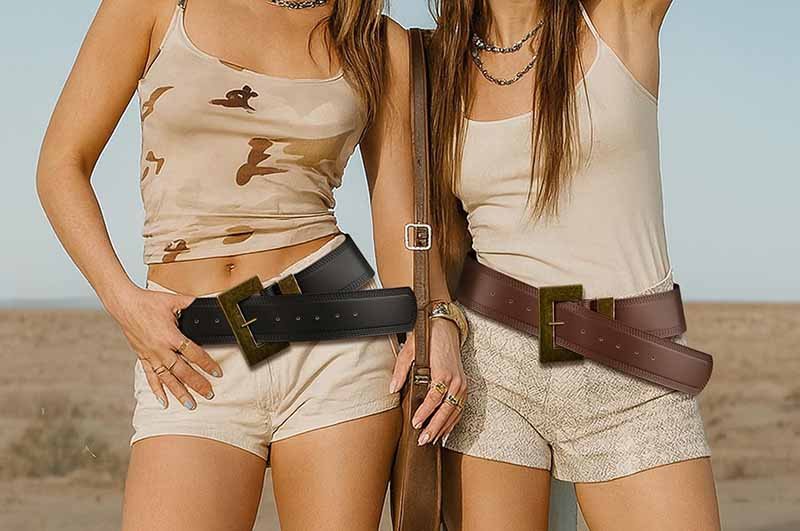
Women’s waist vs hip leather belt fit differs mainly in working length, hole positioning, buckle placement, belt width, and tail length. Waist-worn belts require tighter length control and finer adjustment, while hip-worn belts need longer working length and more flexibility. These differences are structural, not cosmetic, and must be built into the belt from the design stage.
How does working length differ for women’s waist vs hip leather belts?
Working length is the single most important fit variable, yet it’s often misunderstood.
Working length = buckle pin → commonly used hole Not the total belt length. Not the size label. Not the jeans size.
In women’s belts, the difference between waist and hip wearing usually shifts the working length by 10–20 mm, which sounds small—but is very noticeable in wear.
| Wearing Position | Typical Working Length Strategy | Risk if Incorrect |
|---|---|---|
| Waist wearing | Centered tightly around target size | Digging, stiffness |
| Hip wearing | Slightly looser center position | Sliding, rotation |
Using the same working length logic for both waist and hip belts and simply “adding holes.”
What actually happens:
- Waist belts feel uncomfortable when sitting.
- Hip belts require last-hole usage.
- Customers feel the belt is “not made for them.”
Professional factories treat working length as position-specific, not size-only.
How do hole spacing and hole range affect women’s belt comfort?
Hole layout determines whether a belt feels adjustable or frustrating.
Key differences by wearing position:
| Spec Item | Waist Wearing | Hip Wearing |
|---|---|---|
| Hole spacing | 20–25 mm | 25–30 mm |
| Adjustment priority | Precision | Range |
| Typical complaint | “Between holes” | “Runs out of holes” |
Why waist belts need tighter spacing
- Small changes in tension are felt immediately.
- Sitting and standing can change comfort needs.
- Customers often want micro-adjustment.
Why hip belts need wider spacing
- The fit zone is less sensitive.
- Styling tolerance is higher.
- Wider spacing avoids overcrowded holes on longer belts.
What customers notice when this is wrong:
- “One hole is too tight, the next is too loose.”
- “I can’t get it to sit comfortably all day.”
- “It fits, but never feels right.”
How does buckle placement change waist vs hip belt fit?
Buckle placement affects visual balance and pressure distribution, not just aesthetics.
Waist-worn belts
- Buckle sits closer to the body’s centerline.
- Excess buckle weight is felt more strongly.
- Poor placement causes forward pull and discomfort.
Hip-worn belts
- Buckle weight is better supported by the hips.
- Tail control becomes more important.
- Tilt happens if leather is too stiff.
Engineering takeaway:
- Waist belts benefit from lighter buckles and tighter placement control.
- Hip belts benefit from stable keepers and slightly longer tail allowance.
What Fit Issues Occur with Women’s Waist vs Hip Leather Belts?
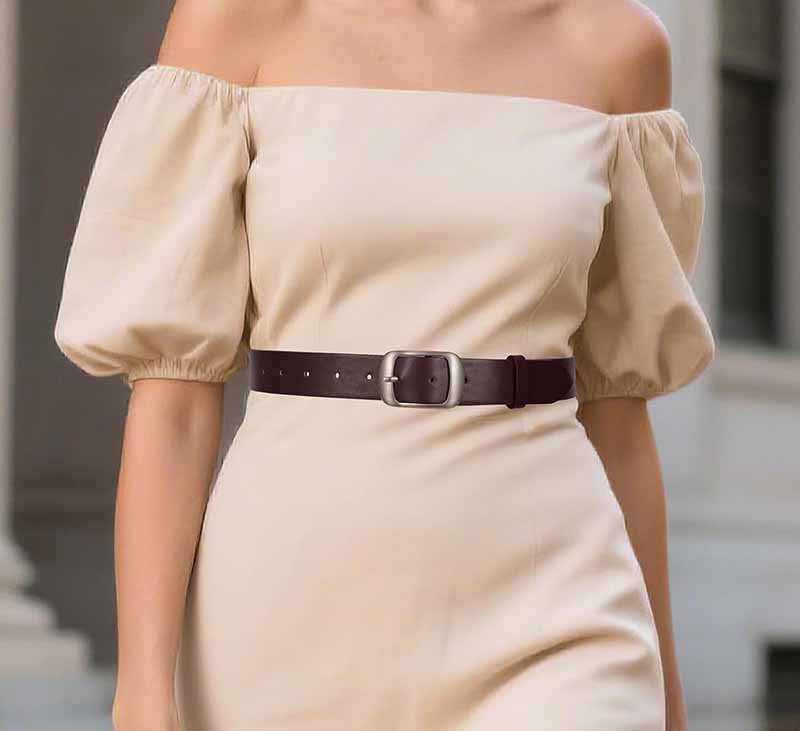
The most common fit issues with women’s waist vs hip leather belts include digging at the waist, sliding at the hips, uneven hole usage, awkward tail length, buckle tilt, and early creasing. These problems are usually caused by incorrect working length, hole layout, belt width, or leather stiffness—not by poor leather quality.
What causes discomfort in women’s waist-worn leather belts?
Waist discomfort almost always comes from over-control.
Typical causes:
- Working length too short
- Leather too stiff
- Belt too wide for the waist zone
- Hole spacing too wide
Customer feedback usually sounds like:
- “It feels tight when I sit.”
- “It leaves marks.”
- “I don’t want to wear it all day.”
Spec-level fixes brands use:
- Reduce belt width by 5–8 mm
- Use medium-soft temper leather
- Increase hole density near center
- Adjust buckle fold length slightly
Comfort at the waist is about precision, not strength.
Why do women’s hip-worn leather belts slide or twist?
Hip belts fail when flexibility and control are out of balance.
Main causes:
- Leather too stiff for the hip curve
- Insufficient tail length control
- Buckle too heavy
- Belt width mismatched to loops
Customer complaints:
- “It slides down when I walk.”
- “The buckle doesn’t stay flat.”
- “It twists in the loops.”
Structural fixes:
- Softer leather temper
- Stable keeper design
- Correct belt width for target denim
- Balanced buckle weight
A hip belt should move with the body, not fight it.
How does belt width influence waist vs hip wearing problems?
Width is often chosen for style—but it directly affects fit.
| Width Range | Waist Wearing | Hip Wearing |
|---|---|---|
| 18–22 mm | Comfortable, decorative | Too narrow |
| 23–30 mm | Ideal for most | Works if loops allow |
| 32–38 mm | Often too wide | Common for jeans |
How Should Women Choose Waist vs Hip Leather Belts?
Women should choose waist vs hip leather belts based on where the belt is worn most often, the type of clothing it supports, and desired comfort level. Waist-worn belts require more precise sizing and softer structure, while hip-worn belts allow longer length and more flexibility. Choosing without defining the wearing position often leads to discomfort, poor appearance, and sizing frustration.
How should women decide between waist vs hip leather belts?
For most women, the decision is not “style first”—it’s use first.
A practical way to choose is to ask three simple questions:
- Where do I wear belts most often?
- Dresses, coats, high-rise pants → waist wearing
- Jeans, casual trousers → hip wearing
- Do I sit for long periods while wearing the belt?
- Yes → waist belts must be softer and precise
- No / casual movement → hip belts tolerate more variation
- Do I prefer structure or ease?
- Defined silhouette → waist belt
- Relaxed, casual feel → hip belt
Many women experience discomfort simply because they try to make one belt work for both positions. In practice, that compromise rarely works well.
What sizing mistakes do women commonly make when choosing belts?
The most frequent mistakes are not about body size—they’re about assumptions.
Common mistakes:
- Buying belt size based on jeans size
- Choosing a belt labeled “waist” but wearing it on hips
- Assuming all belts fit the same regardless of rise
- Ignoring outfit thickness (denim vs dress fabric)
What women usually experience afterward:
- Using the last hole all the time
- Excessive tail length
- Belt feels fine standing, uncomfortable sitting
- Buckle never sits flat
These problems are not “normal.” They signal that the belt was not chosen for the correct wearing position.
What practical tips help women get a better belt fit?
For waist wearing:
- Measure over the exact outfit, not bare skin
- Choose belts with finer hole spacing
- Avoid overly stiff leather
- Prefer lighter buckles
- Expect a cleaner, shorter tail
For hip wearing:
- Measure over jeans or trousers
- Ensure enough hole range
- Choose flexible leather
- Match belt width to belt loops
- Accept slightly longer tail length
When women follow these rules, belt comfort improves immediately—without changing body size or style.
Do Leather Types Affect Women’s Waist vs Hip Belt Fit?
Yes. Leather type, thickness, and softness directly affect how women’s belts feel and perform at the waist versus the hips. Stiffer or thicker leathers tend to restrict movement at the waist, while overly soft leathers may lose shape or slide at the hips. Selecting leather without considering the wearing position is a common cause of comfort complaints.
Which leather characteristics matter most for belt fit?
When it comes to fit, leather behavior matters more than leather grade names.
Key characteristics that affect women’s belt comfort:
- Stiffness (temper) – how easily leather bends
- Thickness – how bulky the belt feels
- Surface friction – how easily it slides on clothing
- Recovery – whether the leather returns to shape after bending
At the waist, leather must flex with the body. At the hips, leather must stay stable while moving.
How do common leather types perform at the waist vs hips?
| Leather Type | Waist Wearing | Hip Wearing | Wear Experience |
|---|---|---|---|
| Soft top-grain | Excellent | Excellent | Balanced, comfortable |
| Full-grain (softened) | Good | Very good | Premium feel |
| Veg-tanned (stiff) | Often uncomfortable | Acceptable | Needs break-in |
| Thick leather (3.2mm+) | Too rigid | Stable but heavy | Fit-sensitive |
| Low-quality split | Poor | Poor | Loses shape quickly |
A softer, well-finished leather almost always performs better for women’s belts than a thick, stiff “luxury-looking” leather.
Why do some leather belts feel uncomfortable even when sized correctly?
Because correct length alone does not guarantee comfort.
Uncomfortable belts usually combine:
- Correct length
- Incorrect stiffness
- Incorrect thickness
- Incorrect wearing position
This is why customers often say:
“The size is right, but it doesn’t feel right.”
That sentence almost always points to leather selection mismatch, not sizing error.
Leather Selection Guide by Wearing Position
| Fit Goal | Recommended Leather Traits |
|---|---|
| Waist comfort | Medium-soft, thinner, flexible |
| Hip stability | Soft-medium, good recovery |
| All-day wear | Balanced temper, smooth finish |
| Fashion belts | Softer leather, lighter structure |
Ready to Develop or Customize Women’s Leather Belts?
At SzoneierLeather, we work with brands and small-to-mid custom buyers who care about fit accuracy, comfort, and long-term wear, not just appearance.
Whether you’re developing:
- Women’s waist-worn fashion belts
- Hip-worn casual or denim belts
- Multi-size collections with lower return risk
- Custom widths, hole layouts, or leather temper
Our team supports:
- Fit-spec development
- Sampling and adjustment
- Leather selection
- OEM / ODM production
If you want women’s leather belts that fit the way customers actually wear them, send us your project details and target wearing position. We’ll help you build the specs correctly—from the first sample.
Contact SzoneierLeather to request samples or pricing today.


