 Skip to content
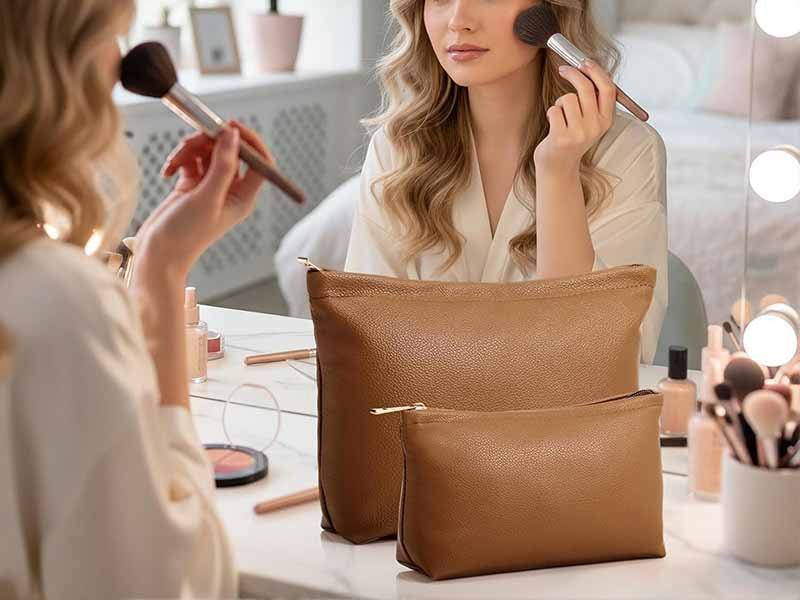
If you’ve ever packed a makeup bag that looked roomy on the outside but somehow couldn’t fit a foundation bottle, you already know the real problem: shape control is capacity control. A makeup bag isn’t just a container—it’s a little system that decides whether your products sit upright, roll around, leak, get crushed, or stay easy to grab in 10 seconds. Brands also feel this difference fast: customers don’t complain because a bag “has a pouch shape,” they complain because the zipper opening is too narrow, the base collapses, brushes bend, or the bag looks wrinkled after two weeks.
So which is better—pouch or boxy? A pouch leather makeup bag wins when you want flexible storage, lighter weight, and easy packing in handbags or luggage. A boxy leather makeup bag wins when you want stable shape, upright storage, faster access, and stronger “premium” presentation. The best choice depends on what users carry (tubes vs bottles), how often they travel, and how much structure the leather and internal layers can realistically hold.
A product manager once told us their “best-looking” cosmetic pouch failed in reviews because it arrived beautiful—but after one trip it slumped, lipstick caps popped off, and the bag looked tired. Their next version added a firmer base and slightly wider zipper arc…and sales jumped. That’s why this topic matters.
What Is a Pouch Leather Makeup Bag?
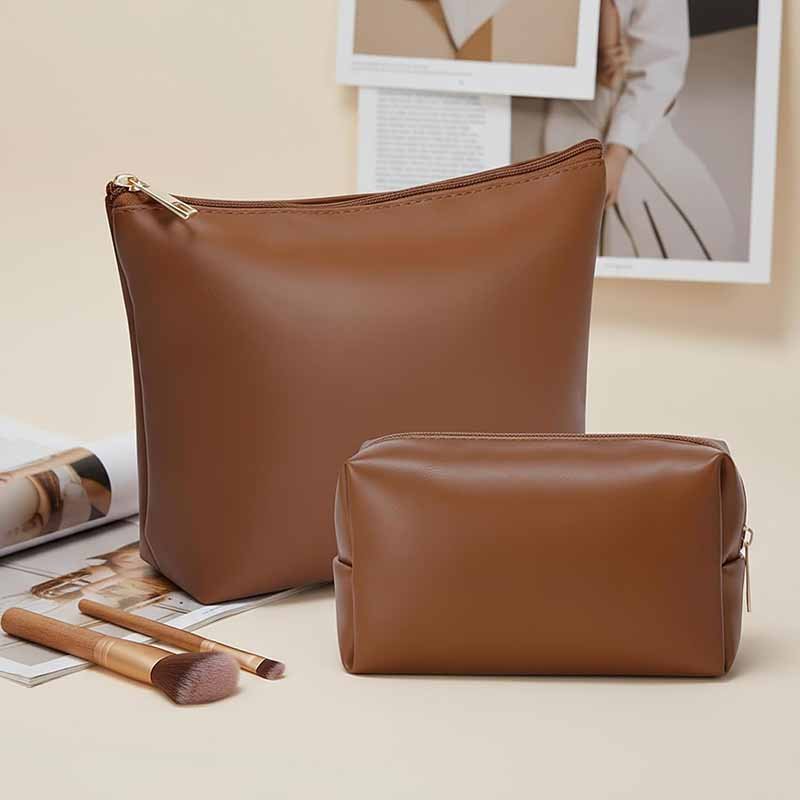
A pouch leather makeup bag is a soft or semi-soft bag designed to flex with the contents. It normally uses fewer reinforcement materials, so it feels lighter and packs easily—but it relies more on pattern design + leather choice to avoid collapsing.
What features define a pouch design?
Pouch designs usually have these construction traits (this is what your customer “feels” even if they don’t know the terms):
- Curved or rounded body panels (helps it expand when filled)
- Minimal internal stiffeners (sometimes none, sometimes light interfacing)
- Single main compartment (fast loading, less sorting)
- Top zipper closure (sometimes with a wide arc for access)
- Soft bottom or lightly padded bottom
What customers care about most in real life:
- Does it open wide enough to see everything?
- Can it hold tall items without poking the zipper?
- Does it stand on the counter or flop over?
- Does it look wrinkled after daily use?
Where pouch bags perform best
- Daily carry in handbags
- Minimal makeup routine users
- Travel packing where compression matters
- Gift-with-purchase programs and high-volume retail
Where pouch bags usually struggle
- Upright bottle storage
- Fast “grab-and-go” organization
- Keeping a clean box-like look after heavy use
Pouch structure levels (what you can manufacture)
| Pouch Type | Internal Support | Shape Control | Best Use |
|---|---|---|---|
| Soft pouch | None / very light | Low | Daily carry, light kits |
| Semi-structured pouch | Light foam/interfacing | Medium | Better look + light travel |
| Stand-up pouch | Reinforced base + side support | Medium-High | Countertop use, mid-size kits |
How is capacity measured in pouches?
With pouches, “capacity” is not only about size printed on a spec sheet. Customers experience capacity through three practical factors:
- Zipper opening length (can you load large items easily?)
- Expansion depth (does the pouch belly out when filled?)
- Effective usable volume (how much space is actually reachable without crushing items?)
A pouch with a wider zipper arc often “feels bigger” than a bag with the same outer dimensions.
Real-world capacity drivers customers notice
| Capacity Driver | What It Means | What Customers Say |
|---|---|---|
| Zipper arc width | Wider opening = easier loading | “I can finally see my stuff.” |
| Base width | Wider base = stands better | “It doesn’t fall over.” |
| Side panel height | Taller sides = holds bottles | “My foundation fits upright.” |
| Leather stiffness | Firmer leather holds space | “It keeps its shape.” |
Practical packaging reality : If a pouch is too soft, items press outward and the bag becomes “bulky” even if it technically fits more. Customers call that “it doesn’t pack well.”
Are pouches easy to carry daily?
Yes—this is the biggest reason pouches stay popular.
Daily-carry advantages customers actually feel:
- Lower weight than structured cases (especially in full leather)
- Compressible when not full
- Comfortable in a tote bag or backpack (fewer hard corners)
- Faster to toss in and out of a bag
But here’s the trade-off your customers will judge quickly:
- Soft pouches can create messy movement inside (items rolling)
- Brushes can bend if not protected
- The bag may look less “premium” if it collapses on a vanity
| Must-Have Detail | Why It Matters | Common Fix |
|---|---|---|
| Wide opening | Easy access | Longer zipper arc |
| Reinforced base (optional) | Better standing | Base board + foam |
| Lining wipeability | Makeup stains happen | PU-coated fabric lining |
| Smooth zipper | Daily use wear | YKK-grade zipper, metal pull |
What Is a Boxy Leather Makeup Bag?
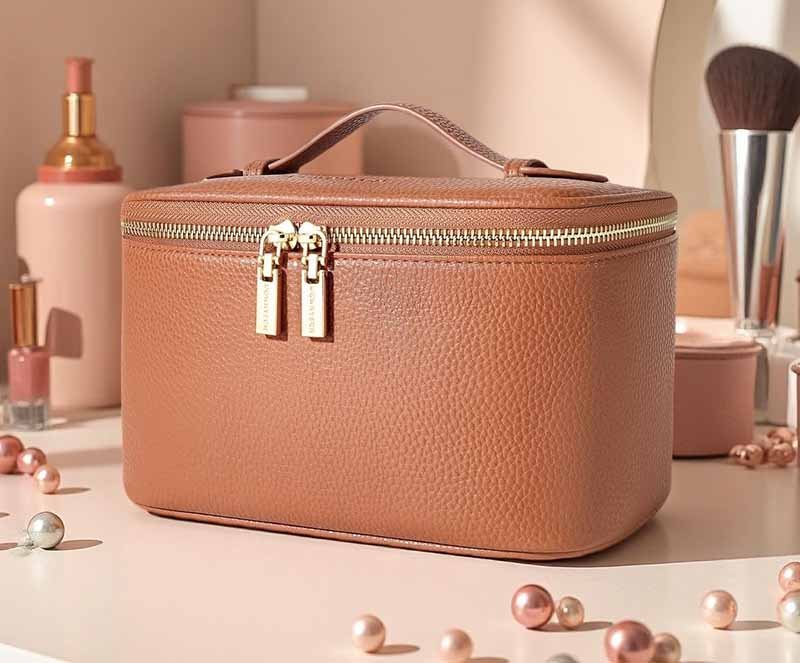
A boxy leather makeup bag is made to hold a stable geometric form—it’s more like a small case than a soft pouch. The goal is not only storage, but control: control of shape, layout, and how the bag presents on a counter or shelf.
What makes a boxy structure different?
Boxy bags feel “premium” because of internal engineering. They often use:
- Foam + interfacing on the panels
- Reinforced base board
- Straight side walls (patterned to stay upright)
- Structured lining (sometimes with a wipe-clean coating)
- Optional: divider panels and elastic holders
Customers immediately notice the difference when:
- The bag stands by itself while open
- Bottles remain upright
- Items stop colliding and leaking
- The bag looks neat in product photos and on shelves
| Structure Material | Thickness Range | What It Adds | Notes |
|---|---|---|---|
| EVA foam | 2–5 mm | Soft stiffness + shape | Popular for travel cases |
| PE board | 0.6–1.2 mm | Strong panel support | Sharper corners |
| Fiberboard base | 1–2 mm | Stable bottom | Needs moisture protection |
| Nonwoven interfacing | 40–120 gsm | Light form control | Often used in semi-structured |
Which shape offers more internal space?
This is where people get surprised.
A pouch can “expand” and hold a lot—but a boxy bag often uses space more efficiently because the walls don’t collapse inward. For many cosmetic kits, stable walls make packing more predictable.
Two types of “space” matter:
- Loose capacity (how much you can shove in)
- Functional capacity (how usable the space is without crushing items)
Boxy bags often win on functional capacity for:
- Bottles and skincare
- Brush sets
- Travel kits that need upright storage
| User Kit Type | Pouch Bag Performance | Boxy Bag Performance |
|---|---|---|
| Minimal makeup (lipstick, powder) | Excellent | Good |
| Full skincare bottles | Medium (may tip) | Excellent (upright) |
| Brush-heavy kit | Medium (needs sleeve) | Excellent (holders/dividers) |
| Travel toiletries + makeup | Good (if wide base) | Excellent (stable) |
Are boxy bags better for organization?
In most cases, yes—because organization isn’t only pockets. It’s also visibility + access speed.
What customers love about a good boxy bag:
- They can see items quickly (less digging)
- Products don’t roll around
- Less risk of leakage from sideways bottles
- Easier to keep “clean zones” (brushes separate)
But there’s also a real trade-off: structured bags take up more “fixed space” in luggage. Even if they’re not full, they still occupy volume.
| Feature | Customer Value | Best For |
|---|---|---|
| Wipe-clean lining | Easy maintenance | Travel + daily |
| Divider system | Fast access | Pro kits |
| Wide-opening zipper | Visibility | All users |
| Reinforced corners | Less deformation | Long-term durability |
| Top handle | Carry convenience | Travel retail |
What Are the Key Differences Between Pouch and Boxy Leather Makeup Bags?
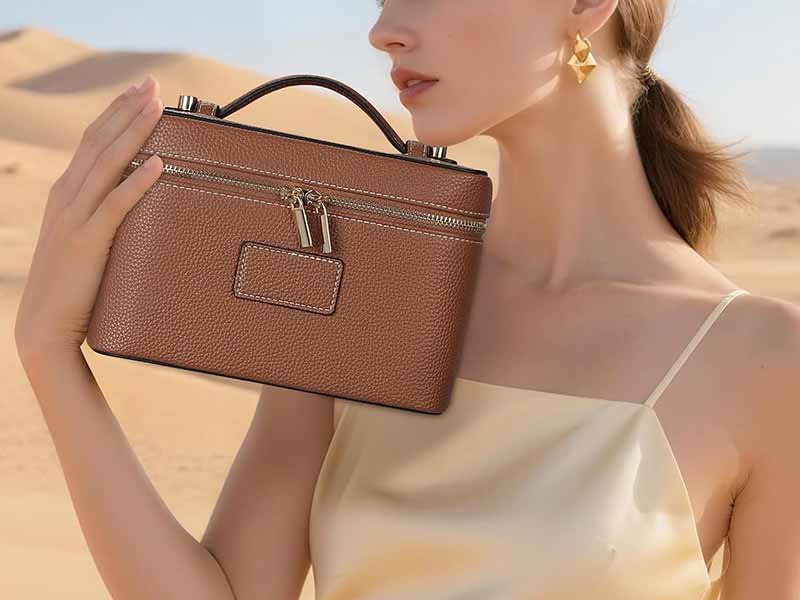
The real difference between pouch and boxy leather makeup bags is not appearance—it is how each design controls space, protects products, and performs during daily use or travel. Soft pouches prioritize flexibility and lightweight carry, while boxy bags prioritize stability, visibility, and long-term structure. Choosing the wrong structure often leads to customer complaints about collapsing shape, poor access, or wasted space.
How does shape control affect real storage performance?
Shape control determines whether the inside of the bag remains predictable. When walls collapse inward, usable space decreases even if the outer size looks large. This is why two bags with identical external dimensions can feel completely different in daily use.
Key performance impacts of weak vs strong shape control:
- Bottle stability – Upright vs sideways movement
- Access speed – Clear visibility vs digging through layers
- Protection – Reduced crushing of powders and brushes
- Visual neatness – Important for premium perception
Shape control vs user experience
| Shape Stability Level | Internal Behavior | Customer Perception | Best Use Case |
|---|---|---|---|
| Low (soft pouch) | Items shift and stack | Casual, flexible | Daily carry |
| Medium (reinforced pouch) | Partial structure | Balanced | Light travel |
| High (boxy case) | Fixed layout, upright items | Premium, organized | Travel & retail |
A useful manufacturing insight: Customers rarely measure volume, but they immediately notice instability. This makes structural engineering more important than simply enlarging dimensions.
Capacity comparison: flexible volume vs usable volume
Capacity should be separated into three technical layers:
- Geometric volume – Length × width × height
- Expandable volume – Extra space gained from soft walls
- Usable volume – Space that remains functional without crushing items
Soft pouches often win in expandable volume, but boxy bags win in usable volume efficiency.
Functional capacity in real cosmetic scenarios
| Scenario | Pouch Result | Boxy Result | Practical Winner |
|---|---|---|---|
| Lipstick + compact set | Easy fit | Easy fit | Equal |
| Full skincare bottles | Bulging, tipping | Upright storage | Boxy |
| Mixed travel kit | Flexible but messy | Structured layout | Boxy |
| Half-empty bag | Compresses smaller | Still occupies space | Pouch |
This explains a common retail pattern:
- Entry-level cosmetic kits → pouch dominance
- Premium skincare sets → boxy dominance
Which design better supports long-term durability?
Durability is influenced less by leather quality alone and more by stress distribution.
Soft pouches:
- Stress concentrates at zipper ends and bottom folds
- Repeated bending can create crease memory
- Appearance aging is faster but sometimes considered “natural”
Boxy bags:
- Stress spreads across reinforced panels
- Corners resist deformation longer
- Shape retention improves perceived lifespan
| Factor | Pouch | Boxy |
|---|---|---|
| Crease resistance | Low–medium | High |
| Corner wear | Minimal corners | Reinforced corners |
| Zipper strain | Higher | Lower |
| Shape retention after 1 year | Medium | High |
For brands selling in mid-to-high price ranges, shape retention strongly affects customer reviews and repeat purchase rates.
How Should You Choose Between Pouch and Boxy Designs?
The correct choice depends on user behavior, product positioning, and price strategy, not just styling preference. Successful cosmetic brands usually design both structures for different scenarios instead of forcing one universal solution.
Which design is better for travel vs daily routines?
Daily routines favor speed and lightness, while travel favors protection and order.
| Usage Context | Better Structure | Reason |
|---|---|---|
| Handbag daily carry | Pouch | Lightweight, compressible |
| Office touch-up kit | Slim pouch | Minimal items |
| Weekend travel | Boxy | Upright bottles, visibility |
| Long flights | Boxy with handle | Stability + portability |
| Gym / shower kit | Semi-boxy | Moisture + organization |
A pattern seen in global retail data: Customers often upgrade from pouch to boxy after experiencing leakage or clutter during travel.
Do leather type and thickness change the outcome?
Yes—material engineering can partially override structure choice.
A thick, firm leather pouch can behave similarly to a semi-structured bag, while very soft leather in a boxy design can still collapse.
| Leather Thickness | Behavior in Pouch | Behavior in Boxy |
|---|---|---|
| 0.8–1.0 mm | Very soft, collapses | Needs strong reinforcement |
| 1.1–1.4 mm | Balanced flexibility | Ideal for clean structure |
| 1.5–1.8 mm | Semi-rigid feel | Strong premium shape |
Increasing leather thickness raises cost, weight, and stitching difficulty, so structure must be optimized—not simply thickened.
Is customization important for brand differentiation?
Customization is often the real competitive factor, especially in saturated cosmetic markets.
Key differentiation areas brands request:
- Interior divider layout
- Opening angle engineering
- Lining color for visibility
- Logo application method
- Hardware finish tone
- Packaging integration with cosmetic sets
| Custom Feature | Cost Impact | Retail Value Impact |
|---|---|---|
| Gold foil logo | Low | Medium |
| Custom lining color | Low | Medium |
| Structured divider system | Medium | High |
| Unique silhouette mold | High | Very high |
Well-designed structure customization can raise retail pricing by 30–120% without major material cost increases.
Why Does Leather Structure Matter for Capacity and Shape Control?
Leather is not only decorative—it acts as a structural skin that determines how the bag bends, stands, and ages. Understanding leather behavior helps brands avoid common problems like sagging walls, warped bases, or distorted zippers.
How does genuine leather support structural stability?
Compared with synthetic fabrics, genuine leather offers:
- Higher tensile strength
- Natural body and memory
- Better long-term shape recovery
But performance varies widely by tanning method.
| Leather Type | Firmness | Shape Retention | Best Bag Style |
|---|---|---|---|
| Full-grain cowhide | High | Excellent | Boxy premium |
| Top-grain leather | Medium | Very good | Boxy or semi-boxy |
| Nappa leather | Soft | Moderate | Pouch luxury |
| Split leather + coating | Medium | Good | Cost-efficient boxy |
Are reinforcement layers always necessary?
Not always. Smart pattern engineering can reduce reinforcement needs, lowering cost and weight.
Reinforcement becomes necessary when:
- Bag height exceeds 10–12 cm
- Leather thickness is below 1.2 mm
- Upright bottle storage is required
- Retail positioning is premium
Otherwise, strategic seam placement + thicker leather may achieve sufficient stability.
What finishes improve durability and cleanability?
Makeup environments expose bags to:
- Oils
- Pigments
- Alcohol
- Moisture
So surface finishing matters as much as structure.
| Finish Type | Stain Resistance | Aging Style | Recommended Positioning |
|---|---|---|---|
| Pigmented finish | High | Minimal patina | Travel / daily |
| Semi-aniline | Medium | Natural aging | Premium retail |
| Full aniline | Low | Rich patina | Luxury niche |
Conclusion: Why Choose SzoneierLeather for Custom Makeup Bags?
At SzoneierLeather, we specialize in creating high-quality, durable, and customizable leather makeup bags—both pouch and boxy designs—that meet the needs of global brands, retailers, and custom buyers.
Whether you’re looking for lightweight, flexible pouches that maximize packing space or premium, structured boxy bags for travel and retail, we offer tailored solutions that reflect your brand identity, product functionality, and customer preferences.
- Custom Design: We can adjust sizes, materials, colors, and interior compartments to match your specific needs.
- Quality Assurance: Our bags undergo strict testing to ensure they maintain their shape, stability, and longevity—ensuring satisfied customers.
- Competitive Pricing: We offer low MOQs, fast prototyping, and flexible order quantities, making us a perfect partner for both large-scale production and niche brands.
Contact us at info@szoneier.com to discuss your custom leather makeup bag needs and receive a quote today!


