
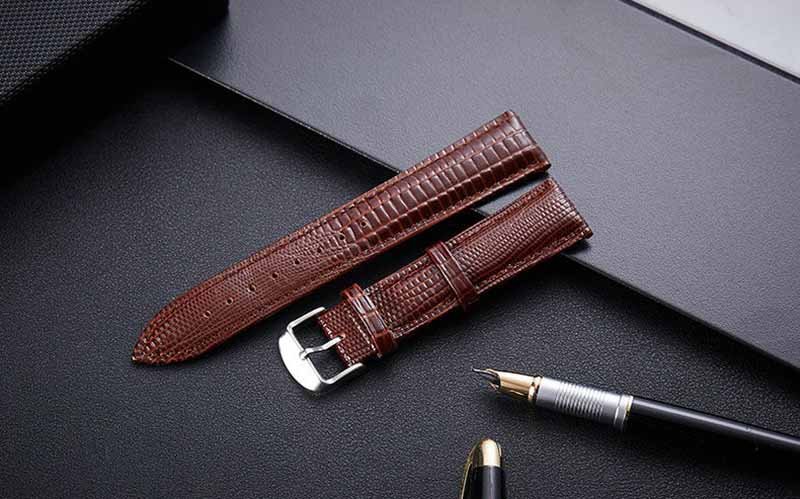
A leather watch strap may look simple, but thickness changes almost everything: how the strap bends, how it supports the watch head, how it feels after eight hours on the wrist, and how long it keeps its shape after months of wear. Many watch brands spend a great deal of time choosing leather color, grain pattern, lining, stitching thread, edge paint, and buckle finish, but in actual product use, strap thickness is one of the first things the end user feels.
In most commercial and premium watch strap projects, the standard leather watch strap thickness usually falls between 2.5 mm and 4.0 mm. Within that range, 3.0 mm to 3.5 mm is widely used because it gives a stable middle ground: not too thin to feel weak, and not too thick to feel bulky. For slim dress watches, many straps are made at 2.2 mm to 2.8 mm. For sports, pilot, field, or large-diameter watches, the range often moves up to 4.0 mm to 5.0 mm, and sometimes even thicker for heavily padded styles.
The important point is that “standard” does not mean “best for every project.” A strap that performs well on a 38 mm dress watch may feel completely wrong on a 44 mm sports watch. A strap designed for formal daily wear needs a different thickness logic from one designed for rugged outdoor use or visual impact at retail.
Thickness also affects how customers judge quality. If a strap is too thin, users may describe it as weak, flat, or cheap. If it is too thick, they may say it feels stiff, heavy, or slow to break in. That is why experienced manufacturers do not treat thickness as a default number copied from an old sample. They treat it as a technical specification tied to watch size, leather type, product positioning, target market, and long-term wear behavior.
At SzoneierLeather, thickness development is connected to the full product process, from material sourcing and leather structure testing to sample adjustment and production control. That matters because a difference of only 0.3 mm to 0.5 mm can noticeably change wrist feel, shape retention, and visual balance. In other words, strap thickness is not a small detail. In many custom watch strap projects, it is the detail that separates an average product from one customers want to reorder.
What Is Leather Watch Strap Thickness?
Leather watch strap thickness is the total vertical measurement of the strap body, including the outer leather, internal structure, and lining. In most projects, it ranges from about 2.0 mm to 5.0 mm. The right thickness depends on watch style, case size, wear comfort, and the look the brand wants to achieve.
What does leather watch strap thickness mean?
When people talk about a leather watch strap being “2.5 mm” or “4.0 mm,” they are talking about the finished thickness of the strap body, not just the top leather layer. This finished thickness is built from several components working together.
In a standard leather watch strap, thickness usually includes:
- the top leather layer
- the reinforcement or filler structure inside
- the lining material on the back
- adhesive layers and finishing treatment
- in some designs, local padding at the center section
That means a strap is not thick because one leather sheet is thick. It is thick because the strap is engineered as a layered product.
This is one reason why two straps with the same nominal thickness can feel very different in real use. For example:
- A 3.2 mm flat strap made with dense vegetable-tanned leather may feel firm and structured
- A 3.2 mm padded strap made with softer top leather and foam-like filler may feel fuller but more flexible
- A 3.2 mm strap with a soft calf lining may feel more comfortable against skin than a strap with a stiffer lining
For brands developing custom collections, understanding this is important. Thickness is not only about measurement. It also relates to:
- bending behavior
- hand feel
- weight perception
- edge profile
- long-term shape stability
In actual product development, manufacturers often evaluate strap thickness together with lug width, taper, leather temper, stitching layout, and buckle size. A strap that looks balanced on paper can still feel wrong if the internal structure is not matched to the intended use.
At SzoneierLeather, thickness control starts before sampling. Leather selection, split thickness, reinforcement choice, lining softness, and finishing method are all reviewed together. This helps reduce common issues such as:
- overly stiff straps in first wear
- collapsing center padding after repeated bending
- edges becoming too bulky
- poor proportion between watch case and strap body
For a professional factory, thickness is not an isolated number. It is part of overall strap architecture.
What is standard leather watch strap thickness?
The market has a broad working range, but several thickness bands appear again and again because they match common watch categories and customer expectations. The table below gives a practical view.
| Watch Strap Category | Finished Thickness | Common Watch Type | Main Product Effect |
|---|---|---|---|
| Ultra-slim | 2.0–2.4 mm | Minimalist, vintage dress | Light, elegant, low profile |
| Slim standard | 2.5–2.9 mm | Dress, office, fashion watches | Clean look, easy cuff fit |
| Core standard | 3.0–3.5 mm | Daily wear, business casual | Balanced comfort and durability |
| Heavy standard | 3.6–4.2 mm | Field, pilot, large classic watches | Stronger presence, better support |
| Thick padded | 4.3–5.5 mm | Sports, dive, oversized watches | Rugged look, stronger wrist presence |
Among these ranges, 3.0 mm to 3.5 mm is one of the most commercially practical choices for many brands because it works across a wide group of watch styles without creating obvious comfort problems.
Why does this range work so well?
- It gives enough body for the strap to look substantial
- It supports medium-size watch cases well
- It still bends naturally for most wrist sizes
- It is easier to control in batch production than very thin or very thick structures
However, standard thickness is only a reference. A watch strap project should not be developed by copying a single number from the market. For example:
- A premium slim watch may lose its elegance if the strap is overbuilt at 3.8 mm
- A large watch with a 44 mm case may feel top-heavy if the strap is made too thin at 2.4 mm
- A fashion-oriented brand may prefer slightly slimmer straps to create a cleaner, more urban profile
- A heritage-style brand may want more body and visible padding for a traditional, crafted appearance
In custom manufacturing, many brands now ask for thickness adjustments in small increments rather than big jumps. A change from 3.0 mm to 3.3 mm may sound minor, but in product feel, it is noticeable. On the wrist, small thickness adjustments influence:
- first-touch comfort
- side profile appearance
- visual weight
- compatibility with the watch case
This is why skilled factories often create more than one pre-production sample before finalizing thickness.
Are thickness standards the same for all straps?
They are not. Thickness standards differ because watch straps serve different product roles. A slim formal watch, a casual everyday watch, and a thick outdoor watch do not ask the strap to do the same job.
The main factors that change thickness requirements are:
- watch case diameter
- case weight
- design language
- target price range
- intended wearing time
- leather type and lining type
- market positioning
A simple way to look at it is this: the strap has to match both the mechanical need and the visual need of the watch.
Here is a practical comparison:
| Product Factor | Thinner Strap Tendency | Thicker Strap Tendency |
|---|---|---|
| Watch style | Dress, fashion, minimalist | Sports, pilot, field, dive |
| Case size | 34–40 mm | 42 mm and above |
| Wearing feel | Light, flexible, easy break-in | Solid, supportive, more substantial |
| Appearance | Clean, refined, understated | Bold, rugged, premium presence |
| Production challenge | More risk of weak structure | More risk of stiffness |
| User concern | Durability | Comfort during early wear |
For example, a 2.6 mm strap may work beautifully for a formal leather watch sold to office users who value a low-profile and lightweight feel. But the same strap may look visually weak on a large watch head and may not provide enough perceived support.
On the other hand, a 4.5 mm strap can give strong style identity and better support for a larger watch, but if the leather temper is too firm or the lining is not soft enough, customers may complain that it feels hard and takes too long to soften.
So the question is not whether there is one correct thickness standard. The real question is whether the strap thickness suits the specific watch and the intended customer experience.
This is where factory experience matters. SzoneierLeather works across leather material sourcing, product development, sample making, and production control, so thickness decisions can be made with a broader view. Instead of treating thickness as a simple factory default, the project can be developed based on real conditions such as:
- expected retail positioning
- desired wearing feel
- leather construction options
- order quantity and repeatability
- packaging presentation and overall product image
That approach is far more useful for brands and custom wholesale clients who already understand products and want a factory that can give informed development support, not just follow a basic spec sheet.
Which Leather Watch Strap Thickness Is Best?
The best leather watch strap thickness is not a fixed number. It depends on how the watch is designed, how it will be worn, and what kind of feeling the end user expects. In most real-world projects, thickness is chosen by balancing visual proportion, wrist comfort, durability, and product positioning.
As a practical reference:
- 2.2–2.8 mm → suitable for slim and formal watches
- 3.0–3.5 mm → most widely used for daily wear
- 3.6–4.5 mm → used for larger or more structured watches
- 4.5 mm+ → mainly for heavy, sport, or statement designs
The key is not choosing the thickest or thinnest option, but choosing the one that matches the watch and user expectations.
Which thickness suits dress watches?
Dress watches focus on clean lines and low profile. The strap should not overpower the watch case. It should feel light, flexible, and easy to wear throughout the day, especially in office or formal environments.
Recommended thickness range:
- 2.2 mm – 2.8 mm for most dress watches
- Up to 3.0 mm if slightly more structure is needed
Why this range works:
- sits flat under shirt cuffs
- reduces bulk on smaller wrists
- enhances a refined and minimal appearance
- provides faster break-in and immediate comfort
However, going too thin creates risks. Common problems seen in mass-market thin straps include:
- edge deformation after 3–6 months
- visible stretching near buckle holes
- lack of structure, making the strap feel “flat”
- lower perceived product value at retail
This is why thickness alone cannot define quality. For thin straps, material and construction become more important.
A well-made 2.6 mm strap using high-density leather can outperform a poorly made 3.0 mm strap. In many premium dress strap projects, manufacturers improve durability by:
- using tighter fiber leather
- reinforcing stress points
- controlling edge finishing thickness
- optimizing stitch placement
From a product development perspective, dress straps should aim for:
- light feel
- stable structure
- clean edge profile
That combination is what customers actually notice when they wear the product.
Which thickness fits sport watches?
Sport watches are heavier, more durable, and visually stronger. The strap must support that design language both structurally and visually.
Recommended thickness range:
- 4.0 mm – 4.8 mm for most sport and field watches
- 4.8 mm – 5.5 mm for large pilot or dive styles
Why thicker straps are preferred:
- better support for heavier watch heads
- improved resistance to stretching and deformation
- stronger visual balance with larger cases
- more solid feel in hand
But thickness alone does not guarantee performance. Many thick straps fail in real use because they are not properly engineered.
Common issues seen in low-quality thick straps:
- stiffness that causes wrist discomfort
- poor bending near lug and buckle areas
- excessive pressure points during long wear
- edge cracking due to rigid structure
A well-designed thick strap needs to manage both strength and flexibility.
Key design adjustments often used in production:
- reducing thickness at folding points (skiving)
- using softer lining materials to improve skin contact
- controlling internal filler density
- adjusting taper to reduce bulk near buckle
Here is a simplified comparison of user experience:
| Thickness | First Wear Feel | Long-Term Feel | Visual Effect |
|---|---|---|---|
| 3.5 mm | Comfortable | Stable | Balanced |
| 4.2 mm | Slightly firm | Comfortable | Strong presence |
| 4.8 mm | Firm | Moderate | Rugged |
| 5.5 mm+ | Stiff | Depends on design | Heavy-duty |
For brands, the goal is not to make the strap as thick as possible. The goal is to create a strap that:
- looks strong
- feels acceptable from day one
- becomes comfortable after short use
That balance is what drives customer satisfaction and repeat purchases.
Which thickness works for large watches?
Large watches (typically 42 mm and above) require careful proportion control. If the strap is too thin, the watch may feel top-heavy and visually unbalanced.
Recommended thickness:
- 3.5 mm – 4.2 mm for refined large watches
- 4.2 mm – 5.0 mm for bold or tool-style watches
The relationship between case size and strap thickness is important:
| Case Size | Suggested Thickness | Reason |
|---|---|---|
| 38–40 mm | 2.6–3.2 mm | maintains elegance |
| 40–42 mm | 3.0–3.8 mm | balanced look |
| 42–44 mm | 3.5–4.5 mm | better support |
| 44 mm+ | 4.0–5.0 mm | visual stability |
Why this matters:
- thicker straps help stabilize heavier watch heads
- they improve visual proportion between case and strap
- they enhance perceived product quality
A common issue in the market is mismatch. For example:
- a large watch paired with a thin strap looks weak
- a small watch paired with a thick strap looks bulky
Customers may not explain this technically, but they will feel it immediately.
Another factor is retail perception. In display environments:
- slightly thicker straps often look more premium
- they create a stronger first impression
- they improve product presence in photos and packaging
For custom projects, many brands fine-tune thickness in small steps rather than making large changes. Adjustments such as:
- 3.4 mm → 3.8 mm
- 3.8 mm → 4.2 mm
can significantly improve the overall balance of the product without affecting comfort too much.
At SzoneierLeather, this stage often involves comparing multiple samples on the actual watch case. This allows brands to evaluate:
- wrist feel
- visual proportion
- structural support
before finalizing production.
How to balance thickness, comfort, and design
The best thickness is always a compromise between different factors. No single thickness works perfectly in all situations.
In practical development, brands usually balance:
- appearance (how the strap looks)
- comfort (how it feels on the wrist)
- durability (how long it lasts)
- cost (material and production impact)
Here is a simplified decision guide:
| Priority | Recommended Thickness Strategy |
|---|---|
| Comfort first | 2.5–3.2 mm |
| Balanced product | 3.0–3.5 mm |
| Premium feel | 3.5–4.2 mm |
| Rugged performance | 4.2–5.0 mm |
Key practical insights:
- Increasing thickness improves structure but reduces flexibility
- Reducing thickness improves comfort but may reduce lifespan
- Material choice can compensate for thickness limitations
- Small adjustments (±0.3 mm) often create noticeable differences
One important observation from real projects is that customers rarely complain that a strap is “too standard.” They complain when:
- it feels uncomfortable
- it looks disproportionate
- it wears out too quickly
That is why thickness selection should always be tested in real conditions, not decided only on paper.
At SzoneierLeather, thickness decisions are usually made through:
- sample comparison
- real wrist testing
- adjustment based on feedback
This approach helps brands avoid costly mistakes in mass production and ensures the final product matches user expectations.
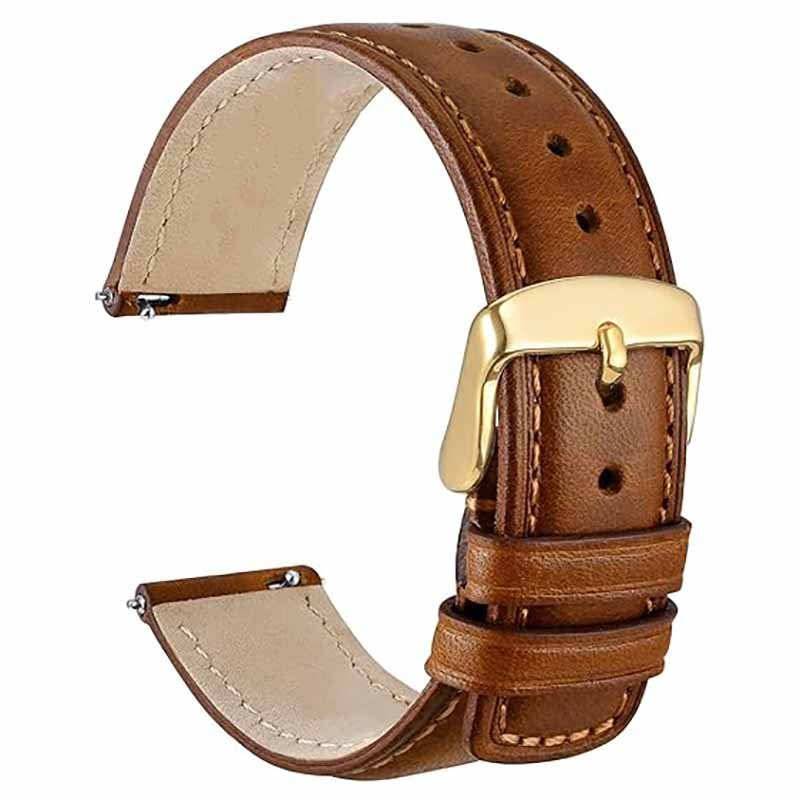
How Leather Watch Strap Thickness Affects Use
Leather watch strap thickness directly affects durability, flexibility, comfort, and long-term performance. Thin straps feel lighter and more flexible but may wear faster, while thicker straps offer stronger support and longer lifespan but require better material and structure control to remain comfortable.
How thickness affects durability
Durability is one of the most practical concerns for any leather watch strap project, especially for brands selling repeat-use products. Thickness plays a direct role, but it is not the only factor.
In general:
- 2.0–2.8 mm straps → lower structural strength, faster edge wear
- 3.0–3.5 mm straps → balanced durability for daily use
- 4.0 mm+ straps → stronger resistance to deformation and stretching
However, durability is not simply “thicker = better.” Real performance depends on how thickness is constructed.
A poorly built 4.5 mm strap can fail faster than a well-built 3.2 mm strap if:
- internal layers separate
- glue bonding is inconsistent
- stitching is too close to the edge
- leather density is too low
Below is a simplified durability comparison based on real production experience:
| Thickness Range | Expected Lifespan (Daily Use) | Common Wear Issues |
|---|---|---|
| 2.0–2.5 mm | 6–12 months | edge cracking, stretching |
| 2.6–3.2 mm | 12–24 months | moderate creasing |
| 3.3–4.0 mm | 18–36 months | stable, minor wear |
| 4.0–5.0 mm | 24–48 months | depends on flexibility |
Another important factor is stress concentration. Most strap damage occurs at:
- lug connection points
- buckle holes
- bending areas near keepers
Thicker straps distribute stress more evenly, reducing the risk of early failure in these areas. But if the strap becomes too rigid, stress shifts to fewer points, which can actually increase cracking risk.
At SzoneierLeather, durability improvement is usually achieved through a combination of:
- proper leather selection (not just thickness increase)
- reinforcement layer optimization
- controlled stitching distance
- edge finishing that resists cracking
For brands, this means durability should be engineered—not solved by simply adding thickness.
How thickness affects flexibility
Flexibility is what determines how quickly a strap adapts to the wrist. It directly affects first-time user experience and long-term comfort.
General behavior:
- Thin straps (2.0–2.8 mm) → very flexible, quick break-in
- Medium straps (3.0–3.5 mm) → moderate flexibility
- Thick straps (4.0 mm+) → slower break-in, more structure
Flexibility depends not only on thickness but also on:
- leather temper (soft vs firm)
- internal filler material
- lining softness
- skiving (thinning) at bending points
For example:
- A 4.2 mm strap with soft lining and proper skiving can feel more flexible than a poorly designed 3.5 mm strap
- A 3.0 mm strap with stiff vegetable-tanned leather may feel harder than expected
One key issue many brands face is initial stiffness complaints from customers. This often happens when:
- thickness is increased without adjusting internal structure
- no flexibility testing is done during sampling
- production batches vary in leather temper
To avoid this, professional factories usually test:
- bending cycles (repeated flex testing)
- recovery speed (how well the strap returns to shape)
- comfort after simulated wear
From a user perspective, flexibility influences:
- how quickly the strap becomes comfortable
- whether the strap presses against the wrist
- how natural the strap feels during movement
For custom projects, SzoneierLeather often adjusts flexibility through:
- partial thinning at fold zones
- selecting softer lining materials
- balancing filler density
This allows even thicker straps to maintain acceptable comfort levels.
How thickness affects comfort
Comfort is where all factors come together. A strap may look good and be durable, but if it feels uncomfortable after a few hours, customers will not continue using it.
Thickness affects comfort in several ways:
- Weight perception
- Thicker straps feel heavier
- On smaller wrists, this can cause fatigue
- Contact surface pressure
- Thick, stiff straps create pressure points
- Thin straps distribute pressure more evenly
- Breathability
- Thicker straps reduce airflow slightly
- Lining material plays a bigger role here
- Adaptation to wrist shape
- Thin straps conform faster
- Thick straps require break-in time
Here is a simplified comfort comparison:
| Thickness | Comfort Level (First Wear) | Comfort After Break-in |
|---|---|---|
| 2.0–2.5 mm | High | Medium (less support) |
| 2.6–3.2 mm | High | High |
| 3.3–4.0 mm | Medium | High |
| 4.0–5.0 mm | Low–Medium | Medium–High |
Comfort problems often appear in these forms:
- strap feels “too hard”
- edges press into wrist
- strap does not sit flat
- irritation from lining material
This is why thickness cannot be designed alone. It must be matched with:
- lining softness (e.g., calfskin vs synthetic)
- edge finishing method
- strap curvature shaping
- buckle position and hole spacing
At SzoneierLeather, comfort is usually evaluated during sampling by:
- real wrist testing
- multi-hour wear simulation
- comparing different thickness variations side by side
For brands, a useful approach is not asking “what is the best thickness,” but asking:
- what thickness feels right for this specific product and user group
That shift often leads to better final products and stronger customer satisfaction.
How Leather Watch Strap Thickness Is Made
Leather watch strap thickness is created through a layered construction process involving top leather, internal reinforcement or padding, and lining materials. The final thickness is controlled through cutting, skiving, layering, and pressing during manufacturing.
How thickness is built in layers
A leather watch strap is not a single piece of leather folded over. It is a structured product built in layers, each contributing to the final thickness and performance.
A typical structure includes:
- Top layer (full grain or corrected leather)
- Filler or reinforcement layer (for shape and body)
- Lining layer (for comfort and skin contact)
In padded straps, an additional shaped filler is inserted in the center to create a raised profile.
Example structure:
| Layer | Function | Thickness Contribution |
|---|---|---|
| Top leather | appearance, durability | 0.8–1.6 mm |
| Filler | structure, volume | 0.5–2.0 mm |
| Lining | comfort, sweat resistance | 0.6–1.2 mm |
These layers are bonded and pressed together, then trimmed and stitched.
The way layers are combined affects:
- stiffness
- edge profile
- durability
- long-term shape retention
For example:
- thicker filler creates a more pronounced padded look
- thinner filler creates a flatter, cleaner strap
At SzoneierLeather, layer selection is customized based on:
- target thickness
- product positioning
- expected usage environment
What materials affect strap thickness
Different materials behave differently even at the same thickness.
Key variables include:
- Leather type (full grain, top grain, split leather)
- Leather density
- Tanning method (vegetable vs chrome)
- Lining material (leather vs synthetic)
- Filler material (fiberboard, foam, leather pieces)
For example:
- Full grain leather is denser and may require less thickness to achieve strength
- Softer leather may require additional reinforcement
- Synthetic lining can reduce cost but may affect comfort
Here is a comparison:
| Material Type | Effect on Thickness Design |
|---|---|
| Full grain leather | allows thinner but strong straps |
| Top grain leather | balanced performance |
| Split leather | often needs reinforcement |
| Soft calf lining | improves comfort without adding much thickness |
| Foam filler | increases volume but may reduce durability |
Material choice directly influences how thickness should be designed. This is why copying thickness from another product without understanding materials often leads to inconsistent results.
How manufacturers control thickness
Controlling thickness consistently in production is one of the most important challenges for watch strap factories.
Key control steps include:
- Leather splitting
- Raw leather is split to precise thickness before cutting
- Skiving (thinning edges)
- Edges and folding areas are reduced in thickness for better bending
- Layer bonding pressure
- Incorrect pressure can cause uneven thickness
- Mold pressing (for padded straps)
- Ensures consistent shape and height
- Final trimming and edge finishing
- Controls visual thickness and feel
Tolerance is critical. In professional production:
- acceptable variation is usually within ±0.1–0.2 mm
If variation exceeds this:
- straps feel inconsistent
- product quality perception drops
- customer complaints increase
At SzoneierLeather, thickness consistency is maintained through:
- calibrated splitting machines
- standardized process parameters
- multi-stage quality checks
- batch sampling inspection
For brands and wholesale clients, this consistency is just as important as design itself. A well-designed strap loses value quickly if production cannot maintain the same thickness across large orders.
Do You Need Custom Leather Watch Strap Thickness?
Custom leather watch strap thickness is often necessary when standard thickness cannot match the watch design, target market, or product positioning. Most brands adjust thickness between 0.2 mm and 0.8 mm to improve comfort, visual balance, and product differentiation.
How to choose thickness for custom straps
Choosing the right thickness for a custom project is not about picking a number from a chart. It is about aligning thickness with the full product concept.
In real development projects, thickness is usually defined based on a combination of the following factors:
1. Watch case size and weight
- 34–40 mm case → 2.5–3.2 mm
- 40–42 mm case → 3.0–3.8 mm
- 42 mm+ case → 3.8–5.0 mm
Heavier watches require more support. If the strap is too thin, users may feel instability or imbalance on the wrist.
2. Product positioning
- Entry-level fashion → lighter, thinner, cost-sensitive
- Mid-range daily wear → balanced thickness (3.0–3.5 mm)
- Premium or heritage style → slightly thicker with visible structure
Thickness influences how customers perceive quality. A slightly fuller strap often creates a stronger “premium” impression, especially in retail display.
3. Wearing scenario
- Office / formal → thinner, flexible, low profile
- Daily casual → medium thickness
- Outdoor / active use → thicker, more durable
4. Target user group
- Slim wrist users → avoid excessive thickness
- Larger wrist users → thicker straps feel more proportional
5. Leather type and structure
Some leather types naturally feel thicker or thinner even at the same measurement. This is why thickness should always be confirmed together with material selection.
In most successful projects, brands do not rely on one sample. Instead, they compare:
- 2–3 thickness options side by side
- real wrist testing
- visual evaluation with actual watch cases
At SzoneierLeather, custom projects typically go through 2–4 sampling iterations, adjusting thickness by small increments (for example: 3.0 → 3.3 → 3.5 mm) until the balance feels right.
This process helps avoid common mistakes such as:
- strap looks good but feels uncomfortable
- strap feels good but looks too thin
- mismatch between watch head and strap profile
What thickness do brands prefer
From actual production data, different types of brands show clear preferences in thickness selection.
| Brand Type | Preferred Thickness | Key Reason |
|---|---|---|
| Fashion brands | 2.5–3.2 mm | lighter feel, cost control |
| Lifestyle brands | 3.0–3.5 mm | balance of comfort and durability |
| Premium watch brands | 3.2–4.2 mm | stronger presence, higher perceived value |
| Outdoor / sport brands | 4.0–5.0 mm | durability and rugged image |
One important trend is that many brands are moving away from “generic standard thickness” and toward fine-tuned thickness for each product line.
For example:
- A single brand may use 2.6 mm for dress collection
- 3.2 mm for everyday collection
- 4.2 mm for sport collection
This creates clearer product segmentation and helps customers immediately feel the difference between product lines.
Another observation is that premium positioning often correlates with slightly increased thickness, but only when comfort is controlled. Customers associate a certain level of thickness with durability and value, but they do not accept stiffness.
That balance is where experienced factories add the most value.
How thickness affects cost
Thickness has a direct and indirect impact on cost. Many brands underestimate this during early planning.
Direct cost impact:
- Thicker straps require more leather material
- More layers increase material consumption
- Higher rejection rate if structure is complex
Indirect cost impact:
- More complex construction increases labor time
- Additional skiving and shaping processes
- Higher quality control requirements
Below is a simplified cost relationship:
| Thickness Range | Cost Impact | Production Complexity |
|---|---|---|
| 2.0–2.5 mm | Low | Simple |
| 2.6–3.2 mm | Medium | Standard |
| 3.3–4.0 mm | Medium–High | Moderate |
| 4.0–5.0 mm | High | Complex |
However, cost should not be evaluated in isolation. A slightly thicker strap that improves durability and reduces returns may create better long-term value.
For example:
- A 3.2 mm strap lasting 18 months
- A 3.8 mm strap lasting 30 months
The second option may have higher upfront cost but better overall product performance and customer satisfaction.
At SzoneierLeather, cost discussions are usually combined with:
- material optimization
- structure simplification where possible
- production efficiency planning
This helps brands achieve the right balance between price, performance, and positioning.
Start Your Custom Leather Watch Strap Project with SzoneierLeather
If you are developing leather watch straps for your brand, thickness is one of the most important decisions you will make. It affects how your product looks, how it feels, how long it lasts, and how customers perceive your quality.
Working with an experienced factory makes this process much more efficient and predictable.
SzoneierLeather brings over 18 years of experience in leather product development and manufacturing.
For watch strap projects, we support:
- custom thickness development (2.0 mm – 5.5 mm+)
- multiple leather options (full grain, top grain, specialty leather)
- padding and flat strap construction
- lining material selection for comfort and durability
- logo customization (embossed, printed, metal, etc.)
- low MOQ support for small and medium brands
What You Can Expect Working With Us
- Clear thickness recommendations based on your watch design
- Sample comparison to help you make confident decisions
- Stable production with tight thickness tolerance control
- Consistent quality across repeat orders
Start Your Project
If you already have a design, sample, or idea, you can send us:
- reference images
- target thickness range
- material preferences
- expected quantity
Our team will help you turn that into a manufacturable product with the right structure and thickness.
If you are still exploring options, we can guide you through:
- thickness selection
- material matching
- structure design
Contact SzoneierLeather today to start your custom leather watch strap project.
A small adjustment in thickness can make a big difference in how your product performs—and how your customers experience it.