
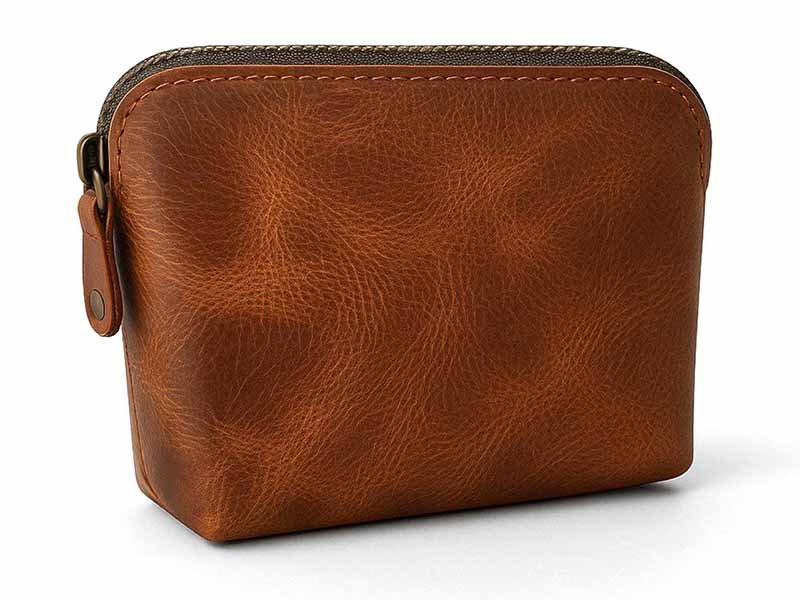
A leather makeup bag can look premium on day one and still disappoint a customer by day seven—because the inside gets messy fast. Foundation drips, lipstick smears, sunscreen oil, powder dust, and mascara spots don’t behave like plain water. They carry pigment, oil, and wax that sink into fibers, leaving shadows that never fully come out. When that happens, users don’t blame the cosmetics. They blame the bag: “hard to clean,” “looks dirty,” “smells,” “cheap lining,” “peeling.” For brands, that turns into returns, low ratings, and repeat customers who quietly disappear.
If you want a lining that people can wipe clean in real life, you usually need a coated or laminated surface—high-grade PU coating, TPU laminate, or a film-backed material such as EVA/PEVA. These surfaces reduce absorption, resist oil and pigment bonding, and make cleaning quick with tissue or a damp cloth. The best choice depends on the bag’s price level, expected lifespan, how often users travel, and whether the design includes pockets, brush holders, or divider seams.
Here’s the thing many brands learn after sampling: outer leather sells the first impression, but lining decides the long-term satisfaction. Let’s break down what “wipe-clean” actually means when the bag is used every day, not just photographed.
What does “wipe-clean lining” mean in real use?
A wipe-clean lining is an interior surface that does not absorb makeup oils and pigments, so stains stay on the surface long enough to be removed. A lining can be “water-resistant” and still fail at wipe-clean if it absorbs foundation oil or lipstick dye. True wipe-clean performance depends on surface chemistry + texture + seam construction.
Practical rule that matches customer behavior
If a stain can be removed within 30–60 seconds using a tissue or damp cloth (without scrubbing hard), users call it “wipe-clean.” If it needs soap, soaking, or scrubbing, users call it “annoying” and stop caring for the bag.
What stains are hardest to remove?
The toughest stains are usually oil-based + highly pigmented, because oil pushes color into fibers. Powder alone is easy; liquid cosmetics are the real problem.
High-risk items inside makeup bags
- Liquid foundation (silicone oils + pigment)
- Cream blush / concealer (oils + waxes)
- Lipstick (waxes + dyes)
- Sunscreen (oily filters + fragrance)
- Essential-oil skincare (oil + scent molecules)
| Cosmetic | Main “carrier” | How fast staining happens | What users experience |
|---|---|---|---|
| Loose powder | Dry pigment | Slow | Wipes off easily |
| Liquid foundation | Silicone oil | Fast (minutes) | Dark shadow remains |
| Lipstick | Wax + dye | Fast (minutes) | Color transfers & spreads |
| Sunscreen | Oils | Medium | Greasy marks + smell |
| Mascara | Carbon particles | Medium | Dots that smear |
If your target customers carry foundation + sunscreen, you should assume oil exposure is daily, not occasional.
How do oil, pigment, and alcohol affect linings?
Different “chemicals” in cosmetics attack lining materials differently:
- Oil: causes fiber absorption, darkening, and long-term odor hold
- Pigment: clings to texture and sinks into woven gaps
- Alcohol: can dry out low-grade coatings and cause micro-cracking
- Cleaning wipes (common customer habit): repeated wiping can accelerate peeling if coating quality is poor
This is why two PU linings can look similar but behave very differently. A thin coating can wipe clean for a month…then start peeling at folds.
| Exposure Type | Why it matters | Priority Level |
|---|---|---|
| Oil (foundation, skincare) | Causes permanent shadows + odor | Highest |
| Pigment (lipstick, blush) | Leaves color stains | High |
| Alcohol (perfume spray) | Can damage coating | Medium |
| Abrasion (brush movement) | Creates wear spots | High |
If your bag is designed for travel, abrasion and fold fatigue matter more because the bag gets squeezed repeatedly.
Is “water-resistant” the same as wipe-clean?
No. Water-resistant often describes how a lining handles water droplets. Makeup stains are not water droplets.
A fabric can repel water but still absorb:
- foundation oil
- lipstick wax
- dye molecules
- sunscreen film
True wipe-clean linings usually share these traits:
- Non-porous surface (coated/laminated/film)
- Smooth texture (less pigment anchoring)
- Low absorption backing (or barrier layer)
- Stable coating that doesn’t crack at folds
| Claim on product page | Real test users do | Pass/Fail logic |
|---|---|---|
| “Water resistant” | Spill foundation + wipe | Often fails |
| “Easy to clean” | Rub lipstick + tissue | Many fail |
| “Wipe clean” | Sunscreen smear + damp cloth | Only barrier linings pass |
Which lining materials are most wipe-clean?
The most wipe-clean linings are barrier surfaces: coated fabrics, laminated textiles, or film-backed materials. For leather makeup bags, the best-performing options usually come from three families:
- PU-coated fabrics (most common, good balance)
- TPU-laminated fabrics (strongest performance, higher cost)
- EVA/PEVA film systems (very easy wipe, needs good backing)
Below is the practical comparison brands use when choosing.
Which coated fabrics work best (PU, PVC, TPU)?
PU coating is widely used because it’s flexible, available in many colors, and can feel soft or glossy depending on finish.
TPU laminate generally resists oils and cleaning chemicals better and stays elastic longer.
PVC is cost-effective and waterproof, but some versions stiffen over time and can show cracking in cold climates or at sharp folds.
The “real life” ranking for wipe-clean interiors
| Material | Wipe-clean ability | Oil resistance | Fold/crack risk | Odor behavior | Cost level |
|---|---|---|---|---|---|
| High-grade PU coated | Good–Very good | Good | Medium | Medium | Medium |
| TPU laminated | Excellent | Excellent | Low | Low | Higher |
| PVC film/coated | Good | Medium | Medium–High | Medium | Low |
If your brand sells travel kits or premium sets, TPU laminate is often the safer long-term choice.
If you need competitive cost, high-grade PU coating can perform very well if thickness and adhesion are done correctly.
Which films are easiest to wipe (PEVA, EVA)?
Film-based linings are very easy to wipe because they create a continuous barrier. EVA/PEVA options are popular in hygienic products because they can be low-odor and smooth.
But films alone can feel “plasticky” if not engineered well, so many premium bags use film + textile backing to improve strength and feel.
| Film Type | Wipe-clean level | Feel in hand | Noise/“crinkle” | Best for |
|---|---|---|---|---|
| EVA film | Very high | Soft | Low | Travel kits, family use |
| PEVA film | Very high | Medium | Medium | Waterproof interiors |
| Film + backing | Very high | Better | Low | Mid-high retail |
If your customer targets “luxury feel,” film-only may need careful texture and thickness selection to avoid a cheap impression.
Are microfiber and nylon easy to clean?
Uncoated microfiber and uncoated nylon are not truly wipe-clean. They can be “cleanable,” but they absorb oils and dyes.
However, coated nylon (PU/TPU) is one of the best combinations for leather makeup bags because it offers:
- smooth wipeable surface
- strong abrasion resistance (brush movement)
- lighter weight than thick films
- good sewing behavior for pockets
| Material | Without coating | With PU/TPU coating |
|---|---|---|
| Nylon | Water-friendly but stains with oil | Wipe-clean and durable |
| Microfiber | Soft but absorbs pigment | Better wipe-clean, premium feel |
For bags with many pockets and brush holders, coated nylon is often the most practical choice.
What lining details do customers complain about most?
This matters because it affects returns and reviews. The most common complaints about cosmetic bag interiors are:
- “The lining stains instantly.”
- “It smells after a few uses.”
- “The coating is peeling.”
- “Powder gets stuck in seams.”
- “The inside looks cheap compared to the leather outside.”
Those complaints usually come from two causes:
- wrong lining family (too absorbent)
- wrong construction (weak seams, poor binding, low adhesion)
| Customer complaint | Likely cause | Practical fix |
|---|---|---|
| Permanent foundation shadow | Porous fabric | Barrier lining (PU/TPU/film) |
| Peeling at folds | Thin coating + weak adhesion | Higher-grade laminate + better bonding |
| Smell stays inside | Absorbent textile | Low-odor lining + sealed seams |
| Powder in corners | Rough seam finish | Binding tape + smooth corners |
| Sticky interior | Low-quality film | Upgrade finish + anti-tack surface |
How do lining choices affect feel, smell, and durability?
A lining is not only about cleaning stains. It directly affects how a makeup bag feels in the hand, smells after weeks of use, and survives repeated folding, wiping, and travel pressure.
Customers rarely describe lining materials in technical terms. Instead, they say:
- “It smells inside.”
- “The coating is peeling.”
- “It feels sticky.”
- “It cracked at the fold.”
These real-world reactions are usually caused by material chemistry, coating thickness, and bonding quality, not by leather quality. That is why lining selection is one of the most important hidden engineering decisions in cosmetic bag manufacturing.
What linings reduce odor and color transfer?
Odor inside a makeup bag usually comes from oil absorption + slow evaporation.
If the lining fibers absorb skincare oil or fragrance, the smell stays trapped for weeks. Barrier-type linings reduce this problem because liquids stay on the surface instead of soaking in.
Color transfer happens in a similar way. Lipstick dye or foundation pigment migrates into porous fibers and becomes permanent. Smooth coated surfaces prevent this migration.
| Lining Type | Oil Absorption | Odor Retention | Color Staining | Customer Impression |
|---|---|---|---|---|
| Plain polyester fabric | High | High | High | “Gets dirty fast” |
| Microfiber (uncoated) | Medium-high | Medium-high | High | “Soft but stains” |
| PU-coated fabric | Low | Medium-low | Medium-low | “Easy to wipe” |
| TPU laminate | Very low | Low | Very low | “Stays clean longer” |
| EVA/PEVA film | Nearly none | Very low | Very low | “Very hygienic” |
Customers often describe TPU or EVA interiors as “fresh” even after months of use, simply because oil cannot penetrate the surface.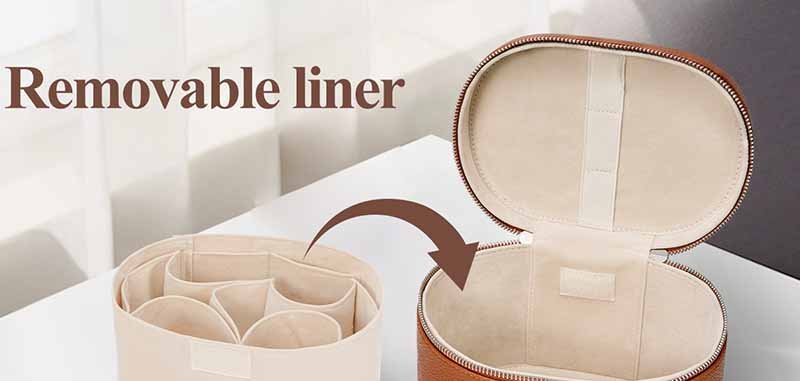
Which linings crack, peel, or delaminate over time?
Durability problems usually appear at fold lines, corners, and stitched seams, where stress concentrates.
Three factors determine long-term stability:
- Coating elasticity – Can the surface bend thousands of times without breaking?
- Adhesion strength – Does the coating stay bonded to the fabric base?
- Thickness balance – Too thin peels; too thick cracks.
Low-cost PVC and thin PU coatings often fail first in cold climates or tight folds. TPU laminates generally perform better because they remain elastic across wider temperature ranges.
| Material | Crack Risk | Peel Risk | Fold Fatigue Life | Expected Lifespan in Daily Use |
|---|---|---|---|---|
| Thin PU coating | Medium | Medium-high | Moderate | 6–12 months |
| Thick PU coating | Low-medium | Medium | Good | 12–24 months |
| TPU laminate | Low | Low | Excellent | 24+ months |
| PVC coating | Medium-high | Medium | Fair | 6–18 months |
For mid- to high-end retail positioning, fold fatigue life matters more than initial appearance.
How do seams and edge binding impact leakage?
Even the best wipe-clean material can fail if construction details are wrong.
Most leakage or stain trapping happens at:
- Stitch holes along the base
- Unsealed seam allowances
- Rough internal corners where powder collects
When liquids seep into seams, wiping the flat surface no longer solves the problem.
| Construction Method | Leakage Risk | Cleaning Ease | Recommended Use |
|---|---|---|---|
| Raw stitched seam | High | Poor | Low-cost bags only |
| Bound seam with tape | Medium-low | Good | Standard retail |
| Folded + sealed seam | Low | Very good | Premium cosmetic bags |
Upgrading seam finishing often improves real cleanliness more than upgrading the lining material alone.
How do you choose the right lining for your product line?
The correct lining depends on price level, usage scenario, and customer expectations, not simply on “best technical performance.”
Successful brands usually define lining strategy by product tier.
Which lining fits daily use vs travel kits?
Daily-carry cosmetic pouches experience:
- frequent opening
- light cosmetic residue
- soft folding inside handbags
Travel bags experience:
- pressure in luggage
- liquid leakage risk
- long storage time without cleaning
| Usage Scenario | Best Lining Choice | Reason |
|---|---|---|
| Small daily pouch | PU-coated fabric | Soft, affordable, wipeable |
| Mid-size travel bag | TPU laminate | Strong chemical resistance |
| Family toiletry case | EVA/PEVA film | Maximum hygiene |
| Luxury vanity bag | Coated microfiber or TPU | Clean look + premium feel |
Travel products should prioritize chemical resistance and seam sealing, while daily pouches focus more on soft touch and cost balance.
What lining works best for brush holders and pockets?
Brush holders create constant friction, which quickly damages weak coatings.
Pocket corners also trap powder and oil.
Best options for brush zones:
- TPU-coated nylon for abrasion resistance
- Dense PU coating for cost-controlled durability
- Smooth film surfaces only if backed with fabric to prevent tearing
| Material | Abrasion Resistance | Visual Aging | Suitability |
|---|---|---|---|
| Plain fabric | Low | Fast wear | Not recommended |
| PU-coated nylon | Medium-high | Moderate | Good balance |
| TPU laminate | High | Slow wear | Best performance |
If brushes are a key selling point, lining durability becomes a marketing feature, not just a hidden detail.
How do you balance cost, MOQ, and lead time?
Material upgrades improve performance but affect:
- unit cost
- minimum order quantity
- production speed
| Lining Type | Relative Cost | MOQ Level | Production Complexity |
|---|---|---|---|
| PU-coated fabric | Low-medium | Low | Easy |
| TPU laminate | Medium-high | Medium | Moderate |
| EVA/PEVA film | Medium | Medium | Moderate |
| Custom laminated textile | High | High | Complex |
Brands launching new product lines often begin with PU coating, then upgrade to TPU after validating market demand.
What should you test before mass production?
Many lining failures appear after shipping, not during sampling.
Reliable brands perform practical simulation tests, not only visual inspection.
A useful rule in cosmetic bag development:
If a lining survives oil, wiping, folding, and heat during testing, it will survive real customers.
What wipe and stain tests should you run?
Basic but effective tests include:
- Foundation smear + wipe after 10 minutes
- Lipstick rub + alcohol wipe
- Sunscreen oil drop + 24-hour observation
Simple factory test standards
| Test | Pass Condition |
|---|---|
| Foundation wipe | No shadow after wiping |
| Lipstick removal | No dye penetration |
| Oil exposure | No swelling or odor |
| Repeated wiping | No peeling after 50 cycles |
How do you check peel strength and abrasion?
Durability testing should simulate real usage cycles, not static storage.
Key checks:
- Repeated fold test (500–1,000 bends)
- Abrasion rub in brush zone
- Adhesion peel at seam edge
These reveal coating weakness early, before mass production risk appears.
What quality checklist prevents returns?
Before approving production, experienced brands confirm:
- stain resistance
- odor neutrality
- seam sealing quality
- coating flexibility
- long-term appearance after folding
A short pre-production checklist often prevents thousands of defective units.
Why brands choose SzoneierLeather for custom leather makeup bags
Selecting the right lining is not just a material decision—it is a product strategy decision that affects durability, hygiene, customer reviews, and brand positioning.
With more than 18 years of experience in leather product development and manufacturing, SzoneierLeather supports global brands through:
- material engineering from leather to lining
- custom structure and compartment design
- rapid sampling and prototyping
- strict quality inspection before shipment
- flexible MOQ for growing brands
Whether you need:
- cost-efficient PU-lined cosmetic pouches
- travel-grade TPU-lined makeup organizers
- or fully customized luxury leather beauty cases
our engineering and production teams can help transform your concept into a reliable, market-ready product.
Ready to develop your custom leather makeup bag?
If you are planning a new cosmetic bag collection—or upgrading lining quality to reduce complaints—this is the right moment to talk with an experienced manufacturing partner.
Contact SzoneierLeather today to request samples, material recommendations, and a tailored quotation for your next leather makeup bag project.