
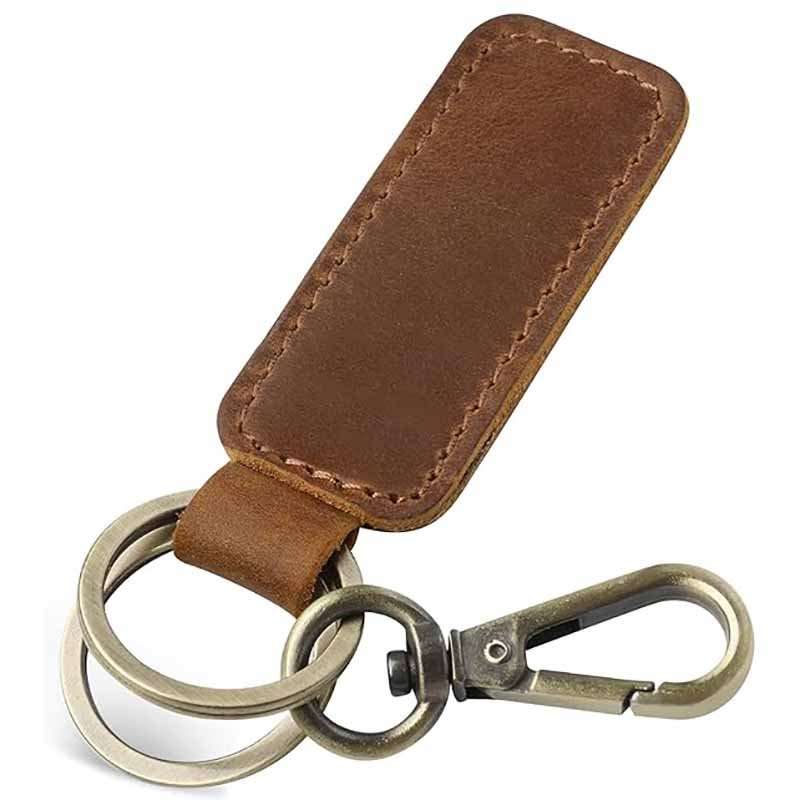
Keychains look small, but they live a rough life. They get squeezed in pockets with coins, scraped by metal keys, pulled hard when someone unlocks a door, and rubbed by sweaty hands in summer. If a keychain fails, it usually fails in one of three ugly ways: the edge “furs up,” the leather cracks near the hardware, or the surface coating peels and looks cheap.
That’s why material choice matters even for a low-cost accessory. Many brands ask the same question during development: Can we use split leather in a leather keychain without hurting quality? The honest answer is: sometimes yes, sometimes no. Split leather is real leather, and it can be a smart choice in the right construction. But if you use it in the wrong design—especially at exposed edges and high-tension holes—it will show wear fast and customers will notice.
Split leather can be acceptable in leather keychains when it is laminated, properly finished, and used in low-stress designs, such as wide key fobs with protected edges or decorative panels. It is not a good choice for premium keychains, thin straps, or designs with tight bends and exposed edges. In those cases, full-grain or top-grain leather delivers better edge strength, cleaner aging, and longer service life.
A good leather keychain is not about “the most expensive leather.” It’s about matching the leather to the design. One brand once solved complaints by changing only one detail: switching from split leather to top-grain leather around the rivet hole. Same shape, same price range—much fewer returns. That’s how small material decisions change customer experience.
What Is Split Leather in Leather Keychain?
Split leather in a leather keychain means the keychain uses leather from the lower layer of the hide (below the grain). It is still genuine leather, but the fiber structure is more open, so it generally needs finishing (PU coating, pigment, embossing, lamination) to look clean and resist wear. Split leather is often used in layered keychains, suede-style keychains, and value-focused programs where cost control matters.
What Is Split Leather?
When a hide is processed, it can be split into layers. The top layer contains the grain surface (the strongest, tightest fiber region). The lower layer is split leather.
Here’s what brands should know in plain language:
- Full-grain: strongest natural surface, best aging, strongest edges
- Top-grain: slightly corrected surface, still strong, very common in retail goods
- Split leather: lower layer, softer fiber structure, often coated or embossed
Quick comparison for keychain use
| Leather Type | Fiber Tightness | Edge Strength | How It Ages | Best Use in Keychains |
|---|---|---|---|---|
| Full-grain | Very high | Excellent | develops patina | premium straps, luxury key fobs |
| Top-grain | High | Very good | ages evenly | most branded keychains |
| Split (coated) | Medium | Medium | coating can wear | value key fobs, layered designs |
| Split (suede) | Medium | Low–Medium | scuffs easily | soft fashion keychains |
Why split leather behaves differently
Split leather lacks the dense grain layer, so:
- the surface often relies on a coating to look uniform
- edges are more likely to become fuzzy if not sealed well
- the leather can stretch more near holes and bends
That does not make split leather “bad.” It just means your design has to respect its limits.
How Is Split Leather Used in Leather Keychain?
Split leather is most successful in keychains when it is used as part of a system, not as a single naked layer.
The common ways brands use split leather effectively:
1) Laminated / bonded keychain bodies
Split leather can be laminated onto a backing (or sandwiched between layers) to improve structure.
- good for wide key fobs (20–30 mm width)
- good for flat key tags with logo stamping
Why it works: the lamination supports the fibers and reduces stretching.
2) Split leather as an internal layer
A smart construction is:
- top-grain outer (touch + look)
- split leather inside (cost control + thickness)
This is common in belts and can also work for thicker key fobs.
3) Suede-style keychains
If the design goal is a soft, matte, suede feel, split leather is often the correct material.
Important: suede split leather should use edge binding or folded edges to prevent fuzzing.
Practical construction examples (used in factories)
| Design | Layer Build | Where Split Leather Works |
|---|---|---|
| Flat key tag | 2-layer laminate + edge paint | inside layer or full body (coated) |
| Wide key fob | top-grain outside + split inside | inside only (best value/quality) |
| Suede keychain | split suede + binding | full body, but edges must be protected |
| Thin strap keychain | single strap with hole | split leather is risky |
Is Split Leather Real Leather for Leather Keychain?
Yes—split leather comes from a real hide, so it is genuine leather.
But customers don’t judge leather by definitions. They judge by what happens after 30–90 days:
- Does the edge stay clean?
- Does the hole stretch?
- Does the surface peel or crack?
- Does it look better or worse with use?
Split leather can pass these tests if the finishing is right.
What finishing matters most for split leather keychains
| Finish / Treatment | What It Improves | Notes for Keychains |
|---|---|---|
| PU coating | water & stain resistance | too thick can crack at bends |
| Pigment + emboss | uniform look | hides fiber looseness |
| Wax / oil (limited) | softer handfeel | less protective than PU |
| Edge paint system | clean edges | needs correct primer + topcoat |
| Folded edge | durability | best for high-wear edges |
The truth brands should say (and what not to say)
If a keychain is made of split leather, it’s better to position it as:
- “genuine leather key fob with protective coating”
- “suede leather keychain” (if suede split)
Avoid pretending it will age like full-grain leather, because customers will compare and notice.
What Customers Usually Care About (And What to Show Them)
When clients ask “Is split leather okay?”, what they often really mean is:
- “Will it look cheap after use?”
- “Will it peel?”
- “Will the edge turn fuzzy?”
- “Will it survive daily pulling?”
To answer that, show them clear quality targets.
Real-world durability checkpoints for keychains
| Checkpoint | Good Standard | Common Failure |
|---|---|---|
| Edge rub test | edge stays smooth after 200–500 rubs | fuzzing / paint cracking |
| Hole pull test | hole holds shape under repeated pull | stretching, tearing |
| Bend test | no surface cracking after 1,000 bends | coating cracks |
| Sweat resistance | no color bleed | staining / dye transfer |
| Hardware area | rivet/loop stays tight | tearing near hardware |
These are the kinds of checks SzoneierLeather can run during sampling so brands can confidently choose split vs top-grain vs full-grain.
How Does Split Leather Perform in Leather Keychain?
Split leather can perform well in leather keychains when the design reduces stress on edges and hardware areas. Its performance mainly depends on three factors: fiber structure, surface finishing, and product construction. While split leather is softer and easier to process than full-grain leather, it usually requires coatings, laminations, or structural reinforcement to maintain durability during daily use.
How Durable Is Split Leather in Leather Keychain?
The durability of split leather keychains depends largely on how the keychain is designed and finished, rather than the leather layer alone.
Because split leather has a more open fiber structure than full-grain leather, it behaves differently under repeated stress.
Key durability characteristics of split leather
| Property | Split Leather Performance | Impact on Keychain |
|---|---|---|
| fiber density | medium | edges require protection |
| flexibility | high | easier to fold or laminate |
| surface durability | depends on finish | coatings influence lifespan |
| tear resistance | moderate | hardware areas need reinforcement |
For most daily-use keychains, the highest stress areas are not the surface but the hardware connection points.
Common stress points include:
- the metal ring hole
- rivet or screw attachments
- narrow strap sections
- folded leather joints
If split leather is used in these locations without reinforcement, stretching or tearing may occur after extended use.
Typical service life comparison
| Leather Type | Expected Keychain Lifespan* |
|---|---|
| split leather | 1–3 years |
| top-grain leather | 3–5 years |
| full-grain leather | 5–10 years |
- Estimated lifespan under regular daily use with proper construction.
These numbers are not absolute; finishing quality and construction design can significantly affect durability.
How Does Split Leather Age in Leather Keychain?
Aging behavior is another key difference between split leather and higher-grade leather types.
Full-grain leather is valued for developing a natural patina, where the surface gradually becomes richer in color and texture.
Split leather, however, usually relies on surface coatings or pigments to create a consistent appearance.
Aging characteristics comparison
| Feature | Split Leather | Full-Grain Leather |
|---|---|---|
| natural patina | limited | strong patina development |
| color change | minimal | gradual darkening |
| surface wear | coating may fade | surface becomes richer |
| scratch visibility | depends on coating | blends naturally |
This means split leather keychains often maintain a stable appearance for a period of time, but when wear eventually occurs, the change may be more noticeable.
When split leather aging works well
Split leather performs well visually when:
- the surface uses durable pigment coatings
- embossed textures help hide wear
- edges are sealed properly
- the design avoids tight bends
Many fashion accessories intentionally use embossed split leather textures, which help conceal wear patterns.
Do Finishes Improve Split Leather Keychain Durability?
Finishing treatments are critical when using split leather in keychains. Without proper finishing, split leather may absorb moisture or show surface wear quickly.
Manufacturers typically apply several finishing techniques to improve durability.
Common finishing treatments for split leather keychains
| Finishing Method | Purpose |
|---|---|
| PU coating | improves water resistance |
| pigment finishing | creates uniform color |
| embossing | improves texture and wear resistance |
| wax finishing | adds softness and sheen |
| edge paint sealing | protects exposed edges |
Edge protection is especially important
The edges of leather keychains experience significant friction.
Without proper edge finishing, split leather edges may:
- become fuzzy
- absorb moisture
- weaken over time
Most manufacturers therefore apply multiple layers of edge paint or fold the edges inward to improve durability.
Typical edge finishing process
- edge sanding
- primer application
- first edge paint layer
- drying and polishing
- second edge paint layer
This process strengthens the edges and improves product appearance.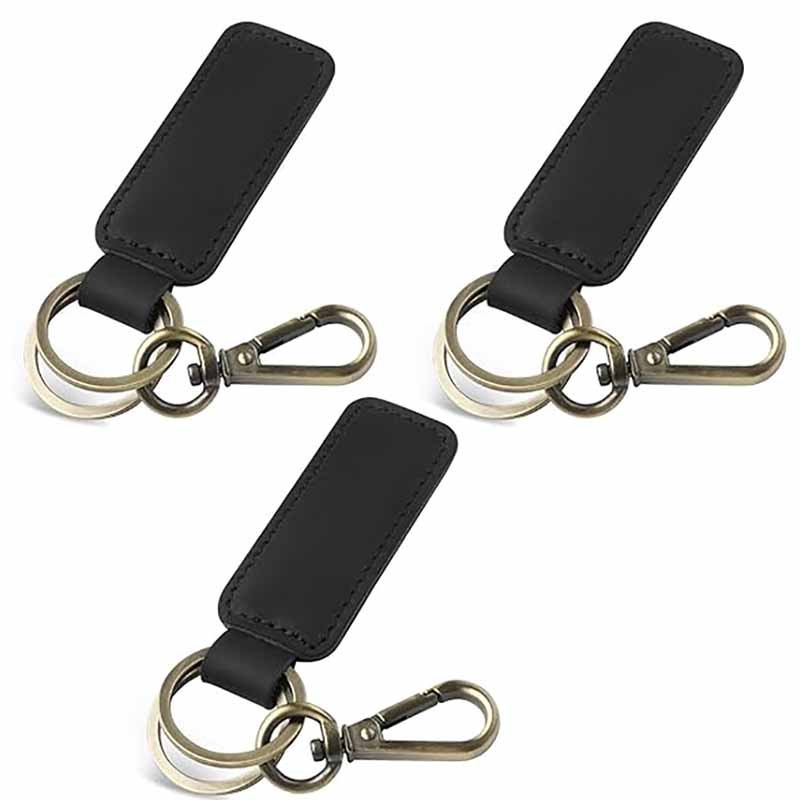
When Is Split Leather Acceptable in Leather Keychain?
Split leather can be a practical material for leather keychains when it is used in appropriate product designs and price segments. Many successful accessory brands use split leather in specific applications where durability requirements are moderate and cost efficiency is important.
Which Leather Keychain Designs Use Split Leather?
Certain keychain designs work particularly well with split leather because they place minimal stress on exposed edges.
Examples of suitable designs
| Keychain Style | Why Split Leather Works |
|---|---|
| wide key fobs | large surface reduces stress |
| decorative key tags | mostly aesthetic use |
| layered leather tags | structural support from multiple layers |
| suede keychains | natural split leather texture |
These designs distribute pressure more evenly and reduce stress concentration at edges or hardware points.
Example layered keychain construction
| Layer | Material |
|---|---|
| outer decorative layer | embossed split leather |
| inner structural layer | top-grain leather |
| backing layer | microfiber or fabric |
This construction allows designers to combine aesthetics and durability while controlling costs.
How Do Brands Use Split Leather in Leather Keychain?
Many brands strategically use split leather as part of a mixed-material construction.
Instead of using one leather type throughout the product, designers combine materials based on their strengths.
Mixed material strategies
| Component | Material Choice |
|---|---|
| outer surface | top-grain leather |
| interior layer | split leather |
| reinforcement patches | full-grain leather |
| hardware attachment | thicker leather layers |
This approach improves durability in high-stress areas while maintaining reasonable production costs.
Benefits for brands
Using split leather in appropriate areas allows brands to:
- reduce material costs
- maintain consistent product appearance
- control overall product weight
- expand product price ranges
This strategy is widely used in leather accessories such as belts, wallets, and small leather goods.
Are Layered Leather Keychains Good for Split Leather?
Layered constructions are one of the best ways to use split leather in leather keychains.
In a layered design, two or more leather pieces are bonded together to create a thicker structure.
Advantages of layered construction
| Advantage | Explanation |
|---|---|
| improved structural strength | layers support each other |
| reduced stretching | bonded layers stabilize fibers |
| enhanced appearance | smooth outer surfaces |
| better hardware durability | thicker material near ring holes |
Many leather keychains use double-layer or triple-layer construction.
Example construction for durability
| Component | Material |
|---|---|
| outer leather | top-grain leather |
| internal layer | split leather |
| backing layer | microfiber or suede |
This construction improves both aesthetic quality and structural stability.
Why Some Brands Still Prefer Split Leather
Despite the advantages of full-grain leather, split leather remains widely used in leather accessories for several reasons.
Practical advantages
| Advantage | Explanation |
|---|---|
| cost efficiency | lower raw material cost |
| consistent texture | easy to emboss patterns |
| easier processing | softer material |
| good for large surfaces | stable appearance |
For brands producing large quantities of promotional accessories or mid-range leather goods, split leather can be a practical option.
However, the key is choosing the right applications for the material.
When Is Split Leather Not Good for Leather Keychain?
Split leather should not be used in leather keychains when the design requires strong edges, narrow straps, or heavy stress near hardware attachments. In these situations, the looser fiber structure of split leather may lead to stretching, edge damage, or premature wear. For premium leather keychains or long-term durability, top-grain or full-grain leather is generally a better choice.
Which Leather Keychains Need Full-Grain Leather?
Some keychain designs naturally require stronger leather because of how the product is used.
Keychains that involve frequent pulling, bending, or friction place significant stress on the leather fibers. In these situations, full-grain leather performs better because the grain layer provides stronger fiber structure.
Keychain designs that benefit from full-grain leather
| Keychain Type | Reason Full-Grain Works Better |
|---|---|
| narrow leather straps | high tension at small cross-sections |
| car key fobs | frequent pulling and twisting |
| loop-style keychains | constant bending stress |
| minimalist leather key straps | exposed edges experience wear |
For example, a thin strap keychain with a metal rivet and key ring concentrates force at a very small area.
If split leather is used in this design, the material may gradually stretch or weaken around the hardware hole.
Full-grain leather maintains its structure better under this type of repeated stress.
How Does Split Leather Fail in Leather Keychain?
When split leather is used in the wrong application, several types of wear patterns may appear over time.
Understanding these potential failure points helps designers avoid them during product development.
Common wear patterns in split leather keychains
| Failure Type | Cause |
|---|---|
| edge fuzzing | loose fiber structure |
| coating wear | surface pigment abrasion |
| hole stretching | weak fiber reinforcement |
| corner cracking | repeated bending |
These problems do not necessarily appear immediately. Instead, they usually occur after several months of regular use.
Stress zones in leather keychains
The following areas experience the highest stress:
| Area | Stress Type |
|---|---|
| hardware hole | pulling force |
| folded strap | repeated bending |
| exposed edges | friction |
| rivet attachments | compression |
Designers often reinforce these areas by:
- increasing leather thickness
- adding multiple leather layers
- using stronger leather grades
By adjusting these structural details, manufacturers can greatly improve product lifespan.
Are Premium Leather Keychains Suitable for Split Leather?
Premium leather accessories are often designed to highlight natural leather texture and aging characteristics.
Because split leather relies on coatings or embossing to achieve its surface appearance, it may not provide the same aesthetic qualities as full-grain leather.
Differences in visual aging
| Characteristic | Split Leather | Full-Grain Leather |
|---|---|---|
| patina development | limited | rich patina over time |
| natural grain | artificial texture | authentic grain |
| scratch blending | scratches visible | scratches blend naturally |
| long-term aging | surface wear | improved character |
Many premium leather goods brands therefore choose full-grain or top-grain leather when they want the product to develop character with age.
For luxury keychains or heritage-style accessories, full-grain leather is often the preferred option.
How Do Brands Choose Leather for Leather Keychain?
Brands choose leather for leather keychains by evaluating durability requirements, product price range, design structure, and expected aging characteristics. Full-grain leather offers the best durability and natural appearance, while split leather can be suitable for layered constructions or decorative elements. Selecting the right leather depends on balancing cost, durability, and brand positioning.
How Do Manufacturers Compare Split Leather and Full-Grain Leather?
Manufacturers often evaluate several technical factors when choosing leather materials.
Important considerations include fiber density, thickness consistency, finishing compatibility, and cost.
Material comparison for leather keychains
| Factor | Split Leather | Full-Grain Leather |
|---|---|---|
| durability | moderate | very high |
| edge strength | moderate | excellent |
| cost | lower | higher |
| surface finishing | required | optional |
| aging characteristics | stable appearance | natural patina |
Manufacturers typically review these characteristics alongside product design requirements.
For example, a promotional leather keychain produced in large volumes may use split leather to maintain cost efficiency.
A premium brand keychain may use full-grain leather to highlight material quality.
Which Leather Is Best for Leather Keychain?
There is no single “best” leather for all keychains. Instead, the ideal material depends on the product’s intended positioning.
Recommended leather types by product category
| Product Category | Recommended Leather |
|---|---|
| promotional keychains | split leather |
| mid-range accessories | top-grain leather |
| premium keychains | full-grain leather |
| heritage leather goods | full-grain vegetable-tanned leather |
This approach allows brands to align material choice with product pricing and customer expectations.
How Do OEM Factories Develop Leather Keychain?
Professional leather manufacturers usually follow a structured product development process when working with brands.
Typical development steps include:
- product concept discussion
- material selection and testing
- prototype development
- hardware and construction evaluation
- production sampling
- mass manufacturing
During these stages, manufacturers often test several leather materials before finalizing the design.
This helps ensure the final product meets durability and appearance requirements.
Why Work With SzoneierLeather for Custom Leather Keychains?
SzoneierLeather is a leather goods manufacturer with over 18 years of experience in leather product development and production.
SzoneierLeather offers integrated capabilities across the entire product development process.
Core capabilities
| Capability | Description |
|---|---|
| raw material sourcing | stable leather supply chain |
| product design | custom design support |
| sampling | rapid prototype development |
| manufacturing | experienced production teams |
| packaging design | brand-specific packaging solutions |
| quality inspection | strict product testing |
These capabilities allow brands to develop leather keychains that match their desired quality level, design style, and price positioning.
Start Your Custom Leather Keychain Project
Choosing the right leather material is one of the most important decisions when developing leather accessories.
While split leather can work well in certain keychain designs, premium products often require stronger materials such as top-grain or full-grain leather.
Understanding the strengths and limitations of each material allows brands to create leather keychains that deliver both durability and visual appeal.
If you are developing a new leather accessory collection, working with an experienced manufacturer can simplify the entire process.
SzoneierLeather collaborates with brands and custom wholesale clients worldwide to design and produce high-quality leather keychains and accessories.
Whether you need:
- custom leather keychains
- private label leather accessories
- OEM / ODM leather goods
- branded leather promotional items
the SzoneierLeather team can support your project from concept to production.
Contact SzoneierLeather today to discuss custom leather keychain development and manufacturing solutions for your brand.