 Skip to content
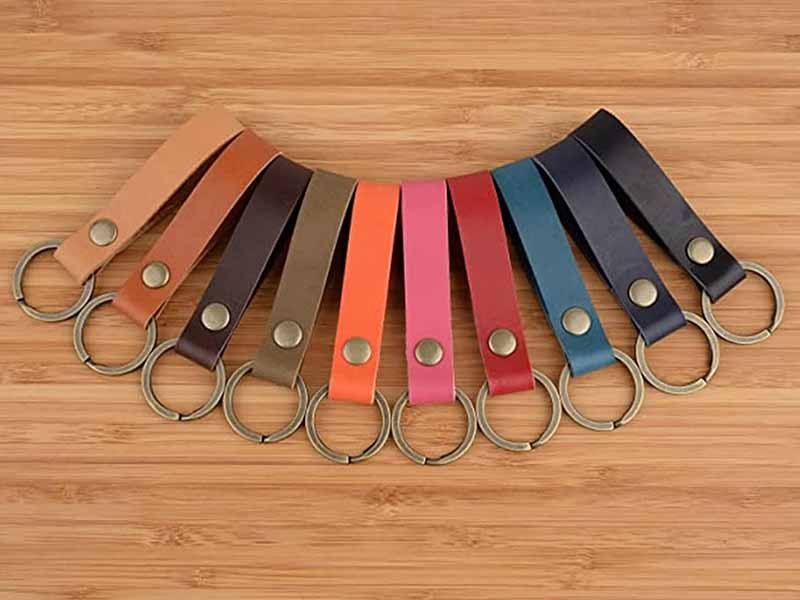
A leather keychain looks small, but it gets treated like a tool. It’s pulled from pockets, dropped on concrete, slammed in car doors, soaked with sweat, rubbed by metal keys, and twisted hundreds of times a week. That’s why brands get negative reviews not because the leather “looks cheap,” but because the keychain fails—stitching pops, rivets loosen, edges peel, or the leather tears at the ring.
Here’s the real issue: the durability difference between loop and strap leather keychains is mostly about how the load travels through the leather. A loop design spreads force in a circle. A strap design creates a “pull point” that keeps stressing the same small area. If you choose the wrong construction for your customer’s daily carry (car keys vs decorative charm), you’ll see returns and replacements—even if you used decent leather.
Loop leather keychains are usually more durable because the loop distributes pulling force evenly and reduces tearing at one point. Strap leather keychains can still be durable, but they rely more on reinforcement—thicker leather, better stitching patterns, and higher-grade hardware. Brands should choose based on key weight, daily pull frequency, and expected product life.
Let’s break it down in a factory-practical way—so you can choose the design that survives real life.
What Are Loop and Strap Leather Keychains?
A loop keychain uses a short leather piece folded into a closed loop, so force travels around the loop. A strap keychain uses a longer leather strip with one main attachment point, so pulling force concentrates near stitching/rivets. Loop designs usually resist tearing and stitch failure better, while strap designs offer more styling and branding area but require stronger reinforcement to match durability.
What Defines a Loop Leather Keychain?
A loop leather keychain is typically:
- A short leather piece (common finished length: 90–120 mm)
- Folded into a closed loop
- Ring sits inside the loop, and the closure is fixed by stitching, rivets, or both
Why brands like it (practical reasons):
- Less “lever effect”: short loop = less twisting force
- Force spreads: tugging doesn’t attack a single edge
- Cleaner failure control: even if stitching weakens, loop often remains functional longer
Where loop designs usually perform best:
- Automotive keys (heavier, frequent pull)
- Office keys / facility keys
- Hotel key fobs
- Gift sets where “premium feel” matters
What loop designs are NOT ideal for:
- If the brand wants big, flat logo space
- If customers want a softer, drapey accessory feel
What Defines a Strap Leather Keychain?
A strap leather keychain is typically:
- A longer leather strip (common finished length: 120–180 mm)
- Ring/clasp attached at one end (or folded end)
- Often includes decorative elements: emboss logo, foil, print, stitch color contrast
Why brands choose strap designs:
- More branding area (logo can be larger and easier to see)
- More style variations (layered straps, color blocking, contrast stitch)
- More comfortable grip when used like a pull tab
Durability risk points (what causes complaints):
- Pull point stress: the attachment zone gets the same pulling force every time
- Twisting fatigue: long strap twists more → stitching loosens faster
- Edge wear: more exposed edge length → more rubbing + peeling risk
Strap designs work best when:
- Keys are lighter (1–3 keys, not heavy car fobs + tools)
- Customers treat it more like a fashion accessory than a work tool
- Brand invests in reinforcement (details below)
Which Leather Types Are Used for Each Keychain?
Loop keychains perform best with thicker, stronger fiber-structure leather (full grain, veg-tan, oil-tan) because stiffness helps durability. Strap keychains need a balance of strength and flexibility (top grain, reinforced split leather, laminated leather) because they bend and twist more. If a strap keychain uses unreinforced split leather, it may look fine initially but often fails earlier at the attachment point.
Are Certain Leathers Better for Loops?
Yes—loops benefit from leather that holds shape and resists tearing.
Recommended leather ranges for loop designs
- Thickness target: 2.2–3.5 mm (depending on style)
- Surface: natural grain or lightly corrected grain
- Fiber density matters more than softness
Common loop leather options (brand-facing view)
| Leather Type | Best Thickness | Strength Feel | Aging Look | Durability Risk |
|---|---|---|---|---|
| Full grain cowhide | 2.4–3.5 mm | Very strong | Develops patina | Low |
| Veg-tan leather | 2.8–4.0 mm | Rigid/structured | Patina + darkening | Low (if edges sealed well) |
| Oil-tanned leather | 2.4–3.2 mm | Strong + flexible | Scuffs blend in | Low–Medium |
| Corrected grain | 2.2–3.0 mm | Medium | More uniform | Medium (coating wear) |
Brand tip:
- If your customer wants a “premium gift feel,” loop + full grain is the safest pairing.
- If you want a stiff luxury look, veg-tan loop performs well only if edge finishing is done properly.
Which Materials Suit Strap Keychains Best?
Strap designs bend more, so material selection must focus on fatigue resistance and tear resistance at the attachment point.
Recommended material ranges for strap designs
- Thickness target: 1.8–2.6 mm outer leather
- Reinforcement: optional but strongly recommended if heavy keys
- If split leather is used: add backing or lamination
Material performance comparison for straps
| Material | Flex Resistance | Tear Resistance | Edge Wear Risk | Notes for Brands |
|---|---|---|---|---|
| Top grain leather | Good | Good | Medium | Best balance for fashion straps |
| Full grain (thin cut) | Medium | Very good | Low | Strong but can feel stiff |
| Split leather (no backing) | Poor | Low | High | Lowest cost, highest complaints |
| Split leather + microfiber backing | Good | Medium | Medium | Much better than raw split |
| PU-coated split | Good at start | Medium | High | Coating can crack/peel over time |
Practical rule brands can use:
- If the keychain is meant to last 2–3 years daily, avoid unreinforced split leather straps.
- If cost is priority, reinforced split leather is safer than raw split.
How Does Construction Affect Durability?
Construction decides whether the leather fails at 3 months or survives years. Loop keychains usually last longer because the loop spreads pulling force across more leather area. Strap keychains focus stress at one connection zone, so they require stronger stitching patterns, reinforcement layers, and better rivet/hardware choices. Brands should evaluate stitching pattern, hole spacing, reinforcement, and edge treatment—not just leather grade.
How Do Loop Designs Stress the Leather?
Loop stress behavior (what happens in real use):
- Pull force goes around the loop → less tearing at one point
- Short length reduces twisting
- Leather crease exists but is usually wider and more stable
Key stress zones for loop designs:
- Inner fold radius (creases)
- Stitch area overlap
- Ring contact area (metal rubbing)
Common durability upgrades brands should request
- Double-layer fold at the stitch zone
- Stitch length: shorter stitches reduce unravel risk
- Edge paint/burnish to block moisture + friction
How Do Strap Designs Distribute Load?
Strap keychains act like a lever:
- The longer the strap, the higher the twisting force at the attachment
- Pulling usually attacks the same stitching/rivet area repeatedly
Typical failure points:
- Stitch line breaks
- Rivet holes elongate
- Leather tears near the ring
- Edges peel (especially coated leather)
Construction choices that significantly improve strap durability
- Reinforcement patch (hidden layer) at the ring zone
- Box stitch or bar-tack style stitching (stronger than straight line)
- Double rivet or rivet + stitch combo
- Rounded corners to reduce stress cracking
Quick Comparison Table (Brand-friendly)
| Item | Loop Keychain | Strap Keychain |
|---|---|---|
| Best for heavy daily use | ✅ Yes | ⚠️ Only with reinforcement |
| Branding/logo space | Medium | ✅ Large |
| Comfort/grip feel | Medium | ✅ Better |
| Failure risk area | Lower | Higher at attachment |
| Safer leather choice | Full grain / veg-tan | Top grain / reinforced split |
| Best customer expectation | “Lasts long” | “Looks stylish + giftable” |
Do Loop and Strap Keychains Last Differently?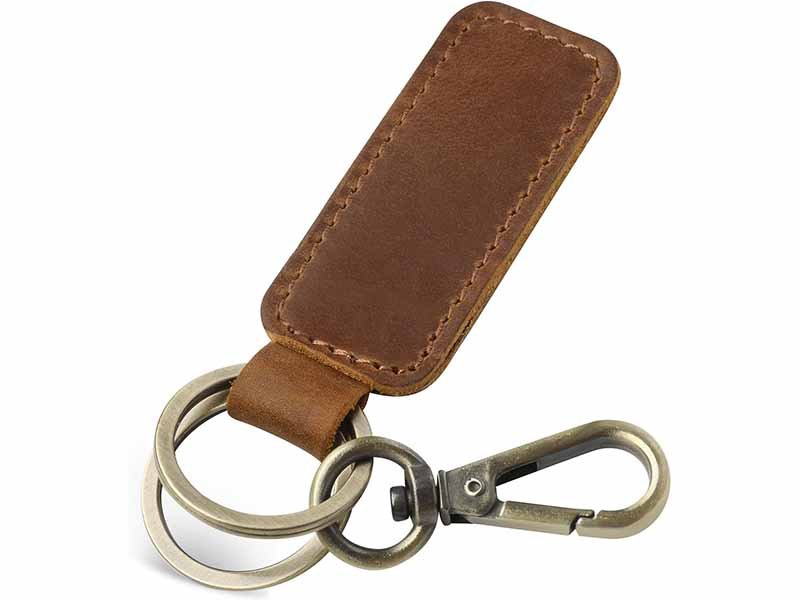
Yes. In real daily use, loop leather keychains generally last longer than strap leather keychains because they reduce stress concentration and twisting fatigue. Strap keychains can still perform well, but only when reinforced with thicker leather, stronger stitching patterns, and higher-grade hardware. Without reinforcement, strap designs usually fail earlier at the attachment point.
Which One Handles Daily Wear Better?
From a factory and after-sales perspective, loop leather keychains handle uncontrolled daily wear better.
Why loop designs survive longer in real life:
- Shorter length = less leverage when keys swing or are pulled
- Circular load path reduces tearing at a single point
- Less folding fatigue, especially at the ring area
- More predictable aging of leather fibers
Typical daily stress sources brands underestimate:
- Pulling keys out of tight pockets
- Keys bouncing while walking or driving
- One-handed yanking from belt loops
- Keys hitting metal surfaces repeatedly
In customer usage simulations:
- Loop keychains maintain structure even when stitching begins to soften
- Strap keychains often fail suddenly once stitching or rivet loosens
Practical brand takeaway:
If your customer carries car keys + remote + accessories, loop designs tolerate abuse better with fewer complaints.
What Real-World Tests Show About Lifespan?
At the production level, durability is often evaluated using repeated pull + swing tests, not just leather specs.
Typical internal test setup used by factories
- Load: 3–5 kg (average key bundle weight with movement)
- Motion: swing + pull cycles
- Cycles: 5,000–15,000
- Failure definition: torn leather, broken stitch, rivet pull-out
Observed lifespan comparison
| Design Type | Avg Cycles Before Failure | Common Failure Mode |
|---|---|---|
| Loop + full grain leather | 12,000–15,000 | Edge wear, cosmetic only |
| Loop + top grain leather | 10,000–13,000 | Stitch softening |
| Strap + reinforced top grain | 8,000–11,000 | Stitch fatigue |
| Strap + unreinforced split | 4,000–6,000 | Tear at ring |
| Strap + PU-coated split | 3,000–5,000 | Coating crack + tear |
What this means for brands:
- Loop designs age gradually
- Strap designs often fail suddenly
- Customer perception is worse when failure is sudden, even if cost was low
Retail insight:
Products that “age slowly” receive fewer negative reviews than products that “look fine, then break.”
What Factors Influence Durability Most?
Durability is driven more by construction details than by leather name alone. Stitching pattern, edge treatment, reinforcement, and hardware quality often determine whether a keychain lasts months or years. Brands that focus only on leather type but ignore construction usually face higher return rates.
Is Stitching or Edge Treatment More Important?
Both matter, but stitching failure usually ends the product first.
Stitching factors that strongly affect lifespan
- Stitch density (shorter stitches = stronger hold)
- Stitch pattern (box stitch > straight stitch)
- Thread material (nylon > cotton)
- Stitch placement (distance from edge)
Edge treatment matters because:
- Raw edges absorb sweat and moisture
- Coated edges crack under bending
- Poor edge finishing accelerates fiber separation
Failure sequence seen in returns
- Edge coating cracks
- Moisture enters leather fibers
- Stitch holes weaken
- Stitch breaks or pulls out
Brand-level recommendation
- Loop keychains: prioritize stitching strength
- Strap keychains: prioritize both stitching + edge sealing
Does Hardware Quality Matter?
Yes—and often more than brands expect.
Hardware issues cause early failure because:
- Soft metal rings deform and cut into leather
- Thin plating wears off and causes corrosion
- Weak rivets enlarge leather holes over time
Hardware comparison (factory experience)
| Hardware Type | Durability | Risk Level |
|---|---|---|
| Solid brass ring | High | Low |
| Stainless steel ring | Very high | Very low |
| Zinc alloy ring | Medium | Medium |
| Thin plated iron | Low | High |
| Aluminum rivet | Low | High |
Hidden cost insight:
- Upgrading hardware often increases unit cost by $0.05–$0.15
- Reduces returns and replacements far more than upgrading leather grade
Professional advice:
If budget is limited, spend on better hardware before upgrading leather.
How Should Brands Choose Between Loop & Strap?
Brands should choose loop keychains for heavy daily use and long product life, and strap keychains for lighter use, branding visibility, and fashion appeal. The correct choice depends on key weight, customer behavior, price positioning, and expected lifespan—not just appearance.
What Uses Favor Loop Keychains?
Loop keychains are best for:
- Automotive brands
- Tool or workwear brands
- Corporate gifts meant to last
- Premium leather accessory lines
Why customers accept loop designs:
- Feel sturdy and “serious”
- Less likely to fail unexpectedly
- Perceived as higher quality even with simple design
When Is a Strap Keychain the Better Choice?
Strap keychains are better when:
- Branding visibility matters
- Product is a gift or promotion
- Key weight is low
- Fashion appeal > lifespan
How brands can make strap designs safer:
- Shorten strap length
- Reinforce ring area
- Use box stitch + rivet combo
- Avoid raw split leather
Closing for Brands
Loop vs strap is not about which is “better,” but which matches your customer’s real behavior.
At Szoneier, we help brands:
- Test durability before mass production
- Choose leather + construction combinations
- Balance cost, appearance, and lifespan
- Customize keychains for different markets and price tiers
If you’re planning a custom leather keychain project, tell us:
- Expected key weight
- Target price
- Market (gift, retail, promo)
- Desired lifespan
We’ll help you design the right structure, not just a good-looking product.