
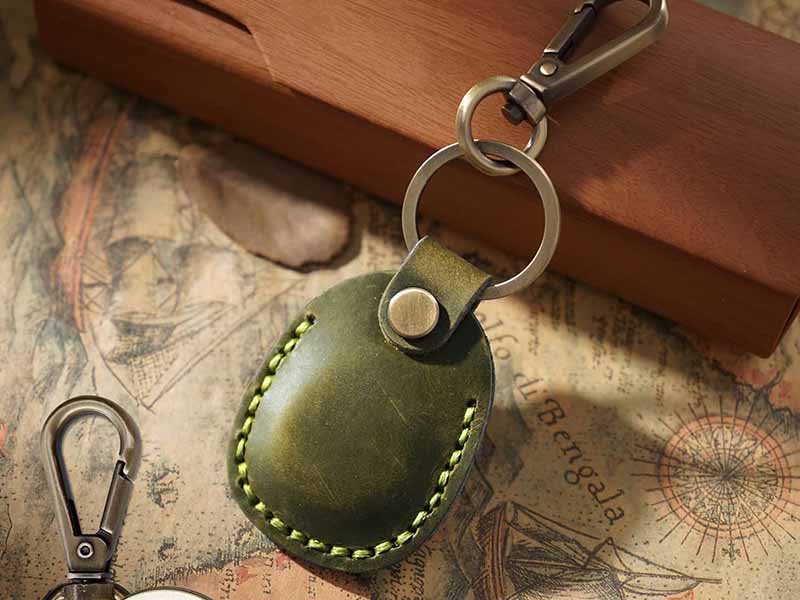
A leather keychain is small, but it’s brutally honest. Customers touch it every day—often more than their wallet. They squeeze it, twist it, drop it, and shove it into pockets with sharp keys. That’s why the edge matters. If the edge is rough, cracked, or wavy, the product feels cheap no matter how nice the leather is. If the edge is clean, rounded, and stays tight after months of use, the keychain suddenly feels “premium” even before the customer reads your brand name.
Folded edge construction is one of the clearest signals of that premium feel. It hides raw fibers, builds a smooth profile, and makes the product feel finished from every angle. But it also adds real cost—extra leather allowance, extra labor steps, tighter tolerances, and more risk of rework if the fold isn’t perfect.
A folded edge leather keychain looks and feels more premium because the edge is turned and secured instead of left exposed. It usually lasts longer with less edge cracking, but it costs more due to skiving, gluing, folding alignment, stitching control, and higher inspection standards.
If you’ve ever held two “similar” keychains—same shape, same hardware—yet one feels luxury and one feels basic, the difference is often right at the edge. Let’s break it down in a way you can actually use for sampling, costing, and production.
What Is a Folded Edge Leather Keychain?
A folded edge leather keychain is made by thinning (skiving) the leather edge, folding it inward, bonding it, and usually stitching close to the fold. This hides the raw cut edge and creates a smooth, rounded perimeter. Compared with edge paint or burnishing, folded edge construction uses more material and labor, needs tighter alignment, and requires stricter quality checks—so it delivers a premium look but increases cost.
What does folded edge mean in a leather keychain?
“Folded edge” means the visible edge is not a cut edge. It’s a turned edge—the leather wraps over itself.
Why customers notice it immediately:
- No raw fibers: The edge looks clean from all angles, even on light-colored leather.
- Softer touch: Fingers feel a rounded edge rather than a sharp cut.
- Better aging: Instead of edge paint chipping or burnish fading, the fold stays “in place” if done correctly.
What folded edge is not:
- It’s not just “folding and pressing.” Without correct skiving and bonding, the edge will open or bubble.
- It’s not automatically higher quality. A badly folded edge can look worse than a good painted edge.
Where it shines most:
- Minimalist keychains with no large logo to distract the eye
- Gift products where the customer inspects details
- Designs with light leather colors where raw edges are more obvious
How is a folded edge leather keychain constructed?
A folded edge leather keychain is built through a controlled chain of steps. If any step is off, the defect shows on the edge—immediately.
Standard production flow (factory view):
- Cutting with fold allowance
- Fold edge needs extra material. If you cut “exact size,” you can’t fold without shrinking the finished width.
- Skiving the fold zone
- Leather is thinned near the edge to avoid bulk. Thickness control here decides whether the edge looks sleek or chunky.
- Glue application
- Even glue film is critical. Too much glue causes waves; too little causes lifting.
- Folding and alignment
- The fold must be straight, symmetrical, and tight. Any misalignment creates a wavy outline.
- Stitching / pressing
- Stitching locks the fold. Pressing sets the shape and reduces spring-back.
- Edge set + final inspection
- This is where premium factories catch lifting, puckering, uneven seam margins, and glue marks.
Key production risks that affect cost:
- Rework from uneven folds
- Scrap from wrong skive depth
- Labor increases due to manual edge control
- Higher QC time to protect the “premium look”
Which leather keychains usually use folded edges?
Folded edge construction is most often used when the keychain is expected to communicate “premium” without saying it.
Most common folded edge leather keychain categories:
- Automotive key fobs (car brands, dealerships, aftermarket)
- Hotel & luxury property key tags
- Corporate gifts for high-value clients
- Designer-style minimalist keychains
- Matching sets (wallet + keychain gift boxes)
When brands choose folded edges, they usually care about:
- Higher perceived value at first touch
- Less edge failure in customer reviews
- Stronger gift presentation
- Better photo results in close-up product images
For entry-level promotional keychains, folded edge is usually avoided unless the order volume supports stable labor costing and tighter QC.
Folded Edge vs Other Edges
| Edge Option | What Customers See | What Customers Feel | Common Failure After Use | Relative Cost |
|---|---|---|---|---|
| Folded edge | Clean, “seam-like” edge | Rounded, smooth | Fold lifting if glue/skive is wrong | High |
| Edge paint | Sharp, uniform color line | Firm edge | Paint cracking/chipping at corners | Medium |
| Burnished edge | Natural, handmade look | Hard edge | Fuzzing/darkening, moisture sensitivity | Low |
Key Spec Numbers Brands Ask for
These ranges help brands and custom buyers speak clearly with factories during sampling.
| Spec Item | Common Range | Why It Matters |
|---|---|---|
| Base leather thickness (before skive) | 1.4–2.2 mm | Too thick = bulky fold; too thin = weak feel |
| Skived thickness at fold zone | ~0.6–1.0 mm | Controls edge bulk and fold tightness |
| Fold allowance (each side) | 3–6 mm | Not enough = edge can’t fold cleanly |
| Stitch margin from edge | 1.5–3.0 mm | Too close risks tearing; too far looks cheap |
| Stitch length | 3.0–4.0 mm | Affects premium look and edge control |
| Glue spread width | 2–5 mm | Controls lifting vs glue marks |
How Does a Folded Edge Leather Keychain Look More Premium?
A folded edge leather keychain creates a smoother, more refined appearance by hiding the raw cut edge. The result is a cleaner, more professional look that appeals to customers looking for premium finishes. This edge treatment adds depth and dimension to the design, making the keychain feel more polished and luxurious compared to keychains with raw or painted edges.
What visual details make a folded edge leather keychain premium?
One of the most noticeable signs of premium craftsmanship in leather goods is how the edges are finished. Folded edges instantly communicate quality, as they show attention to detail. The smooth, rounded look feels consistent and thoughtful, unlike raw-cut edges that might appear rushed or unfinished.
What makes folded edges stand out visually:
- Seamless transition: The edge fold blends into the body of the keychain, creating a continuous, uniform look.
- Clean lines: Unlike painted edges, folded edges have a clean, natural transition from leather to leather without visible brush strokes or imperfections.
- No raw edges exposed: The raw side of leather is hidden, which avoids the risk of fibers fraying or darkening over time, keeping the keychain looking fresh.
Folded edges create a refined and smooth profile, helping the product feel finished, no matter the leather color or style.
How does a folded edge leather keychain feel in hand?
The feel of a keychain is as important as its appearance. Folded edge construction adds a noticeable softness and smoothness to the tactile experience. It also enhances comfort, especially when the keychain is held or carried in a pocket or bag.
Why folded edges feel premium:
- Rounded edges: The folded edge feels soft in the hand, unlike raw or rough edges that might feel sharp or irritating.
- Subtle firmness: When the edge is folded, the leather retains a comfortable firmness, not too stiff, not too soft—just enough to maintain its structure while being easy to hold.
- No uncomfortable bulges: The fold is designed to sit flat, so the keychain doesn’t feel lumpy or unbalanced when it’s carried.
This premium tactile experience makes folded-edge keychains feel more refined and luxurious, reinforcing the overall quality perception.
Which designs benefit most from a folded edge leather keychain?
While folded edges work well in most leather keychains, certain designs benefit significantly from this feature. It’s a great choice for high-end, functional accessories where durability and aesthetic appeal are both important.
Designs that benefit from folded edges:
- Minimalist designs: When there are no large logos or features to distract from the leather itself, a folded edge adds a subtle luxury.
- Corporate gifts: Premium corporate gifting demands a level of polish and quality that folded edges convey.
- Leather key fobs: Often used in automotive branding, these keychains can really stand out with a clean, smooth edge that feels high-end in the hand.
- Personalized keychains: When engraving or stamping is used, a folded edge hides the cut, presenting a cleaner and more finished look.
Folded edges are particularly suited to branding and premium product lines where both function and design matter equally.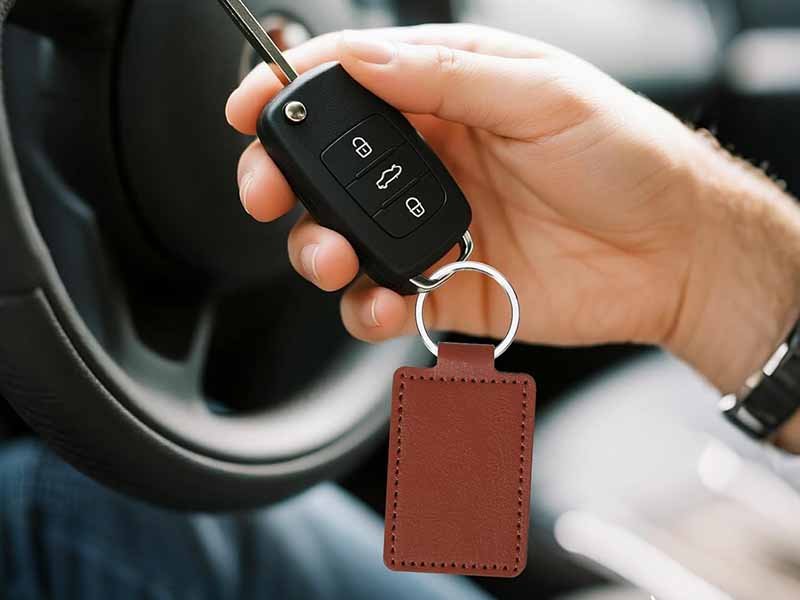
Why Does a Folded Edge Leather Keychain Cost More?
Folded edge leather keychains cost more due to the additional material and labor involved in skiving, folding, gluing, and stitching. These processes require higher skill, more production time, and tighter tolerances. Additionally, the need for more material (due to fold allowances) and precise quality control during each step adds to the overall cost. The result is a keychain that delivers a premium appearance and feel.
Which steps increase folded edge leather keychain cost?
The production of a folded edge leather keychain requires multiple additional steps compared to simpler edges like painted or burnished. These extra steps involve labor-intensive processes that increase both time and cost at each stage.
The primary cost drivers are:
- Leather skiving: Thinning the edge so it can fold evenly takes precision. Skiving too much or too little can ruin the fold.
- Folding process: A proper fold isn’t just a quick press. It requires precise manual labor or special machinery to align the fold and glue it in place.
- Stitching: After folding, stitching must be aligned perfectly, which increases labor hours and requires skilled stitching technicians.
- Inspection and quality control: Ensuring that every folded edge is symmetrical, straight, and clean requires more thorough checks at multiple points of production.
The higher cost breakdown:
- Labor: More skilled labor is needed for each step.
- Materials: Extra leather is required to allow for the fold, adding more cost per unit.
- Time: Longer production time for skiving, folding, gluing, stitching, and checking.
How do labor and materials affect folded edge leather keychain pricing?
Because folded edges require extra materials and labor, they result in a higher production cost. The additional labor costs include time for skilled workers to perform each phase of the production, while the material cost is driven up by the need for extra leather to create the fold.
Labor breakdown:
- Skiving and preparation: Requires experienced workers who know how to thin the edge properly without compromising the leather’s strength.
- Stitching: Proper folding alignment and stitch placement are crucial for durability and a clean look, requiring skilled stitching workers.
- Inspection: A thorough inspection of each piece before it’s approved is critical to ensure a premium finish, which adds time to the process.
Material breakdown:
- Extra leather is needed to allow for the folding process.
- Special gluing agents or adhesives may be required to secure the folded edge and ensure longevity.
- High-quality leathers (like full-grain or vegetable-tanned) tend to be more expensive, increasing the material cost.
What cost mistakes happen with folded edge leather keychains?
When production specs aren’t clear or manufacturers are inexperienced, several common cost mistakes can happen:
Common mistakes that raise costs:
- Incorrect leather selection: Choosing too thick or too thin leather for folding can cause production delays or lead to defective products that require rework.
- Misalignment in folds: If the fold isn’t aligned properly, it creates scrap material or requires extra time to fix.
- Excessive glue usage: If too much glue is applied to the fold, it results in uneven texture and can affect appearance and durability.
- Stitching issues: If the stitching is uneven, customers may feel the fold isn’t professionally done, causing rejection or returns.
To avoid these mistakes, clear communication with the manufacturer is critical to ensure all specifications are followed, and there’s less risk of overspending on rework or quality issues.
Which Edge Finish Works Best for a Leather Keychain?
The best edge finish for a leather keychain depends on positioning, budget, and expected lifespan. Folded edges offer the most premium look and durability, edge paint balances appearance and cost, and burnished edges suit rustic or entry-level designs. There is no “best for all”—only the best match between edge construction, brand promise, and target customer use.
Is a folded edge leather keychain better than edge paint?
In premium perception, yes—but not in every project.
Folded edge vs edge paint from a real-use perspective:
| Aspect | Folded Edge | Edge Paint |
|---|---|---|
| Visual depth | Natural, layered | Flat, uniform |
| Touch feel | Rounded, soft | Firm, defined |
| Aging | Stable if well-made | Risk of cracking |
| Design tolerance | Low (needs precision) | Higher |
| Cost | Higher | Medium |
Where folded edge clearly wins:
- Light-colored leather (white, beige, pastel)
- Minimalist designs with exposed edges
- Products positioned as gifts or luxury add-ons
Where edge paint still makes sense:
- Bold color contrast designs
- Higher volumes with tight budgets
- Brands that want sharp, graphic outlines
A common mistake is using edge paint on a product that looks premium in design but feels average in hand. That mismatch often shows up in customer reviews.
Is a folded edge leather keychain better than burnished edges?
In most modern markets, yes—especially for branded products.
Burnished edges rely on compressed leather fibers. They look natural, but they are sensitive to:
- Moisture
- Sweat
- Friction
- Light-colored leather discoloration
Burnished edges are best when:
- The design is intentionally rustic or handmade
- Leather is thick and dark
- Price sensitivity is high
- The keychain is not positioned as a long-term premium item
For international brands, especially in automotive, hospitality, and corporate gifting, burnished edges often feel too casual and age unevenly. Folded edges provide a more predictable long-term appearance.
How does durability compare between leather keychain edge types?
Durability is not just about edge strength—it’s about how the edge fails.
| Edge Type | Typical Failure Mode | Customer Reaction |
|---|---|---|
| Folded edge | Fold lifting (rare if done well) | “Unlucky defect” |
| Edge paint | Cracking, peeling | “Poor quality” |
| Burnished | Fuzzing, darkening | “Looks old fast” |
From customer psychology:
- Folded edge failures are rare and localized.
- Painted edge failures are highly visible and often judged harshly.
- Burnished edge aging is expected—but not always welcomed.
This is why many premium brands accept the higher upfront cost of folded edges: the risk of visible failure is lower.
How Should You Specify a Folded Edge Leather Keychain for OEM?
To specify a folded edge leather keychain correctly for OEM production, brands must define leather type, thickness, skiving width, fold allowance, stitch margin, adhesive type, and inspection standards. Clear specifications reduce rework, control cost, and ensure consistent quality. Vague instructions like “make it premium” almost always lead to delays and unexpected cost increases.
What specs define a folded edge leather keychain clearly?
A good OEM specification removes guesswork. The clearer the spec, the smoother the production.
Core specs that should always be defined:
- Leather type (top-grain, full-grain, veg/chrome tanned)
- Base leather thickness
- Skived thickness at fold zone
- Fold allowance width
- Stitch distance from edge
- Stitch type and length
- Glue type and application area
Why this matters: Folded edge construction has less tolerance than painted or burnished edges. Small changes in thickness or alignment change the final look immediately.
Which leather thickness works best for folded edge leather keychains?
Thickness selection is one of the biggest success factors.
| Base Thickness | Result After Folding | Recommendation |
|---|---|---|
| 1.2–1.4 mm | Too soft, weak edge | Avoid |
| 1.6–1.8 mm | Slim, refined | Ideal for premium |
| 2.0–2.2 mm | Solid, structured | Good for key fobs |
| 2.4 mm+ | Bulky fold | Risky |
Most clean folded edges for keychains fall in the 1.6–2.0 mm base thickness range, with controlled skiving. Thicker leather is not automatically better.
How do you inspect folded edge leather keychain quality before shipment?
Folded edges should be inspected before packing, not after complaints.
Key inspection points used by professional factories:
Visual
- Straight fold line
- Even stitch spacing
- No glue marks on grain surface
- Symmetry left/right
Touch
- Smooth edge with no hard ridge
- No hollow feeling under fold
- No sharp corners
Stress
- Gentle bend test (edge stays closed)
- Pull test at ring connection
- Light twist (edge does not open)
If a folded edge looks good but fails these tests, it will not survive daily use.
Ready to Develop Folded Edge Leather Keychains?
At SzoneierLeather, we help brands and custom buyers turn design intent into clear, manufacturable specifications.
With over 18 years of experience in leather accessories, we support:
- Folded edge construction development
- Leather selection and thickness control
- Sampling and cost optimization
- OEM / ODM production for leather keychains and small leather goods
If you’re planning a folded edge leather keychain and want it done cleanly, consistently, and cost-effectively, share your design concept with us.
Contact SzoneierLeather to request samples or pricing today.