
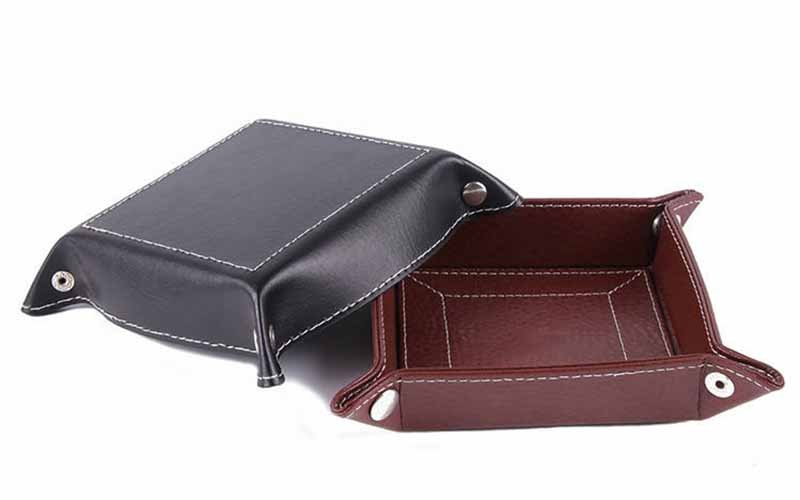
A leather tray looks simple on the surface. It is often seen as a small desktop item, a gift product, a hotel accessory, or a premium organizer for watches, keys, jewelry, coins, cards, and daily carry items. But once you move from a rough idea to real production, the tray quickly becomes more technical than many people expect. A tray that folds poorly, sags after use, shows uneven corners, or wastes too much leather in cutting is usually not a leather problem first. In many cases, it is a pattern problem.
Leather tray pattern engineering is the process of turning a design concept into a workable flat pattern that can be cut, folded, assembled, and reproduced with stable results. It directly affects tray size, corner height, shape consistency, leather usage, hardware placement, assembly speed, and long-term durability. If the pattern is not developed correctly at the beginning, the product may still look acceptable in one handmade sample, but problems usually appear once the order moves into repeated sampling or bulk production.
In practical factory work, this step matters because customers are not just buying a leather tray. They are buying a usable product with the right proportions, stable structure, clean presentation, and repeatable quality. At SzoneierLeather, we have seen clients come with a tray sample that “looks almost right,” but the moment we review the pattern, the real issues become obvious: corner angle mismatch, weak fold area, excessive material consumption, or hardware placement that slows assembly. Good pattern work saves time, saves leather, reduces defects, and makes a custom leather tray easier to scale from sample room to production line. That is why understanding the basics is so important before you approve a design or request a quotation.
What Is Leather Tray Pattern Engineering?
Leather tray pattern engineering is the design work behind the tray’s flat shape, folding structure, corner build, and assembly logic. It decides whether the tray will open neatly, hold its form, fit the intended use, and stay consistent from one unit to the next in production.
What Is a Leather Tray Pattern?
A leather tray pattern is the flat cutting template used to create the final tray. Before the product becomes a three-dimensional tray, it begins as a two-dimensional piece of leather or layered material. This flat piece must be designed with enough accuracy that, once folded and assembled, it becomes the intended shape without distortion, loose corners, or unstable walls.
For clients, this matters because the pattern is where function starts. If the flat pattern is wrong, no amount of premium leather can fully fix the product later. A tray with the wrong base proportions may look oversized in one direction and too shallow in another. A tray with poor corner planning may appear clean in one photo sample but become uneven when produced in quantity.
In real development, a leather tray pattern normally includes the following technical points:
Leather Tray Pattern Base Shape
The base shape controls the tray’s footprint and usage area. It is usually square, rectangular, rounded-square, oval, or a custom silhouette. A tray intended for watches and jewelry often needs a more balanced base with visual symmetry. A tray intended for hotel room accessories or desktop storage may need a longer rectangular format.
Leather Tray Pattern Fold Lines
Fold lines define where the walls rise and how clean the tray forms after assembly. If these lines are too tight, the leather may wrinkle or crack under pressure. If they are too loose, the tray may lose shape and look soft or collapsed.
Leather Tray Pattern Corner Structure
Corners are one of the most important parts of the tray. The corner may be snap-fastened, stitched, riveted, folded, glued, or reinforced in a hybrid way. The pattern must already account for this method before sampling begins.
Leather Tray Pattern Hardware Position
If the tray uses snap buttons, rivets, or magnetic closures, the exact placement has to be built into the pattern. Even a small position error can cause uneven tray height, crooked folding, or assembly delays.
Leather Tray Pattern Edge Allowance
The edge allowance determines how much room is reserved for stitching, edge folding, painting, skiving, or reinforcement. This influences both appearance and durability.
A useful way to understand the pattern is to think of it as the tray’s production language. It tells the cutting team where to cut, the skiving team where to thin, the hardware team where to punch, and the assembly team how the tray should come together.
For customers developing custom leather trays, the pattern is not just an internal factory file. It is one of the main reasons why one supplier’s sample may feel sharp, balanced, and premium, while another supplier’s sample feels rough, floppy, or inconsistent even if both are using similar leather.
What Makes Leather Tray Pattern Engineering Important?
Pattern engineering affects far more than shape alone. It influences cost, visual quality, manufacturing efficiency, and how professional the final product feels in hand. Many customers pay close attention to leather type, color, lining, logo treatment, and packaging, which is natural. But experienced buyers and product developers also know that pattern quality has a direct impact on every one of those areas.
A well-engineered tray pattern helps control the following:
| Key Area | What the Pattern Influences | Why It Matters to the Customer |
|---|---|---|
| Final tray shape | Wall height, base proportion, corner alignment | Determines whether the tray looks premium and usable |
| Material usage | Cutting layout, waste ratio, panel size | Affects product cost and leather consumption |
| Assembly efficiency | Fold logic, hardware position, stitching path | Influences lead time and labor cost |
| Quality consistency | Repeatability from sample to bulk order | Reduces complaints and replacement risk |
| Product durability | Stress distribution in folds and corners | Helps the tray keep shape over time |
| Visual presentation | Symmetry, edge appearance, structure neatness | Affects retail value and brand image |
In practical terms, poor pattern engineering can create several costly problems:
Leather Waste Becomes Too High
Leather is one of the most expensive parts of the product. If the tray pattern is oversized, badly nested, or designed without efficient cutting logic, material waste rises fast. On smaller leather accessories, a difference of 5% to 12% in material efficiency can significantly change the final quotation, especially when using full-grain leather, top-grain leather, or specialty finishes.
Tray Shape Becomes Inconsistent
One of the biggest customer concerns in bulk production is consistency. A tray may look good in the first sample, but if the corner angle or fold line is not engineered correctly, the product may show visible differences from piece to piece. That inconsistency becomes very noticeable when trays are displayed in retail sets, hotel rooms, gift boxes, or branded collections.
Assembly Time Increases
When patterns are not optimized, workers spend more time adjusting panels, aligning corners, correcting hardware position, or forcing the structure into shape. This slows production and increases labor cost. For medium and large orders, even a small increase in assembly time per piece can have a clear effect on total manufacturing cost.
Long-Term Use Performance Drops
A tray is a practical item. Customers place watches, keys, cosmetics, cards, coins, chargers, and accessories inside it. If the fold area is too stressed or the corner structure is too weak, the tray may flatten over time, deform at the corners, or show surface damage faster than expected.
At SzoneierLeather, this stage often determines whether a tray is suitable only for short-run gift use or strong enough for long-term retail and branded programs. That distinction matters to customers because different end uses need different engineering standards. A tray sold in a luxury store, included in a premium gift set, or used in a hotel suite cannot be developed with the same loose structure as a low-cost giveaway item.
How Does Leather Tray Pattern Engineering Shape the Final Product?
The pattern is not a background technical file. It directly controls what the customer sees, what the user feels, and what the production team can repeat. Every visible and functional feature of the tray is influenced by pattern planning.
To understand this clearly, it helps to look at the relationship between pattern decisions and product results.
| Pattern Decision | Direct Result | Customer Impact |
|---|---|---|
| Base dimensions | Inner storage space | Determines whether the tray fits intended items |
| Wall height | Tray depth and appearance | Affects function and perceived quality |
| Corner type | Tray stability and style | Changes both look and durability |
| Fold allowance | Smooth forming and edge tension | Prevents cracking, distortion, and stress marks |
| Leather thickness match | Structure firmness | Helps achieve the right soft or rigid feel |
| Hardware spacing | Clean closure and symmetry | Improves appearance and production accuracy |
Let’s look at this from the product developer’s point of view.
Pattern Controls Product Proportion
Customers often focus on tray length and width, but proportion is about more than footprint. A tray that is too shallow may look flat and weak. A tray that is too deep may look bulky and waste material. The pattern determines the visual balance between base area and wall height, which strongly affects the tray’s commercial appeal.
For example, a compact EDC tray for keys and wallet storage may work well with a lower wall height and a neat, squared shape. A gift tray for jewelry or branded accessories may need a softer edge profile and a slightly deeper structure for a more premium presentation. Those differences begin in the pattern.
Pattern Controls Structural Behavior
Some trays are meant to be soft and foldable for travel or packaging efficiency. Others need to remain firm on a dresser, reception desk, or luxury display shelf. Structure does not come from leather thickness alone. It comes from how the pattern works with the leather.
If the pattern pushes thick leather into too tight a corner, the fold may fight the material and cause wrinkling. If the pattern uses thin leather without enough reinforcement, the wall may fall outward and reduce the tray’s usable form. Good engineering balances material, fold angle, and support method.
Pattern Controls Production Stability
A tray pattern that works only in one handmade sample is not enough for commercial orders. Production stability means the tray can be cut, marked, assembled, and finished repeatedly with minimal variation. This is especially important when customers need:
custom logo programs, matching product sets, retailer packaging standards, or long-term reorder capability.
At SzoneierLeather, many customers ask for trays that match other leather accessories such as wallets, watch rolls, desk mats, belts, notebook covers, or gift boxes. In these cases, the tray pattern must not only work by itself, but also fit into the visual and dimensional logic of the wider product line. That is why factory-level pattern work is important for serious custom development.
A simple-looking tray may contain a surprising amount of technical thinking. Once customers understand that, they usually become much more careful about sample review, size confirmation, and material selection. That is a good thing, because a better pattern at the beginning usually means a smoother project from development to shipment.
How to Design a Leather Tray Pattern
To design a leather tray pattern properly, you need to decide the finished tray size first, then convert that into a flat layout, calculate fold areas, choose the corner method, and reserve the right allowance for stitching, skiving, edge finishing, and hardware. The goal is not just to make the tray look correct in one sample, but to make it practical, stable, and efficient to produce.
How to Size a Leather Tray Pattern
Size planning is where many tray projects either start well or start with hidden problems. The most common mistake is assuming the finished tray size and the flat pattern size are almost the same. In reality, once wall height, corner construction, leather thickness, and edge treatment are included, the flat pattern can become noticeably larger than the final visible tray.
For customers, tray size should always begin with use scenario. Before discussing pattern lines, the first question should be: what will the tray hold? A tray for keys and coins needs very different proportions than a tray for watches, hotel room accessories, sunglasses, cosmetics, or gift packaging inserts.
A practical sizing review usually includes these points:
Leather Tray Pattern Finished Inner Size
This is the usable storage area after the tray is assembled. Customers should pay attention to inner size, not only outer size, especially if the tray must hold products with fixed dimensions such as watches, perfume, cards, remote controls, or boxed accessories.
Leather Tray Pattern Wall Height
Wall height affects appearance, storage security, and forming difficulty. A lower wall gives a cleaner and lighter look, but may not hold loose items well. A higher wall improves containment, but usually increases material consumption and may require more careful corner planning.
Leather Tray Pattern Flat Size
The flat size includes the base, all four side walls, fold area, and structural allowance. This is the actual size used for cutting.
Leather Tray Pattern Material Compensation
Thicker leather needs more room to fold and form. If the material is not considered early, the final tray can become tight, distorted, or dimensionally inaccurate.
Here is a simplified comparison that helps customers understand how dimensions change during development:
| Item | Small Tray Example | Medium Tray Example | Large Tray Example |
|---|---|---|---|
| Intended use | Keys / coins | Watch / wallet / phone | Hotel / desk accessories |
| Finished inner size | 140 x 140 mm | 180 x 180 mm | 250 x 180 mm |
| Approx. wall height | 25 mm | 35 mm | 40 mm |
| Approx. flat size before allowances | 190 x 190 mm | 250 x 250 mm | 330 x 260 mm |
| Typical material thickness | 1.4–1.8 mm | 1.6–2.2 mm | 1.8–2.5 mm |
These are not fixed formulas, but they show why pattern size cannot be guessed casually.
At SzoneierLeather, when customers send a reference image without exact dimensions, we usually guide them through size planning based on usage. That makes development faster and avoids the common issue of approving a beautiful sample that later turns out to be impractical in daily use.
How to Draw a Leather Tray Pattern
After size is confirmed, the next step is building the actual pattern layout. This is the stage where concept becomes something the factory can test, adjust, and manufacture. For a customer, this stage may look invisible, but it has a strong effect on sample speed, production accuracy, and cost control.
The drawing process usually begins with the base panel. From there, the side walls are extended outward, fold positions are marked, and corner construction is defined. If the tray includes lining, padding, reinforcement board, suede interior, snap button closure, or decorative stitching, all of these must be reflected in the pattern file.
A strong tray pattern drawing usually addresses the following details:
Leather Tray Pattern Symmetry
A tray usually relies on visual balance. If opposite sides are even slightly off, the finished product can look twisted or uneven. Symmetry is especially important for square trays and luxury valet trays where clean shape is part of the selling point.
Leather Tray Pattern Punching Position
Snap buttons, rivets, and magnetic points cannot be placed by rough visual judgment. Their position must be measured from edge lines and fold lines with high repeatability. Even small errors can make one corner sit higher than the others.
Leather Tray Pattern Edge Route
If the tray will be edge-painted, folded, raw-edge finished, or stitched with decorative thread, the edge route needs enough space for clean workmanship. Different finishing methods need different allowances.
Leather Tray Pattern Layer Structure
Some trays are single-layer leather. Others use lining, EVA support, cardboard reinforcement, microfiber, or suede. When multiple layers are involved, the pattern may need separate files for each layer because they do not always share the same dimensions.
Customers who plan to source from an experienced factory should pay close attention to whether the supplier is treating the tray as a real development project or simply copying a photo reference. A supplier that cannot explain the pattern logic behind the tray may still produce a sample, but the risk of trouble later is much higher.
That is why professional tray development often includes at least one or two rounds of adjustment. In many cases, the first sample is used to confirm visual direction, while the second sample improves proportion, corner cleanliness, or structure stability. This is normal and often necessary for better commercial results.
How to Plan Leather Tray Pattern Corners
If the base is the foundation of the tray, the corners are the test of whether the pattern truly works. Most tray quality problems become visible first at the corners. This is where leather changes direction, material tension concentrates, hardware alignment matters, and the tray either looks refined or looks cheap.
Customers often compare trays by touching and looking at the corners, even if they do not say so directly. Crooked corners, stress marks, loose folds, exposed raw edges, or uneven tray heights immediately reduce the premium feeling of the product.
Corner planning usually starts with choosing the assembly style. Different styles fit different price levels, design languages, and production methods.
| Corner Method | Appearance | Strength | Labor Level | Cost Level | Best For |
|---|---|---|---|---|---|
| Snap corner | Clean and practical | Medium | Low | Low | Gift items, travel trays, promotional use |
| Stitched corner | Refined and premium | High | Medium to high | Medium to high | Retail collections, luxury accessories |
| Riveted corner | Strong and decorative | High | Medium | Medium | Rugged or masculine tray styles |
| Folded and glued corner | Smooth appearance | Medium | Medium | Medium | Minimalist structured trays |
| Hybrid reinforced corner | Strong and stable | Very high | High | High | Premium custom projects |
Leather Tray Pattern Corner Angle
The corner angle decides how naturally the wall rises from the base. If the angle is too aggressive, the leather may bunch or resist folding. If it is too open, the tray can feel weak and spread outward.
Leather Tray Pattern Corner Height Balance
All four corners need to rise evenly. If hardware position, cut line, or fold logic differ even slightly, the tray may rock on the table or show obvious visual imbalance.
Leather Tray Pattern Corner Reinforcement
For trays carrying heavier items or requiring long service life, reinforcement may be added through layered construction, lining support, or controlled skiving. This is especially useful for thicker trays used in hotels, office accessories, or premium gift sets.
At SzoneierLeather, corner review is often one of the main checkpoints during sampling because it tells us whether the tray will remain a simple photo sample or become a strong production item. For serious custom orders, customers benefit from asking direct questions here: Will the corner stay stable after repeated opening and closing? Will the leather show pressure marks? Is the structure suitable for the selected leather thickness? These questions help avoid weak development decisions early on.
Which Leather Fits a Leather Tray Pattern
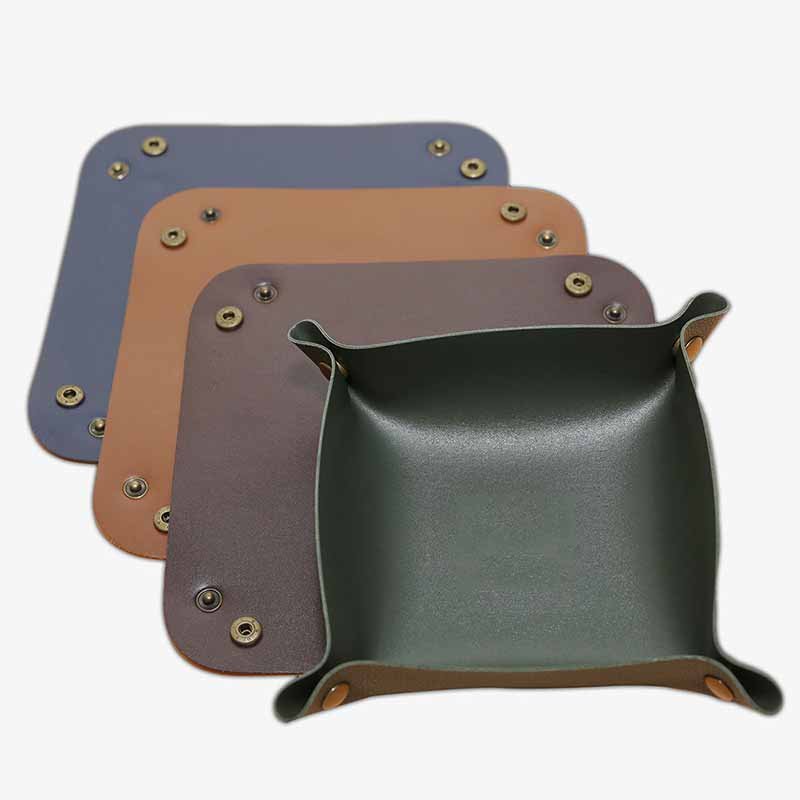
Choosing the right leather for a tray pattern is not just about appearance. It directly affects how the tray folds, how well it holds shape, how long it lasts, and how consistent it will be in production. A well-designed pattern can fail if the material does not match the structure. At the same time, the right leather can enhance even a simple pattern and make the product feel premium and reliable.
Which Leather Works for a Leather Tray Pattern
Different leather types behave very differently when folded and shaped. For customers, the choice should be based on the tray’s intended use, price level, and visual positioning.
Here is a practical comparison of commonly used leather types:
| Leather Type | Surface Feel | Structure Behavior | Cost Level | Typical Use |
|---|---|---|---|---|
| Full-grain leather | Natural, premium | Firm, strong memory | High | Luxury trays, branded gifts |
| Top-grain leather | Smooth, refined | Balanced flexibility | Medium to high | Retail products, OEM orders |
| Split leather | Softer, less dense | Weak structure | Low | Budget trays, promotional items |
| PU leather | Uniform, synthetic | Stable but less natural | Low to medium | Mass market, large volume |
| Vegetable-tanned leather | Natural, firm | Excellent for shaping | Medium to high | Handmade, premium trays |
| Chrome-tanned leather | Soft, flexible | Easier to fold | Medium | Soft trays, foldable designs |
Leather Tray Pattern and Structure Matching
A tray pattern designed for firm leather may not work well with soft leather. For example, if you use soft chrome-tanned leather with a pattern designed for stiff vegetable-tanned leather, the tray may collapse outward and lose its shape. On the other hand, using very thick vegetable-tanned leather in a pattern with tight corner folds may cause stress marks or uneven forming.
At SzoneierLeather, we often adjust the pattern slightly depending on the selected leather. This may include widening fold areas, adjusting corner cuts, or adding reinforcement layers.
Leather Tray Pattern and Surface Finish
Surface finish also matters. Smooth leather shows imperfections more clearly, so the pattern must be precise. Textured leather can hide minor inconsistencies but may reduce the sharpness of edges and folds.
For example:
- Smooth calf leather → requires high precision pattern
- Pebbled leather → more forgiving in production
- Waxed leather → changes appearance over time, needs balanced structure
Leather Tray Pattern and Use Scenario
Different use cases require different material behavior:
| Use Scenario | Recommended Leather | Key Reason |
|---|---|---|
| Desk tray (keys, wallet) | Top-grain / veg-tan | Balanced structure and durability |
| Travel tray (foldable) | Chrome-tan / thinner PU | Flexibility and portability |
| Luxury gift tray | Full-grain / veg-tan | Premium feel and structure |
| Hotel tray | PU / top-grain | Consistency and cost control |
For customers developing a product line, it is often better to define the use scenario first, then match the leather and pattern together, rather than choosing leather only based on appearance.
What Thickness for Leather Tray Pattern
Thickness is one of the most underestimated factors in tray development. It directly affects folding behavior, edge finishing, structure strength, and overall product feel.
A small change in thickness can completely change how the tray performs.
Here is a practical guideline:
| Leather Thickness | Structure Feel | Folding Difficulty | Recommended Use |
|---|---|---|---|
| 1.0–1.4 mm | Soft | Easy | Foldable trays, travel use |
| 1.4–1.8 mm | Medium | Balanced | Standard trays |
| 1.8–2.5 mm | Firm | Moderate | Premium trays |
| 2.5 mm+ | Very rigid | Difficult | Heavy-duty or reinforced trays |
Thickness and Folding Performance
Thicker leather gives better structure but is harder to fold. Without proper skiving (thinning at fold areas), thick leather can create:
- Bulky corners
- Uneven edges
- Visible stress lines
Thinner leather folds easily but may lack strength. In many cases, factories combine thinner leather with reinforcement layers to achieve both flexibility and structure.
Thickness and Edge Treatment
Edge finishing depends heavily on thickness:
- Thin leather → easier for folded edges
- Medium thickness → ideal for painted edges
- Thick leather → may require sanding, multiple coating layers
For customers, this affects not only appearance but also cost, because more complex edge treatment increases labor time.
Thickness and Cost Balance
Thicker leather increases material cost and sometimes increases waste due to cutting limitations. However, it may reduce the need for reinforcement materials.
At SzoneierLeather, we often help clients balance:
- Material cost
- Structure requirement
- Target price
Instead of simply choosing the thickest leather, the goal is to choose the most suitable thickness for the product’s positioning.
How Material Affects Leather Tray Pattern
Material is not just a selection step. It actively changes how the pattern needs to be designed and adjusted.
Flexibility and Pattern Adjustment
Soft leather requires tighter pattern control to maintain shape. This may include:
- Smaller corner openings
- Additional reinforcement
- Slightly increased wall height
Firm leather allows cleaner structure but needs more allowance for folding.
Memory and Shape Retention
Some leathers, especially vegetable-tanned leather, have strong “memory,” meaning they hold shape well after forming. Others, like soft chrome-tanned leather, may relax over time.
This affects long-term product performance:
- High memory → tray keeps shape longer
- Low memory → tray may flatten with use
Moisture and Forming Behavior
In production, some trays are slightly moistened and shaped during forming. This works well with certain leathers but not all.
For example:
- Vegetable-tanned leather → excellent for forming
- PU leather → not suitable for wet forming
- Chrome-tanned leather → moderate forming ability
This is why pattern and material decisions are often developed together, not separately.
How to Improve Leather Tray Pattern Production
A good pattern is not only about design. It must also work efficiently in production. Many trays look good as a sample but become difficult, slow, or inconsistent when produced in large quantities. Improving pattern production means making sure the design is practical for cutting, assembly, and quality control.
How to Optimize Leather Tray Pattern Layout
Pattern layout directly affects material usage and production cost. Leather is not a uniform material like fabric. It has natural grain direction, defects, and irregular shapes. This makes layout planning very important.
Leather Tray Pattern Nesting Efficiency
Nesting means arranging multiple patterns on a leather hide to minimize waste. A well-optimized layout can improve material usage by 8%–15%, which is significant for large orders.
For example:
| Layout Type | Material Usage | Waste Level |
|---|---|---|
| Poor layout | 70–75% | High |
| Standard layout | 80–85% | Medium |
| Optimized layout | 85–92% | Low |
At SzoneierLeather, we use digital nesting tools combined with manual adjustment to achieve better efficiency, especially for large orders.
Leather Tray Pattern Orientation
Leather has natural stretch direction. Placing patterns incorrectly can lead to:
- Uneven stretching
- Shape distortion over time
For trays, maintaining consistent orientation helps ensure all pieces behave similarly.
Leather Tray Pattern Size Standardization
Standardizing sizes across product lines allows:
- Faster production
- Easier material planning
- Better cost control
For customers developing multiple tray sizes, aligning dimensions strategically can reduce overall cost.
How to Standardize Leather Tray Pattern
Consistency is one of the most important factors in bulk production. Customers expect every tray in an order to look and function the same.
Template and Tooling
Factories use cutting dies, laser templates, or CNC cutting systems to ensure each piece matches the pattern exactly. This reduces human error and improves repeatability.
Hole Position Control
Hardware holes must be placed with precision. Standardized templates ensure:
- Even corner height
- Smooth assembly
- Clean appearance
Process Control
Standardizing the pattern also means standardizing the process:
- Same folding method
- Same stitching path
- Same edge finishing sequence
This ensures stable quality across thousands of units.
How Factories Use Leather Tray Pattern
In a professional factory environment, the pattern is not just a drawing. It becomes part of the production system.
From Pattern to Sample
The first step is sampling. The pattern is tested, adjusted, and refined. Most trays require at least 1–2 rounds of adjustment to reach optimal balance.
From Sample to Production
Once approved, the pattern is converted into production tools:
- Cutting dies
- Digital cutting files
- Assembly guides
Quality Control Based on Pattern
Quality inspection often checks:
- Size accuracy
- Corner alignment
- Structure stability
All of these are linked back to the pattern.
At SzoneierLeather, pattern files are stored and managed for repeat orders. This allows customers to reorder products with consistent quality even after months or years.
What Problems in Leather Tray Pattern Design
Even with a good concept and quality leather, many leather tray projects run into problems during sampling or bulk production. In most cases, these issues are not caused by material defects, but by pattern design that does not fully consider structure, folding behavior, or production reality.
Understanding these problems early helps customers avoid delays, reduce cost, and achieve a more stable final product.
Why Leather Tray Pattern Fails
Pattern failure usually appears during one of three stages: first sample, repeated sampling, or mass production. A tray that looks acceptable in a single handmade sample may fail when scaled to larger quantities.
Weak Structure and Collapse
One of the most common issues is a tray that cannot hold its shape. This usually happens when:
- The wall height is too high for the chosen leather thickness
- The corner structure is too simple for the intended use
- The pattern does not include reinforcement
For example, a tray designed with thin chrome-tanned leather and snap corners may look fine initially, but after repeated use, the walls begin to fall outward.
A better solution is to adjust one or more of the following:
- Increase leather thickness slightly
- Add reinforcement layer (EVA, board, or lining)
- Modify corner structure
Uneven Corners and Poor Alignment
Another frequent issue is inconsistent corner height. This creates a visually unbalanced tray and reduces perceived quality.
Common causes include:
- Incorrect hole placement for snaps or rivets
- Asymmetrical pattern design
- Inconsistent folding allowance
Even a 1–2 mm deviation can create visible misalignment, especially in square trays.
Surface Wrinkles and Stress Marks
Wrinkles often appear at fold areas or corners. These are usually caused by:
- Insufficient fold allowance
- Leather too thick for tight folding
- No skiving at bending zones
This problem is especially visible on smooth leather surfaces, where imperfections cannot be hidden.
High Defect Rate in Production
A pattern that is too sensitive or difficult to assemble may result in a higher defect rate.
Typical signs include:
- Workers needing to adjust pieces manually
- Inconsistent folding results
- Slow assembly speed
For bulk orders, even a 5% increase in defect rate can significantly impact delivery time and cost.
What Causes Leather Tray Pattern Errors
Understanding the root cause of pattern errors helps prevent them before sampling begins.
| Error Type | Root Cause | Result |
|---|---|---|
| Incorrect dimensions | Miscalculation of flat vs finished size | Tray too large or too small |
| Poor corner design | Wrong angle or structure choice | Weak or uneven corners |
| Material mismatch | Pattern not adapted to leather type | Deformation or instability |
| Missing allowances | No space for folding or stitching | Cracking or tight edges |
| Hardware misplacement | Inaccurate hole positioning | Assembly difficulty |
Over-Reliance on Visual Reference
Some projects start with only a photo reference. While this helps with design direction, it is not enough for production.
Without proper measurement and pattern reconstruction, the result may:
- Look similar visually
- Perform very differently in use
Ignoring Material Behavior
Leather is not a uniform material. It stretches, compresses, and reacts to folding. A pattern that ignores these properties may work on paper but fail in real production.
Skipping Prototype Adjustment
Skipping sample refinement to save time often leads to bigger problems later. Pattern engineering usually requires at least one adjustment cycle.
At SzoneierLeather, we recommend confirming:
Size
Structure
Corner behavior
before moving to bulk production.
How to Fix Leather Tray Pattern Issues
Most pattern issues can be corrected if identified early.
Adjusting Pattern Geometry
Small changes in:
- Corner cut shape
- Fold line position
- Wall height
can significantly improve the tray’s structure.
Improving Material Matching
If the pattern is fixed, adjusting the material may help:
- Switching to firmer leather
- Adding reinforcement layers
- Changing thickness
Refining Production Process
Sometimes the issue is not only the pattern but how it is executed:
- Adding skiving at fold areas
- Using better forming techniques
- Improving assembly consistency
The key is to treat pattern, material, and process as one system rather than separate decisions.
How to Customize Leather Tray Pattern
Customization is where leather tray products become truly valuable for brands. A tray is not just a functional item—it is often used for branding, gifting, retail display, and customer experience.
A well-designed pattern makes customization easier, more consistent, and more scalable.
How to Brand a Leather Tray Pattern
Branding is usually applied through logo techniques and design details. The pattern must support these elements from the beginning.
Logo Placement Planning
Logo placement should be considered during pattern design, not after sampling.
Common positions include:
- Center base
- Corner area
- Inner wall
- Outer side
Each position requires:
- Enough flat space
- Correct alignment with pattern symmetry
Logo Techniques and Requirements
| Logo Method | Effect | Pattern Consideration |
|---|---|---|
| Embossed | Clean, premium | Needs stable flat surface |
| Debossed | Subtle, luxury | Requires proper pressure area |
| Foil stamping | Eye-catching | Sensitive to surface texture |
| Printed | Colorful | Needs smooth finish |
| Metal plate | Strong branding | Requires fixing position in pattern |
Stitching and Edge Customization
Customization is not only about logos. Stitching color, edge paint color, and lining material all contribute to brand identity.
The pattern must ensure:
- Even stitching distance
- Clean edge finish
- Balanced visual proportions
Which Styles Use Leather Tray Pattern
Different tray styles require different pattern logic. Customers should choose a style that matches their market and price level.
| Style Type | Pattern Complexity | Market Position |
|---|---|---|
| Minimal flat tray | Low | Entry-level / promotional |
| Snap corner tray | Medium | Standard retail |
| Stitched tray | Medium to high | Premium retail |
| Rigid structured tray | High | Luxury / hotel / display |
| Foldable travel tray | Medium | Travel / gifting |
Minimalist vs Structured Design
Minimalist trays focus on simplicity and cost efficiency. Structured trays focus on form and durability.
Foldable vs Fixed Structure
Foldable trays are easier to ship and store. Fixed trays offer stronger structure and higher perceived value.
Multi-Function Tray Design
Some trays include:
- Compartments
- Removable inserts
- Magnetic closures
These require more advanced pattern engineering but offer higher product differentiation.
How to Adapt Leather Tray Pattern Use
A good pattern can be adapted for multiple product lines.
Size Variations
Once a base pattern is developed, it can be scaled to create:
- Small tray
- Medium tray
- Large tray
This allows brands to offer product sets.
Material Variations
The same pattern can be used with:
- Different leather types
- Different colors
- Different textures
This creates multiple SKUs without redesigning the product.
Market-Specific Adjustments
Different markets may prefer:
- Softer trays (lifestyle products)
- Firmer trays (luxury goods)
- Lower-cost materials (promotional items)
Pattern adjustments help adapt the same design to different customer segments.
Start Your Custom Leather Tray Project with SzoneierLeather
A leather tray may look simple, but developing a product that performs well, looks consistent, and can be produced efficiently requires careful pattern engineering, material selection, and production planning.
At SzoneierLeather, we support clients through the full development process:
- Product concept discussion and size planning
- Pattern development and optimization
- Material sourcing based on target price and positioning
- Sample making and refinement
- Bulk production with stable quality control
- Packaging and branding support
With over 18 years of experience in leather product manufacturing, we understand what works in real production—not just in theory.
If you are planning to develop:
- Custom leather trays
- Branded valet trays
- Gift set accessories
- Retail leather organizers
we can help you turn your idea into a reliable product.
Send us your design, reference image, or size requirement, and our team will provide:
- Professional suggestions
- Quick sampling support
- Competitive quotation
A well-designed leather tray starts with the right pattern. Let’s build it correctly from the beginning.