
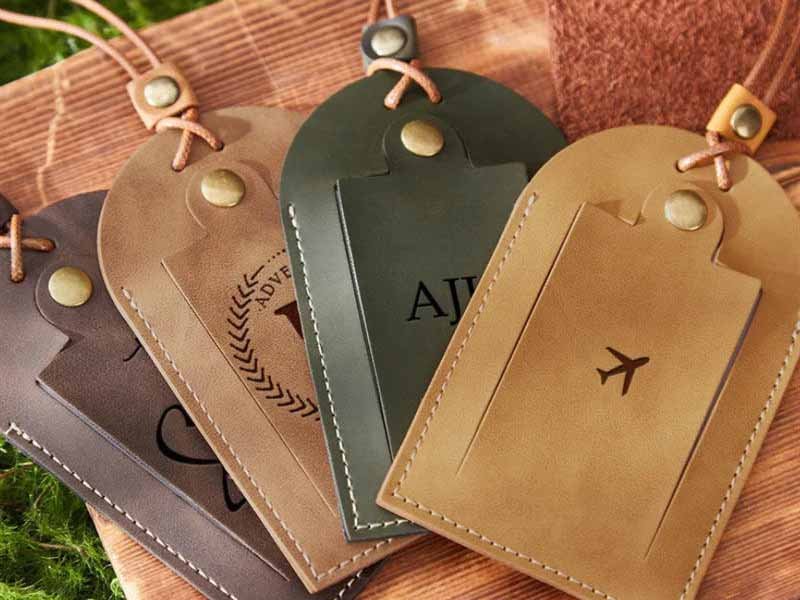
Retail stores often treat leather luggage tags as a small add-on product, but in practice, they can do much more than fill shelf space. A well-made leather luggage tag helps a store raise product value, strengthen visual branding, and create an easy-entry item for customers who may not be ready to buy a larger leather product. It is compact, practical, giftable, and highly customizable. That combination makes it one of the most flexible leather accessories in retail.
A leather luggage tag for retail stores is a branded travel accessory made from genuine leather or alternative leather materials, designed to identify luggage while also presenting a premium look. A retail-ready tag needs durable material, a secure fastening structure, neat edge finishing, clear branding, and packaging that fits store display or gift sales. Good production is not only about making the tag look attractive, but also about making it reliable, consistent, and easy to scale in bulk orders.
For many retailers, the real challenge is not deciding whether to sell luggage tags. The real challenge is finding a factory that can turn a simple accessory into a product customers actually want to pick up, touch, and buy. That is where production detail starts to matter.
What Is a Leather Luggage Tag?
A leather luggage tag is a travel accessory attached to suitcases, carry-on bags, backpacks, or duffels to display identification details. In retail, it is more than an ID tag. It is a small leather product that combines function, appearance, brand presentation, and profit margin in one compact item.
What makes a leather luggage tag retail-ready?
A luggage tag may look simple, but a retail-ready version has a very different standard from a basic low-cost promotional item. Many tags in the market look acceptable in photos, but once handled in real life, the problems become obvious: leather feels thin, edges crack, straps break, logo placement is uneven, or the card window turns cloudy after a short period of use. Retail customers notice these details quickly.
A retail-ready leather luggage tag needs to perform well in five areas: material feel, structural durability, visual consistency, functional usability, and packaging presentation. If one of these is weak, the whole product feels cheap, no matter how attractive the design is.
For example, a retail store usually cares about questions like these:
- Does the tag feel premium when a customer touches it?
- Will the strap stay secure after repeated baggage handling?
- Is the ID card easy to insert and remove?
- Can the logo stay clear and sharp on every batch?
- Will the product still look clean after months on shelf display?
These are not small concerns. They directly affect sell-through rate, return rate, and customer reviews.
A good retail program usually starts with a clear product positioning strategy. Some stores want an entry-level leather gift item with competitive pricing. Others want a premium add-on to match travel bags, wallets, or passport holders. The factory must understand that difference before development starts.
Below is a practical comparison of what retail stores usually expect:
| Item | Basic Low-End Tag | Retail-Ready Tag |
|---|---|---|
| Leather feel | Thin, flat, artificial touch | Fuller hand feel, cleaner grain, better texture |
| Strap structure | Weak buckle or soft loop | Reinforced strap with stable fastening |
| Edge finish | Rough painted edge or exposed fibers | Smooth sealed edge, neat color finish |
| Logo effect | Inconsistent print | Clear embossing, debossing, foil, or precise print |
| Card window | Thin PVC, easy to scratch | Better transparency, better stitching support |
| Batch consistency | Visible color and shape variation | More controlled color, cutting, and stitching |
| Packaging | Simple polybag only | Hang tag, gift card, box, sleeve, or retail-ready pack |
In real retail settings, small details create buying confidence. A customer may not analyze the production process, but they immediately notice whether a tag feels durable, whether the leather smells natural, whether the stitching is straight, and whether the product looks gift-worthy. That first impression often decides whether the item stays on the shelf or goes to the checkout counter.
For a factory like SzoneierLeather, making a tag retail-ready is not just about producing a sample that looks good once. It is about building a product that can hold the same quality across repeated orders, color extensions, packaging changes, and seasonal launches.
Why choose a leather luggage tag over other materials?
Retail stores have many luggage tag material options. Common choices include PVC, silicone, fabric, PU leather, microfiber leather, and genuine leather. Each material has its place, but leather keeps a strong position because it offers a balance that many other materials struggle to match: it looks premium, lasts longer, accepts elegant branding, and fits both gift and utility markets.
The first advantage is perceived value. Customers often judge quality with their hands before they judge it with logic. Leather has natural texture, better body, and a more substantial feel. Even before a customer checks the price, genuine leather usually creates a stronger impression than plastic or woven fabric.
The second advantage is durability. A properly made leather luggage tag can hold shape, resist daily wear, and age better over time. This matters in travel products because rough handling is normal. Bags get thrown into overhead bins, baggage belts, trunks, hotel carts, and airport trolleys. A luggage tag that cannot handle bending, pulling, friction, moisture exposure, and repeated use will quickly disappoint customers.
The third advantage is branding quality. Leather supports logo methods that look more refined than many surface prints on cheaper materials. Retailers selling leather accessories often want the branding to feel subtle and premium, not loud and disposable. Leather makes that possible.
Here is a useful comparison from a product development angle:
| Material | Appearance Level | Durability | Logo Options | Retail Positioning |
|---|---|---|---|---|
| PVC | Low to medium | Medium | Print, emboss | Budget travel accessory |
| Silicone | Casual | Medium | Molded logo, print | Youth or novelty market |
| Fabric | Casual | Medium | Print, patch, embroidery | Outdoor or casual market |
| PU leather | Medium | Medium | Print, deboss, foil | Fashion budget line |
| Microfiber leather | Medium to high | Medium to high | Deboss, foil, print | Mid-range retail |
| Genuine leather | High | High | Emboss, deboss, foil, laser | Premium retail and gifting |
Leather also gives retailers more room for product line expansion. A luggage tag can easily be developed into a set with a passport holder, card holder, travel wallet, or keychain. This matters because stores do not always want one isolated product. They often want product families that raise average order value and improve display cohesion.
There is also an emotional side. Customers often buy leather products because they associate them with travel memories, personal style, gifting occasions, and long-term use. A leather luggage tag feels less disposable. That alone can justify a better retail price.
From a business point of view, leather tags usually support stronger retail margins than many low-cost material tags, especially when packaging and logo detail are handled properly. A product that costs slightly more to make can often sell at a much more meaningful premium if the presentation is done right.
Are leather luggage tags still in demand?
Yes, and not only in traditional luggage stores. The customer base for leather luggage tags is broader than many people assume. Today, demand comes from travel brands, department stores, gift shops, lifestyle retailers, airport stores, leather accessory brands, hotel gift programs, promotional merchandise companies, and corporate gifting channels.
The reason demand stays strong is simple: the product solves more than one problem at once.
It helps customers:
- identify their baggage
- personalize their travel gear
- match other travel accessories
- buy a practical small gift
- add a premium accessory without a high spend
For retail stores, this creates multiple selling angles. A luggage tag can be merchandised as a travel essential, gift item, branded accessory, checkout add-on, or seasonal travel promotion. Few small leather items are this flexible.
Leather luggage tags are also well-suited to impulse purchase behavior. A customer may hesitate over a travel bag priced at a much higher level, but a luggage tag is a lower-commitment purchase. It lets the customer participate in the brand without a major spending decision. This is especially useful for retail stores that want to attract first-time buyers.
Another reason demand remains healthy is customization. Customers increasingly like products that feel personal. A leather luggage tag can be customized by color, grain, logo, metal hardware, strap design, card window style, monogram space, gift packaging, or matching set concept. This makes it attractive not only for stores, but also for brand campaigns and private label programs.
Below are some common retail demand drivers:
| Demand Driver | Why It Matters |
|---|---|
| Travel recovery and mobility | More travel means more accessory demand |
| Giftable leather products | Small leather goods are easy to gift |
| Personalization trend | Customers want initials, logos, and unique colorways |
| Matching accessory sets | Stores prefer coordinated product collections |
| Corporate branding needs | Tags work well for hospitality, events, and gifting |
| Entry-level leather item | Good for customers trying a brand for the first time |
In many stores, luggage tags also work well because they do not require complex sizing, technical fitting, or heavy product education. Customers understand the product immediately. That simplicity helps retail conversion.
However, demand does not automatically mean easy sales. The tags that continue to sell are usually the ones that get the balance right between price, design, leather selection, and branding. Cheap tags with weak straps or poor finishing often fail after the first reorder. Better-made tags with clean construction and clear product identity tend to last longer in the assortment.
This is why many retail clients do not just ask for “a leather luggage tag.” They ask for something more specific:
- a tag that matches an existing travel collection
- a tag with better edge paint durability
- a gift-ready tag for holiday programs
- a branded tag for department store channels
- a simple design that can scale to 3,000 to 20,000 units with stable quality
That shift is important. It shows the market is not disappearing. It is becoming more selective.
What information do retail clients care about before development starts?
When a retail store or brand contacts a factory about leather luggage tags, the first thing they usually want is not a long theory about leather. They want practical answers that help them make decisions quickly. They are trying to reduce risk, control costs, and understand whether the supplier can actually deliver consistent product quality.
Most retail clients care about these points early in the conversation:
- Which leather options fit the target price?
- What structure is most durable for the strap?
- What is the minimum order quantity by color?
- How long does sampling take?
- Which logo method works best on this leather surface?
- What packaging options are available?
- Can the factory match Pantone or brand color references?
- What are the usual production lead times?
- How is quality checked before shipment?
These questions matter because luggage tags may be small, but production mistakes are expensive at scale. A small flaw multiplied across 5,000 units becomes a major retail problem.
A professional development process should therefore begin with a clear product brief. The more complete the brief, the smoother the development stage. Retail clients usually get better results when they define the following:
| Development Item | Why It Matters |
|---|---|
| Target retail price | Helps choose the right leather and hardware level |
| Sales channel | Airport store, gift shop, department store, online retail, or corporate gifting all need different positioning |
| Brand style | Minimal, classic, luxury, youthful, travel-focused, or corporate |
| Logo method | Affects cost, look, tooling, and production lead time |
| Packaging type | Influences presentation, shipping cost, and shelf display |
| Order quantity | Determines material planning and unit cost |
| Matching products | Useful if the tag should align with passport holders, wallets, or travel bags |
For SzoneierLeather, the strongest projects usually begin when the client shares not only artwork, but also business goals. That allows the factory to recommend better material thickness, construction methods, packaging solutions, and cost-saving adjustments. Sometimes a small design change, such as using a folded leather strap instead of a single-layer strap, can significantly improve durability without pushing the cost too far.
That is the difference between simply making a product and helping a retail client build a stronger item for the market.
What Leather Is Best for Luggage Tags?
The best leather for luggage tags depends on your target price, product positioning, and how the tag will be used. For retail stores, the goal is not simply to choose “the highest grade leather,” but to choose the most suitable leather that balances durability, appearance, cost, and production consistency.
Which leather types work best for luggage tags?
There are several leather options commonly used in luggage tag production. Each has its own strengths, limitations, and suitable retail positioning. Choosing the right one early can avoid unnecessary cost increases or product quality issues later.
The most widely used types include:
- Full-grain leather: highest durability, natural surface, develops patina over time
- Top-grain leather: smoother and more uniform surface, easier for consistent production
- Split leather (with coating): lower cost, often used with PU coating for appearance
- PU leather (synthetic): budget-friendly, stable color, but lower long-term durability
- Microfiber leather: more advanced synthetic option with better strength than PU
From a production perspective, top-grain leather is often the most practical choice for retail luggage tags. It offers a clean surface for logo application, better control in large batches, and fewer natural defects compared to full-grain leather.
Below is a clear comparison to help retail clients make decisions:
| Leather Type | Surface Look | Durability | Cost Level | Best Use Case |
|---|---|---|---|---|
| Full-grain | Natural, visible grain | Very high | High | Premium retail, luxury gifting |
| Top-grain | Smooth, refined | High | Medium-high | Mainstream retail, branded products |
| Split leather | Coated, uniform | Medium | Medium | Cost-sensitive retail |
| PU leather | Artificial, consistent | Medium-low | Low | Budget promotions |
| Microfiber | Clean, modern | Medium-high | Medium | Mid-range retail |
Retail stores often choose top-grain leather because it offers a strong balance: it looks premium enough for branding, but still allows cost control in bulk orders.
Another important point is thickness. For luggage tags, leather thickness usually ranges between 1.2mm and 2.0mm. Thinner leather may feel weak, while overly thick leather can make folding, stitching, and edge finishing more difficult. A well-balanced thickness improves both durability and appearance.
How does leather quality affect luggage tag cost?
Leather is the biggest cost factor in a luggage tag, often accounting for 40% to 65% of total production cost. Small changes in leather grade, thickness, and finish can significantly affect the final price.
Retail clients should understand that “leather quality” is not a single factor. It includes:
- raw material grade (full-grain vs split)
- surface treatment (natural vs coated)
- thickness and density
- cutting yield (how much waste during cutting)
- defect rate (marks, scars, color variation)
For example, full-grain leather may look attractive, but it often has more natural variation. This can lead to lower cutting efficiency and higher rejection rates during production. As a result, the actual cost per usable piece becomes higher than expected.
Here is a simplified cost impact overview:
| Factor | Low Impact Option | High Impact Option | Cost Effect |
|---|---|---|---|
| Leather type | Split / PU | Full-grain | +20% to +60% |
| Thickness | 1.2mm | 2.0mm | +10% to +25% |
| Surface finish | Coated | Natural grain | +10% to +30% |
| Cutting efficiency | High yield | Low yield | +5% to +20% |
Retailers should not always chase the highest grade. Instead, they should match the material to the product’s price point and sales channel. For example:
- Airport gift shops may accept higher pricing for premium leather
- Online stores may prefer balanced cost with good appearance
- Promotional programs often require strict cost control
An experienced factory like SzoneierLeather will usually recommend different leather solutions for different markets, instead of pushing a single material option.
Are eco leather luggage tags a good option?
Sustainability has become an important topic in retail, especially in Europe and North America. Many clients now ask for eco-friendly leather options, but the term “eco leather” can mean different things depending on the context.
Common eco-related options include:
- Vegetable-tanned leather: uses natural tannins, less chemical processing
- Recycled leather: made from leather fibers bonded together
- PU alternatives with water-based coatings
- Bio-based materials (partially plant-derived)
Vegetable-tanned leather is often considered the most traditional eco option. It avoids heavy chemical tanning and develops a natural aging effect over time. However, it also has some limitations:
- higher cost
- longer production time
- more sensitivity to water and stains
- color consistency challenges
For retail programs, especially large-volume ones, consistency and stability are just as important as sustainability. That is why many brands choose a hybrid approach:
- using top-grain leather from certified tanneries
- selecting environmentally controlled finishing processes
- reducing packaging waste
- optimizing material usage to lower waste rates
Below is a practical comparison:
| Option | Eco Level | Stability | Cost | Retail Suitability |
|---|---|---|---|---|
| Vegetable-tanned leather | High | Medium | High | Premium niche products |
| Certified chrome-tanned leather | Medium | High | Medium | Mainstream retail |
| Recycled leather | Medium | Medium | Medium | Cost-sensitive eco positioning |
| PU eco alternatives | Low to medium | High | Low | Promotional items |
For many retail clients, the best strategy is not to choose the “most eco” material, but to choose a responsible, stable, and scalable material that fits both brand values and production realities.
How Are Leather Luggage Tags Made?
Leather luggage tag production is a structured process that combines material preparation, precise cutting, assembly, finishing, and quality control. Even though the product is small, the production steps require careful coordination to ensure consistency across thousands of units.
What is the leather luggage tag production process?
A typical production workflow includes the following stages:
Material selection and inspection
Leather is checked for thickness, color consistency, surface defects, and softness.
Pattern development
CAD or manual templates are created based on design specifications.
Cutting
Leather pieces are cut using die-cutting machines or CNC cutting systems.
Logo application
Embossing, debossing, foil stamping, or printing is applied at this stage.
Skiving (thinning edges)
Edges are reduced in thickness to allow smooth folding and stitching.
Stitching and assembly
Tag body, strap, and window parts are sewn together.
Edge finishing
Edges are painted, polished, or burnished for a clean look.
Hardware installation
Buckles, rivets, or metal loops are attached.
Cleaning and inspection
Each piece is checked for defects and cleaned before packaging.
Packaging
Products are packed according to retail requirements.
Each step has its own quality control points. Skipping or rushing one stage often leads to visible defects later.
How are leather luggage tags cut and stitched?
Cutting and stitching are two of the most critical steps in determining the final product quality.
Cutting accuracy directly affects:
- product shape consistency
- alignment during stitching
- overall appearance
High-volume production usually uses steel die cutting, which ensures uniform shapes and faster output. For more complex designs or smaller runs, CNC cutting may be used.
Stitching quality affects durability and visual appeal. Common stitching considerations include:
- stitch density (usually 4–6 stitches per cm)
- thread type (polyester is commonly used for strength)
- stitch alignment (must be straight and evenly spaced)
- reinforcement at stress points (especially strap connection areas)
Below is a comparison of stitching quality levels:
| Feature | Basic Stitching | High-Quality Stitching |
|---|---|---|
| Stitch spacing | Uneven | Consistent |
| Thread tension | Loose or tight | Balanced |
| Edge alignment | Slight misalignment | Clean alignment |
| Reinforcement | Minimal | Reinforced stress points |
Retail clients often underestimate how much stitching quality affects product lifespan. Weak stitching is one of the most common reasons for product returns.
Which logo methods suit leather luggage tags?
Logo application is one of the most important elements in retail leather products. It directly affects brand perception.
The most common methods include:
- Embossing (debossing): pressed into leather surface, subtle and premium
- Foil stamping: metallic or colored foil pressed into leather
- Screen printing: used for colorful or complex designs
- Laser engraving: precise, modern look
Each method has its own advantages:
| Method | Look | Durability | Cost | Best Use |
|---|---|---|---|---|
| Embossing | Subtle, classic | Very high | Medium | Premium branding |
| Foil stamping | Bright, eye-catching | Medium | Medium | Gift products |
| Printing | Flexible colors | Medium-low | Low | Promotional items |
| Laser | Sharp, modern | High | Medium | Minimalist brands |
Retail brands often prefer embossing or foil stamping because they create a stronger visual identity while maintaining a clean product look.
What Features Make a Good Luggage Tag?
A good leather luggage tag is not just about material or logo. It must function well in real travel situations while still looking attractive on a retail shelf.
What features improve leather luggage tag usability?
Practical usability is critical. Customers expect the tag to work easily without effort.
Key features include:
- secure strap attachment
- easy-to-open ID window
- protective privacy flap
- flexible but strong structure
- readable information card
A poorly designed tag may look good but fail in actual use, leading to negative feedback.
How should a leather luggage tag be designed?
Good design balances simplicity and function. Overly complex designs increase production cost and risk of defects.
Most successful retail designs follow these principles:
- clean rectangular or minimal shape
- neutral or classic color palette
- visible but not oversized logo
- balanced proportions for card size
- strong but flexible strap structure
Design also affects production efficiency. Simpler designs usually result in better consistency and lower defect rates.
Which leather luggage tag styles sell best?
Retail sales data shows that certain styles consistently perform better:
- classic rectangle with buckle strap
- fold-over privacy tag
- minimalist single-layer tag
- matching sets with passport holders
Color trends often include:
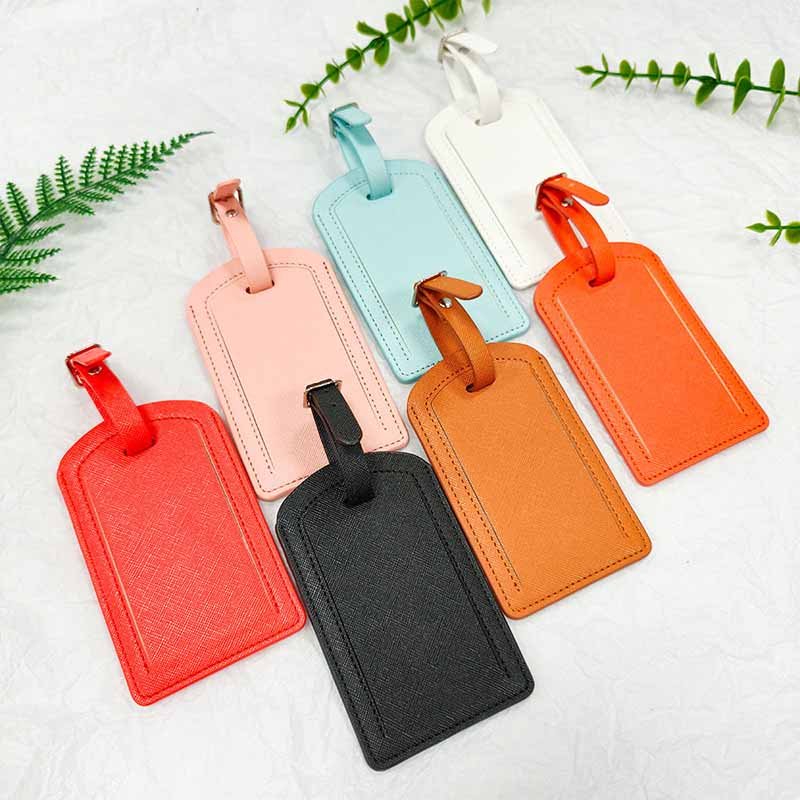
- black, brown, tan (core colors)
- navy, dark green (premium alternatives)
- seasonal colors (limited editions)
Retailers often achieve better results by offering 2–4 core styles with multiple color options, rather than too many different designs.
How Do Retail Stores Source Leather Luggage Tags?
Retail stores usually don’t just “buy” leather luggage tags — they build a supply system that ensures stable quality, predictable cost, and consistent delivery. The sourcing process is where many problems either get solved early or become expensive later.
How does leather luggage tag OEM production work?
OEM production for leather luggage tags typically follows a structured path. Retail clients who understand this process can save time, reduce mistakes, and control costs more effectively.
A standard workflow looks like this:
Initial inquiry
Client shares product idea, reference images, or sketches.
Specification confirmation
Details are defined: size, leather type, thickness, logo method, color, packaging.
Sampling stage
Factory produces 1–3 samples for approval.
Sample revision
Adjustments are made based on feedback.
Bulk order confirmation
Final sample is approved and order quantity is confirmed.
Production stage
Materials are prepared, and mass production begins.
Quality inspection
Products are checked before shipment.
Packaging and delivery
Goods are packed and shipped according to client requirements.
Most sampling cycles take 5–10 working days, while bulk production usually takes 20–35 days, depending on order size and complexity.
One common mistake retail clients make is rushing the sampling stage. A poorly confirmed sample often leads to larger issues in mass production. It is always better to spend a few extra days refining details early.
What are MOQ and lead time for luggage tags?
Minimum order quantity (MOQ) and lead time are two of the most important factors for retail planning.
Typical MOQ ranges:
| Product Type | MOQ Range |
|---|---|
| Simple design (single color) | 300–500 pcs |
| Multiple colors | 500–1000 pcs |
| Complex design (multi-part, special packaging) | 1000–3000 pcs |
Lead time depends on several factors:
- leather availability
- color matching requirements
- logo tooling preparation
- order quantity
- packaging complexity
Typical lead times:
| Stage | Time Range |
|---|---|
| Sampling | 5–10 days |
| Production | 20–35 days |
| Packaging prep | 3–7 days |
| Total cycle | 25–45 days |
Retail clients should plan orders at least 6–8 weeks ahead, especially for seasonal sales like summer travel or holiday gifting.
A factory with strong supply chain control, like SzoneierLeather, can shorten lead times by:
- maintaining stable leather suppliers
- controlling in-house sampling
- optimizing production scheduling
This becomes critical when clients need repeat orders or fast replenishment.
How to choose a leather luggage tag supplier?
Choosing the right supplier is one of the most important decisions for retail success. Many issues such as inconsistent quality, delayed delivery, or poor communication can be traced back to supplier selection.
Retail clients should evaluate suppliers based on:
- experience in leather goods production
- ability to control raw materials
- sampling speed and accuracy
- communication clarity
- quality control process
- production capacity
- packaging support
Here is a practical comparison checklist:
| Criteria | Weak Supplier | Strong Supplier |
|---|---|---|
| Material sourcing | Unstable, outsourced | Controlled supply chain |
| Sampling | Slow, inconsistent | Fast, accurate |
| Communication | Delayed, unclear | Responsive, detailed |
| Quality control | Basic inspection | Multi-stage QC system |
| Production capacity | Limited | Scalable |
| Customization | Limited | Flexible OEM/ODM |
SzoneierLeather’s advantage lies in end-to-end control — from raw material sourcing to final packaging. This allows better consistency, faster development, and more flexibility for retail clients.
What Quality Standards Apply to Luggage Tags?
Quality control is often underestimated in small leather goods, but for retail stores, it directly affects return rates, brand reputation, and long-term profitability.
What tests ensure leather luggage tag durability?
A luggage tag must survive real travel conditions, not just look good in packaging. That means testing is essential.
Common durability tests include:
- strap pull test (ensures the tag won’t detach easily)
- bending test (checks leather flexibility and resistance to cracking)
- color fastness test (ensures color doesn’t transfer or fade)
- abrasion test (checks surface resistance to wear)
- humidity exposure test (simulates travel conditions)
Below is a simplified overview:
| Test Type | Purpose | Expected Result |
|---|---|---|
| Strap strength | Prevent detachment | No break under pressure |
| Flexibility | Avoid cracking | No visible damage after bending |
| Color fastness | Maintain appearance | No fading or transfer |
| Abrasion | Surface durability | Minimal wear |
| Moisture resistance | Travel reliability | No deformation |
Retail clients should always confirm what tests are performed before production.
How is leather luggage tag quality controlled?
Quality control should not happen only at the final stage. It must be integrated throughout the production process.
A strong QC system usually includes:
Incoming material inspection
Leather is checked for defects, thickness, and color consistency.
In-line production checks
During cutting, stitching, and assembly.
Final inspection
Before packaging, ensuring all products meet standards.
Random sampling inspection
Checking batch consistency.
Factories with weak QC often rely only on final inspection, which increases the risk of defects slipping through.
Here is a typical QC structure:
| Stage | Focus |
|---|---|
| Material stage | Leather quality, color |
| Cutting stage | Shape accuracy |
| Stitching stage | Alignment, strength |
| Assembly stage | Functionality |
| Final stage | Overall appearance |
For retail clients, a good QC system can reduce return rates by 30%–50%, which directly improves profitability.
Are certifications needed for leather luggage tags?
Certifications are not always mandatory, but they are increasingly important for certain markets.
Common requirements include:
- REACH compliance (Europe market)
- CA Prop 65 (USA market)
- material safety standards
- environmental compliance for tanning processes
Retail brands working with large distributors or department stores often require these certifications as part of supplier qualification.
Even when not required, having compliant materials can:
- reduce legal risk
- improve brand trust
- support long-term partnerships
SzoneierLeather supports clients with material compliance documentation and can align production with different market requirements.
How Can Leather Luggage Tags Boost Sales?
Leather luggage tags are small products, but they can play a big role in retail performance when positioned correctly.
Why do leather luggage tags sell well in retail?
They sell well because they combine low entry price with high perceived value.
Customers often hesitate to buy expensive items, but a luggage tag offers:
- affordable price point
- practical use
- gifting potential
- brand connection
This makes it an ideal product for:
- impulse purchases
- add-on sales
- first-time customers
Retailers often use luggage tags as:
- checkout counter items
- bundle products with bags
- seasonal travel promotions
How does packaging improve luggage tag sales?
Packaging can significantly increase perceived value.
A well-packaged luggage tag can feel like a gift, even at a low price.
Common packaging options include:
- kraft paper cards
- branded boxes
- fabric pouches
- hang tags with story cards
Impact of packaging:
| Packaging Type | Effect on Sales |
|---|---|
| Basic polybag | Low perceived value |
| Branded card | Medium |
| Gift box | High |
| Premium set packaging | Very high |
Retail data shows that upgrading packaging can increase conversion rate by 15%–35%.
What trends affect leather luggage tag demand?
Current trends include:
- minimalist design
- neutral and natural colors
- personalized products (initials, names)
- eco-conscious materials
- matching travel sets
Retailers who follow these trends can improve product relevance and increase sales.
Work With SzoneierLeather for Custom Leather Luggage Tags
If you are planning to develop or upgrade your leather luggage tag product line, the most important step is choosing the right manufacturing partner.
SzoneierLeather brings over 18 years of experience in leather product development.
Whether you need a simple retail tag, a premium branded collection, or a full travel accessory line, the team can help you move from concept to finished product with clear communication and reliable execution.
If you already have designs, samples can be developed quickly. If you only have ideas, the team can help turn them into production-ready products.
Send your inquiry today to start your custom leather luggage tag project with SzoneierLeather.