
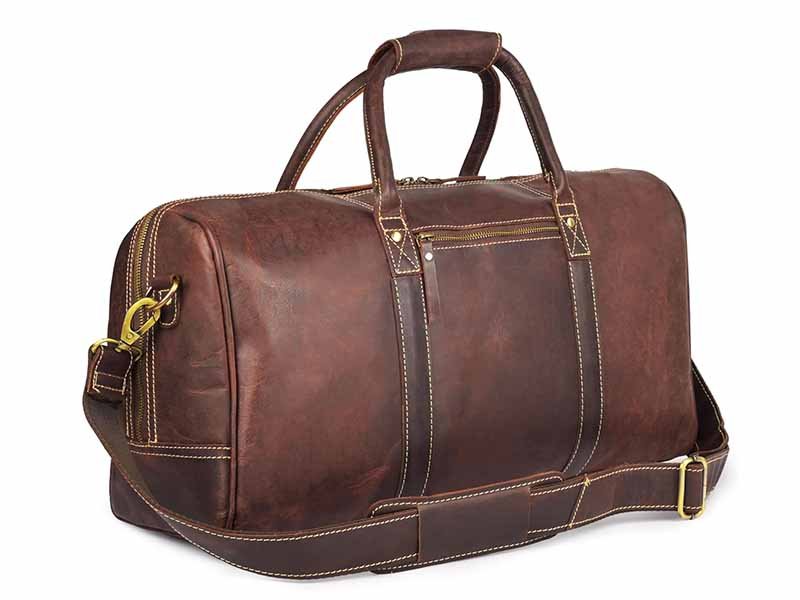
A leather duffle bag is often judged before it is used. People look at the grain, color, hardware, stitching, edge paint, and overall silhouette. Yet the more revealing moment comes after the bag has carried shoes, clothing, a laptop, a toiletry case, charging equipment, and several kilograms of personal items. A bag that looked clean and balanced on a display table may develop a bowed base, a sunken zipper line, collapsed end panels, or raised areas around the handle attachments.
Good shape retention is not created by adding one hard sheet inside the bag. It comes from a balanced relationship between leather temper, panel dimensions, gusset geometry, reinforcement placement, base support, seam construction, handle anchoring, and expected carrying weight. Each layer must perform a clear function without making the bag heavy, stiff, noisy, or difficult to pack.
A leather duffle bag retains its shape when its outer leather and hidden structural layers share the load correctly. The base spreads downward pressure, gussets control depth, reinforced openings reduce zipper waves, and handle or strap anchors transfer force into larger body areas. The best structure supports the intended silhouette while allowing enough flexibility for packing, carrying, and storage.
One sample can look impressive when filled with tissue paper, yet behave very differently with an eight-kilogram travel load. That difference is where real product engineering begins. The following sections explain how manufacturers identify the causes of deformation and build a leather duffle bag that continues to look intentional after repeated use.
Why Does a Leather Duffle Bag Lose Shape?
A leather duffle bag loses shape when the force created by its contents and carrying points exceeds the support provided by the leather, reinforcement, seams, and base. Deformation often starts at one weak area and then spreads into nearby panels. Common signs include bottom sag, zipper waves, handle-area peaks, twisted gussets, collapsed corners, and permanent fold lines.
What Makes a Leather Duffle Bag Sag?
Base sag is one of the most visible structural problems in a leather duffle bag. It develops when the weight inside the bag is concentrated in the middle while most structural support remains around the perimeter seams. The bottom then behaves like a long shelf with support at the edges but limited support across the center.
Several conditions increase the risk:
- A long base panel with no internal load-spreading layer
- Soft leather with high stretch and low bending resistance
- A bottom stiffener that is too thin for the bag size
- Reinforcement that stops too far from the lower seams
- Heavy contents placed in one small area
- Feet positioned near the corners without enough support between them
- A lining that is expected to carry weight without structural backing
The first response should not always be “use thicker leather.” A soft 1.8 mm leather may sag more than a firm 1.4 mm leather because temper and stretch behavior matter as much as thickness. Increasing leather thickness can also make the finished bag heavier, create bulky seams, and reduce flexibility around the gussets.
A more effective base often uses several coordinated layers:
| Base Layer | Main Function | Common Development Range |
|---|---|---|
| Outer leather | Appearance, abrasion resistance and hand feel | 1.3–2.0 mm |
| Flexible backing | Reduces leather stretch and surface rippling | 0.3–0.8 mm |
| Base support sheet | Spreads concentrated weight across the bottom | 0.6–1.5 mm |
| Cushioning layer | Softens hard edges and reduces visible impressions | 1.0–3.0 mm |
| Lining | Protects contents and covers internal construction | Project-specific |
These ranges are starting references rather than fixed requirements. A compact 40 cm gym bag and a 58 cm travel duffle should not use the same base package merely because both are made from leather.
The transition between the reinforced base and the softer sidewall is equally important. When a hard support sheet ends with a sharp straight edge, the leather may fold exactly along that line. Rounded corners, softened edges, skived transitions, and controlled overlap help the bag bend gradually instead of forming a permanent hinge.
Does Leather Duffle Bag Size Matter?
Size has a direct effect on shape retention because larger panels have longer unsupported spans. When the length of a leather duffle bag increases, the base has more room to bow, the zipper opening has more room to wave, and the side panels have more room to twist.
A common development mistake is to enlarge an existing small bag by increasing every pattern dimension at the same percentage. The enlarged sample may have the correct visual proportions but insufficient structural support. Reinforcement strength does not increase automatically with pattern size.
The following comparison shows why bag dimensions should guide the structural package:
| Bag Format | Approximate Length | Expected Load | Main Structural Concern |
|---|---|---|---|
| Compact gym duffle | 38–44 cm | 4–7 kg | Base control and handle balance |
| Overnight duffle | 45–50 cm | 6–9 kg | Zipper support and gusset stability |
| Travel duffle | 51–58 cm | 8–13 kg | Base sag, anchor loads and body twist |
| Large equipment duffle | 59 cm and above | 12 kg or more | Full load path and panel deflection |
The intended shape also affects the design. A long, shallow duffle may require stronger opening support because the zipper span is large. A short, deep duffle may place more outward pressure on the gussets. A tall bag with narrow base width may tip easily even when its panels remain firm.
Before pattern development, the project specification should define:
- External length, height, and depth
- Opening length and zipper position
- Target empty weight
- Expected working load
- Maximum short-term load
- Required standing ability
- Desired level of softness when empty
- Packing method during shipment
- Whether a laptop, shoe compartment, or bottle pocket is included
Without these points, two teams may interpret “structured leather duffle” very differently. One may develop a nearly rigid body, while another may create a soft weekender with only a supported base.
How Does Weight Affect a Leather Duffle Bag?
Weight does not act in one direction. Contents pull the body downward, handles pull upward, and a shoulder strap pulls diagonally from two separate anchor points. These forces meet inside the leather panels and seams.
When the bag is carried by two handles, the highest stress usually appears around:
- The upper ends of the handle tabs
- The stitch line nearest the handle opening
- The reinforcement edge behind the tab
- The upper side panel
- The seam connecting the upper body to the gusset
- The center of the base
If the internal reinforcement patch is only slightly larger than the visible handle tab, the leather around the patch may stretch. The attachment itself may remain intact, yet the panel can rise into a visible peak. Extending reinforcement farther into the body spreads the force over a wider area and reduces local deformation.
Shoulder carrying creates another set of problems. The bag hangs at an angle, which can pull the end panels inward and twist the opening. A heavy shoe compartment at one end or a laptop sleeve attached to one side can make the imbalance more noticeable.
For development, the working load should be based on real use rather than a vague product name. A weekend bag may be designed around 7–9 kg, while a larger travel duffle may need to remain stable at 10–13 kg. Test loads should be placed in distributed pouches or representative travel items. A single metal block creates pressure that does not resemble normal packing.
The project team should record more than complete failure. The following changes can appear well before a seam tears:
- Handle-tab elongation
- Base deflection
- Zipper-line curvature
- Gusset twisting
- Corner collapse
- Stitch-hole enlargement
- Leather grain distortion
- Permanent asymmetry after unloading
A leather duffle bag can remain technically unbroken while already failing visually. For premium programs, appearance after loading and recovery is just as important as maximum breaking strength.
Which Leather Duffle Bag Materials Work Best?
The best materials depend on the required silhouette, expected load, panel size, desired hand feel, and target empty weight. Leather provides the visible character, while backing materials, stiffeners, foam, lining, thread, adhesives, and base supports control how the bag behaves. Successful material selection balances firmness, recovery, weight, flexibility, and long-term durability.
Which Leather Suits a Leather Duffle Bag?
Leather type alone does not determine shape retention. Full-grain cow leather, top-grain cow leather, milled leather, vegetable-tanned leather, combination-tanned leather, and corrected-grain leather can all be suitable when their physical behavior matches the product design.
The most important properties include:
- Temper: how soft or firm the leather feels when bent
- Stretch: how much the leather elongates under load
- Recovery: how well it returns after bending or tension
- Thickness consistency: how evenly the hide performs across cut panels
- Grain break: how the surface folds when compressed
- Tear resistance: how well the leather resists propagation from stitch holes
- Finish flexibility: whether the coating can bend without whitening or cracking
- Weight per area: how much the leather contributes to finished bag weight
A relaxed weekender can use softer, fuller leather because natural folds are part of the desired appearance. A clean travel duffle with straight side panels needs firmer temper or stronger internal backing. A highly structured design may use vegetable-tanned components in selected areas, but using heavy firm leather across the entire body can increase weight quickly.
For example, a 50 cm leather duffle can require approximately 1.8–2.6 square meters of leather depending on panel layout, cutting yield, pockets, straps, piping, and defect allowance. Increasing average leather weight by only 300 grams per square meter can add more than half a kilogram to the finished product before hardware and lining are included.
Material decisions should therefore consider the final product, not just the leather swatch. A beautiful heavy leather may produce a bag that becomes uncomfortable once packed. A soft lightweight leather may feel luxurious but require extra backing, which adds cost, labor, and thickness.
Leather approval should include physical sample review under several conditions:
- Flat and unreinforced
- Backed with the proposed interlining
- Folded around intended seam allowances
- Stitched with the proposed needle and thread
- Bent repeatedly at corner radii
- Loaded through a test handle tab
- Exposed to the planned edge-finishing process
This allows the development team to see how the complete construction behaves before cutting a full sample.
What Thickness Does a Leather Duffle Bag Need?
Leather thickness should be assigned by component rather than applied as one number across the entire bag. Body panels, handles, piping, tabs, trim, and zipper facings perform different functions.
The following ranges can help during early development:
| Component | Leather Starting Range | Main Consideration |
|---|---|---|
| Main body panels | 1.3–2.0 mm | Balance between body, weight and sewability |
| Gussets | 1.2–1.8 mm | Ability to curve without hard wrinkling |
| Handle wraps | 1.2–1.8 mm before folding | Finished grip thickness |
| Handle tabs | 1.5–2.2 mm or layered construction | Load transfer and stitch security |
| Piping leather | 0.7–1.1 mm after splitting | Smooth turning around corners |
| Zipper facings | 1.0–1.6 mm | Opening stability without bulk |
| Decorative patches | 1.0–1.8 mm | Edge finish and visual definition |
The correct value depends on temper. A firm 1.4 mm leather may provide more shape than a soft 1.8 mm leather. Thickness should therefore be recorded together with a physical temper standard or approved swatch.
Skiving is also part of shape engineering. If a 1.8 mm body panel is folded into a seam without thinning, the seam can become hard and push adjacent leather outward. Excess bulk may distort curved corners and make zipper alignment difficult. Controlled skiving reduces local thickness while preserving strength in the main panel.
Areas that often need separate skiving specifications include:
- Folded zipper edges
- Piping covers
- Handle wraps
- Tab fold lines
- Corner seam intersections
- Pocket openings
- Turned top edges
Over-skiving introduces another risk. Leather that becomes too thin beside a stitch line may tear under repeated loading. Sample approval should therefore include a cross-section review of critical seams, not only an exterior appearance check.
Which Stiffener Supports a Leather Duffle Bag?
No single stiffener is suitable for every part of a leather duffle bag. Materials should be selected according to the movement and load of each area.
Flexible nonwoven backing can stabilize soft leather and reduce stretching. Microfiber reinforcement can support handle tabs and strap anchors. Fiberboard can create cleaner panel definition. PE or PP sheets can spread base loads. EVA foam can smooth the surface and prevent hard support layers from printing through the leather.
| Support Material | Best Use | Main Advantage | Main Risk |
|---|---|---|---|
| Nonwoven interlining | Large body panels | Light stabilization | Limited load support |
| Microfiber sheet | Tabs and anchor zones | Flexible tear resistance | Higher material cost |
| Fiber stiffener | Structured panels | Clean shape definition | Creasing if too rigid |
| PE sheet | Base and selected facings | Moisture resistance and flexibility | Edge visibility |
| PP sheet | Firm base structures | Strong load distribution | Can feel hard or noisy |
| EVA foam | Surface smoothing and cushioning | Soft transition | Compression over time |
| Leather board | Handles, tabs and trim | Dense leather-like feel | Moisture sensitivity by grade |
Adhesion must be tested with the selected leather finish. Some adhesive systems can bleed through light-colored leather, create hard spots, release odor, or lose strength under heat. Large-area lamination can also change the natural hand feel of the leather.
A useful reinforcement plan identifies each zone separately:
- Base zone: load distribution and sag control
- Lower sidewall: transition from base to body
- Main body: stretch control and surface smoothness
- Zipper zone: opening alignment
- Handle zone: upward load transfer
- Strap-anchor zone: diagonal load transfer
- Corner zone: folding and impact resistance
- Pocket zone: local weight and stitch visibility
The stiffest material should not automatically cover the largest area. Excessive rigidity can move stress into adjacent soft sections, creating a new failure line. A controlled transition is often more durable than a hard plate surrounded by unsupported leather.
How Does Lining Support a Leather Duffle Bag?
Lining contributes to stability, but it should not be treated as a substitute for structural reinforcement. Its main roles are to protect contents, conceal internal construction, support pockets, reduce abrasion, and help control the interior volume.
A lining that is too large creates folds in the base and corners. Those folds can trap items, interfere with zipper operation, and make the bag feel unfinished. A lining that is too small pulls against the shell, distorts the top opening, and carries weight through seams that were not designed as primary supports.
Pocket design also affects shape. A padded laptop sleeve attached to one side can make that panel significantly firmer than the opposite panel. A large internal zipper pocket can create visible stitch impressions on soft leather. A bottle pocket may pull one gusset inward when loaded.
The lining specification should therefore include:
- Fabric composition and weight
- Coating or backing
- Abrasion resistance
- Colorfastness
- Seam allowance
- Pocket load
- Pocket reinforcement
- Attachment points
- Ease allowance
- Cleaning requirements
For travel duffles, tightly woven polyester or nylon linings are often selected for abrasion resistance and lower moisture absorption. Cotton linings can provide a softer, more natural feel but may absorb moisture and add weight. Microfiber can support a premium interior, although cost and cleaning behavior need consideration.
The lining should be checked with the bag fully packed. Inspectors should confirm that it does not pull away from the shell, twist around the base, block the zipper path, or carry visible tension at pocket seams. A clean interior is not only a cosmetic detail; it is part of the overall structural performance.
How Is a Leather Duffle Bag Structured?
A leather duffle bag is structured by coordinating panel geometry, gusset depth, base support, zipper construction, seam placement, and reinforcement transitions. The structure should control sag, twisting, and opening distortion without turning the bag into a rigid case. Good construction allows the bag to remain stable when loaded, flexible while packing, and visually balanced after the contents are removed.
How Are Leather Duffle Bag Panels Shaped?
Panel geometry determines how a leather duffle bag behaves before any stiffener is added. A large uninterrupted body panel creates a clean appearance, but the wide unsupported area can bow or wrinkle under load. Dividing the body with piping, side seams, yokes, or decorative straps reduces the free span and gives the leather more controlled fold lines.
The main pattern approaches include:
- One-piece wraparound body: fewer visible seams and a smooth appearance, but greater dependence on leather consistency and base reinforcement
- Separate front, back, and bottom panels: easier control over each section, with more opportunities to use different support materials
- Front and back panels with full end gussets: strong visual definition and easier depth adjustment
- Multi-piece gusset construction: improved control around zipper ends, pockets, and curved corners
- Piped panel construction: clearer edge definition and better silhouette control
Pattern proportions should reflect the intended carrying load. A front panel measuring 50 cm wide and 28 cm high will behave differently from a 50 cm by 20 cm panel. Taller panels have more room to fold inward, while longer panels are more likely to bow across the center.
The cutting direction also affects stability. Leather stretches differently across the hide. Panels cut from the belly area may stretch more than panels cut closer to the backbone. Paired front and back panels should be selected from areas with similar temper and stretch. Uneven panel behavior can create a bag that leans or twists even when the paper patterns are identical.
Several dimensions should be controlled during development:
| Panel Item | What to Check | Why It Matters |
|---|---|---|
| Front and back width | Finished width after sewing | Controls symmetry |
| Panel height | Measured at center and sides | Reveals bowing or shrinkage |
| Gusset circumference | Match to body seam line | Prevents forced wrinkles |
| Seam allowance | Consistent around curves | Maintains final dimensions |
| Piping position | Distance from stitch line | Controls edge definition |
| Reinforcement coverage | Distance from panel edges | Prevents hard transition lines |
A paper pattern should never be approved only because the flat dimensions look correct. A full sample should be packed, carried, compressed, and emptied. Leather can change shape during turning, gluing, sewing, and edge finishing, so final geometry must be evaluated on the complete bag.
How Is a Leather Duffle Bag Base Reinforced?
The base carries the greatest continuous load in a leather duffle bag. Shoes, clothing, laptops, bottles, and travel accessories all press downward, often in uneven positions. A strong base spreads the weight over a larger area while allowing the edges to flex into the sidewalls.
A useful base construction may include:
- Outer leather for appearance and abrasion resistance
- Flexible backing to reduce stretching
- Firm support sheet to control bending
- Cushioning layer to soften hard edges
- Protective lining
- Optional removable base board for cleaning or replacement
The base support should not extend directly into the corner seam. Leaving a controlled distance from the seam allows the edge to turn without forcing the stiffener into a sharp fold. For many medium duffle bags, a gap of approximately 8–15 mm from the seam line may be evaluated during sampling. The correct distance depends on leather thickness, corner radius, piping, and seam construction.
Rounded stiffener corners reduce the risk of visible pressure points. A rectangular support sheet with sharp corners can press through the leather or damage the lining after repeated use. Edge sanding, beveling, foam wrapping, or a thin cushioning layer helps create a smoother transition.
Base feet can protect the exterior, but their placement needs engineering attention. Four feet near the corners do not automatically stop center sag. A long bag may still bow between them. Six feet, bottom rails, or a broader internal plate may provide better support, but every added component increases weight and cost.
The following starting points can guide prototype development:
| Bag Length | Working Load | Base Support Approach |
|---|---|---|
| 38–44 cm | 4–7 kg | Flexible backing with light support sheet |
| 45–50 cm | 6–9 kg | Semi-firm base layer with softened edges |
| 51–58 cm | 8–13 kg | Stronger load-spreading sheet with cushioning |
| Above 58 cm | 12 kg or more | Multi-zone base support and reinforced transitions |
A removable base board can improve standing shape, but it should fit closely enough to avoid sliding. Rounded corners, a lining sleeve, hook-and-loop retention, or a concealed pocket can hold the board in position. The base board should also be removable without damaging the lining.
How Are Leather Duffle Bag Gussets Built?
Gussets determine the depth, capacity, and side stability of a leather duffle bag. They also control how the bag opens, folds, and responds to uneven packing. A gusset that is too soft may collapse inward. A gusset that is too stiff may resist packing and create hard creases around the corners.
Common gusset forms include:
- Oval end gussets for a classic travel silhouette
- D-shaped gussets for wider bases and controlled upper curves
- Rectangular gussets for a structured, box-like form
- Multi-piece gussets for pockets, shoe compartments, or hardware integration
- Continuous side-and-bottom gussets for smoother construction and fewer corner joins
Depth should be selected with both capacity and stability in mind. Increasing depth adds volume quickly, but it also places more outward pressure on the front and back panels. A deep gusset may require stronger piping, better side reinforcement, or internal straps to prevent over-expansion.
Piping can strengthen the gusset edge and improve shape definition. The piping cord diameter should match the leather thickness and visual scale of the bag. A thin cord may disappear under heavy leather, while a large hard cord can make the seam difficult to turn and create uneven corners.
Gusset reinforcement is often more effective when zoned:
- Upper gusset: moderate support around the zipper and strap anchors
- Center gusset: flexible enough to adapt to packing volume
- Lower gusset: stronger support near the base
- Corner zones: softer transition to prevent hard folds
- Pocket zones: added backing around loaded compartments
Shoe compartments require special attention. A side shoe pocket changes the stiffness and load distribution of one end panel. When filled, the compartment can push the gusset outward and make the bag lean. The compartment floor, zipper, lining, and attachment seams should be evaluated with footwear inside, not only when empty.
During sample review, the gussets should be checked in at least four conditions:
- Empty and unsupported
- Lightly packed
- Fully packed to the working load
- Unevenly packed with more weight at one end
A well-developed gusset should maintain the intended depth without creating severe diagonal folds or pulling the zipper ends out of alignment.
How Is a Leather Duffle Bag Opening Supported?
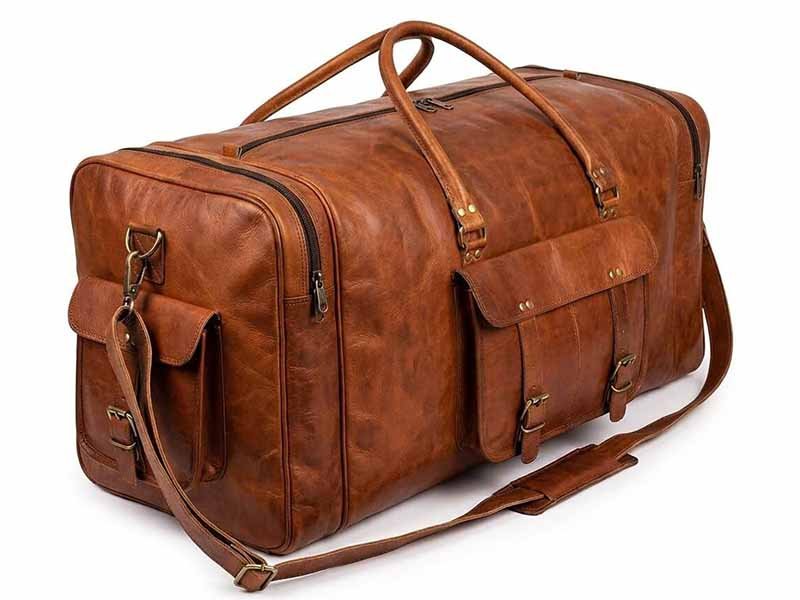
The opening is a long flexible span, and it often shows deformation before other areas. A weak opening can create zipper waves, a sunken center, raised handle areas, or difficulty closing the bag when packed.
Opening support can be created through:
- Reinforced zipper facings
- Rolled leather top edges
- Internal support strips
- Piping around the opening
- Structured end tabs
- Double-layer leather construction
- Metal or polymer frame components for highly structured designs
The zipper tape should be stabilized, but excessive stiffness can make the opening hard to fold or pack. A flexible backing bonded behind the zipper facing often provides better control than a hard narrow strip.
Zipper length and placement also matter. A long straight zipper across a soft top panel is more likely to wave than a zipper supported by curved end sections or reinforced facings. Dual sliders can improve access but add weight to the center or ends depending on where they rest.
Assembly tension is one of the most common causes of zipper distortion. If one side of the zipper is stretched during sewing, the top edge may twist. Alignment marks should be placed at the center, quarter points, and ends. Sewing operators can then match the sections progressively rather than forcing the zipper to fit at the final end.
The opening should be tested under realistic conditions:
- Empty zipper operation
- Lightly packed zipper operation
- Full-load zipper closure
- One-handed opening
- Repeated cycling
- Shoulder-carry condition
- Handle-carry condition
A zipper can function correctly while still producing an unattractive opening. Product teams should inspect straightness, symmetry, slider movement, end alignment, and leather tension together.
How Is a Leather Duffle Bag Reinforced?
A leather duffle bag is reinforced by spreading stress away from small attachment points and into larger structural areas. Handles, shoulder straps, corners, zipper ends, and loaded seams require different reinforcement strategies. The reinforcement should follow the direction of force, remain hidden, and avoid creating hard edges, bulky patches, or visible impressions on the leather surface.
How Are Leather Duffle Bag Handles Secured?
Handles carry the full weight of the leather duffle bag during lifting and walking. The visible handle tab may be small, but the hidden reinforcement should extend far enough to spread the upward force into the body panel.
Handle constructions may include:
- Short stitched tabs attached to the upper body
- Long straps extending toward the base
- Wraparound straps passing under the bag
- Rolled leather handles with reinforced internal cores
- Webbing-supported leather handles
- Handles captured inside a structural seam
Longer attachment areas usually distribute load more effectively. A small tab can hold securely at the stitch line while still pulling the surrounding leather upward. The result is a visible peak or stretched area above the tab.
Internal reinforcement should exceed the visible tab dimensions. For example, a visible tab measuring 40 mm by 70 mm may require an internal support patch extending 15–30 mm beyond the stitch area, depending on leather strength and target load. High-load travel bags may need a larger bridge-shaped reinforcement connecting several layers.
Handle reinforcement materials may include:
- Microfiber sheet for flexible tear resistance
- Leather board for dense support
- Nylon or polyester webbing for hidden tensile strength
- Split leather for natural material continuity
- Thermoplastic support for controlled stiffness
- Multi-layer combinations for heavy loads
Stitching should be designed around the leather’s tear behavior. More stitches do not always increase strength. A very short stitch length can create a perforation line. A longer stitch may reduce hole concentration but provide less control. Sample testing should confirm the best balance.
The handle system should be evaluated for:
- Vertical pull
- Repeated lifting
- Walking movement
- Sudden load shock
- Hand comfort
- Handle symmetry
- Tab elongation
- Stitch-hole growth
- Surface distortion
A bag can pass a pull test and still look poor after repeated use. Shape around the attachment area should therefore be included in the approval standard.
How Are Leather Duffle Bag Corners Protected?
Corners experience abrasion, impact, folding, and multi-directional stress. They also contain several overlapping layers, making them vulnerable to excessive bulk and uneven stitching.
A clean corner begins with a suitable radius. Small radii create a sharper visual form but are harder to sew and turn. Heavy leather may wrinkle or bunch around a tight curve. Increasing the radius by only a few millimeters can improve sewing consistency and reduce stress without changing the overall appearance noticeably.
Corner protection can come from:
- Reinforced piping
- External leather patches
- Internal flexible backing
- Bottom corner caps
- Metal protectors
- Cushioning between stiffener and leather
- Wider seam allowances at high-stress areas
External corner patches should cover the actual abrasion zone. A decorative patch placed too high may add visual detail without protecting the bottom edge. The lower edge, side transition, and contact point should be considered together.
Internal stiffeners should not terminate directly at the corner fold. A hard ending can create a diagonal crease. Tapered reinforcement, rounded corners, and flexible transition layers reduce concentrated bending.
Corner bulk should be measured during sample cutting. If body leather, gusset leather, piping, reinforcement, and lining all meet at one point, the combined thickness may exceed the machine’s ability to feed the layers evenly. Skiving plans should define which layers are reduced and by how much.
Corner inspection should include:
- Symmetry between left and right sides
- Smooth piping
- No exposed seam allowance
- No sharp stiffener impression
- No lining tension
- No edge-paint cracking
- No permanent fold after compression
How Are Leather Duffle Bag Straps Anchored?
Shoulder straps create diagonal force through the leather duffle bag. When the bag is carried on one shoulder, the two anchors are pulled toward each other and upward. The body may twist, the end panels may bow inward, and the zipper line may curve.
A strong shoulder anchor should connect to a broad internal support area. The D-ring tab may be:
- Surface stitched onto the gusset
- Captured inside a side seam
- Integrated into a reinforced top band
- Extended downward as a longer leather strap
- Supported internally by webbing
- Connected to a hidden bridge reinforcement
Tabs captured in seams often transfer load more effectively than small surface-mounted tabs, but the seam must be designed to carry the force. Surface-mounted tabs can work well when the internal patch is large enough and the stitch layout is appropriate.
Hardware size affects both strength and deformation. A large D-ring may look premium but can add significant weight and repeatedly strike the leather. A narrow ring can pinch the strap and create uneven wear. The ring opening should match the strap hook and allow smooth rotation.
Anchor angle should follow the direction of pull. A tab positioned vertically may be forced sideways when the bag hangs diagonally. Angled tabs or rotating D-rings can reduce twisting.
The strap system should be tested with several strap lengths because the hanging angle changes. Evaluations should include:
- Bag carried close to the body
- Bag carried at hip level
- Crossbody carrying where suitable
- Full working load
- Uneven internal load
- Repeated attachment and removal of hooks
The product team should observe whether the bag remains balanced, whether the anchors twist, and whether the leather stretches around the tabs.
Which Seams Strengthen a Leather Duffle Bag?
Seams connect the structural parts of a leather duffle bag. Their performance depends on leather strength, seam type, thread, needle, stitch length, seam allowance, reinforcement, and operator control.
Common seam constructions include:
| Seam Type | Suitable Area | Main Benefit | Main Concern |
|---|---|---|---|
| Turned seam | Body and gusset joins | Clean exterior | Internal bulk |
| Piped seam | Panel edges and gussets | Strong visual definition | Difficult corner turning |
| Lapped seam | Decorative or structural panels | Flat appearance | Visible stitch accuracy |
| Bound seam | Interior construction | Protected raw edges | Added internal thickness |
| Folded seam | Openings and facings | Clean finished edge | Requires controlled skiving |
Thread should be selected for strength, abrasion resistance, appearance, and compatibility with the leather. Bonded nylon and bonded polyester are common options, but the final choice depends on product use, exposure, and finish.
Needle size should match the thread and leather. An oversized needle creates large holes that may reduce tear resistance and look rough. A needle that is too small may cause skipped stitches, thread damage, or inconsistent tension.
Stitch length should be tested on the actual leather. A dense stitch line can weaken thin or firm leather by creating a row of perforations. A sparse stitch line may look coarse and provide insufficient control around curves.
High-stress seams need additional support where required:
- Base-to-gusset seams may use reinforced seam allowances
- Zipper ends may use extra backing
- Handle tabs may include multiple stitch rows
- Shoulder anchors may be captured in structural seams
- Pocket openings may use hidden reinforcement
- Lining joins may require binding or taped edges
Seam testing should identify how the assembly fails. Different failure modes require different corrections:
- Thread breaks: review thread size, tension, abrasion, and stitch layout
- Leather tears: review edge distance, stitch density, reinforcement, and leather quality
- Seam slips: review seam allowance and panel stability
- Reinforcement separates: review adhesive and lamination process
- Panel distorts: review load path and support area
- Stitch holes enlarge: review needle size, leather temper, and repeated loading
A strong seam is not only a seam that does not break. It should hold the panels in the intended position without producing puckering, stretched holes, uneven piping, or visible deformation.
How Is a Leather Duffle Bag Tested?
A leather duffle bag should be evaluated as a complete carrying system rather than as a collection of separate materials. Leather strength, handle construction, zipper performance, base support, lining fit, hardware attachment, and panel recovery influence one another. Testing should reproduce the way the bag will be packed, lifted, carried, compressed, stored, and emptied in actual use.
How Is Leather Duffle Bag Sag Tested?
Sag testing measures how far the base and body panels deform under a defined load. The test should reflect the intended use of the leather duffle bag. A compact gym bag, an overnight bag, and a large travel duffle carry different items and should not be assessed with the same loading method.
A useful test begins by recording the empty bag:
- Overall length, height, and depth
- Base length and width
- Distance from the base center to a flat surface
- Zipper-line straightness
- Handle-tab alignment
- Front and back panel symmetry
- Gusset angle
- Standing stability
The bag is then packed with a distributed load. Filled fabric pouches, clothing bundles, wrapped weights, or representative travel items are better than one heavy metal block because they distribute pressure more naturally.
A development load can be selected according to the product category:
| Leather Duffle Bag Type | Working Load | Higher Test Load |
|---|---|---|
| Compact gym bag | 4–7 kg | 7–9 kg |
| Overnight bag | 6–9 kg | 9–11 kg |
| Medium travel duffle | 8–12 kg | 12–15 kg |
| Large travel duffle | 10–15 kg | 15–18 kg |
| Equipment duffle | Project-specific | Project-specific |
The working load represents expected daily use. The higher test load helps reveal weaknesses before production approval. It should not be presented as the recommended carrying capacity unless the product has been fully validated for that claim.
The loaded bag should be checked in several positions:
- Resting on a flat table
- Suspended by both handles
- Carried by the shoulder strap
- Supported at one end
- Placed on an uneven surface
- Packed with more weight on one side
Base deflection can be measured at the center and compared with the empty condition. The acceptable amount depends on the desired silhouette. A relaxed weekender can tolerate more movement than a structured executive travel bag.
The inspection should also record visual changes:
- Does the bottom form a smooth curve or a sharp fold?
- Do the lower side panels bulge outward?
- Does the zipper line sink in the middle?
- Do the handle tabs pull the upper panel into peaks?
- Does one gusset collapse before the other?
- Does the bag still stand without rolling?
- Are the feet or bottom rails positioned evenly?
A bag may remain functional while already looking poorly engineered. Sag testing should therefore include visual appearance, dimensional change, and recovery after unloading.
How Is Leather Duffle Bag Recovery Checked?
Recovery testing measures how well a leather duffle bag returns to its approved shape after loading, compression, folding, or storage. Some constructions appear stable while packed but retain deep creases after the contents are removed. The recovery period reveals whether the leather and support materials are working together or fighting against one another.
A practical recovery procedure may include the following stages:
- Measure and photograph the empty bag.
- Load the bag to the agreed working weight.
- Keep the load inside for 4, 8, or 24 hours.
- Suspend the bag by the handles for part of the test.
- Remove the contents.
- Measure the bag immediately after unloading.
- Measure again after 30 minutes.
- Measure again after 24 hours.
- Compare the final shape with the approved sample.
Important areas include:
- Center base curvature
- Side-panel wrinkles
- Gusset folds
- Corner collapse
- Zipper-line straightness
- Handle-tab stretching
- Shoulder-anchor distortion
- Leather grain changes
A crease is more serious when it follows the exact edge of a hidden stiffener. Such a mark often indicates that the support layer is too rigid, too small, or cut with an abrupt edge. The solution may involve rounding the stiffener, reducing its thickness, adding cushioning, or extending support farther into the surrounding panel.
Compression testing is also important because finished bags are stacked, boxed, shipped, and stored. A leather duffle bag may spend several weeks inside export packaging before reaching a warehouse or retail location.
The packing test should reproduce the planned shipment method:
- Flat-packed
- Lightly stuffed
- Fully shaped with paper
- Folded at selected points
- Packed inside a dust bag
- Packed in an individual carton
- Packed with several bags in one master carton
Fold lines should never pass through firm base sheets, rigid reinforcement patches, thick handle tabs, or structured zipper facings. If folding is necessary, the development team should define safe folding zones during sampling.
Temperature also influences recovery. Heat can soften adhesives, foam, and thermoplastic sheets. Cold conditions can temporarily increase stiffness. For international programs, packed samples may be checked after exposure to warm and cool storage conditions to identify changes in bonding, odor, shape, and finish.
A leather duffle bag does not need to return to a perfectly rigid geometric form. The recovery standard should match the intended style. Soft leather can retain natural folds while still recovering its main silhouette. The key question is whether the bag looks deliberately relaxed or accidentally collapsed.
How Is Leather Duffle Bag Balance Tested?
Balance testing evaluates how a leather duffle bag sits, hangs, and moves under different packing conditions. A well-balanced bag should not tip excessively, rotate toward one side, pull away from the body, or force the user to constantly adjust the handles.
Balance begins with the base. The width should provide enough support for the height and expected load. A tall, narrow bag may look elegant but become unstable when placed on the floor. A very wide base may improve stability but make the bag uncomfortable to carry against the body.
Handle placement also affects balance. The relationship between handle spacing, bag width, center of gravity, and opening structure should be checked carefully.
Handles positioned too close together may:
- Pull the top panels inward
- Make the zipper difficult to access
- Concentrate pressure on the hand
- Cause the bag to swing
- Raise the center section of the opening
Handles positioned too far apart may:
- Pull the body outward
- Reduce carrying comfort
- Distort the upper side panels
- Interfere with the shoulder strap
- Make the handles difficult to hold together
A shoulder strap changes the carrying angle. The bag should be tested with the strap at short, medium, and long settings. At each setting, the team should observe:
- Whether the bag hangs level
- Whether the top rotates toward the body
- Whether the anchors twist
- Whether the gussets pull inward
- Whether hardware presses against the leather
- Whether the shoulder pad remains in position
- Whether the bag swings excessively while walking
Uneven packing is essential during balance testing. Real users do not distribute every item evenly. A laptop may sit against one side, shoes may be placed at one end, and toiletries may be concentrated in one pocket.
A useful uneven-load test may include:
| Packing Condition | Purpose |
|---|---|
| Equal weight at both ends | Establish normal balance |
| Heavy item at one end | Check end-panel twisting |
| Laptop against one side | Check side-to-side lean |
| Full shoe compartment | Check gusset expansion |
| Empty main body with loaded pocket | Check local distortion |
| Shoulder carry with uneven load | Check anchor alignment |
The sample should be carried while walking, turning, climbing stairs, and setting it down. These simple movements often reveal problems that remain hidden during a static pull test.
Balance should also be checked after repeated use. Handle tabs can stretch, base supports can shift, and internal pockets can pull the lining out of position. The product should remain usable and visually balanced after the planned carry-cycle test.
What Should Leather Duffle Bag Brands Inspect?
Inspection should cover materials, dimensions, construction, appearance, function, and structural performance. A leather duffle bag can pass a basic visual check while containing incorrect reinforcement, uneven skiving, misaligned handle patches, or a poorly fitted base board.
A clear inspection standard should be created from the approved sample. The document should contain measurements, photos, material references, construction notes, and acceptable visual limits.
The incoming leather inspection should verify:
- Leather article and color
- Thickness range
- Temper
- Grain appearance
- Surface defects
- Stretch behavior
- Finish adhesion
- Color consistency
- Color rub where required
- Usable cutting area
Leather shade alone is not enough. A new production lot may match the approved color while feeling significantly softer. That difference can change the finished structure even when every other material remains the same.
Cutting inspection should confirm:
- Correct panel direction
- Balanced grain appearance
- Paired panel consistency
- Avoidance of weak belly areas in load-bearing parts
- Correct skiving zones
- Accurate notch positions
- Proper reinforcement dimensions
- Clean edges without deep cuts
Assembly inspection should focus on:
- Panel alignment
- Gusset symmetry
- Piping consistency
- Zipper straightness
- Handle spacing
- Strap-anchor angle
- Stitch tension
- Stitch length
- Seam allowance
- Edge-paint coverage
- Lining fit
- Pocket position
The hidden construction should also be checked during production. Once the lining is closed, many important areas can no longer be seen. Inline inspection should verify:
- Handle reinforcement size
- Shoulder-anchor reinforcement
- Base sheet position
- Stiffener edge treatment
- Adhesive coverage
- Webbing alignment
- Seam capture
- Corner cushioning
- Hardware backing
A structured production control plan can separate inspections by stage:
| Production Stage | Main Inspection Points |
|---|---|
| Incoming materials | Leather, lining, stiffeners, hardware and zippers |
| Cutting | Panel direction, dimensions, defects and skiving |
| Preparation | Reinforcement placement, edge preparation and bonding |
| Sewing | Alignment, stitch quality, piping and seam strength |
| Assembly | Base position, handle balance and gusset symmetry |
| Finishing | Edge paint, cleaning, hardware protection and shape |
| Packing | Stuffing, folding points, dust bag and carton fit |
| Final inspection | Appearance, dimensions, function and loaded checks |
Final inspection should include more than an empty visual review. Selected finished units can be loaded to the agreed working weight and checked for:
- Base sag
- Handle alignment
- Zipper operation
- Standing stability
- Shoulder balance
- Panel distortion
- Hardware movement
- Recovery after unloading
The approved sample should be stored correctly. Leather changes with heat, humidity, pressure, and age. A crushed or dried reference sample can lead to inconsistent inspection decisions. Clear photos and written measurements provide additional control.
How Can SzoneierLeather Develop Your Leather Duffle Bag?
SzoneierLeather develops custom leather duffle bags from product concept through material selection, sample engineering, production, packaging, and final quality control. More than 18 years of leather-product experience allows our team to evaluate not only how a design should look, but also how it should perform when packed, carried, compressed, and used repeatedly.
Our development scope includes:
- Leather sourcing and leather article development
- Material color and texture selection
- Pattern engineering
- Structural reinforcement planning
- Base-support development
- Gusset and opening construction
- Handle and shoulder-anchor engineering
- Hardware sourcing
- Logo development
- Lining and pocket development
- Sample manufacturing
- Packaging design
- Production quality control
- Final inspection coordination
A useful development brief does not need to be perfect, but it should provide enough information to establish the intended product direction.
The most helpful project information includes:
| Project Detail | Why It Matters |
|---|---|
| Target dimensions | Determines panel span, capacity and reinforcement |
| Intended use | Defines structure, pockets and carrying method |
| Working load | Guides base, handles, seams and hardware |
| Preferred leather | Establishes appearance, weight and flexibility |
| Desired structure | Clarifies soft, semi-structured or firm shape |
| Target order quantity | Influences material and process planning |
| Target price range | Helps balance leather, hardware and construction |
| Logo method | Affects panel preparation and positioning |
| Packaging method | Influences recovery and shipment protection |
| Target market | Guides function, labeling and product expectations |
| Delivery schedule | Affects sampling and production planning |
Reference photos are helpful, but they should be supported by comments. A photograph cannot explain whether the bag should stand independently, carry 12 kilograms, use a removable base, fit under an airline seat, or remain foldable for lower shipping volume.
During sample development, SzoneierLeather can review the following decisions with the client:
- Whether the body should remain upright when empty
- How much natural slouch is acceptable
- Whether the base should be removable
- How firmly the gussets should hold their form
- Whether the zipper opening needs additional support
- How the handles should transfer the load
- Whether the shoulder strap should be removable
- How the bag should recover after packing
- How it should be protected during shipment
Material options can be compared through swatches, small construction trials, and complete samples. For shape-sensitive projects, a handle-tab trial, base trial, or reinforced panel test can reduce development risk before the full sample is completed.
The approved sample should establish more than appearance. It should confirm:
- Finished dimensions
- Leather article and thickness
- Reinforcement materials
- Base construction
- Handle construction
- Gusset depth
- Zipper type and length
- Hardware finish
- Lining material
- Pocket arrangement
- Stitching requirements
- Logo position
- Packaging method
- Working-load expectations
Changes after sample approval should be documented because even a small adjustment can affect structure. Increasing the bag length, changing to softer leather, replacing metal hardware, or adding a shoe compartment can alter weight distribution and shape retention.
Request a Leather Duffle Bag Quotation
A successful leather duffle bag is more than a leather shell with handles. Its structure should match the intended use, carrying weight, visual style, and price position. Good engineering helps the bag retain a clean silhouette without making it unnecessarily heavy or rigid.
SzoneierLeather supports established labels, product developers, wholesalers, and growing custom programs with leather sourcing, product engineering, sampling, manufacturing, packaging, and quality control.
Our team can review the construction, identify possible shape-retention risks, recommend materials, and prepare a sampling and quotation plan for your custom leather duffle bag.
Contact SzoneierLeather to discuss your leather duffle bag design, material options, sample development, production requirements, and quotation.