
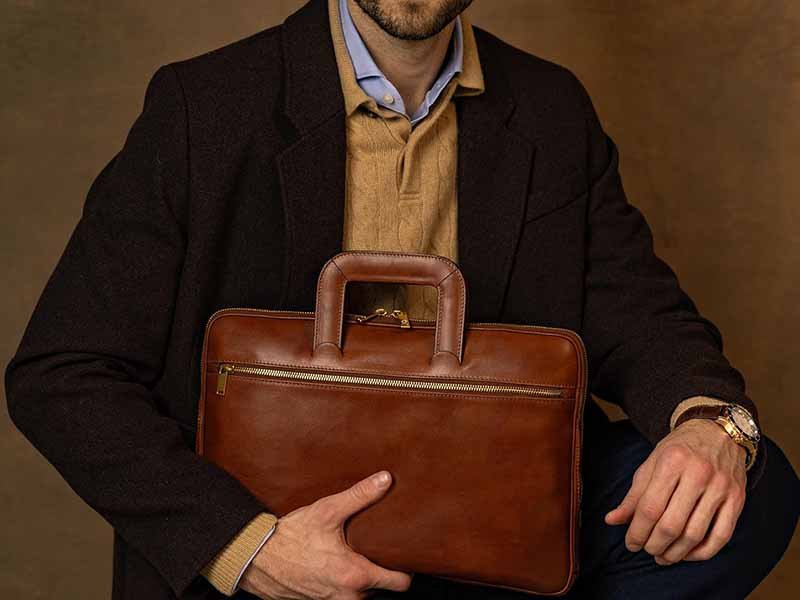
A leather briefcase is supposed to feel “premium,” but many commuters associate it with one thing: shoulder pain. The funny part is that the pain doesn’t always come from carrying a heavy load. Plenty of people carry 3–5 kg every day without a problem—until the bag’s strap digs into one spot, the case swings on the hip, or the laptop compartment pulls the weight away from the body. That’s when a short walk turns into a stiff neck, tight traps, and an angry shoulder by lunchtime. For brands, this shows up as a familiar review pattern: “looks great, not comfortable,” “strap hurts,” “bag feels heavier than it is,” “slides off my shoulder,” “pulls me to one side.”
A comfortable leather briefcase is engineered to keep mass close to the body, spread pressure over a wider contact area, and prevent the load from shifting as you walk. The biggest comfort gains usually come from strap width and padding, correct attachment points, and internal layout that centers heavy items (especially laptops) instead of letting them sag toward the outer wall. When those details are done right, the same 4–6 kg load can feel noticeably lighter.
One product manager once said their best-selling briefcase wasn’t the most stylish—it was the one commuters forgot they were wearing. That’s the goal here: a bag that looks sharp and feels effortless. Let’s start by defining what “load distribution” really means in a briefcase.
What is load distribution in a briefcase?
Load distribution means how the briefcase’s weight is positioned and transferred to the body through the handle or strap. A well-balanced briefcase keeps the center of mass close to the torso and reduces pressure peaks on the shoulder by spreading contact area. Good load distribution also stops the bag from swinging or rotating, which is a major cause of muscle fatigue during commuting.
How does load distribution affect comfort?
Comfort depends on two things people feel immediately:
- Pressure (how hard the strap presses into the shoulder)
- Torque (how much the bag pulls you sideways or away from your body)
A briefcase can weigh the same but feel worse if it creates higher pressure or higher torque.
Pressure is basically weight ÷ contact area. If the strap is narrow, the contact area is small, so pressure rises and you feel a “hot spot.”
How strap width changes pressure
Assume a 5 kg load (about 49 N force). The numbers below are simplified, but they match what users feel.
| Strap Width | Approx. Contact Area on Shoulder | Relative Pressure Feel |
|---|---|---|
| 20 mm | Small | High (digging) |
| 30 mm | Medium | Medium |
| 40–50 mm | Larger | Low (more spread) |
Torque happens when weight sits far from the body. The farther the load is from your torso, the more your shoulder and back muscles work to stabilize it.
| Load | Distance from Body | How it feels |
|---|---|---|
| 4 kg | close (bag hugs torso) | manageable |
| 4 kg | far (bag hangs away) | feels heavier |
| 6 kg | close | heavy but stable |
| 6 kg | far | tiring fast |
So comfort engineering is mostly about bringing weight closer and spreading pressure.
What forces act on the shoulder and back?
Three real forces show up in daily carry:
- Downward force
- The weight compresses the shoulder where the strap contacts.
- This is where strap width, padding, and surface grip matter.
- Side pull (torque)
- If the bag hangs away from the body, it pulls your shoulder outward.
- This creates muscle tension in the neck and upper back.
- Swing and rotation
- When walking, the bag wants to swing and twist.
- Swing makes the load “dynamic,” meaning it feels heavier than the scale says.
Common user complaints and the force behind them
| Complaint | Most likely cause |
|---|---|
| “Strap hurts my shoulder” | High pressure (narrow strap / hard edge) |
| “Bag feels heavier than it is” | Bag hangs away + swings |
| “Slides off my shoulder” | Low friction strap surface + wrong angle |
| “Pulls me to one side” | Unbalanced internal layout / strap anchor points |
A great briefcase doesn’t eliminate weight—it reduces the bad forces that make weight feel brutal.
Why do poorly balanced bags cause pain?
Shoulder pain usually comes from repeat stress, not a single heavy day. The design mistakes that trigger repeat stress are predictable:
- Laptop placed away from the body (weight sits on the outer wall)
- Soft base that sags (mass drops lower and increases swing)
- Strap anchored too high or too wide (creates twist and instability)
- Narrow strap with little padding (pressure peaks)
Over time, the body compensates: you hike one shoulder up, lean slightly, or tighten your neck muscles. That’s when “annoying” turns into “pain.”
| Design Issue | Body area affected first |
|---|---|
| Narrow strap | top of shoulder (pressure point) |
| Bag hangs away | neck/traps (muscle tension) |
| Swinging load | lower shoulder + back fatigue |
| Bad handle position | wrist/forearm strain (hand carry) |
Which briefcase designs balance weight best?
The best weight-balanced briefcases control three things:
- Where the heavy items sit
- How the bag holds shape (no sag)
- How the bag connects to the strap/handle
A good-looking layout is not always a good load layout. For comfort, the internal geometry matters.
Which internal layouts centralize heavy items?
The most important rule: the heaviest item should sit closest to the body. In most briefcases, that item is the laptop.
Best practice layout:
- Laptop sleeve on the body-side panel
- Charger and power bank in center pockets, not outer pockets
- Water bottle (if included) placed low and near center, not far outside
| Layout choice | Result |
|---|---|
| Laptop near body | less torque, more stable |
| Laptop near outer wall | pulls away, feels heavier |
| Heavy pockets on outer face | increases swing |
| Center-weighted organization | smoother walking feel |
Even small changes can matter. Moving a 1.5–2.0 kg laptop 3–5 cm closer to the body noticeably reduces torque.
How do compartments reduce shift and sag?
Compartments do two jobs:
- Stop items from sliding
- Hold the bag’s structure so it doesn’t collapse
When a bag collapses, the center of mass shifts lower and outward. That increases swing and shoulder fatigue.
Good compartment design features:
- A semi-rigid laptop panel
- A reinforced base (so the bag doesn’t “banana fold”)
- Dividers that keep chargers from migrating to corners
What happens when the bag sags
| Problem | What the user feels |
|---|---|
| base sagging | bag bumps hip, swings more |
| items sliding | load changes while walking |
| soft side walls | bag pulls outward, more torque |
Does a wider base improve stability?
Yes—within reason. A wider base does two things:
- It lowers the chance of “collapse” under load
- It keeps weight centered instead of drooping into a narrow bottom
But extremely wide bases can make the briefcase feel bulky. The right design choice depends on laptop size and daily carry style.
| Use case | Base depth target |
|---|---|
| slim office carry (13–14″) | 7–10 cm |
| commuter carry (15–16″) | 9–12 cm |
| travel + extra gear | 11–14 cm |
For comfort, it’s better to have a stable base at 9–12 cm than a “slim-looking” base that collapses.
How should straps be engineered for comfort?
If there’s one place brands should not cut corners, it’s the strap. The strap is the interface between product and body. A premium briefcase with a painful strap won’t be used—no matter how beautiful the leather is.
What strap width reduces pressure points?
A wider strap spreads the force. But “wider” isn’t always better if the strap becomes stiff and doesn’t curve over the shoulder.
A strong comfort range for briefcases is often 35–45 mm, depending on load.
Strap width by load class
| Daily load | Suggested strap width |
|---|---|
| 2–3 kg (light) | 30–35 mm |
| 3–5 kg (normal) | 35–45 mm |
| 5–7 kg (heavy) | 45–55 mm |
Also, the strap edge matters. A sharp edge can feel like a wire. A rounded/burnished edge is a small detail that improves comfort.
Which padding materials stay comfortable over time?
Padding often feels great on day one and terrible after six months if it compresses permanently.
Common padding choices:
- EVA foam: light, stable, good for everyday
- PU foam: soft, can compress faster
- Gel layer: very comfortable, heavier, may shift if not built well
- Multi-layer (EVA + soft top layer): best balance
Padding options
| Padding type | Comfort | Long-term shape | Weight impact |
|---|---|---|---|
| PU foam | high | medium-low | low |
| EVA foam | good | high | low |
| gel | very high | medium | medium-high |
| layered | high | high | medium |
For commuter briefcases, EVA or layered systems are usually the safest long-term choice.
How do attachment angles affect load path?
Strap anchors decide whether the bag hangs:
- close to the body (stable)
- away from the body (torque and swing)
- twisted (strap digging and slipping)
Smart strap engineering uses:
- anchor points positioned to keep the bag’s face parallel to the torso
- swivel clips to reduce twisting
- balanced left/right anchor spacing
| Anchor design | What happens |
|---|---|
| anchors too far apart | bag tilts, twists |
| anchors too high | bag swings |
| anchors aligned + swivels | stable carry |
What materials improve structural support without adding excess weight?
A comfortable briefcase is not simply made from thicker leather. True comfort comes from smart structure per gram of weight.
Many heavy briefcases feel uncomfortable not because of what users carry, but because the bag itself adds unnecessary mass. On the other hand, very soft and thin constructions may reduce weight but allow sagging, torque, and shifting, which increases shoulder fatigue.
The real engineering goal is:
- high stiffness where structure is needed
- low weight where flexibility is acceptable
- balanced mass close to the body
This is why modern leather briefcase design combines selected leather thickness + lightweight internal reinforcements, instead of relying on thick leather alone.
Which leather thickness balances strength and comfort?
Leather thickness strongly affects:
- total bag weight
- flexibility around the body
- resistance to stretching and deformation
- long-term durability under load
Too thin → the bag collapses and shifts weight. Too thick → the bag becomes heavy before anything is placed inside.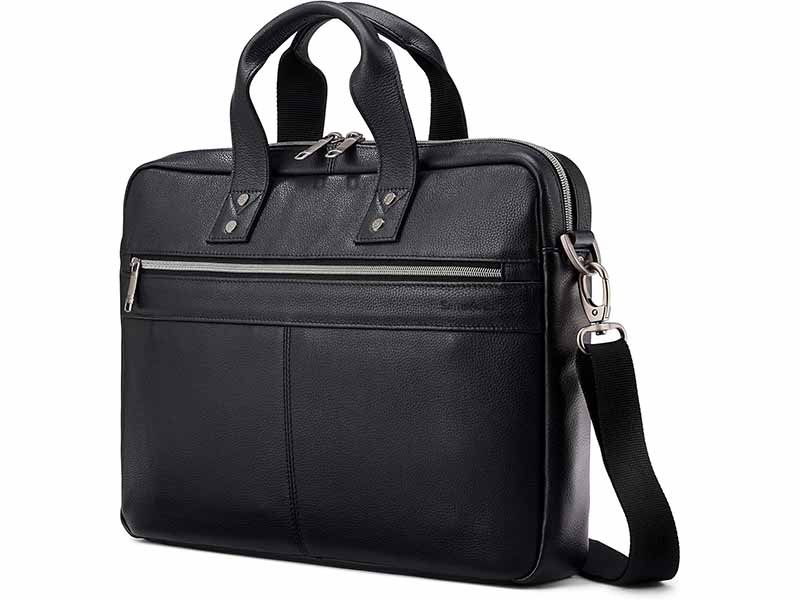
Practical leather thickness by briefcase type
| Briefcase Type | Recommended Thickness | Comfort Result |
|---|---|---|
| Slim office carry | 1.4–1.8 mm | Light and flexible |
| Standard commuter | 1.6–2.0 mm | Balanced strength and weight |
| Heavy laptop / travel | 1.8–2.4 mm | Strong but still manageable |
| Premium structured | 2.0–2.6 mm | Maximum shape stability |
Most daily-use briefcases perform best around 1.6–2.0 mm, where durability and comfort remain balanced.
How do internal reinforcements stabilize shape without heaviness?
Instead of thicker leather, structural stability usually comes from hidden reinforcement layers placed only where needed:
- base panels to prevent sagging
- side walls to keep geometry upright
- laptop sleeve frames to hold weight near the body
Lightweight materials commonly used:
- EVA sheets for stiffness with low mass
- fiberboard or PP panels for base stability
- non-woven reinforcement for panel control
| Material | Structural Strength | Weight Impact | Best Location |
|---|---|---|---|
| EVA sheet | High | Low | base, walls |
| PP board | Medium-high | Low | base plate |
| Fiberboard | High | Medium | premium rigid base |
| Extra leather layer | Medium | High | decorative areas only |
Well-placed reinforcements can reduce perceived load without increasing total bag weight, which is critical for commuter comfort.
Are lightweight composite structures better than thick leather alone?
Yes, in most commuter scenarios.
A multi-layer composite (moderate leather + reinforcement + lining) often performs better than single thick leather because it:
- keeps the bag upright
- prevents torque from sagging
- lowers total mass
- maintains shape after years of use
From an engineering standpoint, structure-to-weight ratio matters more than raw material thickness.
Thick leather vs composite structure
| Construction Method | Weight | Shape Stability | Carry Comfort |
|---|---|---|---|
| Thick single leather | High | Medium | Medium-low |
| Moderate leather + reinforcement | Medium | High | High |
| Lightweight composite | Low-medium | High | Very high |
This is why many modern premium briefcases feel lighter even when fully loaded.
How does handle placement influence balance and fatigue?
Even when using a shoulder strap, users frequently hand-carry their briefcase—especially in offices, elevators, or short walks. Handle engineering therefore plays a direct role in:
- wrist comfort
- arm fatigue
- perceived bag balance
A poorly positioned handle makes the bag tilt forward or backward, forcing the wrist to compensate.
Where should the handle sit for natural balance?
The ideal handle position aligns with the center of gravity when the bag is fully loaded, not when empty.
If the handle is too far forward:
- the bag tilts outward
- wrist strain increases
If too far back:
- the bag presses into the leg
- walking comfort decreases
| Handle Position | Carry Feeling | Long-Term Impact |
|---|---|---|
| Forward-shifted | outward tilt | wrist fatigue |
| Rear-shifted | leg contact | awkward walking |
| Centered on load | neutral balance | comfortable carry |
Designers often test this using real laptop weight inside, not empty samples.
Does handle padding or shape affect comfort?
Yes—especially during short but frequent carries.
Comfort depends on:
- handle diameter (too thin cuts into fingers)
- edge softness (sharp edges create pressure points)
- padding resilience (should not flatten quickly)
| Feature | Recommended Range | Reason |
|---|---|---|
| Handle diameter | 10–16 mm | fills hand without strain |
| Padding thickness | 3–6 mm | cushions pressure |
| Edge finish | rounded/burnished | prevents finger pain |
These small details strongly influence daily usability perception.
Should shoulder strap and handle balance be coordinated?
Yes. If the shoulder strap anchor points and handle center are not aligned with the same mass center, the bag will feel balanced in one carry mode but unstable in another.
High-quality briefcase engineering ensures:
- consistent center of gravity
- smooth transition between shoulder and hand carry
- no sudden rotation when switching modes
This coordination is often invisible—but immediately noticeable to users.
How can brands test comfort before mass production?
Comfort cannot be judged only by visual inspection. Reliable briefcase development includes real load simulation and user testing before production begins.
Testing early prevents:
- painful strap geometry
- incorrect balance
- structural sagging after use
Even small prototype tests can save large return costs later.
What load tests simulate real commuting conditions?
Effective pre-production testing usually includes:
- static load test (3–7 kg for 24–48 hours)
- walking simulation to observe swing and rotation
- strap fatigue test for repeated stress cycles
| Carry Scenario | Typical Load |
|---|---|
| Light office carry | 2–3 kg |
| Standard laptop commute | 3–5 kg |
| Business travel carry | 5–7 kg |
Design should remain comfortable within the 3–5 kg daily range, since this represents the largest user group.
How do you evaluate pressure and strap slip?
Two simple prototype checks reveal major comfort problems:
- Pressure check
- wear the bag for 20–30 minutes
- inspect shoulder redness or soreness
- Slip check
- walk normally on smooth clothing
- observe whether strap slides off
Both tests provide fast, real-world feedback before tooling investment.
What user feedback matters most in prototype trials?
During trials, the most valuable comments are simple:
- “Feels heavier than expected” → torque or swing issue
- “Strap digs in” → width or padding problem
- “Bag bumps my hip” → center of gravity too low
- “Slides off shoulder” → friction or angle issue
These direct reactions often reveal core engineering flaws faster than lab measurements.
Why brands choose SzoneierLeather for ergonomic briefcase development
Creating a comfortable leather briefcase requires more than premium materials.
It requires engineering knowledge, structural testing, and real-world user understanding.
With over 18 years of leather product manufacturing experience, SzoneierLeather supports global brands through:
- ergonomic load distribution design
- optimized strap and handle engineering
- lightweight structural reinforcement development
- rapid sampling and real-use testing
- strict durability and comfort inspection
- flexible MOQ for both emerging and established brands
Whether your goal is:
- a lightweight commuter briefcase
- a balanced crossbody business bag
- or a premium ergonomic leather collection
our development team can transform your concept into a market-ready product that looks refined and feels effortless to carry.