
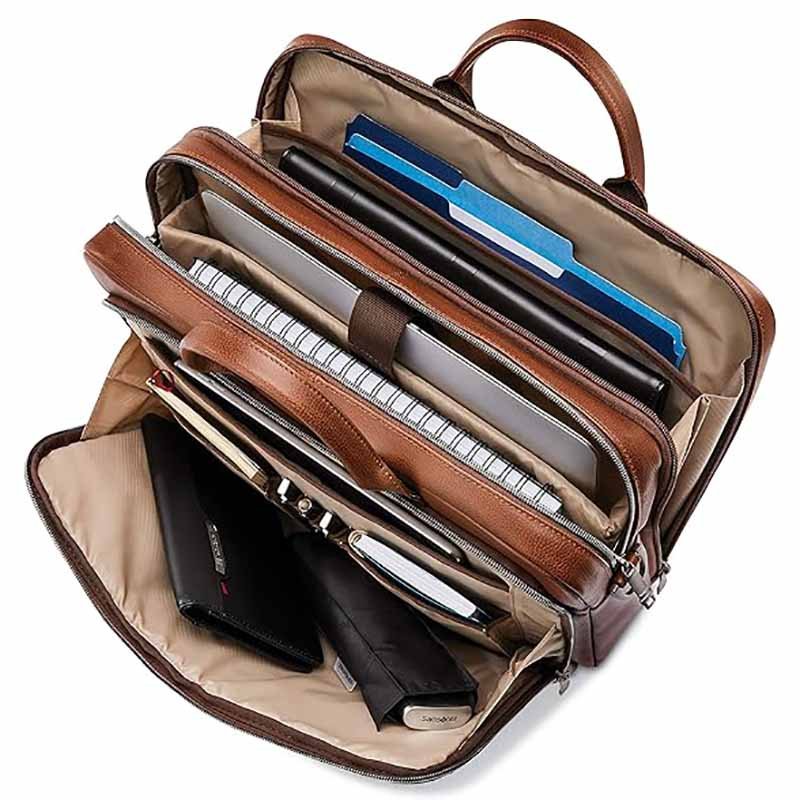
A leather briefcase can look impressive on a conference table, but the real test begins when someone opens it before a meeting. Are contracts still flat? Is the laptop protected from metal zippers? Can the user find a passport without digging through cables? Are pens separated from signed documents? A good leather briefcase is not only a polished leather shell. It is a moving office, a document protector, and a daily confidence tool.
Document compartments in leather briefcases are structured interior sections designed to separate, protect, and organize papers, files, folders, laptops, tablets, notebooks, cards, travel documents, and work tools. Good compartment design prevents bending, scratching, pressure marks, moisture transfer, and clutter while keeping the briefcase professional, slim, balanced, and easy to use.
For brands planning custom leather briefcases, document compartments affect far more than storage. They influence leather thickness, lining selection, interlining stiffness, bag weight, sample cost, sewing difficulty, hardware choice, retail positioning, and user reviews. SzoneierLeather has over 18 years of experience in leather product development and manufacturing, covering leather bags, wallets, belts, straps, accessories, leather boxes, raw material development, product design, sampling, production, packaging design, and packaging inspection. A leather briefcase may win attention with beautiful grain, but strong interior engineering is what makes people carry it every day.
What Are Document Compartments?
Document compartments are dedicated interior areas inside leather briefcases that hold files, contracts, A4 papers, letter papers, legal documents, notebooks, tablets, laptops, and work essentials in separated spaces. They protect paper edges, improve access, reduce clutter, and help the briefcase keep a cleaner shape during daily use.
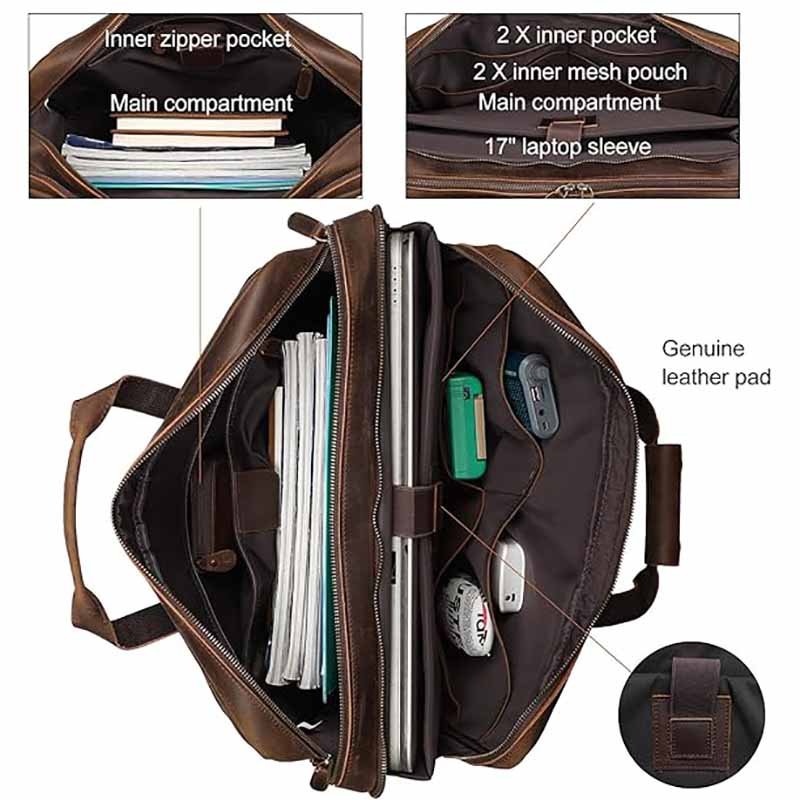
A document compartment can look like a simple pocket, but in leather briefcase development it is a structural decision. A flat sleeve on the back wall keeps documents close to the body. A center divider separates laptop and papers. A zipper pocket protects confidential items. A gusseted file section allows thicker folders. A padded sleeve protects electronics. A hidden pocket supports travel documents. Each choice changes the weight, thickness, sewing process, and final user experience.
Many briefcase problems start inside. A product may use premium leather on the exterior but still feel inconvenient if the interior layout is weak. Papers bend because the sleeve is too shallow. Laptop corners press into folders because no padded divider exists. Pens leave marks because the organizer panel sits too close to documents. Chargers create bumps on the leather surface because the pocket has no volume control. These small issues turn into complaints after daily use.
A well-designed leather briefcase should answer several workday needs:
Documents should stay flat without curling at the corners.
Laptop and paper should not rub against each other.
Pens, keys, and chargers should stay away from contracts.
Folders should slide in and out without forcing the opening.
The briefcase should not become bulky after normal loading.
The interior should look refined when opened in front of clients.
The lining should protect leather edges and paper surfaces.
For custom manufacturing, document compartment planning should begin before pattern making. Leather briefcases are less forgiving than soft fabric bags because leather has thickness, grain direction, edge finish, and seam bulk. If the inner pocket is added too late, the sample may become too tight, heavy, or difficult to sew. SzoneierLeather can review compartment size, leather thickness, lining material, interlining stiffness, opening method, and target carry items before sample development.
Common document sizes should also guide compartment design. A4 paper measures 210 × 297 mm. US letter paper measures 8.5 × 11 inches. US legal paper measures 8.5 × 14 inches. A 13-inch laptop, 14-inch laptop, and 15.6-inch laptop all require different sleeve widths and padding allowances. Without these details, a briefcase may look correct but fail in real use.
| Carry Item | Standard Size Reference | Better Compartment Direction | Key Design Risk |
|---|---|---|---|
| A4 paper | 210 × 297 mm | Full-width flat sleeve or center divider | Paper corners bend if pocket is shallow |
| US letter paper | 8.5 × 11 in | Flat document sleeve | Width must include folder clearance |
| US legal paper | 8.5 × 14 in | Extended file section | Standard A4 layout may be too short |
| 13-inch laptop | Varies by device | Padded laptop sleeve | Screen size does not equal actual device size |
| 15.6-inch laptop | Varies by device | Wide padded section with bottom support | Leather body may become too bulky |
| Tablet | 9–13 in range | Slim padded pocket | Keys and pens can scratch screen |
| Passport | 125 × 88 mm approx. | Zipper or hidden pocket | Easy loss if placed in open cavity |
| Notebook | A5, B5, A4 | Slip pocket or main divider | Thickness can compress documents |
| Charger and mouse | Variable | Gusseted accessory pocket | Hard items can create leather bumps |
| Pens and cards | Small accessories | Organizer panel | Poor placement can mark papers |
What Are They?
Document compartments are built-in sections that keep flat work items separate from electronics, accessories, and loose objects. They can be made as open sleeves, zipper pockets, padded dividers, gusseted file pockets, center sections, or layered organizer panels. In leather briefcases, these compartments often combine leather, microfiber, suede-like lining, polyester lining, foam, reinforcement board, non-woven backing, or fiberboard interlining.
A strong compartment needs four qualities. It must fit the intended item, protect the item surface, support the briefcase structure, and remain easy to use. A pocket that looks elegant but cannot hold a real folder has little value. A padded sleeve that protects a laptop but consumes too much space may damage the overall layout. SzoneierLeather can adjust pocket height, opening width, divider stiffness, lining texture, and bottom support based on the client’s product level.
Where Are They Placed?
Document compartments are usually placed along the back wall, front wall, center divider, or main body section of a leather briefcase. Back-wall placement works well for flat papers because it keeps documents stable and close to the body. A center divider is useful when the briefcase needs to separate laptop and files. Front-wall pockets are better for quick-access documents, tablets, pens, cards, and business tools.
Placement should follow user behavior. A lawyer may need quick access to contracts and legal files. A sales manager may need brochures, catalogs, and business cards. A consultant may carry a laptop, tablet, notebook, and printed proposals. A travel executive may need a passport, boarding pass, and documents separated from chargers. SzoneierLeather can develop layouts around these real use cases instead of adding pockets randomly.
Why Do They Matter?
Document compartments matter because a leather briefcase is often used in high-pressure moments. Meetings, airport checks, client visits, court preparation, sales presentations, and office commutes all require quick access and clean organization. If a user opens a briefcase and finds bent papers, scratched files, tangled cables, or a buried passport, the product fails at the moment it should feel most professional.
For leather goods brands, compartment quality affects customer satisfaction and repeat orders. Exterior leather brings visual value, yet interior layout creates daily value. A briefcase that protects documents well can justify a higher retail price because users feel the benefit every day. A weak layout creates returns, poor reviews, and reduced trust even when the leather itself is good.
What Do They Hold?
Document compartments can hold business files, A4 papers, letter papers, legal-size documents, folders, contracts, notebooks, tablets, laptops, envelopes, passports, receipts, pens, business cards, cables, and slim accessories. A premium briefcase should not force all of these items into one open space.
Capacity should be planned by item type, not by vague volume. Papers need flat width and height. Laptops need padding and bottom protection. Tablets need scratch-resistant lining. Passports need secure closure. Pens need loops or narrow slots. Chargers need a pocket with depth. SzoneierLeather can translate these daily items into measurable pocket dimensions during sample development so the briefcase feels organized rather than crowded.
| Compartment Feature | Recommended Use | Custom Design Note |
|---|---|---|
| Full-width sleeve | A4 papers, files, contracts | Add enough height to prevent papers from slipping |
| Padded divider | Laptop and tablet separation | Foam thickness should balance protection and slimness |
| Zipper pocket | Passport, receipts, confidential papers | Zipper should not scratch documents or laptop surface |
| Gusseted section | Thicker folders and notebooks | Side depth must prevent bulging |
| Organizer panel | Pens, cards, phone, cables | Hard items should face away from document sleeve |
| Hidden back pocket | Travel papers and valuables | Good for executive and travel briefcases |
| Elastic strap | Laptop or tablet hold-down | Useful when users move often |
| Magnetic pocket | Quick-access paper or phone | Magnet strength must not affect usability |
| File divider | Multi-document organization | Divider edge should be smooth and reinforced |
Which Compartment Layout Works Best?
The best compartment layout depends on paper size, laptop size, daily workload, user habits, briefcase thickness, leather structure, and product price level. A slim executive briefcase needs clean flat sections, while legal, laptop, and travel briefcases need deeper, more protective layouts.
No single layout works for every leather briefcase. A minimalist executive briefcase may need only one main compartment, one laptop sleeve, and one flat document pocket. A legal briefcase may need deeper file sections and longer internal clearance. A laptop briefcase may require padding, bottom protection, and cable storage. A travel briefcase may need passport storage, zipper pockets, and secure quick-access sections.
Layout planning should start with actual carrying behavior. What does the user carry every day? How thick are the documents? Does the bag need to fit A4, US letter, or legal papers? Will users carry a 13-inch, 14-inch, or 15.6-inch laptop? Does the briefcase need to stay slim under a suit? Will it sit upright in an office? Does it need a detachable shoulder strap? These questions decide the compartment structure.
A common mistake in custom briefcase development is adding too many pockets. More pockets may sound impressive in a product description, but each pocket adds lining, stitching, edges, seam bulk, labor time, and weight. A leather briefcase with too many small compartments may lose the clean interior space needed for real files. Another mistake is over-padding. Laptop protection is important, but thick foam and stiff dividers can make a leather briefcase bulky and less elegant.
A good compartment layout balances five factors:
Flat storage for documents.
Padded protection for electronics.
Small-item control for accessories.
Weight balance when the briefcase is carried.
Clean appearance when opened.
SzoneierLeather can help clients choose between slim executive layouts, dual-compartment layouts, center-divider layouts, legal-file layouts, laptop-focused interiors, and travel-ready structures. The factory’s raw material supply chain and development capabilities make it easier to adjust leather thickness, lining grade, interlining stiffness, pocket depth, and hardware selection during sampling.
| Layout Style | Best Use Case | Interior Structure | Main Benefit | Development Risk |
|---|---|---|---|---|
| Slim executive layout | Meetings, office, formal use | One main section + flat sleeve | Elegant and lightweight | Limited storage for accessories |
| Dual-compartment layout | Laptop + files | Two main sections | Clear separation | Thickness can increase quickly |
| Center-divider layout | Daily professional carry | Middle divider + side pockets | Balanced organization | Divider must hold shape |
| Legal-file layout | Lawyers, real estate, finance | Extended file section | Fits longer papers | Requires longer body pattern |
| Laptop-focused layout | Business travel, commuting | Padded sleeve + accessory pockets | Protects electronics | Padding can reduce file space |
| Travel-ready layout | Airport, sales, executive travel | Document pocket + passport pocket + laptop sleeve | Fast access and security | Too many pockets can add weight |
| Expandable layout | Variable workload | Gusset or expandable side | More flexible capacity | May look bulky when filled |
| Portfolio layout | Light document carry | Flat body + slim pockets | Clean and refined | Not ideal for heavy electronics |
Which Fits A4 Files?
A4 file compartments need enough internal width, height, and opening clearance to hold 210 × 297 mm papers without bending. A4 is common in Europe, Asia, Australia, and many international office settings, so export-focused briefcases should consider A4 fit carefully. A pocket that only fits loose paper may not fit an A4 folder, document sleeve, or thin binder.
A good A4 compartment often uses a flat back-wall sleeve, a full-width center divider, or a dedicated document section. The opening should allow papers to slide in straight, not at an angle. The sleeve height should cover enough of the document to stop papers from slipping out when the briefcase moves. SzoneierLeather can build A4-fit interiors with smooth lining, firm divider edges, and controlled seam bulk so documents remain flat while the briefcase still looks slim.
Which Fits Legal Papers?
Legal papers need more length than A4 or letter-size documents, so the briefcase body must be designed around longer internal clearance. Legal-size paper measures 8.5 × 14 inches, and folders can be slightly larger. A standard business briefcase may not fit legal documents unless the pattern, zipper path, gusset, and divider length are adjusted.
A leather legal briefcase usually needs a deeper profile, wider opening, and stronger file divider. For lawyers, real estate professionals, finance teams, and contract-heavy users, document edge protection is critical. Papers should not bend at the corners or press against zipper ends. SzoneierLeather can customize legal-file sections with reinforced dividers, longer sleeves, smooth lining, and structured gussets for professional use.
Which Fits Laptops?
Laptop compartments need more than size matching. They need padding, lining, corner protection, and stable placement. A laptop should not rub against paper edges, zippers, metal hardware, keys, or pen clips. The compartment should hold the laptop securely without forcing the user to push it into the sleeve.
A 13-inch laptop sleeve may work well for slim executive bags. A 14-inch laptop sleeve is often useful for modern office users. A 15.6-inch laptop sleeve needs a wider body, stronger bottom support, and careful weight balance. Brands should provide real device dimensions when possible, because screen size does not equal full device size. SzoneierLeather can customize padded laptop sleeves with foam, microfiber lining, elastic straps, Velcro tabs, magnetic closures, or zipper sections based on product style and target cost.
Which Fits Tablets?
Tablet compartments should protect the screen surface while keeping the briefcase slim. Tablets are thinner than laptops but can still be scratched by keys, pens, zippers, and metal accessories. A tablet pocket should sit away from hard objects and use soft lining or light padding. For executive briefcases, tablet pockets often work well on the front interior wall or inside a center divider.
Sizing should consider whether the tablet is used with a keyboard case or protective cover. A bare tablet needs less depth; a tablet with keyboard cover needs extra clearance. A narrow pocket may look neat but become annoying if users need to force the device in and out. SzoneierLeather can design tablet compartments for iPad, e-reader, digital planner, or custom electronic devices.
Which Fits Daily Carry?
Daily carry layout should control small objects that cause mess and damage. Phones, pens, business cards, chargers, earbuds, keys, mouse, receipts, passports, and wallets should not sit loose against important documents. A leather briefcase needs enough accessory storage, but not so much that the interior becomes crowded.
Useful daily carry features include pen loops, card pockets, a zipper pocket, a phone sleeve, a charger pocket, a key leash, and a slim notebook area. These sections should be placed away from flat document zones. Hard items should face toward the front organizer panel, not toward paper or laptop screens. SzoneierLeather can build interiors based on work style, from minimalist executive layouts to travel-ready professional layouts with more storage control.
How Do Compartments Protect Documents?
Document compartments protect papers and work items by keeping them flat, separated, cushioned, and away from hard accessories. Good briefcase interiors reduce bending, scratching, edge damage, moisture transfer, pressure marks, and clutter, while helping the leather body keep a professional shape during daily use.
A leather briefcase is often used in situations where documents cannot look damaged. Contracts, legal papers, proposals, invoices, certificates, presentation folders, passports, and business files need to arrive clean and flat. A crumpled agreement or scratched folder may look careless in front of clients, even when the content is correct. Interior compartment design prevents that embarrassment.
Protection starts with separation. Documents should not sit in the same open area as chargers, keys, pens, metal buckles, laptop corners, or water bottles. Even small objects can create pressure marks on paper or leave visible dents through thin folders. A flat sleeve, center divider, zipper pocket, or file section keeps documents away from hard accessories.
Protection also depends on structure. A document compartment that is too soft may collapse when the briefcase is carried by the handle. A divider that is too stiff may make the bag heavy and uncomfortable. A pocket that is too shallow may let papers slide out. A sleeve that is too tight may bend document corners during insertion. Good design needs enough support without making the briefcase feel like a hard case.
Leather behavior matters as well. Leather moves with use. Soft leather can create a relaxed, premium feel, but it may need stronger interlining around document compartments. Firm leather can hold shape better, but may require careful edge finishing and lining to prevent stiffness. SzoneierLeather can adjust leather thickness, lining texture, reinforcement material, and divider structure based on the target briefcase type.
Moisture protection is another detail often ignored. Leather itself should be handled carefully around water, and documents can absorb moisture from humid environments. A good briefcase interior may use lining, coating direction, zipper protection, and pocket positioning to reduce direct contact between paper and damp outer surfaces. For travel or commuting use, clients may request more secure zipper sections or protective sleeves.
A document compartment should also protect the briefcase. Poor interior layout can create exterior bulges. A charger pressing against thin leather can leave a visible bump. Heavy files placed on one side can distort the body. A laptop without bottom support can stress the seams. A better compartment system balances weight and keeps pressure away from visible leather panels.
| Protection Goal | Compartment Solution | Design Detail | Risk If Ignored |
|---|---|---|---|
| Keep papers flat | Full-width sleeve or center divider | Firm but slim interlining | Corners curl or bend |
| Prevent scratches | Soft lining and separated zones | Microfiber or suede-like lining | Laptop or papers rub against hard items |
| Stop pressure marks | Accessory pockets away from documents | Gusseted pockets for chargers | Leather surface shows bumps |
| Improve security | Zipper pocket or hidden sleeve | Smooth zipper placement | Passport or papers fall out |
| Control moisture | Lined document area | Better material separation | Paper absorbs moisture or stains |
| Keep shape | Structured divider and bottom support | Balanced reinforcement | Briefcase collapses or deforms |
| Protect laptop + files | Padded sleeve + paper divider | Foam and smooth lining | Laptop presses into documents |
| Improve daily use | Organized pockets | Smart access sequence | User wastes time searching |
Prevent Bending
Bending is one of the most common document problems in briefcases. It happens when the pocket is too short, too narrow, too soft, or placed in an area where other items press against the paper. A4 sheets, letter documents, legal papers, contracts, and folders all need extra clearance beyond their exact size because users rarely carry loose sheets alone.
A strong document compartment should support the paper from the bottom and sides. For A4 files, internal height should allow the paper to slide in easily while keeping enough pocket wall above the lower edge. For legal documents, extra length must be planned from the beginning. SzoneierLeather can add a firmer divider, board reinforcement, or structured lining to keep papers flat while preserving a slim leather profile.
Stop Scratches
Scratches happen when documents, folders, tablets, or laptops rub against zippers, metal parts, pens, keys, or rough lining. In a leather briefcase, scratch prevention depends on both compartment separation and surface choice. A soft lining can protect laptop screens, tablets, and document covers, while small organizer pockets prevent hard items from moving freely.
Good scratch control often includes microfiber lining, suede-like lining, smooth polyester lining, padded dividers, zipper guards, or covered seams. Pens should sit in loops, not loose in the document section. Keys should be placed in a dedicated pocket or key leash area. Zipper teeth should not face laptop screens directly. SzoneierLeather can help adjust pocket direction, lining texture, and hardware placement so documents and devices stay protected.
Control Moisture
Moisture can damage documents, leather, lining, and metal hardware. A briefcase does not need to be a waterproof case, but it should reduce normal exposure risks from rain, humidity, wet hands, damp surfaces, or travel conditions. Document compartments should not sit directly against unprotected outer leather if the briefcase is designed for commuting or travel.
Material selection helps. A lined document pocket creates a barrier between paper and leather. Zipper sections can protect passports or papers from brief exposure. Coated lining can improve cleanability in certain designs. For premium leather briefcases, moisture control should be balanced carefully because overly synthetic interiors may reduce luxury feel. SzoneierLeather can recommend leather finish, lining, zipper direction, and internal pocket placement based on office, travel, or legal use.
Keep Shape
Document compartments help a briefcase keep shape by distributing pressure and organizing weight. If laptops, folders, chargers, and notebooks sit loosely in one cavity, the briefcase may bulge, sag, or collapse unevenly. Structured dividers and sleeves keep flat items upright and prevent weight from pushing into visible leather panels.
Shape control is especially important for full-grain leather briefcases, executive briefcases, and slim portfolio styles. Leather can develop character over time, but poor internal pressure can create unwanted deformation early. SzoneierLeather can use interlining, reinforcement board, foam, bottom support, and carefully positioned seams to hold the briefcase structure. The goal is not to make the bag hard, but to keep it clean, balanced, and professional under normal load.
| Briefcase Type | Shape Control Need | Recommended Inner Support |
|---|---|---|
| Slim executive briefcase | High need for clean flat body | Thin board reinforcement + flat sleeve |
| Laptop leather briefcase | High need for bottom and side support | Foam sleeve + structured divider |
| Legal briefcase | Need longer flat document support | Extended divider + firm file section |
| Travel briefcase | Need balanced load control | Center divider + accessory pockets |
| Soft leather briefcase | Need hidden internal stability | Flexible interlining + padded sleeve |
| Luxury leather briefcase | Need refined opening and structure | Premium lining + controlled reinforcement |
| Expandable briefcase | Need side shape control | Gusset reinforcement + stronger bottom |
| Portfolio briefcase | Need ultra-slim paper support | Thin divider + smooth lining |
What Materials Work Better?
Better document compartments depend on leather type, lining texture, interlining strength, hardware quality, thread choice, and edge finishing. Full-grain leather, soft microfiber lining, padded dividers, strong zippers, stable reinforcement, and clean stitching can improve both document protection and product value.
Material selection decides how the compartment feels and performs. A briefcase interior may look neat in a photo, but daily use reveals whether the materials are suitable. Does the lining attract dust? Does the divider collapse? Does the zipper scratch files? Does the leather become too heavy? Does the pocket edge stretch after repeated use? These questions are material questions as much as design questions.
Leather choice affects compartment construction. Full-grain leather has premium character and strong durability, but it may require careful skiving and edge work to avoid bulky seams. Top-grain leather can provide a smooth surface and controlled finish. Split leather, corrected leather, or bonded material may reduce cost but may not match premium briefcase expectations. Vegetable-tanned leather can create a refined, structured look, while chrome-tanned leather may feel softer and more flexible.
Lining affects document protection directly. Microfiber or suede-like lining gives a soft premium feel and helps protect laptops, tablets, and document covers. Polyester lining offers lighter weight, cost control, and color flexibility. Cotton lining feels natural but may absorb moisture more easily. Leather lining looks luxurious but adds weight and cost. For custom briefcases, lining should match target retail level and daily use.
Interlining is often invisible but extremely important. It controls stiffness, divider body, pocket recovery, and long-term shape. A flat document sleeve may need thin reinforcement. A laptop compartment may need foam and board support. A legal file section may need stronger divider stability. Poor interlining can make a luxury briefcase feel weak, while excessive reinforcement can make it heavy and rigid.
Hardware must also work with document compartments. Zippers should run smoothly and avoid scratching contents. Magnetic closures should be positioned carefully. Snap buttons should not press into documents. Buckles and metal corners should not create interior pressure points. SzoneierLeather can match hardware finish, function, weight, and placement to the briefcase structure.
Stitching and edge finishing complete the system. Clean stitching gives durability and visual quality. Edge paint or turned edges can improve comfort and reduce paper abrasion. Reinforced stress points protect pocket openings. Strong thread helps pockets survive repeated pulling. A beautiful document compartment needs both soft touch and hidden strength.
| Material Area | Common Options | Better For | Development Note |
|---|---|---|---|
| Outer leather | Full-grain, top-grain, vegetable-tanned, chrome-tanned | Premium structure and appearance | Thickness affects pocket and seam bulk |
| Lining | Microfiber, suede-like, polyester, cotton, leather | Document and device protection | Texture should not scratch paper or screens |
| Interlining | Board, non-woven, foam, fiber sheet | Shape control and divider strength | Too much stiffness adds weight |
| Padding | EVA foam, sponge foam, laminated foam | Laptop and tablet protection | Thickness reduces inner capacity |
| Zipper | Nylon, metal, waterproof-style, premium polished | Secure pockets and main closure | Teeth direction should avoid scratches |
| Thread | Polyester, bonded nylon, waxed thread | Durable seam performance | Thread size must fit leather thickness |
| Edge finish | Edge paint, folded edge, binding, raw polished edge | Clean look and comfort | Poor edges may rub documents |
| Hardware | Buckles, snaps, magnets, feet, locks | Security and premium feel | Heavy metal increases overall weight |
Which Leather Is Best?
The best leather depends on the briefcase style, target price, structure, and expected use. Full-grain leather is often preferred for premium briefcases because it preserves natural grain, develops character, and supports long-term value. Top-grain leather offers a cleaner, more controlled look for business products. Vegetable-tanned leather can create a more structured and refined briefcase, while chrome-tanned leather often feels softer and more flexible.
For document compartments, leather thickness matters. A thick outer leather may look strong but can reduce internal space if pocket layers are not skived properly. A soft leather may feel luxurious but may need more hidden support to keep documents flat. SzoneierLeather can review leather type, thickness, temper, grain, finish, and color before sampling so the exterior and interior structure work together.
Which Lining Feels Better?
Lining should feel smooth, protective, and appropriate for the product level. Microfiber lining is often chosen for premium leather briefcases because it feels soft and protects laptops, tablets, and document covers. Suede-like lining gives a refined touch but needs quality control to reduce shedding or dust. Polyester lining offers good cost control, color options, and lighter weight. Cotton lining can feel natural but may not be best for moisture-sensitive interiors.
The lining should not wrinkle, stain documents, or catch paper corners. For laptop compartments, a soft lining protects device surfaces. For document sleeves, a smooth lining helps papers slide in easily. SzoneierLeather can customize lining color, texture, thickness, logo printing, jacquard pattern, or branded label placement based on client positioning.
Which Interlining Adds Strength?
Interlining adds the hidden structure that keeps document compartments useful. Without interlining, a pocket may sag. With too much reinforcement, the briefcase may feel stiff and heavy. The best choice depends on the compartment purpose. A flat document pocket may need thin but firm support. A laptop sleeve may need foam plus backing. A legal file divider may need stronger vertical stability.
Common reinforcement options include non-woven backing, paperboard, fiberboard, EVA foam, PE board, sponge foam, and laminated composite layers. SzoneierLeather can test interlining combinations during sampling to control thickness, flexibility, weight, and recovery. For slim executive briefcases, thinner reinforcement is often better. For heavy laptop briefcases, stronger bottom and divider support may be worth the extra weight.
Which Hardware Helps?
Hardware helps when it improves access, security, structure, and long-term use. Smooth zippers protect confidential document pockets. Magnetic closures can make slip pockets easy to open. Metal locks can improve executive styling. Bottom feet can protect leather from desk or floor contact. D-rings and strap hooks support detachable shoulder straps for heavier document loads.
Hardware should not create hidden problems. A zipper pull may scratch paper if it faces inward. A snap button may press a circular mark into documents. A heavy lock may make the front panel sag. Weak magnets may feel cheap. SzoneierLeather can help choose hardware based on weight, finish, plating quality, opening force, and placement. Good hardware should feel useful, not only decorative.
Which Stitching Lasts Longer?
Long-lasting stitching depends on thread type, stitch density, seam allowance, leather thickness, needle size, and stress-point reinforcement. For leather briefcases, bonded nylon and polyester threads are common choices because they offer strong abrasion resistance and stable performance. Stitching must look clean while holding pocket openings, handles, gussets, dividers, and strap points securely.
Document compartments experience repeated pulling, especially at pocket openings and divider edges. Reinforcement stitches, bar tacks, backstitching, or stronger seam construction may be needed in high-use areas. Stitching should not create rough edges where papers slide. SzoneierLeather reviews seam type, thread size, stitch spacing, and finishing details during sampling to make sure compartments remain durable without looking bulky.
| Component | Standard Direction | Premium Direction | Best Upgrade Situation |
|---|---|---|---|
| Outer leather | Top-grain or corrected leather | Full-grain or vegetable-tanned leather | Executive, luxury, legal, retail premium lines |
| Lining | Polyester lining | Microfiber or suede-like lining | Laptop, tablet, luxury briefcase |
| Divider | Basic fabric layer | Reinforced divider with board or foam | Document protection and shape control |
| Laptop sleeve | Thin padding | EVA foam + soft lining | 13–15.6 inch laptop briefcase |
| Zipper | Standard nylon zipper | Polished metal or premium smooth zipper | Legal, travel, executive use |
| Pocket edge | Simple stitched edge | Folded or painted edge | Luxury interior finish |
| Thread | Standard polyester | Bonded nylon or premium polyester | Heavy use and long-term durability |
| Packaging | Polybag and carton | Dust bag, gift box, molded insert | Private label or premium retail launch |
How Should Brands Customize?
Leather briefcase customization should start with the user’s daily workflow, document size, device size, preferred structure, leather type, pocket depth, closure method, and target price. A good custom layout balances flat document storage, laptop protection, accessory control, refined appearance, and long-term durability.
Custom leather briefcases can fail when design begins with appearance alone. A clean exterior sketch may look elegant, but interior planning decides whether the product feels useful after purchase. A briefcase for lawyers needs longer file clearance and secure document sections. A briefcase for executives may need slim compartments, clean lining, and discreet laptop storage. A briefcase for sales teams may need brochure storage, business card pockets, a tablet section, and quick-access document areas. A briefcase for travel may need passport storage, zipper pockets, trolley sleeve options, and stronger handle reinforcement.
Customization should answer real carrying questions first:
What document size must fit: A4, letter, legal, folders, or binder sleeves?
What device size must fit: tablet, 13-inch laptop, 14-inch laptop, or 15.6-inch laptop?
How many main sections are needed?
Should documents be accessed quickly or secured by zipper?
Should the bag stay slim under a suit or carry heavier office tools?
Will the user carry chargers, mouse, keys, pens, phone, wallet, passport, and cards?
Should the briefcase stand upright or remain soft and relaxed?
Should the look be executive, vintage, minimalist, luxury, legal, or travel-focused?
A strong custom briefcase does not simply add every possible feature. Over-designed interiors create bulk, weight, sewing difficulty, and higher cost. Pockets also reduce flexible space. A deep charger pocket may help one user but create exterior bulging for another. A zipper divider adds security but may make document access slower. A laptop sleeve adds protection but reduces paper capacity. A good factory helps clients choose features according to product purpose, not wish lists.
SzoneierLeather can guide custom development through leather choice, pocket layout, interlining, lining texture, hardware, zipper direction, handle structure, shoulder strap system, stitching, logo method, and packaging. Since the factory has raw material supply chain strength and in-house development capability, adjustments can be made during sampling rather than after bulk production problems appear.
| Custom Choice | Better For | Design Note | Cost Impact |
|---|---|---|---|
| 1 main section | Slim executive look | Good for light documents and laptop sleeve | Lower |
| 2 main sections | Laptop + paper separation | Balanced for daily office carry | Medium |
| 3 sections | Legal, sales, travel users | More storage, more weight | Medium to high |
| Padded laptop sleeve | Electronics protection | Needs correct device size | Medium |
| Zipper file pocket | Confidential documents | Adds security and sewing time | Medium |
| Gusseted file section | Thicker folders | Needs side structure control | Medium |
| RFID pocket | Cards, passport protection | Useful for travel briefcases | Medium |
| Trolley sleeve | Business travel | Must match luggage handle width | Medium |
| Custom lining logo | Private label interior detail | Adds identity without outer change | Low to medium |
| Gift packaging | Premium launch or corporate gift | Improves presentation | Medium to high |
How Many Sections?
The number of sections should match the workday load. A slim executive briefcase may only need one main compartment, one document sleeve, and one laptop or tablet section. A daily office briefcase may work better with two main compartments: one for laptop and one for documents. A legal or travel briefcase may need three sections, including a secure zipper file pocket or gusseted document area.
More sections do not always mean better design. Each added divider reduces open space and increases weight. Leather, lining, foam, zipper tape, reinforcement, and stitching all add thickness. For a premium briefcase, interior space should feel calm and intentional. SzoneierLeather can help test compartment number during sample development by loading real items such as A4 files, laptops, notebooks, chargers, and folders to check whether each section earns its space.
How Deep Should Pockets Be?
Pocket depth should be based on the item being carried, not only the size of the briefcase. A document sleeve needs enough height to keep papers from falling out. A phone pocket needs easy access without making the phone sink too deep. A passport pocket needs secure coverage but quick retrieval. A charger pocket needs depth and side room, or it may create visible bumps.
As a practical guide, a document sleeve should usually cover a meaningful portion of the paper height while leaving enough opening for easy removal. A laptop sleeve should hold the device securely without forcing the corners. A pen pocket should hold the pen clip area firmly but not scratch documents. SzoneierLeather can adjust pocket depth, opening width, edge reinforcement, and gusset shape after reviewing the target items.
| Pocket Type | Recommended Planning Point | Common Problem |
|---|---|---|
| A4 sleeve | Fit documents plus folder clearance | Paper bends at upper corners |
| Legal file sleeve | Extend body length and pocket depth | Papers only fit diagonally |
| Laptop sleeve | Match real device dimensions | Sleeve too tight after padding |
| Phone pocket | Allow finger access | Phone sits too deep |
| Passport pocket | Secure with zipper or flap | Passport slips out |
| Card pocket | Add enough width for easy pull | Cards jam inside |
| Pen loop | Match pen diameter range | Pen marks lining or paper |
| Charger pocket | Add gusset volume | Exterior leather bulges |
Do Zippers Help?
Zippers help when the compartment needs security, privacy, or travel protection. A zipper pocket is useful for passports, legal papers, receipts, checks, contracts, small electronics, or confidential files. For commuters and frequent travelers, zippers reduce the risk of items slipping out when the briefcase is opened quickly.
Yet zippers also need careful placement. Metal teeth or rough zipper edges can scratch laptop surfaces, document folders, or leather interiors. A zipper pocket placed too close to a document sleeve may make paper insertion awkward. A thick zipper divider can increase body weight and reduce slimness. SzoneierLeather can select nylon zippers, metal zippers, smooth zipper pulls, hidden zipper structures, or leather zipper guards according to the product level.
Are Dividers Needed?
Dividers are needed when the briefcase must separate papers, laptop, tablet, and accessories. A center divider can stop a laptop from pressing against documents. A reinforced divider can help a soft leather briefcase keep shape. A padded divider can create a safer electronics zone. A thin divider can create organization without adding too much weight.
The divider material should match product purpose. A slim office briefcase may need a thin but firm divider. A laptop briefcase may need foam and soft lining. A legal file briefcase may need longer vertical support. A travel briefcase may need a zipper divider for security. SzoneierLeather can test board, foam, non-woven backing, microfiber lining, and leather trim combinations during sampling to control stiffness, weight, and usable space.
Is RFID Useful?
RFID protection can be useful for briefcases designed for travel, executive commuting, passports, access cards, corporate cards, and international business use. It is usually added to a specific pocket rather than the whole briefcase. A hidden RFID pocket for passport or cards can increase perceived value without changing the exterior design.
RFID should be used where it makes sense. A legal document briefcase may not need it. A travel briefcase with passport and card storage may benefit from it. A corporate gift briefcase may use RFID as an added selling point. SzoneierLeather can add RFID lining or RFID-blocking pocket layers based on client positioning, cost range, and target user habits.
How Can SzoneierLeather Help?
SzoneierLeather helps clients develop custom leather briefcases through material sourcing, leather development, product design, sample making, compartment engineering, production, packaging design, quality inspection, and private label support. The factory can turn document compartment ideas into practical briefcase structures ready for production.
A professional leather briefcase needs cooperation between design, material, structure, sewing, finishing, inspection, and packaging. SzoneierLeather has over 18 years of leather goods experience and supports a wide product range, including bags, wallets, belts, straps, accessories, leather boxes, and custom leather goods. For leather briefcases, the team can help clients develop exterior style and interior function together.
The development process usually begins with product direction. Clients may provide a sketch, reference photo, existing sample, tech pack, logo file, target size, preferred leather, and expected quantity. SzoneierLeather then reviews whether the proposed layout can work in real leather production. The team may suggest changes to compartment size, laptop sleeve width, divider stiffness, pocket placement, zipper direction, handle reinforcement, shoulder strap hardware, edge finishing, and packaging.
Sampling is where the concept becomes real. A sample briefcase can be tested with actual work items: A4 files, legal documents, laptop, tablet, notebook, charger, phone, cards, pens, and passport. If a document pocket is too tight, it can be revised. If the leather becomes bulky around the divider, the thickness can be adjusted. If a zipper pocket scratches documents, zipper direction can be changed. If the briefcase feels heavy, reinforcement or hardware can be optimized.
Production control matters because briefcases depend on consistent structure. A document pocket that shifts by a few millimeters may affect paper fit. A laptop sleeve that loses width after sewing may frustrate users. A divider with weak interlining may collapse. A handle without enough reinforcement may deform under load. SzoneierLeather checks materials, cutting, stitching, edge finishing, hardware, lining, compartments, packaging, and final presentation to support stable manufacturing.
Packaging is also part of the product experience. A leather briefcase can be damaged by pressure, poor folding, weak carton support, or rough handling during shipment. Premium leather briefcases may need dust bags, tissue paper, shaped inserts, protective wrapping, branded boxes, or reinforced export cartons. SzoneierLeather can design packaging that protects shape and improves presentation for retail, wholesale, corporate gift, or online sales channels.
| Support Area | What SzoneierLeather Can Provide | Why It Matters |
|---|---|---|
| Raw material sourcing | Leather, lining, interlining, hardware | Better material matching |
| Product design | Exterior style and interior layout | Balanced function and appearance |
| Sample making | Prototype for real-use testing | Faster correction before production |
| Compartment engineering | Document pockets, laptop sleeves, dividers | Better daily usability |
| Leather development | Grain, thickness, finish, color | Stronger product identity |
| Production | Cutting, sewing, assembly, finishing | Scalable manufacturing |
| Quality inspection | Size, stitching, pocket function, hardware | Reduced shipment risk |
| Packaging design | Dust bag, box, carton, insert | Better protection and presentation |
| Private label support | Logo, lining, tags, packaging | Stronger market identity |
| Long-term cooperation | Repeat order consistency | More stable supply |
How Is Design Reviewed?
SzoneierLeather reviews leather briefcase designs by checking exterior style, document capacity, compartment layout, leather thickness, lining choice, handle structure, hardware, edge finishing, and target use. A briefcase design must look refined and work under real daily load.
Design review usually checks:
Does the briefcase fit A4, letter, or legal documents?
Can the laptop sleeve fit the target device?
Are document compartments deep enough?
Are hard items separated from papers?
Will the divider make the briefcase too thick?
Can the pocket layout be sewn cleanly in leather?
Does the handle need reinforcement?
Is the shoulder strap system needed?
Does the interior match the retail price level?
Will packaging protect the final shape?
These checks help avoid sample failure. A beautiful drawing may still need adjustment because leather thickness, lining, foam, interlining, and seam allowance reduce internal space. SzoneierLeather helps clients refine ideas before committing to bulk production.
How Are Samples Made?
Samples are made by converting the approved concept into patterns, material panels, interior parts, reinforcements, and finished construction. For leather briefcases, sample making includes leather cutting, skiving, lining preparation, pocket assembly, divider construction, handle making, edge finishing, hardware installation, sewing, shaping, and final inspection.
A useful sample should be tested with real items. A4 papers should slide into the compartment smoothly. Legal papers should fit if the briefcase is designed for legal use. Laptop and tablet sleeves should be checked with actual device dimensions. Zippers should open without catching lining. Handles should feel stable under load. Pockets should not create unwanted exterior bulges.
SzoneierLeather can support sample adjustments after physical review. If the pocket is too shallow, the pattern can be changed. If the laptop sleeve is too tight, padding allowance can be adjusted. If the briefcase feels too heavy, reinforcement and hardware can be reviewed. Sample correction is the safest place to improve design before production begins.
| Sample Check | Test Method | What It Reveals |
|---|---|---|
| A4 fit | Insert paper and folder | Pocket width and height accuracy |
| Legal fit | Insert legal paper or folder | Body length and opening clearance |
| Laptop fit | Insert real device or size mockup | Sleeve tolerance and padding allowance |
| Document access | Remove papers repeatedly | Pocket opening convenience |
| Weight test | Load 3–7 kg for office use | Handle and structure stability |
| Zipper test | Open and close repeatedly | Smoothness and lining interference |
| Shape check | Place briefcase standing and lying | Body balance and structure |
| Packing check | Simulate carton placement | Shape protection during shipment |
How Is Quality Checked?
Quality checking for leather briefcases should cover both appearance and function. Exterior leather may look good, but a weak document compartment can still create a poor user experience. SzoneierLeather inspects materials, cutting, sewing, compartments, hardware, lining, edge finishing, logo position, structure, packaging, and final appearance.
Key inspection points include:
Leather surface: grain, color, marks, scratches, finish consistency.
Cutting: panel size, direction, symmetry, edge preparation.
Compartments: pocket size, depth, alignment, opening smoothness.
Laptop sleeve: padding, lining, opening width, bottom support.
Stitching: stitch length, seam strength, skipped stitches, thread trimming.
Hardware: zipper, buckle, lock, magnet, D-ring, feet, handle hardware.
Edge finishing: edge paint, folded edges, smoothness, cracking risk.
Interior lining: wrinkles, stains, glue marks, loose threads.
Logo: embossing, debossing, metal logo, woven label, lining logo.
Packing: dust bag, protective wrapping, carton strength, shape support.
Briefcase quality should be checked against the approved sample. For repeat orders, the approved sample becomes the standard for compartment size, leather feel, stitching, logo placement, lining color, and packaging. This helps keep production consistent across batches.
How Is Packaging Designed?
Packaging for leather briefcases should protect shape, leather surface, hardware, corners, handles, and interior structure during storage and shipping. A document briefcase can lose its premium impression if it arrives with compressed corners, scratched leather, bent handles, or deformed compartments.
Packaging options may include:
Soft dust bag.
Tissue paper wrapping.
Protective foam around hardware.
Corner protection.
Shape insert inside the briefcase.
Branded paper box.
Rigid gift box.
Export carton with proper stacking strength.
Moisture-control pouch if needed.
Barcode, label, or retail sticker placement.
SzoneierLeather can design packaging based on sales channel. Corporate gift projects may need gift boxes. Retail products may need display-ready packaging. Online sales may need stronger carton protection. Wholesale shipments may need efficient packing to control freight cost. Good packaging protects both product and brand image.
How Can Projects Start?
A custom leather briefcase project can start with a simple product idea, a reference photo, a physical sample, a technical drawing, or a rough sketch. The more details the client provides, the faster the development process becomes.
Useful project information includes:
Briefcase style: executive, legal, laptop, travel, portfolio, vintage, luxury, minimalist.
Target size: A4, letter, legal, 13-inch laptop, 15.6-inch laptop.
Leather preference: full-grain, top-grain, vegetable-tanned, soft leather, structured leather.
Interior needs: document sleeve, padded laptop pocket, zipper file pocket, organizer panel.
Hardware: zipper, lock, buckle, magnet, shoulder strap, bottom feet.
Logo method: embossing, debossing, metal logo, woven label, printed lining.
Color: leather color, lining color, stitching color, hardware finish.
Quantity: sample order, small custom wholesale order, larger production program.
Packaging: dust bag, paper box, gift box, carton packing.
Quality requirements: inspection details, testing needs, target market, retail positioning.
After receiving project details, SzoneierLeather can review feasibility, recommend materials, prepare sample direction, discuss cost structure, and move toward prototype development.
Start a Custom Leather Briefcase Project With SzoneierLeather
Document compartments are not hidden details. They decide whether a leather briefcase truly works. A good compartment system keeps papers flat, laptops protected, tablets scratch-free, passports secure, pens controlled, and daily tools easy to reach. Poor interior planning turns even beautiful leather into an inconvenient product.
For brands developing leather briefcases, the strongest results come from early compartment planning. Decide paper size. Confirm laptop dimensions. Choose lining carefully. Balance pocket count with usable space. Select interlining that supports shape without making the briefcase too heavy. Place zippers and hardware where they help rather than interfere. Test samples with real items before bulk production.
SzoneierLeather supports custom leather goods development with over 18 years of experience, strong raw material supply chain capability, leather and finished product development, product design, sampling, manufacturing, packaging design, packaging inspection, and quality control. The factory can help develop custom leather briefcases, bags, wallets, belts, straps, accessories, leather boxes, and private label leather products for professional markets.
If your next leather briefcase project needs better document compartments, laptop sections, legal-file storage, executive interior layouts, premium leather, custom logo, private label packaging, or wholesale production, SzoneierLeather can help turn your concept into a workable sample and production-ready product.
Send your design idea, reference photo, sample, logo file, target size, and quantity plan to SzoneierLeather to start a custom leather briefcase project built around real professional use.