
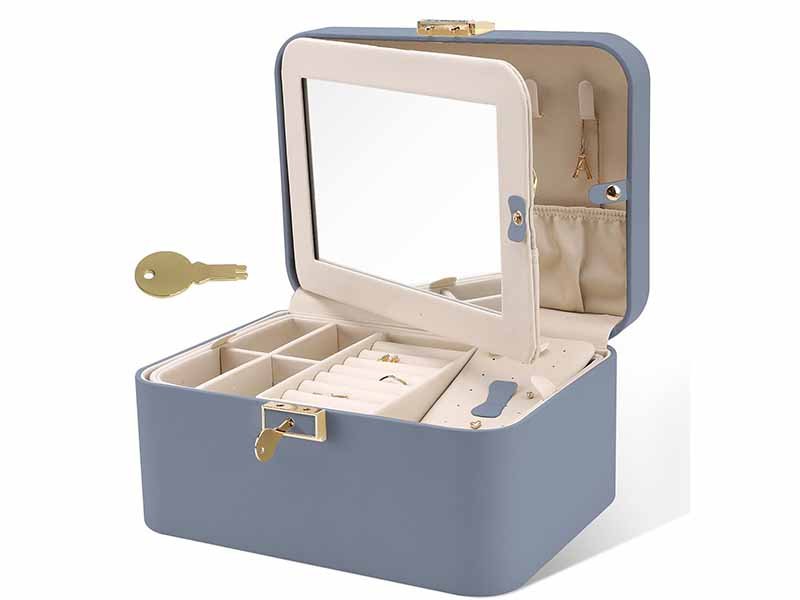
Jewelry gets scratched in ways most brands don’t expect. It’s not always “rough customers” or “cheap plating.” A lot of damage happens when jewelry sits inside a box that looks premium but lets pieces move, touch, or rub. A ring sliding half a centimeter can hit a pendant. A chain clasp can tap a polished surface. Even a soft lining can create marks if it wrinkles, pills, or exposes a hard corner underneath.
For brands, a jewelry leather box isn’t just packaging. It’s part of your product promise: protection, storage, and an unboxing moment that should feel calm and confident. When a customer opens the box and sees tiny marks, the jewelry feels less valuable—no matter how good the jewelry is.
Jewelry leather boxes prevent scratches by controlling movement and separating pieces with properly sized compartments, stable inserts, and soft linings. Scratch-safe designs avoid hard contact points, reduce free space, and keep jewelry from rubbing during daily handling and shipping. The best results come from matching compartment dimensions to jewelry types, using low-friction linings, and building edge and lid structures that won’t create pressure or abrasion.
If you’ve ever had a “brand-new but scratched” complaint, the fix usually starts inside the box.
What Makes Jewelry Leather Boxes Scratch-Safe?
Jewelry leather boxes are scratch-safe when they reduce movement, isolate each jewelry piece, and eliminate hard rubbing points. The main protection comes from compartment separation, correct sizing tolerances, soft low-friction lining, and stable structure that doesn’t shift or collapse. Most scratch issues come from jewelry-to-jewelry contact and hidden hard edges—not from the leather exterior.
Why Do Jewelry Leather Boxes Get Scratches Inside?
Most internal scratches come from one of four causes—and brands can usually predict them by looking at jewelry behavior, not just box appearance.
The top causes brands see in real complaints
- Jewelry-to-jewelry contact Rings bump earrings; pendants hit clasps; bracelets rub rings.
- Excess free space If a compartment is too large, jewelry slides during movement.
- Hard points under the lining Board corners, hinge plates, glue lines, magnets, or metal parts not fully padded.
- Lining problems over time Pilling, wrinkles, loose fabric tension, or lint that becomes abrasive.
What scratches look like (so your team can identify the root cause)
- Short hairline scratches → jewelry rubbing jewelry (rings, pendants)
- Circular micro scuffs → jewelry rotating in an oversized pocket
- Straight pressure lines → lid clearance too tight; jewelry pressed into lining
- Random dotted marks → hardware contact or hard debris trapped in lining
| Complaint Type | Most Likely Cause | Fix Direction |
|---|---|---|
| “Scratched when opened” | shipping vibration + free space | reduce movement + add retention |
| “Fine marks after 1–2 weeks” | daily handling + jewelry rubbing | tighter compartments + dividers |
| “Marks only on one side” | lid pressure / uneven insert | fix lid clearance + insert flatness |
| “Looks dusty and scratches” | lining shedding / pilling | change lining grade + test rub |
How Do Jewelry Leather Boxes Control Jewelry Movement?
Scratch prevention is basically movement control. The best jewelry leather boxes “hold” jewelry gently so it can’t slide, collide, or rotate.
The 5 movement-control methods that work in production
- Compartment sizing with real tolerances Not just “ring area” — you need width/depth ranges based on jewelry category.
- Soft compression (foam + lining) A 3–6 mm foam layer stabilizes jewelry without leaving pressure marks.
- Dedicated paths for chains Necklaces need channels, hooks, and drop space.
- Divider height that matches jewelry height Dividers that are too low allow crossover rubbing.
- Insert stability (no wobble) If inserts shift, jewelry shifts. Insert flatness matters more than people think.
Practical tolerance guidance (brand-friendly)
| Jewelry Type | Movement Risk | Recommended Hold Method |
|---|---|---|
| Rings | high (rolling/rotation) | slotted pad + light compression |
| Earrings | medium (metal contact) | paired holes + cushioned base |
| Necklaces | very high (tangling) | hooks + grooves + separation |
| Bracelets | medium (swing + collision) | curved channel + side spacing |
A simple “does it move?” test brands can use
- Put sample jewelry inside the box
- Close it
- Shake gently for 10 seconds
- Reopen and check: if items shifted more than 3–5 mm, you’re likely to see scratches in real shipping.
Which Compartment Designs Work Best in Jewelry Leather Boxes?
The best compartment designs in jewelry leather boxes are jewelry-specific: ring slots for rings, structured pads for earrings, and hook-and-channel systems for necklaces. Open trays look clean but allow contact and sliding. A good layout prevents jewelry from touching, controls height and spacing, and keeps delicate surfaces away from clasps, edges, and hard inserts.
Which Jewelry Leather Boxes Compartments Fit Rings and Earrings?
Rings and earrings create the most scratches because they are small, hard, and often stored together.
Ring compartment design that prevents scratches
- Slot width: 12–18 mm (depends on ring size range)
- Slot depth: 20–30 mm
- Foam firmness: medium (too soft = ring sinks + rubs; too hard = pressure marks)
- Lining: microfiber or short-pile velvet (stable surface)
What goes wrong in weak designs
- Ring slots too wide → rings tilt and touch
- Slots too shallow → rings fall out under vibration
- Foam too soft → rings rotate and scuff
Earring compartment design that prevents metal contact
- Paired holes or paired pads so earrings don’t collide
- Cushioned backing under posts and clasps
- Separate mini-lane for each pair, especially for sets
Practical spec table (easy for your team to use)
| Category | Recommended Size Range | Main Failure If Wrong |
|---|---|---|
| slim rings | 12–14 mm slot width | sliding + rotation scratches |
| wider rings | 15–18 mm slot width | edge rubbing + pressure marks |
| stud earrings | 10–15 mm pad depth | post scuffs + loose movement |
| drop earrings | 18–25 mm clearance | tangling + metal contact |
How Do Jewelry Leather Boxes Prevent Necklace Tangling?
Necklaces are the highest-risk category because they tangle easily and clasps can scratch pendants.
What actually prevents tangling (not just “a long compartment”)
- Top hooks or bars Keeps necklace starting points separated.
- Vertical drop space Chains need room to hang, not pile.
- Bottom grooves Guides chain ends into lanes.
- Clasp isolation Clasps are hard metal—keep them away from the pendant surface.
Necklace layout options brands choose
| Necklace Layout | Best For | Weak Point |
|---|---|---|
| Hook + drop channel | premium boxes | needs enough depth |
| Flat lane + divider | budget boxes | tangling risk remains |
| Zipper pocket | travel boxes | clasp rubbing if unlined |
| Removable necklace card | sets | card must be stable |
What Interior Materials Are Used in Jewelry Leather Boxes?
Jewelry leather boxes rely on soft, stable interior materials to reduce friction and absorb micro-movement. Microfiber, velvet, synthetic suede, and flannel are the most common options. Their performance differs greatly in fiber shedding, pressure marking, aging behavior, and scratch risk. Choosing the wrong lining often causes fine scratches even when compartments are well designed.
Which Linings Protect Jewelry Best in Jewelry Leather Boxes?
From a factory quality and after-sales perspective, lining choice is one of the biggest scratch risk variables—especially for polished, plated, or mirror-finish jewelry.
Below is a practical comparison based on production testing and customer feedback:
| Lining Material | Surface Softness | Fiber Stability | Long-Term Scratch Risk | Typical Use |
|---|---|---|---|---|
| Microfiber | Very high | Very stable | Very low | Fine jewelry, plated items |
| Short-pile velvet | High | Medium | Low | Premium gift boxes |
| Synthetic suede | Medium | Stable | Medium | Fashion jewelry |
| Flannel | Medium | Low | Medium–High | Budget packaging |
Why microfiber performs best
- Extremely fine fibers reduce point pressure
- Low lint and minimal shedding
- Maintains softness after repeated compression
- Performs consistently across suppliers
Where velvet becomes risky
- Longer pile compresses over time
- Can trap dust particles
- Inconsistent pile height between batches
- Pressure marks visible in high-use boxes
Brand decision rule
- Gold, silver, plated, or mirror-polished jewelry → microfiber
- Costume or short-term promotional jewelry → velvet or suede
- High return sensitivity markets (EU / US) → avoid flannel
How Do Soft Linings Reduce Scratches in Jewelry Leather Boxes?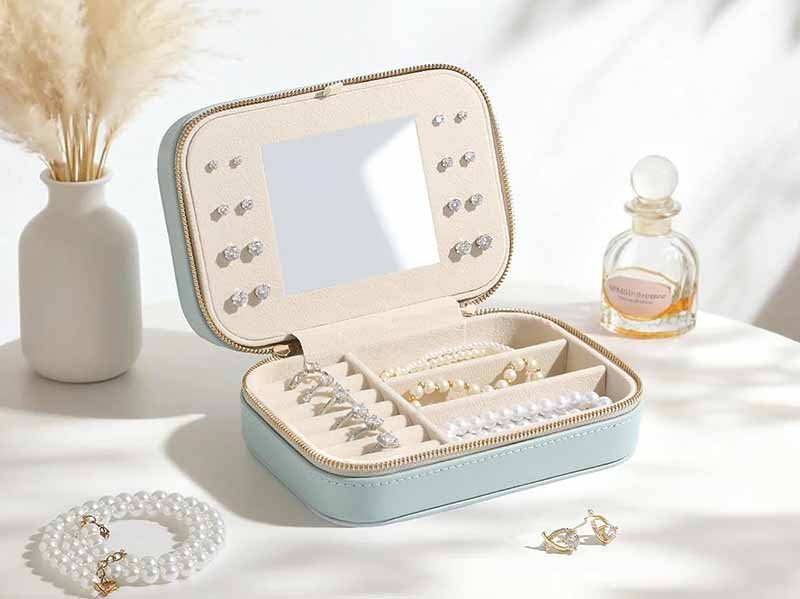
Soft linings prevent scratches through energy absorption, not just softness.
How linings actually work
- Distribute pressure across a wider surface
- Buffer vibration during movement and shipping
- Prevent hard contact between jewelry and internal board
However, lining effectiveness depends heavily on installation quality.
Common lining failures seen in rejected boxes
- Fabric glued without tension → wrinkles form
- Foam layer too thin → jewelry touches hard board
- Lining cut flush to board → exposed hard edges
- Glue overspill → hardened scratch points
Recommended interior build structure
- Outer leather shell
- Rigid board (wood or MDF)
- 3–6 mm foam buffer
- Tension-wrapped lining fabric
Boxes built with this structure show 30–45% fewer scratch complaints after vibration testing compared to single-layer linings.
How Does Structure Affect Jewelry Leather Boxes Protection?
Even with good compartments and linings, poor structure can still cause scratches. Lid clearance, hinge placement, internal tolerances, and edge finishing determine whether jewelry rubs, compresses, or contacts hard parts. Structural problems often cause hidden damage that appears only after shipping or weeks of use.
How Do Lids and Hinges Impact Jewelry Leather Boxes Safety?
Lids and hinges are among the most overlooked scratch sources.
Common lid-related problems
- Lid presses jewelry into lining → pressure marks
- Lid too loose → vertical movement during handling
- Internal hinge plates not fully covered
- Uneven closing force causing side friction
Safe lid design guidelines
- Minimum clearance above tallest jewelry: 3–5 mm
- No exposed metal hardware inside the box
- Full lining coverage over hinge zones
- Even pressure distribution when closed
Test result insight
In drop and vibration testing, boxes with insufficient lid clearance generated up to 2× more micro-scratches than boxes with controlled clearance—even using the same lining material.
Which Edge Designs Reduce Friction in Jewelry Leather Boxes?
Edges cause scratches quietly and consistently.
High-risk edge conditions
- Sharp internal board corners
- Lining cut flush instead of wrapped
- Hardened glue lines near jewelry zones
Best-performing edge solutions
- Rounded board corners (R3–R5 radius)
- Fully wrapped lining around edges
- Foam extending slightly past board edge
- No exposed seams or glue ridges
| Edge Treatment Method | Scratch Risk |
|---|---|
| Sharp board + flat lining | High |
| Rounded board + flat lining | Medium |
| Rounded board + wrapped lining | Low |
| Rounded + wrapped + foam buffer | Very low |
How Are Jewelry Leather Boxes Tested for Scratch Prevention?
Scratch prevention is verified through movement, abrasion, drop, and vibration tests that simulate real handling and shipping. Jewelry leather boxes that pass appearance checks but skip movement testing often fail after delivery. Testing must focus on jewelry behavior inside the box, not just box strength.
How Do Brands Test Jewelry Leather Boxes for Daily Use?
Effective factories test boxes using jewelry-in-box scenarios, not empty shells.
Common daily-use tests include:
- Open/close cycle testing (3,000–5,000 cycles)
- Jewelry rub testing against lining
- Slot retention pressure testing
- Insert stability checks
Boxes that fail typically show:
- Slot collapse
- Lining pilling
- Jewelry shifting marks
- Insert deformation
How Do Jewelry Leather Boxes Perform During Shipping?
Shipping creates more scratches than daily use if boxes aren’t designed correctly.
Shipping stress factors
- Vertical drops
- Continuous vibration
- Temperature changes affecting foam elasticity
Effective shipping-safe design features
- Tight internal tolerances
- Minimal headspace
- Secondary inner wrap for premium items
- Stable insert fixation
Brands that include shipping simulation testing report significantly lower after-sales damage, especially in cross-border shipments.
How Can Brands Customize Jewelry Leather Boxes Safely?
Brands can customize jewelry leather boxes without increasing scratch risk by controlling logo placement, material layering, color contrast, and internal tolerances. Safe customization focuses on what customers touch and how jewelry moves, not just visual impact. The key is adding branding where friction is low and reinforcing areas where pressure increases.
What Branding Details Work Best on Jewelry Leather Boxes?
Branding should enhance perceived value without creating new friction points. In practice, many scratch issues appear after brands add logos or decorative elements in the wrong places.
Low-risk branding options (recommended)
- Debossed or blind-embossed logos on the exterior leather
- Foil stamping on flat, non-contact surfaces
- Interior logo on lid lining, above jewelry height
- Metal logo plates placed outside, never inside compartments
High-risk branding choices (use carefully)
- Raised interior logos near jewelry zones
- Hard metal badges inside the box
- Thick embroidery near ring or necklace areas
- Decorative studs or rivets close to compartments
| Branding Method | Visual Impact | Scratch Risk |
|---|---|---|
| Blind emboss (exterior) | Medium | Very low |
| Foil stamp (exterior) | High | Very low |
| Interior printed logo | Medium | Low |
| Interior metal logo | High | High |
How Do Brands Balance Cost and Protection in Jewelry Leather Boxes?
Scratch prevention doesn’t always mean “higher cost.” It means spending money in the right places.
Where spending actually reduces complaints
- Better lining fabric (microfiber over flannel)
- Proper foam thickness (3–6 mm)
- Insert stability and tight tolerances
- Rounded internal edges
Where overspending adds little protection
- Thicker exterior leather
- Overly complex outer shapes
- Decorative hardware with no functional role
Cost vs protection comparison (factory view)
| Upgrade Option | Cost Impact | Scratch Reduction |
|---|---|---|
| Upgrade lining material | Low–Medium | High |
| Add foam buffer | Low | High |
| Improve compartment sizing | Low | High |
| Thicker outer leather | Medium | Low |
| Decorative metal parts | Medium–High | None |
Why Choose Szoneier for Custom Jewelry Leather Boxes?
Jewelry leather boxes are not one-size-fits-all. At Szoneier, we design boxes around how jewelry is actually used, not just how it looks in photos.
What Szoneier Does Differently
Material-driven design
We match lining, foam, and leather types to jewelry material (gold, silver, plated, gemstone).
Compartment-first development
Inserts are designed around jewelry dimensions before exterior styling.
Scratch-risk review before sampling
We identify friction points and movement risks during design—not after complaints.
Low-MOQ customization
Suitable for brands testing new collections or seasonal packaging.
In-house sampling & QC
Faster iteration, tighter tolerances, consistent quality.
Typical Customization Options We Support
- Ring, earring, necklace, bracelet layouts
- Travel boxes vs retail display boxes
- Magnetic, zipper, or hinge closures
- Color matching for brand collections
- Logo embossing, foil, lining print
- Gift-ready or shipping-ready packaging
Conclusion
Scratches don’t come from bad luck. They come from movement, friction, and hard contact—all of which can be designed out of a jewelry leather box.
When compartments fit correctly, linings are stable, structure is balanced, and branding is placed thoughtfully, jewelry arrives and stays exactly as customers expect it to be.
If you’re planning a new jewelry collection, upgrading packaging, or solving scratch complaints, Szoneier can help you:
- Review your current box design
- Recommend safer compartment layouts
- Optimize materials without overpricing
- Develop custom samples quickly
Contact Szoneier today to discuss your jewelry leather box project and get professional guidance from design to production.