
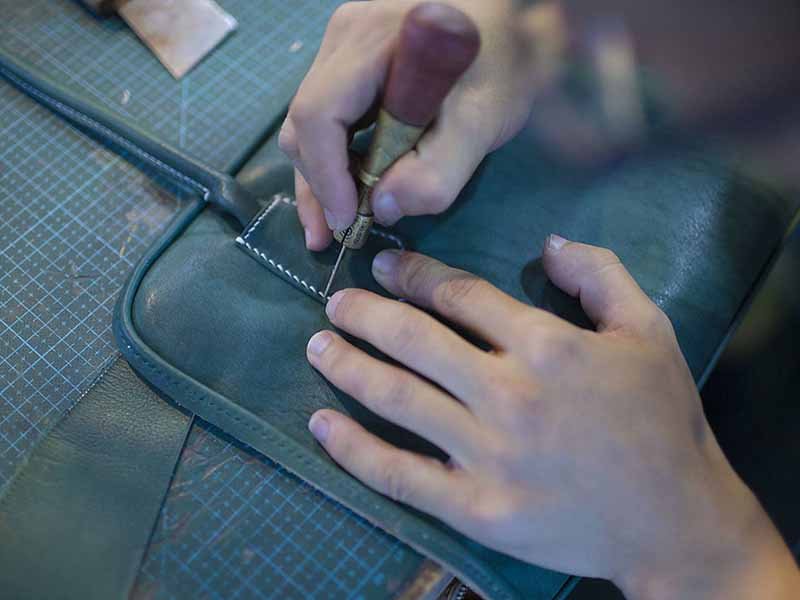
A leather bag can have premium leather, perfect edges, and expensive hardware—and still fail at the seam. That’s because seams are the “hinge points” of a bag: they take bending, twisting, pulling, and shock loads every day. When a customer loads a tote with a laptop, swings it by the handles, or yanks a zipper open, the seam doesn’t just hold pieces together; it carries dynamic stress. If stitch density is wrong, one of two things happens: the thread breaks because each stitch carries too much load, or the leather tears because too many holes create a perforation line.
Stitch density in leather bags is measured in stitches per inch (SPI) and should be set based on leather thickness, leather softness, seam location, thread size, and needle point. Strong, long-lasting seams commonly use 5–7 SPI for structural seams on medium-to-thick leather, and 7–9 SPI for lighter panels or decorative lines. Matching SPI with thread/needle and reinforcing load zones prevents seam failure.
One factory manager once said the most expensive defect is the one that looks “small”—a 3 cm seam opening can destroy a brand’s trust faster than a broken zipper. Stitch density is one of the few quality levers you can adjust early and protect your product for years. Let’s break it down clearly.
What is stitch density in leather bags?
Stitch density is the spacing of stitches along a seam, usually stated as SPI (stitches per inch). It affects seam strength, seam flexibility, and the risk of leather tearing around stitch holes. Proper stitch density spreads load across enough stitches without weakening the leather by over-perforating it. Different parts of the same bag should use different SPI based on stress and leather properties.
What does SPI mean in leather stitching?
SPI = Stitches Per Inch, the most practical unit for factories because it converts directly to stitch length and machine settings.
- Higher SPI = shorter stitch length, more holes per inch
- Lower SPI = longer stitch length, fewer holes per inch
Quick conversion for production teams:
| SPI | Approx. stitch length (mm) | What it looks like |
|---|---|---|
| 4 | ~6.35 mm | bold, wide spacing |
| 5 | ~5.08 mm | strong utility stitch |
| 6 | ~4.23 mm | balanced structural stitch |
| 7 | ~3.63 mm | cleaner look, still strong |
| 8 | ~3.18 mm | fine stitch, more perforation |
| 9 | ~2.82 mm | very fine, decorative/light load |
SPI is one reason a bag “feels” premium. But premium doesn’t mean maximum SPI. Premium means the right SPI in the right place.
How does stitch density affect seam strength?
Seam strength is a system. You’re balancing thread load, leather between holes, and movement stress.
Think of the seam like a chain:
- If stitches are too far apart, each stitch carries more load → thread breaks or seam opens.
- If stitches are too close, leather becomes a tear line → leather splits along holes.
- If SPI is balanced, load is shared and leather remains intact.
Here are the most common failure patterns tied to SPI:
| SPI problem | What happens first | What the customer sees |
|---|---|---|
| Too low (wide stitches) | thread loosens / breaks | seam gap, thread ends |
| Too high (tight stitches) | leather tears at holes | rip line near seam |
| Wrong tension + high SPI | puckering + weak edge | wavy seam, early cracking |
| Wrong needle + high SPI | cut fibers | sudden seam tear |
Practical rule used in many factories:
For load seams, you want enough stitches to distribute force, but not so many that you turn leather into “paper perforation.”
Which parts of a leather bag need higher SPI?
Not all seams are equal. Some seams carry weight. Others are mainly cosmetic. Using one SPI everywhere is a common reason for seam complaints.
High-load zones (use lower-to-mid SPI + reinforcement):
- Handle bases and strap anchors
- Side seams on tote bags
- Bottom panel joins
- Shoulder strap tabs and D-ring mounts
Lower-load zones (can use higher SPI for appearance):
- Flaps, trims, decorative topstitch lines
- Interior pockets
- Lining attachment seams
A practical SPI map:
| Bag area | Stress level | Recommended SPI | Extra note |
|---|---|---|---|
| Handle anchor seam | Very high | 5–6 | add box stitch / bartack |
| Strap tab seam | High | 5–7 | reinforce with backing patch |
| Side structural seam | High | 5–7 | avoid over-perforation |
| Bottom seam | High | 5–6 | use thicker thread |
| Zipper tape seam | Medium | 6–8 | match needle to tape+leather |
| Decorative topstitch | Low | 7–9 | focus on straightness |
| Interior pocket | Low | 8–10 | thin thread, lower tension |
If a bag is meant to carry weight (work tote, travel bag), handle seams are not the place for “fine fashion stitches.” Strength beats prettiness there.
Which stitch density works for different leather types?
The right stitch density depends mainly on leather thickness and temper (softness). Thick, firm leather often performs best at 5–6 SPI in structural seams. Medium leather commonly uses 6–7 SPI, and thin or soft leather may need 7–9 SPI to distribute tension. Coated or laminated leathers typically use 6–8 SPI with careful needle selection to prevent surface cracking.
Which SPI suits thick leather vs thin leather?
Thickness controls how much leather remains between holes. Thin leather has less “meat” around holes, so spacing must help distribute stress without tearing.
Recommended starting ranges:
| Leather thickness (mm) | Common bag parts | Recommended SPI | Main risk if wrong |
|---|---|---|---|
| 0.9–1.2 | linings, light panels | 8–10 | tearing if too low |
| 1.3–1.6 | wallets, light bags | 7–9 | puckering if tension high |
| 1.7–2.0 | most handbags | 6–8 | balanced zone |
| 2.1–2.6 | straps, structural panels | 5–7 | perforation if too high |
| 2.7–3.5 | belts/handle cores | 4–6 | thread break if too low |
When thickness increases, many teams lower SPI slightly and increase thread size, because the leather can carry load and you want fewer holes.
How does soft leather change stitch density needs?
Soft leather stretches and rebounds. That sounds good, but it creates two problems:
- Stitches can “saw” into the leather under load
- Seams can wave or pucker if tension is wrong
Adjustments for soft leather:
- Use slightly higher SPI (often +1 SPI compared to firm leather of same thickness)
- Reduce machine tension to avoid wrinkling
- Use a needle that pierces cleanly, not aggressively cutting fibers
Practical guidance:
| Leather temper | Example feel | Recommended SPI shift | Why |
|---|---|---|---|
| Firm | structured, holds shape | baseline | stable seam line |
| Medium | classic handbag feel | baseline | balanced |
| Soft | drapey, slouchy | +1 SPI | better load distribution |
| Very soft | lambskin-like | +1 to +2 SPI | prevent localized tearing |
Soft leather feels luxury—but it punishes bad stitching choices faster. That’s why many soft-leather bags fail at corners and strap tabs if standards aren’t strict.
Do coated or laminated leathers need different SPI?
Yes. Coated and laminated leathers can crack or show “white stress lines” if stitching is too aggressive.
Main risks:
- Too high SPI → many holes weaken coating line
- Too low SPI → stress concentrates between stitches
- Wrong needle → coating chips around holes
Safer starting ranges:
| Surface type | Recommended SPI | Key needle/setting note |
|---|---|---|
| Light PU-coated leather | 6–8 | clean pierce, avoid tearing |
| Heavily finished leather | 6–7 | reduce tension, prevent cracking |
| Laminated fashion leather | 7–8 | avoid tight stitch + high tension |
Customer-facing advantage:
When SPI and needle are correct, coated leathers stay cleaner longer and resist staining—but if stitching is wrong, cracks show early and look like “cheap leather,” even when the base hide is fine.
Quick “Standard SPI Range” Table for OEM Orders
This is a simple reference sheet brands often include in tech packs:
| Product type | Main load seams SPI | Decorative SPI | Notes |
|---|---|---|---|
| Work tote | 5–6 | 7–8 | reinforce handles |
| Crossbody bag | 5–7 | 7–9 | strap tabs are critical |
| Backpack | 5–6 | 7–8 | bottom and shoulder straps |
| Fashion handbag | 6–7 | 8–9 | balance look + strength |
| Mini bag | 6–8 | 8–10 | thin leather, fine look |
How do thread and needle choices prevent seam failure?
Seam durability in leather bags depends heavily on thread material, thread thickness, needle size, and needle point geometry. Even with correct stitch density, poor thread or needle selection can cause fraying, leather tearing, or early seam breakage. Matching SPI with thread size and needle type distributes stress evenly, protects leather fibers, and keeps seams intact during long-term daily use.
Thread and needle decisions are often underestimated because they are less visible than leather or hardware. Yet in real warranty cases, thread breakage and hole tearing are among the most common root causes of seam failure. Correct engineering here dramatically reduces returns.
Which thread types last longer in leather bags?
Leather bags require high-tensile, abrasion-resistant threads that tolerate bending, pulling, and environmental exposure. The two dominant industrial options are bonded nylon and bonded polyester, each with specific strengths.
| Thread type | Strength | UV resistance | Abrasion resistance | Best use |
|---|---|---|---|---|
| Bonded nylon | Very high | Medium | Excellent | structural seams, handles |
| Bonded polyester | High | Very high | Very good | outdoor bags, light colors |
| Cotton/poly blend | Medium | Low | Medium | decorative seams only |
| Linen thread | Medium | Low | Low | hand-stitch luxury, not heavy load |
Practical production insight:
- Bonded nylon remains the most common for load-bearing seams because of its superior tensile strength and flexibility.
- Bonded polyester is preferred where sunlight exposure or color stability matters, such as light-colored handbags or travel bags.
Using decorative threads in structural seams is a frequent cause of early seam opening.
How does thread size match SPI?
Thread thickness must align with stitch density. If thread is too thin for the SPI, it cannot carry load. If too thick, it forces holes too large and weakens leather.
General matching logic:
- Lower SPI → thicker thread
- Higher SPI → thinner thread
| SPI range | Common thread size (Tex) | Seam role |
|---|---|---|
| 4–5 SPI | Tex 135–210 | heavy load seams, straps |
| 5–6 SPI | Tex 90–135 | structural bag seams |
| 6–7 SPI | Tex 70–90 | general construction |
| 7–9 SPI | Tex 45–70 | decorative or light panels |
| 9–10 SPI | Tex 30–45 | small accessories, lining |
When fine thread is used with low SPI, seams often fail suddenly because each stitch carries too much tension.
Which needle points reduce leather tearing?
Needle geometry determines how fibers are separated or cut during stitching. Incorrect needle choice can weaken leather even if SPI and thread are correct.
Common industrial needle point styles:
| Needle point | Penetration style | Effect on leather | Best use |
|---|---|---|---|
| Diamond point | slices fibers cleanly | strong seam, minimal distortion | thick leather seams |
| LR (reverse twist) | angled cut | decorative slanted stitch look | visible topstitch |
| Round point | pushes fibers aside | safer for fabric, not leather | lining only |
| Triangular point | aggressive cut | strong penetration, higher tear risk | very thick leather |
If seam edges show micro-cracks around holes, the needle point is often too aggressive or too large.
What seam failures happen most, and why?
The most common leather bag seam failures include tear-out along stitch holes, thread breakage, seam burst under load, and corner abrasion damage. These problems usually result from incorrect SPI, weak thread, poor reinforcement, or uneven load distribution. Identifying failure patterns early allows factories to correct stitching standards before mass production.
Seam failure rarely comes from one mistake. It is typically the combined effect of SPI, thread, needle, leather temper, and structural design.
What causes seam tearing near stitch holes?
Hole tearing happens when leather between stitches becomes too weak to resist tension.
Main technical causes:
- Excessively high SPI creating a perforation line
- Needle diameter too large for leather thickness
- Soft leather under high load without reinforcement
| Cause | Mechanical effect | Visible symptom |
|---|---|---|
| Too many stitches | perforation weakening | straight tear along seam |
| Oversized needle | fiber cutting | cracks around holes |
| No reinforcement | stress concentration | tearing at handles or tabs |
What causes thread breakage and fraying?
Thread failure often appears after weeks or months of use, not immediately.
Primary reasons:
- Thread tensile strength too low
- Abrasion against hardware or edges
- UV or moisture degradation
| Failure source | Result | Prevention |
|---|---|---|
| Low-strength thread | sudden seam opening | use bonded nylon/polyester |
| Edge abrasion | gradual fraying | smooth edge paint, spacing |
| Sun exposure | brittle thread | choose polyester thread |
Thread problems are among the most frequent customer complaints because they quickly become visible.
How do load zones and bag structure affect seams?
Even perfect stitching cannot compensate for poor structural design. Load must be distributed across panels, not concentrated on a single seam.
Critical load-bearing areas:
- Handle bases
- Shoulder strap anchors
- Bottom corners
- Zipper ends
| Structure issue | Seam consequence | Engineering fix |
|---|---|---|
| Single-layer handle tab | seam tearing | add backing reinforcement |
| Thin bottom panel | seam burst | insert support board |
| Sharp corner fold | abrasion crack | round edge + edge paint |
Durable leather bags rely on structure first, stitching second.
How do you set stitching standards for OEM production?
Reliable OEM stitching standards define SPI ranges by leather thickness, approved thread sizes, needle types, reinforcement rules for load zones, and seam strength test requirements. Standardization prevents inconsistency across production batches, reduces seam failure risk, and ensures predictable durability for branded leather bags in global retail markets.
Without written stitch standards, even skilled sewing lines produce variable seam quality. Consistency—not just craftsmanship—is what protects brands from returns and warranty costs.
What SPI ranges should a factory standardize?
Professional factories rarely use a single SPI value. Instead, they define controlled SPI windows for each leather thickness and seam function.
A practical OEM SPI matrix:
| Leather thickness | Structural seam SPI | Decorative seam SPI | Typical products |
|---|---|---|---|
| 1.0–1.3 mm | 7–9 | 8–10 | mini bags, light panels |
| 1.4–1.8 mm | 6–8 | 7–9 | handbags, crossbody bags |
| 1.9–2.4 mm | 5–7 | 6–8 | totes, satchels |
| 2.5–3.0 mm | 4–6 | 6–7 | straps, handles |
| 3.0 mm+ | 4–5 | 5–6 | belts, heavy handles |
Structural seams must always prioritize load capacity over visual fineness. Many seam failures begin when decorative SPI is mistakenly used in high-stress zones.
Which seam tests catch weak stitching early?
Testing seams before mass production is one of the lowest-cost, highest-impact quality controls in leather bag manufacturing.
Common industrial seam tests:
| Test method | What it measures | Typical acceptance level |
|---|---|---|
| Seam tensile pull | Maximum load before failure | ≥ 180–300 N (depends on bag type) |
| Stitch fatigue cycling | Long-term durability | 5,000–20,000 cycles |
| Handle load suspension | Real carry simulation | 72-hour static load |
| Abrasion rubbing test | Thread wear resistance | No break after set cycles |
These tests simulate months or years of real use within hours. Brands that skip seam testing often discover defects only after products reach customers.
How should brands write a stitch specification sheet?
Clear technical documentation allows factories to reproduce identical seam quality across orders. Without it, SPI, thread, and reinforcement may change unintentionally.
Essential items in a stitch spec sheet:
- Leather thickness and temper range
- SPI requirement by seam location
- Approved thread material and size
- Needle type and size
- Reinforcement method for load zones
- Minimum seam strength test value
A simplified example structure:
| Spec category | Example requirement |
|---|---|
| Handle seam SPI | 5–6 SPI with Tex 135 nylon |
| Side seam SPI | 6–7 SPI with Tex 90 polyester |
| Needle type | Diamond point size 23 |
| Reinforcement | Double-layer leather backing |
| Tensile test | ≥ 220 N pass value |
Documentation like this transforms design intent into repeatable manufacturing quality.
Start Your Custom Leather Bag Project with SzoneierLeather
Stitch density standards are not just a technical topic—they are a core indicator of real leather bag quality. Correct SPI, matched thread and needle, reinforced structure, and verified seam strength together determine whether a bag lasts for months or for years.
With more than 18 years of leather product development and manufacturing experience, SzoneierLeather provides:
- Stable full-grain and top-grain leather sourcing
- Precise SPI control for different bag structures
- Professional thread, needle, and reinforcement engineering
- Complete seam strength testing and QC inspection
- Low-MOQ sampling with efficient production timelines
- Consistent bulk manufacturing for global brands
Whether you are developing a new private-label leather bag line or upgrading an existing product to reduce warranty risk, our engineering team can deliver durable, production-ready stitching solutions tailored to your market.
Contact SzoneierLeather today to request samples, review stitch specifications, or receive a detailed quotation.
Because in leather bags, true quality is not only seen on the surface—it is proven in every seam that never fails.