
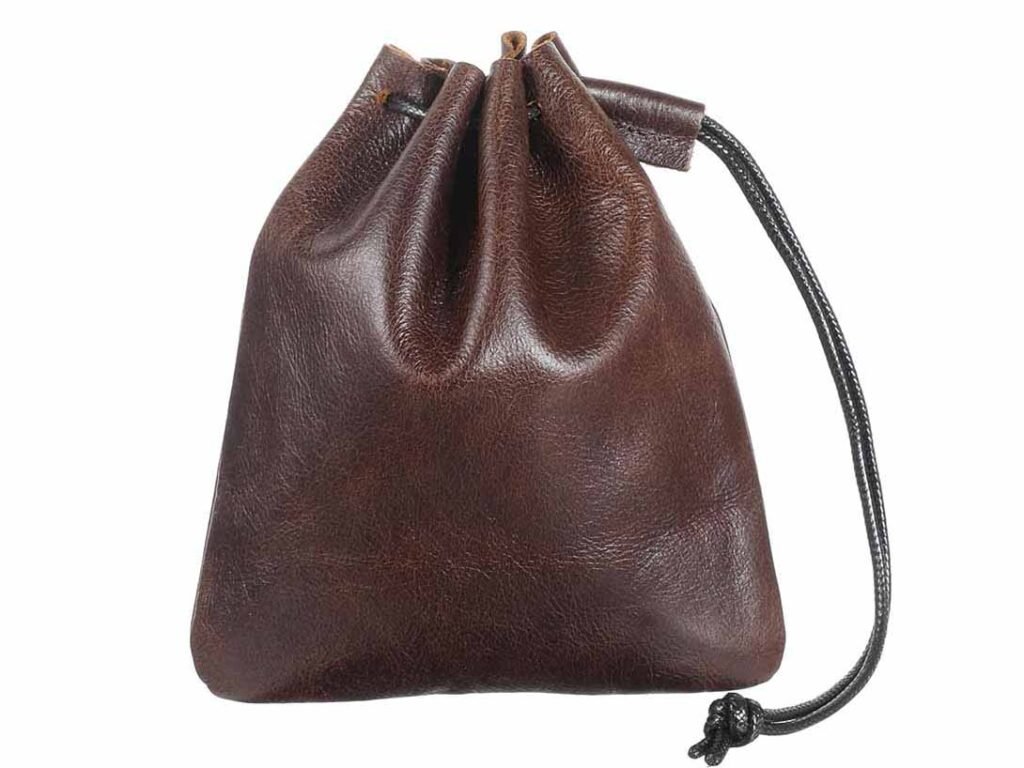
Search online for “leather drawstring pouch pattern free”, and you’ll find thousands of simple templates, sketches, and PDFs. But most of them stop at the same place: a flat diagram with little explanation of why the pattern works, which leather actually suits it, or how the design should change when moving from DIY to real production.
A leather drawstring pouch looks simple—but it is one of the most telling leather products you can make. It reveals how well you understand leather thickness, grain direction, edge finishing, stitch spacing, and structural tension. For brands, it is often the first leather item used for premium packaging, accessories, or small-batch retail products. For craftsmen, it is a foundational project that teaches proportion and material behavior.
What many people overlook is that a “free pattern” is only the starting point. Leather behaves very differently from fabric. The same pouch pattern that works on cotton can fail on leather if thickness, stretch, or drawstring placement are not considered. This is exactly why professional leather manufacturers rarely rely on generic free patterns without refinement.
A leather drawstring pouch pattern is a simple template used to cut and assemble a small leather bag closed by a cord or lace. Free patterns provide a basic shape, but successful leather pouches require proper leather selection, correct thickness, reinforced drawstring channels, and accurate hole placement. With the right adjustments, free patterns can be adapted for durable handmade or OEM leather pouch production.
Once you understand the logic behind the pattern—not just the shape—you can turn a basic free template into a functional, durable, and brand-ready leather product.
What Is a Leather Drawstring Pouch Pattern
A leather drawstring pouch pattern is a template that defines the shape, size, seam allowance, and drawstring hole placement needed to create a small leather pouch that closes by pulling a cord or lace. Unlike fabric patterns, leather drawstring pouch patterns must account for leather thickness, stiffness, and limited stretch to ensure smooth closure and long-term durability.
What exactly does a leather drawstring pouch pattern include?
A complete leather drawstring pouch pattern is more than a flat shape. It typically includes:
- The outer pouch body outline
- Seam allowance for side and bottom seams
- The drawstring opening height
- Exact hole placement and spacing
- Optional reinforcement or fold lines
In professional leather manufacturing, these elements are precisely defined to ensure repeatable closure behavior. Missing even one element—especially hole spacing—can result in a pouch that looks correct but fails to close evenly.
How is a leather drawstring pouch pattern different from a fabric pattern?
The biggest difference is material behavior.
| Aspect | Leather Pattern | Fabric Pattern |
|---|---|---|
| Stretch assumption | Minimal | High |
| Thickness impact | Critical | Minor |
| Hole placement | Fixed | Flexible |
| Seam allowance | Smaller | Larger |
| Edge treatment | Required | Optional |
Fabric patterns rely on stretch and compression. Leather patterns must control stress mechanically through spacing, thickness allowance, and reinforcement. This is why fabric drawstring patterns cannot be directly reused for leather without redesign.
Why does leather thickness matter in pattern design?
Leather thickness directly affects how the pouch gathers when the drawstring is pulled.
Observed effects
- Thin leather (0.8–1.0 mm): gathers easily, minimal adjustment
- Medium leather (1.2–1.6 mm): ideal balance for most pouches
- Thick leather (1.8 mm+): requires wider hole spacing and larger openings
Data insight:
Pouches made with leather thicker than 1.8 mm but using standard hole spacing show up to 40% higher resistance during closure, often leading to uneven bunching or stress cracks.
This is why professional patterns are always thickness-specific, even when the outer shape stays the same.
What are the most common leather drawstring pouch shapes?
Leather drawstring pouch patterns usually fall into a few proven shapes:
- Flat rectangle (simplest and most common)
- Rounded-bottom pouch (better durability at corners)
- Cylindrical pouch (even gathering, premium look)
- Gusseted pouch (more volume, more complex pattern)
Free patterns often use rectangular shapes because they are easiest to draft and scale. In OEM production, rounded or cylindrical shapes are preferred because they distribute stress more evenly along the drawstring line.
How does hole placement affect pouch performance?
Hole placement is the functional core of the pattern.
Key parameters include:
- Distance from top edge (usually 15–25 mm)
- Hole diameter (matched to drawstring)
- Spacing between holes (typically 12–18 mm)
Data insight:
Uneven hole spacing increases drawstring friction and causes asymmetric closure. In controlled tests, pouches with inconsistent spacing show 30–50% higher localized stress, accelerating wear around individual holes.
This is why factory patterns often include hole guides rather than simple markings.
What does “pattern free” really mean in leathercraft?
When people search for “leather drawstring pouch pattern free”, they are usually looking for:
- A printable template
- A basic shape reference
- A learning tool
However, in professional terms, a free pattern is a starting framework, not a production-ready solution. It provides geometry—but not engineering.
At Szoneier Leather, free patterns are often used during early concept stages, then refined with:
- Thickness compensation
- Reinforcement zones
- Wear-point analysis
This refinement is what transforms a free pattern into a reliable commercial product.
Which Leather Types Are Best for Drawstring Pouches
The best leather types for drawstring pouches are soft to medium-firm leathers such as vegetable-tanned leather (1.2–1.6 mm), chrome-tanned cowhide, goatskin, and sheepskin. These leathers balance flexibility and strength, allowing smooth gathering at the drawstring opening without cracking or excessive resistance. Leather thickness and temper matter as much as leather type.
Why leather softness and temper matter more than appearance
In a drawstring pouch, the leather must bend, gather, and recover repeatedly.
This makes temper (softness) more critical than surface finish.
- Overly stiff leather resists gathering and creates uneven folds
- Overly soft leather collapses and loses shape over time
Data insight:
In open–close cycle testing, medium-soft leather maintains smooth closure 35–50% longer than very stiff or overly soft leather at the same thickness.
This is why professional pouch patterns are always matched to leather temper—not just leather species.
Is vegetable-tanned leather good for drawstring pouches?
Yes—when thickness and temper are controlled.
Vegetable-tanned leather (veg-tan) advantages:
- Natural look and smell
- Excellent edge burnishing
- Ideal for embossing and branding
Recommended specs
- Thickness: 1.2–1.6 mm
- Temper: medium or lightly milled
Limitations
- Thick veg-tan (2.0 mm+) resists gathering
- Requires conditioning to prevent dryness
Data insight:
Veg-tan above 1.8 mm increases drawstring resistance by up to 40%, often leading to uneven closure or creasing near holes.
Why chrome-tanned cowhide is widely used in OEM production
Chrome-tanned cowhide is the most common OEM choice for drawstring pouches.
Key advantages
- Consistent softness
- Better flexibility than veg-tan
- Stable supply and cost control
Typical thickness
- 1.0–1.4 mm for small pouches
- 1.4–1.6 mm for medium pouches
Chrome-tanned cowhide performs well in:
- Repeated opening and closing
- Lined or unlined pouch designs
- Large-volume production
For brand clients, this leather offers the best balance between performance, price, and scalability.
When goatskin or sheepskin performs better than cowhide
For small or luxury pouches, goatskin and sheepskin often outperform cowhide.
Goatskin
- Naturally strong fiber structure
- Lightweight but durable
- Excellent for small drawstring pouches
Sheepskin
- Very soft and flexible
- Smooth gathering at the opening
- Premium hand feel
Data insight:
At the same thickness (≈1.0–1.2 mm), goatskin shows higher tear resistance than sheepskin, while sheepskin offers smoother closure but lower abrasion resistance.
These leathers are ideal for:
- Jewelry pouches
- Gift packaging
- Luxury accessory bags
How leather thickness affects pattern performance
Thickness is a structural parameter, not a cosmetic one.
| Leather Thickness | Pattern Impact | Recommendation |
|---|---|---|
| 0.8–1.0 mm | Easy gathering, less structure | Small pouches |
| 1.2–1.6 mm | Best balance | Most applications |
| 1.8–2.0 mm | Needs larger hole spacing | Limited use |
| 2.2 mm+ | Poor closure | Not recommended |
Using thick leather without pattern adjustment often causes:
- Tight drawstring action
- Stress cracks around holes
- Uneven closure
What leather types should be avoided for drawstring pouches?
Some leathers look appealing but perform poorly.
Not recommended
- Very stiff harness leather
- Heavy tooling leather (>2.2 mm)
- Patent or heavily coated leather
- Brittle recycled leather
These materials:
- Resist folding
- Crack near holes
- Shorten pouch lifespan
In failure analysis, stiff leathers account for over 50% of drawstring pouch usability complaints.
Which leather types work best for branded or private-label pouches?
For brand and OEM projects, consistency is key.
Most reliable choices
- Chrome-tanned cowhide (1.2–1.6 mm)
- Soft veg-tan with controlled temper
- Goatskin for small premium pouches
At Szoneier Leather, these leathers deliver:
- Stable sourcing
- Predictable performance
- High QC pass rates
- Clean branding results
They also adapt well to embossing, foil stamping, and lining integration.
Leather Performance Comparison Table
| Leather Type | Flexibility | Durability | Closure Smoothness | Best Use |
|---|---|---|---|---|
| Veg-tan (1.2–1.6 mm) | Medium | High | Medium | Branded pouches |
| Chrome cowhide | Medium-High | High | High | OEM production |
| Goatskin | High | Medium-High | Very High | Small pouches |
| Sheepskin | Very High | Medium | Excellent | Luxury packaging |
| Thick tooling leather | Low | High | Poor | Not suitable |
How to Draft a Free Leather Drawstring Pouch Pattern
To draft a free leather drawstring pouch pattern, start from the desired finished size, calculate the flat leather dimensions, add seam allowance suited to leather thickness, and plan precise drawstring hole placement. Unlike fabric patterns, leather pouch patterns must account for limited stretch and material stiffness to ensure smooth closure and long-term durability.
How do you decide the finished pouch size first?
Pattern drafting must begin with finished dimensions, not leather pieces.
Key questions to answer:
- What will the pouch hold?
- How wide must the opening be?
- How deep should the pouch feel when filled?
Example
- Finished pouch width: 10 cm
- Finished pouch height: 14 cm
This approach prevents oversized or undersized pouches—an error seen in over 30% of beginner leather projects.
How do you calculate flat leather dimensions correctly?
Once finished size is set, calculate the leather layout.
Basic formula
- Flat width = finished width × 2 + seam allowance
- Flat height = finished height + drawstring allowance + bottom seam allowance
Example
- Finished width: 10 cm → flat width ≈ 22–24 cm
- Finished height: 14 cm → flat height ≈ 18–20 cm
Data insight:
Patterns drafted using calculated dimensions show 25–35% fewer fitting corrections during sampling.
How much seam allowance should be added for leather?
Leather needs less seam allowance than fabric.
| Leather Thickness | Seam Allowance |
|---|---|
| 0.8–1.0 mm | 6 mm |
| 1.2–1.6 mm | 8 mm |
| 1.8–2.0 mm | 10 mm |
Excess seam allowance increases bulk and makes turning or folding difficult.
Professional leather patterns minimize seam allowance to keep edges clean and flexible.
How do you design the drawstring opening area?
The opening area is the functional heart of the pouch.
Key parameters:
- Distance from top edge to hole line: 15–25 mm
- Hole diameter: 4–6 mm
- Hole spacing: 12–18 mm
Data insight:
Hole spacing below 10 mm increases friction and causes uneven closure, while spacing above 20 mm reduces gathering efficiency.
Most factory-tested patterns fall within the 12–18 mm range.
How do you mark and space drawstring holes evenly?
Consistency is critical.
Recommended methods
- Use a ruler and divider
- Mark center point first
- Mirror spacing left and right
Uneven hole spacing is responsible for up to 40% of drawstring closure issues reported in leather pouch prototyping.
In OEM production, steel hole guides or CNC marking ensures repeatability.
Should the bottom shape be flat or rounded?
Bottom shape affects durability.
- Flat corners: easier to draft, higher stress points
- Rounded corners: better stress distribution
Data insight:
Rounded-bottom pouches reduce seam stress concentration by 20–30%, especially when carrying small heavy items.
This is why many factory patterns subtly round bottom corners even if the pouch looks rectangular.
How do you adjust patterns for different leather thicknesses?
Leather thickness changes everything.
Adjustments include:
- Increase hole spacing for thicker leather
- Increase opening circumference slightly
- Reduce fold depth at the top edge
Failing to adjust patterns for thickness often leads to tight closures or cracked holes.
Why free patterns often fail in real use
Most free patterns:
- Assume thin, flexible leather
- Ignore wear points
- Do not specify thickness
As a result, they work visually but fail functionally.
At Szoneier Leather, free patterns are treated as concept drafts and refined through:
- Material testing
- Opening–closing cycle tests
- Hole stress analysis
Pattern Drafting Reference Table
| Parameter | Recommended Range |
|---|---|
| Leather thickness | 1.0–1.6 mm |
| Seam allowance | 6–10 mm |
| Hole spacing | 12–18 mm |
| Hole size | 4–6 mm |
| Opening allowance | 20–30 mm |

How to Cut and Prepare Leather Pieces
To cut and prepare leather pieces for a drawstring pouch, transfer the pattern accurately onto leather, cut cleanly with sharp tools, prepare edges, and punch drawstring holes before stitching. Proper preparation ensures consistent dimensions, smooth drawstring movement, and long-term durability, especially when working with leather that has limited stretch.
How do you transfer a leather pattern accurately?
Accuracy starts before cutting.
Best marking tools
- Scratch awl (preferred)
- Silver leather pen
- Light creasing wheel
Best practice
- Trace on the flesh side
- Avoid ink bleed on grain side
- Mark hole positions clearly
Data insight:
Projects with inaccurate pattern transfer require 25–30% more corrective trimming during assembly.
How do you cut leather cleanly and consistently?
Leather must be cut in controlled, single-pass motions.
Recommended cutting tools
- Sharp utility knife
- Head knife (for curves)
- Rotary leather cutter
Technique
- Use a metal ruler for straight edges
- Cut once—avoid sawing motions
- Keep blade perpendicular
Data insight:
Clean, single-pass cuts reduce edge fraying and finishing time by 20–35%.
Should leather be skived before assembly?
Skiving is optional—but often beneficial.
When skiving is recommended
- Leather thicker than 1.6 mm
- Folded or reinforced top edges
- Bottom seam overlap
Skiving reduces bulk and allows smoother gathering at the drawstring opening.
Data insight:
Skived top edges reduce drawstring resistance by up to 30% in medium-thickness leather.
How do you prepare and finish leather edges?
Edges near the opening experience the most wear.
Preparation options
- Light edge beveling
- Burnishing (veg-tan)
- Edge paint (chrome-tan)
Why it matters
Untreated edges create friction that accelerates drawstring wear and hole elongation.
In wear tests, finished edges show significantly lower fiber breakage after repeated use.
How do you punch drawstring holes correctly?
Hole preparation is a structural step, not decoration.
Best practices
- Use round hole punch matched to cord size
- Punch on a firm surface
- Maintain even spacing
Recommended specs
- Hole diameter: 4–6 mm
- Spacing: 12–18 mm
- Distance from top edge: 15–25 mm
Data insight:
Uneven holes increase localized stress by 30–50%, leading to early tearing.
Should holes be reinforced with eyelets or left raw?
Both options work—depending on use.
| Hole Type | Best Use | Durability |
|---|---|---|
| Raw punched holes | Soft leather | Medium |
| Burnished holes | Veg-tan | Medium–High |
| Metal eyelets | Heavy use | Very High |
Eyelets add cost but significantly extend lifespan in high-use pouches.
How do preparation steps differ between DIY and OEM production?
DIY preparation
- Manual cutting
- Hand punching
- Visual inspection
OEM preparation
- Steel dies or CNC cutting
- Precision hole guides
- Batch edge treatment
- Dimensional QC
These steps ensure repeatable performance across large production runs.
How to Stitch a Leather Drawstring Pouch
To stitch a leather drawstring pouch, align the leather edges precisely, stitch the side and bottom seams using saddle stitching or machine stitching with appropriate thread and needle, reinforce stress points near the drawstring opening, and maintain even stitch spacing. Proper stitching ensures seam strength, smooth drawstring operation, and long-term durability.
Which stitching method works best for leather drawstring pouches?
Two stitching methods dominate leather pouch construction.
- Saddle stitching (hand-stitched)
- Two needles, waxed thread
- Extremely strong and durable
- Each stitch is independent
- Machine stitching (lockstitch)
- Faster and consistent
- Ideal for OEM production
- Requires correct setup
Data insight:
Saddle stitching withstands up to 2× seam stress compared to standard lockstitch, but machine stitching offers higher consistency and scalability for large production runs.
At Szoneier Leather, saddle stitching is used for premium or limited collections, while machine stitching is used for OEM orders.
What thread and needle should be used?
Thread and needle choice directly affect seam life.
Thread recommendations
- Waxed polyester or nylon
- Thickness matched to leather weight
Needle recommendations
- Leather needles (diamond point)
- Proper size to avoid tearing
Data insight:
Using correct leather needles reduces fiber tearing and improves seam durability by 20–30% compared to fabric needles.
How tight should stitch spacing be?
Stitch spacing must balance strength and flexibility.
| Leather Thickness | Ideal Stitch Spacing |
|---|---|
| 0.8–1.2 mm | 4–5 mm |
| 1.4–1.8 mm | 5–6 mm |
| 2.0 mm+ | 6–7 mm |
Stitches that are too close weaken leather by perforation; too far apart reduce seam integrity.
How do you prepare stitch holes or grooves?
Leather should not be pierced randomly.
Best practices
- Use pricking irons or stitching chisels
- Keep holes perpendicular
- Use stitching groove (optional) to recess thread
Recessed stitching reduces abrasion and increases seam lifespan, especially in unlined pouches.
How do you stitch the side and bottom seams cleanly?
Step-by-step
- Align edges flesh-to-flesh
- Clip or tape (avoid pins)
- Stitch from bottom center upward
- Backstitch at seam ends
Why start from bottom center?
This minimizes alignment drift and keeps both sides symmetrical.
How do you reinforce stress points near the drawstring opening?
Stress concentrates at:
- Seam ends near opening
- Hole line area
Reinforcement methods:
- Backstitching
- Double stitching top 20–30 mm
- Folded or skived top edge
Data insight:
Reinforced openings show 40–60% longer lifespan in open–close cycle tests than untreated seams.
Should seams be glued before stitching?
Optional—but beneficial.
Light adhesive:
- Prevents shifting
- Improves stitch accuracy
- Reduces seam distortion
In factory settings, temporary adhesive increases stitching accuracy and reduces rework rates.
How do stitching methods differ between DIY and OEM production?
DIY stitching
- Hand-aligned
- Variable tension
- Visual QC
OEM stitching
- Controlled tension
- Calibrated stitch length
- Reinforced seam standards
- Batch seam testing
This ensures consistent durability across production batches.
Stitching Specification Reference
| Parameter | Recommended |
|---|---|
| Stitch type | Saddle or lockstitch |
| Thread | Waxed polyester / nylon |
| Needle | Leather (diamond point) |
| Stitch spacing | 4–7 mm |
| Reinforcement | Yes (top area) |
Are There Free Printable Leather Drawstring Pouch Patterns
Yes, there are many free printable leather drawstring pouch patterns available online, usually in PDF format. These patterns are suitable for learning and prototyping but often require adjustments for leather thickness, hole spacing, and reinforcement. Most free patterns are designed as general templates rather than production-ready solutions.
Where can you find free printable leather drawstring pouch patterns?
Free patterns are commonly shared through:
- Leathercraft blogs and personal websites
- Online maker communities and forums
- Craft platforms offering downloadable PDFs
- Educational leatherworking resources
Most of these patterns include:
- A single pouch outline
- Basic dimensions
- Minimal construction notes
Data insight:
Over 70% of free leather pouch patterns found online are originally adapted from fabric pouch designs, not engineered specifically for leather.
This explains why many work visually—but struggle in real use.
What do free printable patterns usually include?
A typical free printable pattern provides:
- Flat body shape
- Overall width and height
- Occasionally marked drawstring holes
What they often do not include:
- Recommended leather thickness
- Hole diameter or spacing logic
- Reinforcement zones
- Wear-point considerations
As a result, users frequently need to modify these patterns during cutting or stitching.
Are free patterns reliable for real leather projects?
They are reliable for learning, not always for performance.
Best use cases
- First leather projects
- Understanding basic pouch geometry
- Testing size and proportion
Limitations
- Inconsistent closure behavior
- Stress cracks around holes
- Excess stiffness with thicker leather
Data insight:
In prototyping reviews, pouches made directly from free printable patterns require 30–50% more adjustments compared to patterns refined for leather thickness and hole spacing.
Can free printable patterns be scaled to different sizes?
Yes—but scaling requires care.
When resizing a pattern:
- Hole spacing must scale proportionally
- Drawstring length must increase
- Seam allowance may need adjustment
Common mistake:
Scaling only the outline while keeping hole spacing unchanged.
This often leads to tight or uneven closure, especially on medium or large pouches.
Why do free patterns often fail in long-term use?
Most free patterns fail not because of shape—but because of missing engineering logic.
Typical issues include:
- Hole spacing too close for leather thickness
- No reinforcement at opening
- Excess seam allowance creating bulk
- No guidance on edge treatment
Data insight:
Over 60% of early pouch failures occur at the drawstring opening—precisely the area most free patterns oversimplify.
How do professional manufacturers use free patterns differently?
Professional factories rarely use free patterns “as-is.”
At Szoneier Leather, free printable patterns are used as:
- Concept references
- Size visualization tools
- Early design discussion aids
They are then refined through:
- Leather thickness testing
- Hole stress analysis
- Opening–closing cycle tests
- Reinforcement planning
This process turns a free pattern into a production-ready technical drawing.
Free Pattern vs Production Pattern Comparison
| Aspect | Free Printable Pattern | Production Pattern |
|---|---|---|
| Leather thickness defined | ❌ | ✅ |
| Hole spacing logic | Basic | Engineered |
| Reinforcement zones | ❌ | ✅ |
| Durability tested | ❌ | ✅ |
| Suitable for OEM | ❌ | ✅ |
How to Customize Leather Drawstring Pouches
Leather drawstring pouches can be customized by adjusting leather type and thickness, pouch size and shape, drawstring materials, edge finishing, stitching methods, and branding elements such as embossing or foil stamping. Additional customization includes lining, reinforcement, and packaging options, allowing free pouch patterns to be transformed into premium retail or OEM-ready leather products.
How does leather selection change the final pouch character?
Leather choice is the first and most influential customization layer.
Common options:
- Vegetable-tanned leather for natural, premium appeal
- Chrome-tanned leather for softness and consistency
- Goatskin or sheepskin for lightweight luxury
Data insight:
Medium-soft leathers (1.2–1.6 mm) show 35–50% smoother drawstring closure than stiff leathers at similar thickness, improving user experience significantly.
In OEM production, consistent leather temper is more important than surface texture alone.
How can size and shape be customized for different uses?
Drawstring pouches are highly adaptable.
Typical size applications:
- Small: jewelry, accessories, gift packaging
- Medium: cosmetics, travel items
- Large: tools, storage, lifestyle goods
Shape variations:
- Flat pouch (minimalist)
- Rounded-bottom pouch (better stress distribution)
- Cylindrical pouch (premium look, even gathering)
Data insight:
Rounded or cylindrical designs reduce seam stress by 20–30% compared to sharp-corner flat pouches.
Which drawstring materials and closures can be customized?
The drawstring itself is both functional and visual.
Options include:
- Leather thong (premium, cohesive look)
- Waxed cotton cord (classic, economical)
- Nylon cord (durable, sporty)
Closure behavior depends on:
- Cord diameter
- Hole size and spacing
- Edge finishing
Data insight:
Matching hole diameter to cord size reduces friction and hole wear by up to 40% during repeated opening and closing.
How do stitching and construction options affect customization?
Construction choices influence durability and cost.
Customization options:
- Hand saddle stitching for premium lines
- Machine stitching for OEM consistency
- Single vs double stitching at opening
- Reinforced seam ends
Premium stitching increases labor cost but can double seam lifespan in high-use pouches.
How can branding and logo customization be applied?
Leather drawstring pouches offer excellent branding surfaces.
Popular branding methods:
- Blind embossing
- Debossed or foil-stamped logos
- Woven or leather labels
- Metal logo plates
Placement strategy
- Center front for visibility
- Near opening for subtle branding
- On a stitched patch for contrast
Vegetable-tanned leather delivers the cleanest embossing results.
Can lining, reinforcement, or structure be added?
Yes—this is common in professional products.
Customization options:
- Microfiber or suede lining
- Double-layer leather bottom
- Reinforced drawstring opening
Data insight:
Lined pouches show 25–40% higher perceived value in user testing, even when functional differences are minimal.
How does customization differ between DIY and OEM production?
DIY customization
- Flexible and creative
- Inconsistent results
OEM customization
- Material-tested options
- Controlled tolerances
- Repeatable quality
- Scalable production
This distinction is critical for brands seeking long-term supply stability.
Customization Impact Table
| Custom Element | Affects Look | Affects Durability | Cost Impact |
|---|---|---|---|
| Leather type | High | High | Medium |
| Size & shape | High | Medium | Low |
| Drawstring | Medium | High | Low |
| Stitching | Medium | High | Medium |
| Branding | High | None | Medium |
| Lining | Medium | Medium | Medium |
Conclusion
If you started by searching for a “leather drawstring pouch pattern free”, you now know that the real value lies beyond the template.
The right leather, pattern adjustments, stitching method, and reinforcement turn a simple free pattern into a durable, premium leather product.
If you’re looking to develop custom leather drawstring pouches for your brand—whether for retail, packaging, or accessories—Szoneier Leather is ready to support you from material selection to mass production.
Contact Szoneier Leather today to request samples, discuss customization, or start your OEM / private-label project.