
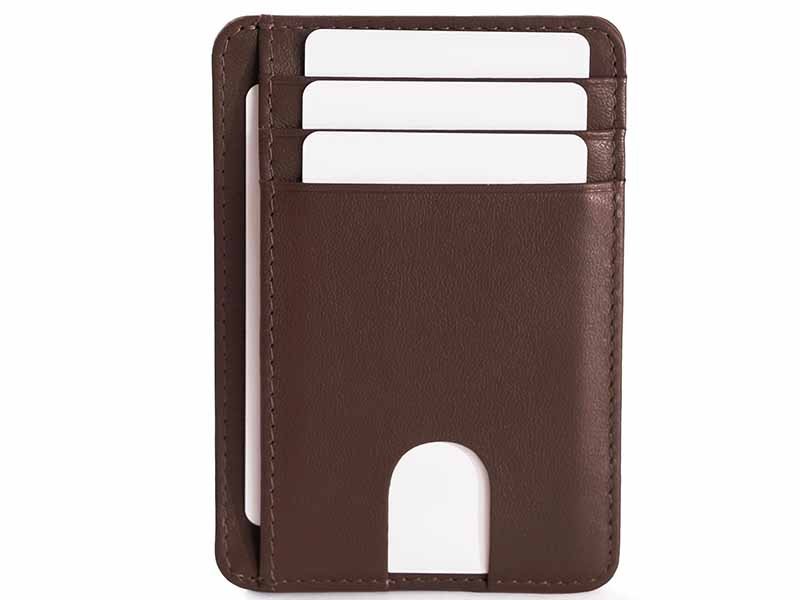
A card holder looks simple, but the material choice behind it affects almost everything that matters to a brand: how it feels in the hand, how long it lasts, how it ages, how stable production will be, and whether the final retail price makes sense in the target market. Many product developers hear that full grain leather is the “best” leather and stop there. In real product development, that is only half the story. For card holders, the better leather is not always the more expensive one. It is the one that matches the product’s positioning, thickness target, surface style, expected lifespan, and order budget.
For example, a slim card holder carried in a front pocket faces constant bending, rubbing, pressure, and skin contact. The leather must not only look good on day one. It must keep its shape, avoid premature edge failure, and maintain a clean appearance after months of daily use. That is where the difference between full grain and top grain becomes highly practical.
Full grain leather is usually better for premium card holders that need maximum durability, natural texture, and strong aging character. Top grain leather is often better for card holders that require a smoother look, more stable batch consistency, easier thickness control, and better cost efficiency in scaled production. Neither option is universally better. The right choice depends on product goals, target price, and customer expectations.
Many brands only realize this after sampling. A leather that looks impressive on a raw hide may become too bulky after folding, or too inconsistent for a large retail program. On the other hand, a cleaner and more controlled leather may produce a better-selling card holder simply because it performs better in the real world. That is why material selection should be treated as a product strategy decision, not just a sourcing step.
What Is Full Grain Leather?
Full grain leather is the outermost layer of the hide with its natural grain left intact. It is not buffed to remove surface character, so it keeps the strongest fiber structure and the most authentic leather appearance. For card holders, full grain leather is often chosen when the goal is to create a premium product with long service life, visible natural texture, and strong material identity.
Full Grain Leather Structure
Full grain leather comes from the top layer of the hide, where the fiber density is highest. This matters because leather strength is not only about thickness. It is also about how tightly the fibers are packed. In full grain leather, the grain surface remains intact, which helps the material resist stretching, tearing, and surface breakdown over time.
For card holders, this stronger fiber structure gives several practical advantages. First, the pockets are less likely to loosen too quickly after repeated card insertion and removal. Second, the body panel has better resistance to collapse, especially in designs with two folded sides or multiple inner slots. Third, the leather can hold stitch lines and folded edges more reliably when the pattern is properly engineered.
At the same time, full grain leather is less forgiving during development. Because the natural surface is preserved, scars, wrinkles, insect bites, healed marks, and pore variation remain visible to different degrees. That is not a defect in leather terms. In premium leather goods, it is often seen as part of the material’s authenticity. But in production terms, it means a factory must sort hides carefully and cut strategically.
This directly affects usable yield. In many full grain leather programs, actual material utilization can be around 70% to 85%, depending on the hide grade, product size, and surface selection standard. For brands with strict appearance requirements, that percentage may drop further. This is one reason full grain leather products often cost more than customers first expect.
Full Grain Leather Features
The first thing most people notice about full grain leather is its natural surface. It does not look overly corrected or coated. Instead, it shows real grain character, subtle texture change from area to area, and a more organic visual depth. For many premium brands, this is exactly the point. Customers are not buying a perfectly identical plastic-like finish. They are buying something that feels real, substantial, and alive.
Another important feature is aging performance. Good full grain leather gradually develops a richer surface tone through use. Contact with hands, friction from pockets, exposure to light, and normal movement all contribute to that change. This visual evolution is one of the biggest reasons why many leather enthusiasts prefer full grain leather in small accessories.
For card holders specifically, full grain leather also offers a sense of structural confidence. It usually feels firmer and more substantial than top grain leather of the same thickness range. That can be a strong advantage for products aimed at luxury retail, gifting programs, heritage collections, and long-term use.
Still, there are trade-offs. Full grain leather is not always the easiest material for ultra-slim designs. If the target is a highly compact card holder with a very tight silhouette, the leather often needs careful splitting and skiving. If the leather is not processed correctly, the final product may feel too thick in the pocket, especially when loaded with 4 to 8 cards.
Below is a practical comparison of what full grain leather usually offers in card holder development:
| Factor | Full Grain Leather Performance |
|---|---|
| Fiber strength | Very high |
| Natural surface character | Strong |
| Patina development | Excellent |
| Surface consistency | Moderate to low |
| Slim design adaptability | Moderate |
| Premium perception | Very high |
| Production control difficulty | Higher |
| Material waste risk | Higher |
Full Grain Leather Pros
The biggest advantage of full grain leather is long-term value. A well-made card holder in full grain leather can remain attractive and functional for many years. For brands selling in higher price ranges, that matters because customers expect the product to age with character rather than simply wear out.
Another major strength is emotional value. In leather goods, people do not only judge a product by measurement and function. They also judge by feeling. Full grain leather tends to communicate craftsmanship, substance, and authenticity in a way that heavily corrected leather often cannot. This makes it suitable for brands that want stronger storytelling and stronger differentiation.
From a performance standpoint, full grain leather usually does well in these areas:
- Better resistance to long-term surface fatigue
- Stronger fiber integrity at fold lines
- Better edge life when paired with proper construction
- More natural hand feel
- Better aging character for customers who value leather development over time
For custom projects, full grain leather is often a good fit for:
- Premium retail card holders
- Executive gift programs
- Small-batch high-value collections
- Heritage-style leather accessories
- Products positioned around craftsmanship and material honesty
That said, not every order should use it. If the brand requires large-volume consistency, very smooth uniform surfaces, or aggressive cost targets, full grain may create pressure in both sourcing and production. This is where many experienced product teams start comparing it against top grain leather more seriously.
What Is Top Grain Leather?
Top grain leather is also made from the upper section of the hide, but the surface is lightly corrected to remove part of the natural irregularity. This gives it a cleaner and more even appearance. For card holders, top grain leather is often selected when brands want a refined look, reliable batch consistency, easier thickness control, and smoother mass-production performance.
Top Grain Leather Process
Top grain leather begins with the same high-value area of the hide, but unlike full grain leather, the surface is usually sanded or buffed to reduce visible marks and improve uniformity. After that, the leather may receive pigments, protective finishing, embossing, or texture treatments depending on the design goal.
This process changes how the leather behaves in both appearance and manufacturing. On the appearance side, it becomes cleaner, more consistent, and easier to standardize across many units. On the production side, it becomes easier to match color, easier to manage surface acceptance, and easier to use in large-volume programs.
For factories, this is a major advantage. When thousands of card holders must look visually aligned, corrected top grain leather reduces variation risk. A brand launching into department stores, gift chains, e-commerce marketplaces, or large promotional orders often benefits from that stability.
It also improves planning efficiency. Since the surface defects are reduced, the usable cutting area can increase. In many cases, usable yield may reach 80% to 92%, depending on the finish and quality level. That improvement can make a noticeable difference in total project cost.
Here is a simple production comparison:
| Production Factor | Full Grain | Top Grain |
|---|---|---|
| Surface uniformity | Lower | Higher |
| Cutting efficiency | Moderate | Higher |
| Color consistency | Moderate | High |
| Bulk repeatability | Moderate | High |
| Appearance control | Moderate | High |
Top Grain Leather Look
Top grain leather is popular because it looks neat, polished, and commercially versatile. The surface is more controlled, so it works well for clean product lines, minimal design language, and structured retail presentation. If a brand wants card holders that look sharp, modern, and visually consistent across every unit, top grain leather is often a very practical choice.
This is especially important in online selling. In e-commerce, customers expect the item they receive to closely match the product image. If the leather shows too much random texture or too many natural marks, returns and complaints can increase, even if the material itself is technically premium. A more uniform top grain surface helps reduce that mismatch between expectation and delivery.
Top grain leather is also highly adaptable in style. It can be finished as smooth, matte, semi-gloss, embossed, pebble grain, saffiano-like, soft touch, or waxed. This allows brands to align the leather surface with different market segments:
- Clean smooth finish for business accessories
- Pebble finish for casual everyday products
- Fine embossed finish for fashion collections
- Matte finish for minimalist modern branding
- Coated finish for easier stain resistance
For card holders, this visual flexibility makes top grain leather particularly useful when the design language is driven by market trends rather than by traditional leather culture alone.
Top Grain Leather Pros
Top grain leather performs strongly in the areas that many customers care about most during actual product development: consistency, appearance control, production efficiency, and overall cost balance.
One of its biggest strengths is thickness management. Slim card holders often need leather panels to be skived and folded with precision. Top grain leather generally responds more predictably in these processes, especially when the finish is stable and the hide selection is well controlled. That makes it easier to produce compact designs without too much bulk buildup at folded edges and slot openings.
Another important benefit is lower visual risk. Since the surface has already been corrected, brands can set clearer appearance standards. This is useful for private label programs, uniform retail collections, and clients who want a polished, repeatable finish rather than visible natural variation.
In real custom production, top grain leather is often chosen for these reasons:
- Cleaner and more consistent appearance
- Better alignment for mid- to large-volume production
- Easier color matching between batches
- More efficient cutting and lower waste
- Better control for slim and modern constructions
- More flexible cost structure than full grain leather
Below is a practical comparison for card holder projects:
| Factor | Top Grain Leather Performance |
|---|---|
| Surface consistency | High |
| Visual cleanliness | High |
| Production efficiency | High |
| Slim structure suitability | High |
| Patina development | Moderate to low |
| Natural character | Moderate |
| Luxury heritage feel | Moderate |
| Cost control | Better |
For many brands, top grain leather is not a downgrade. It is a smarter fit. When the goal is to build a reliable commercial product with strong appearance consistency and better manufacturing efficiency, top grain leather can easily be the better material choice.
Full Grain and Top Grain Leather at a Glance
| Item | Full Grain Leather | Top Grain Leather |
|---|---|---|
| Surface | Natural, uncorrected | Corrected, more uniform |
| Fiber strength | Higher | High |
| Patina | Stronger over time | More limited |
| Visual consistency | Lower | Higher |
| Best for | Premium, authentic products | Clean, scalable products |
| Waste rate | Usually higher | Usually lower |
| Cost | Higher | More controlled |
| Slim card holder development | More demanding | Easier |
Full Grain vs Top Grain Leather Differences
Full grain and top grain leather differ in structure, appearance, durability, aging behavior, and production performance. For card holders, these differences directly affect how the product feels, how it performs after months of use, how consistent it looks across batches, and how efficiently it can be produced at scale.
Full Grain vs Top Grain Leather Durability
Durability is often the first factor brands consider, but it needs to be understood in a practical way. Full grain leather has a stronger fiber structure because the surface layer is not altered. This makes it more resistant to long-term wear, especially in areas that experience repeated bending and pressure.
In card holders, stress points usually include:
- Slot openings where cards are inserted and removed
- Fold lines along the spine
- Outer edges exposed to friction in pockets or bags
Full grain leather performs very well in these areas because the fibers remain intact. It is less likely to crack or weaken prematurely when properly processed.
Top grain leather is still durable, but the surface correction slightly reduces fiber density at the outermost layer. In daily use, this does not mean it will fail quickly. A well-made top grain card holder can still last several years. However, under heavy use conditions, it may show surface fatigue earlier than full grain leather.
Below is a realistic durability comparison based on typical usage:
| Usage Condition | Full Grain Leather | Top Grain Leather |
|---|---|---|
| Light daily use | 5–10 years | 3–5 years |
| Frequent pocket friction | Very strong resistance | Moderate resistance |
| Edge wear over time | Slower | Slightly faster |
| Fold stress performance | Excellent | Good |
For premium positioning and long product lifecycle expectations, full grain leather has an advantage. For standard retail use, top grain leather is usually sufficient.
Full Grain vs Top Grain Leather Aging
Aging is one of the most noticeable differences between these two materials. Full grain leather changes over time. It darkens slightly, develops a softer sheen, and gains character from use. Many customers see this as a positive feature, especially in higher-end products.
For card holders, this means:
- The surface becomes richer after months of handling
- Small scratches blend into the overall look
- The product feels more personal over time
Top grain leather behaves differently. Because of the finishing layer applied during processing, it tends to maintain a more consistent appearance. It does not develop the same level of patina. Instead, it stays closer to its original look throughout its life cycle.
This difference matters depending on the target market:
| Customer Preference | Better Choice |
|---|---|
| Values natural aging and character | Full Grain |
| Prefers clean, consistent look | Top Grain |
| Wants product to look “new” longer | Top Grain |
| Accepts visible wear as part of quality | Full Grain |
For brands selling through e-commerce or retail chains, controlled aging (top grain) can reduce return rates, because customers receive a product that looks stable over time. For niche or premium brands, aging (full grain) can increase perceived value.
Full Grain vs Top Grain Leather Texture
Texture plays a major role in first impressions. It affects how customers judge quality within seconds of touching the product.
Full grain leather has a more natural and irregular texture. This creates visual depth and variation. No two pieces are exactly the same. This uniqueness is attractive in premium markets but can create challenges in product uniformity.
Top grain leather offers a more consistent texture. The surface is smoother and more controlled. This makes it easier to maintain a unified look across large production runs.
For card holders, texture also affects usability:
- Rougher natural grain may feel more “grippy” in hand
- Smoother surfaces slide more easily in and out of pockets
- Embossed top grain textures can add both style and scratch resistance
Comparison:
| Texture Aspect | Full Grain Leather | Top Grain Leather |
|---|---|---|
| Natural variation | High | Low |
| Surface smoothness | Moderate | High |
| Grip feel | Strong | Moderate |
| Visual consistency | Lower | Higher |
| Design flexibility | Moderate | High |
If the brand focuses on clean design and visual alignment, top grain leather is often easier to manage. If the goal is material authenticity, full grain leather stands out.
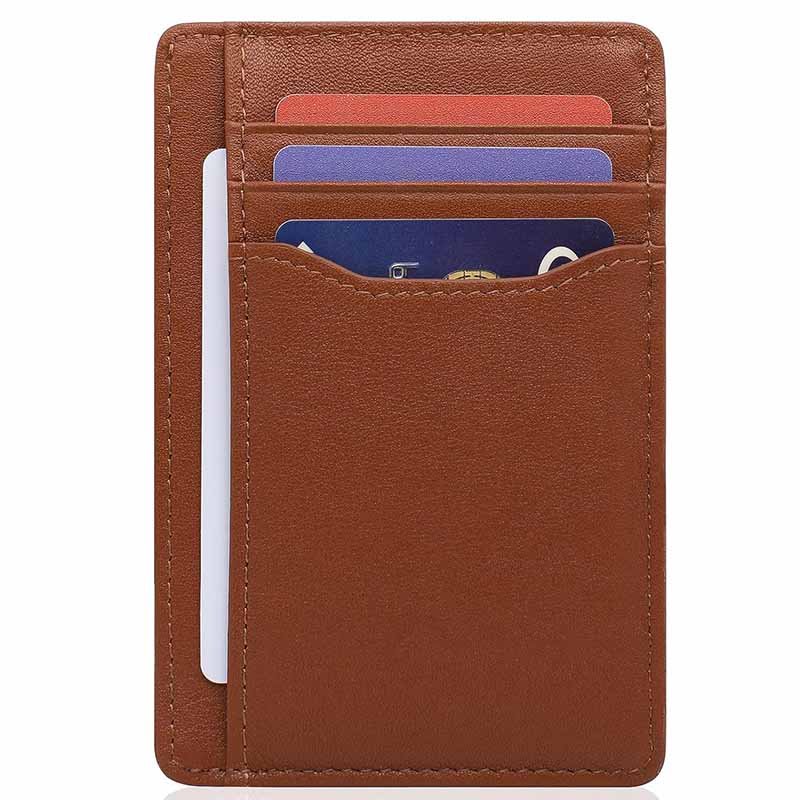
Full Grain vs Top Grain Leather Cost
Cost is not just about raw material price. It includes yield, processing complexity, defect rate, and production efficiency.
Full grain leather is more expensive for several reasons:
- Higher-grade hides are required
- More material is rejected due to natural imperfections
- Cutting requires more skilled selection
- Production time can be longer
Top grain leather reduces many of these variables:
- More usable surface area per hide
- Faster cutting and processing
- Lower rejection rate during production
- More predictable cost per unit
A simplified cost structure comparison:
| Cost Factor | Full Grain Leather | Top Grain Leather |
|---|---|---|
| Raw material price | Higher | Medium |
| Material utilization | Lower | Higher |
| Labor complexity | Higher | Medium |
| Production efficiency | Lower | Higher |
| Final unit cost | Higher | More controlled |
For brands targeting specific price points, this difference is critical. A small change in material can impact retail pricing by 20–40% depending on positioning.
Full Grain vs Top Grain Leather for Card Holders
For card holders, the choice between full grain and top grain leather should be based on real usage, product design, and production goals—not just material ranking. The right material improves both product performance and business outcomes.
Full Grain vs Top Grain Leather Daily Use
Card holders are exposed to continuous daily stress. They are pressed inside pockets, rubbed against clothing, bent when sitting, and handled frequently. This creates a combination of pressure, friction, and movement.
Full grain leather handles stress very well over time. It maintains structural integrity and resists long-term deformation. However, it may show visible marks earlier, especially in lighter colors or softer finishes.
Top grain leather provides a more stable appearance in daily use. The surface finish helps resist minor scratches and keeps the product looking cleaner for longer. This is particularly important for customers who prefer a “like-new” appearance.
Practical comparison:
| Daily Use Factor | Full Grain | Top Grain |
|---|---|---|
| Resistance to pressure | Excellent | Very good |
| Scratch visibility | Higher | Lower |
| Surface maintenance | Lower | Easier |
| Visual stability | Lower | Higher |
For everyday commercial products, top grain leather often performs better in terms of customer satisfaction.
Full Grain vs Top Grain Leather Thickness
Thickness is one of the most critical factors in card holder design. A difference of even 0.2 mm can significantly affect how bulky the product feels.
Full grain leather is naturally thicker and requires additional processing to achieve slim profiles. If not handled carefully, the final product can feel heavy or stiff.
Top grain leather is easier to control in thickness. It responds better to splitting and skiving, making it ideal for slim, lightweight designs.
Typical thickness ranges for card holders:
| Component | Full Grain | Top Grain |
|---|---|---|
| Outer layer | 1.2–1.6 mm | 0.9–1.3 mm |
| Inner slots | 0.6–1.0 mm | 0.5–0.8 mm |
| Folded edges | Thicker buildup | Cleaner finish |
For minimalist card holders, top grain leather often provides better results.
Full Grain vs Top Grain Leather Design Fit
Different product designs require different material behaviors.
Full grain leather works well for:
- Structured card holders with fewer slots
- Premium designs with visible stitching
- Products emphasizing craftsmanship and material identity
Top grain leather works well for:
- Slim multi-slot card holders
- Clean, modern designs
- Large-scale retail products
- Private label programs requiring consistency
Design alignment table:
| Design Goal | Recommended Leather |
|---|---|
| Luxury positioning | Full Grain |
| Minimalist slim design | Top Grain |
| High-volume production | Top Grain |
| Unique natural appearance | Full Grain |
| Consistent retail look | Top Grain |
Key Takeaways for Product Development
When developing a card holder, the material decision should be based on a combination of:
- Target retail price
- Expected product lifespan
- Visual consistency requirements
- Design thickness limitations
- Production volume
- Customer expectations
Many successful brands use both materials in different product lines. Instead of asking which leather is better overall, it is more effective to define which leather is better for a specific product strategy.
How to Choose Full Grain vs Top Grain Leather
Choosing between full grain and top grain leather for card holders is not about selecting the “best” material in general. It is about selecting the most suitable material for your specific product strategy. The right choice depends on price positioning, target customer expectations, design structure, and production scale.
Full Grain vs Top Grain Leather by Budget
Budget is often the first real constraint in product development. Even small differences in material cost can significantly affect final retail pricing, especially when production volume increases.
Full grain leather typically carries a higher cost due to:
- Higher-grade raw material selection
- Lower usable yield per hide
- More manual inspection and cutting
- Longer processing time
Top grain leather offers a more controlled cost structure because:
- More of the hide can be used
- Surface defects are minimized
- Production efficiency is higher
- Labor cost per unit is lower
Here is a simplified cost positioning reference for card holders:
| Product Level | Target Retail Price | Recommended Leather |
|---|---|---|
| Entry level | $10 – $25 | Top Grain |
| Mid-range | $25 – $60 | Top Grain / Mixed |
| Premium | $60 – $150 | Full Grain |
| Luxury | $150+ | Full Grain |
For brands entering new markets or testing new designs, top grain leather often provides a safer starting point. It allows better cost control and more predictable margins. Once the product proves successful, a full grain version can be introduced as a premium upgrade.
Full Grain vs Top Grain Leather by Brand Level
Different brand positions require different material strategies. The leather used should align with how the brand wants to be perceived.
Full grain leather is suitable for:
- Brands emphasizing craftsmanship and heritage
- Collections focused on long-term value and aging
- Limited editions or high-end gift products
- Customers who appreciate natural material variation
Top grain leather is suitable for:
- Brands focused on clean, modern design
- Large-scale retail or e-commerce distribution
- Products requiring strong visual consistency
- Customers who prioritize appearance stability
Brand alignment comparison:
| Brand Positioning | Material Strategy |
|---|---|
| Craft / Heritage | Full Grain |
| Modern / Minimalist | Top Grain |
| Mass retail | Top Grain |
| Premium niche | Full Grain |
| Corporate gifting | Top Grain / Full Grain mix |
Many mature brands do not rely on a single material. Instead, they build tiered product lines:
- Entry line → Top grain
- Core line → High-quality top grain or mixed leather
- Premium line → Full grain
This approach allows the brand to cover different price points while maintaining a consistent design identity.
Full Grain vs Top Grain Leather for Custom Orders
In custom manufacturing, material selection affects not only the product itself but also the entire development process.
Full grain leather projects often require:
- More careful hide selection
- Higher sampling iteration (to control appearance)
- Skilled cutting to avoid visible defects
- Clear communication on acceptable natural marks
Top grain leather projects are usually:
- Faster to sample
- Easier to standardize
- More predictable in bulk production
- Less sensitive to surface variation
From a factory perspective, this directly impacts lead time and risk control.
Typical development timeline comparison:
| Stage | Full Grain | Top Grain |
|---|---|---|
| Material confirmation | Longer | Faster |
| Sampling rounds | 2–4 rounds | 1–2 rounds |
| Production preparation | More complex | More efficient |
| Bulk consistency control | More challenging | Easier |
For clients with tight deadlines or large orders, top grain leather often reduces project risk. For clients focused on premium storytelling and long-term brand value, full grain leather remains a strong choice.
A Practical Decision Framework
To simplify the decision process, the following framework can be used when developing a card holder:
| Key Question | If Your Answer Is… | Recommended Leather |
|---|---|---|
| Do you need strict visual consistency? | Yes | Top Grain |
| Is premium aging part of your value? | Yes | Full Grain |
| Is your design very slim? | Yes | Top Grain |
| Is your target price high-end? | Yes | Full Grain |
| Is production volume large? | Yes | Top Grain |
| Do you want natural uniqueness? | Yes | Full Grain |
This kind of structured thinking helps avoid common mistakes such as:
- Choosing full grain leather for a slim design that becomes too bulky
- Choosing top grain leather for a premium product that lacks character
- Ignoring production efficiency when scaling up
What Most Brands Overlook
Many brands focus heavily on leather type but overlook how construction and processing affect the final result.
For example:
- Edge finishing quality can impact durability more than leather type
- Stitch density and thread choice influence long-term performance
- Skiving precision determines whether a card holder feels slim or bulky
- Lining materials can affect structure and user experience
A well-made top grain card holder can outperform a poorly made full grain one. Material selection and manufacturing execution must work together.
At SzoneierLeather, product development is approached as a system, not a single decision. The process includes:
- Leather selection based on product positioning
- Thickness planning for each component
- Structure design for long-term durability
- Sampling with real usage simulation
- Production optimization for consistency
- Quality control aligned with brand standards
This integrated approach helps clients avoid costly adjustments after production begins.
Full Grain vs Top Grain Leather
| Category | Full Grain Leather | Top Grain Leather |
|---|---|---|
| Durability | Higher | High |
| Aging | Strong patina | Stable appearance |
| Texture | Natural, varied | Smooth, uniform |
| Thickness control | More difficult | Easier |
| Production consistency | Lower | Higher |
| Cost | Higher | More controlled |
| Best use | Premium products | Scalable products |
Conclusion
Full grain and top grain leather are both high-quality materials, but they serve different purposes. Full grain leather is ideal for products that focus on durability, authenticity, and long-term aging. Top grain leather is better suited for products that require consistency, clean appearance, and efficient production.
The most successful card holder products are not defined by using the “highest grade” leather. They are defined by using the right leather for the right design, market, and customer expectation.
Start Your Custom Card Holder Project with SzoneierLeather
If you are planning to develop or upgrade your card holder collection, the material decision should be made with both product performance and business goals in mind.
SzoneierLeather brings over 18 years of experience in leather product development and manufacturing, supporting brands and custom clients.
Whether you are building a premium leather line or scaling a commercial product, choosing the right leather from the beginning can save time, reduce cost, and improve product performance.
Send your design, target price, or product idea to SzoneierLeather today. Our team will help you select the most suitable leather and turn your concept into a reliable, high-quality product ready for your market.