 Skip to content
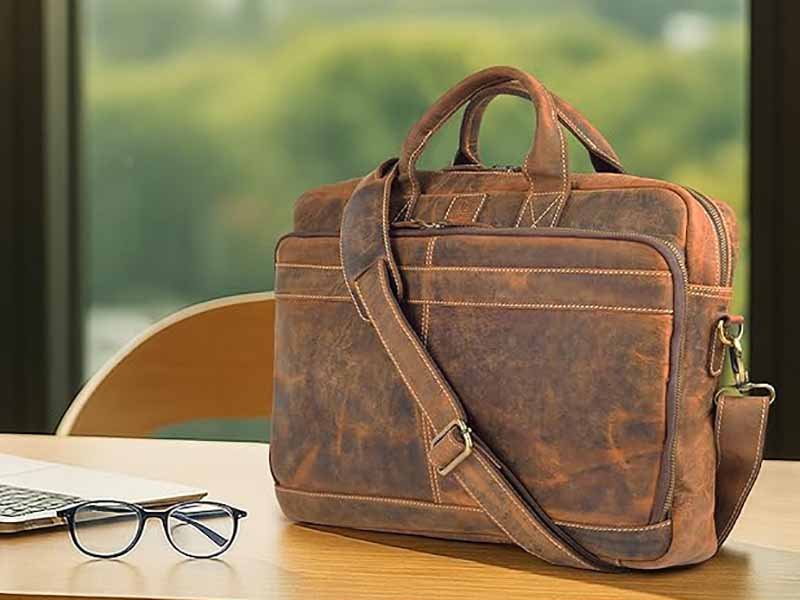
Briefcases look deceptively simple. At a glance, they’re just rectangular leather bags meant for work. Yet in real use, briefcase dimensions quietly determine everything—from whether your laptop actually fits, to whether documents crease, to whether the bag feels elegant or awkward when carried all day.
Most people only realize this after making a mistake: a bag that’s too slim to close once the charger is inside, too wide to slide under an airplane seat, or too tall to feel balanced when worn crossbody. In professional settings, these small sizing misjudgments become daily frustrations.
The problem isn’t a lack of options—it’s a lack of clear, practical sizing logic. Brands label products as “standard,” “slim,” or “business,” but rarely explain what those sizes really mean in inches, centimeters, or real-world use. Add laptops, airline rules, and gendered naming conventions into the mix, and confusion multiplies. A standard briefcase typically measures 15–18 inches wide, 10–12 inches tall, and 3–5 inches deep. This size comfortably fits A4 documents and most 13–15.6 inch laptops while remaining portable for daily work and travel. The right briefcase size depends on what you carry, how you commute, and whether you prioritize slim profile, capacity, or airline compatibility.
At Szoneier Leather, after 18+ years of developing leather briefcases for professionals and brands worldwide, we’ve learned one thing clearly: dimensions are not about numbers alone—they’re about behavior. How people move, work, and travel shapes the ideal size. This guide breaks down briefcase dimensions from that real-world perspective, so you can choose—or custom-build—the right one with confidence.
What Are Standard Briefcase Dimensions
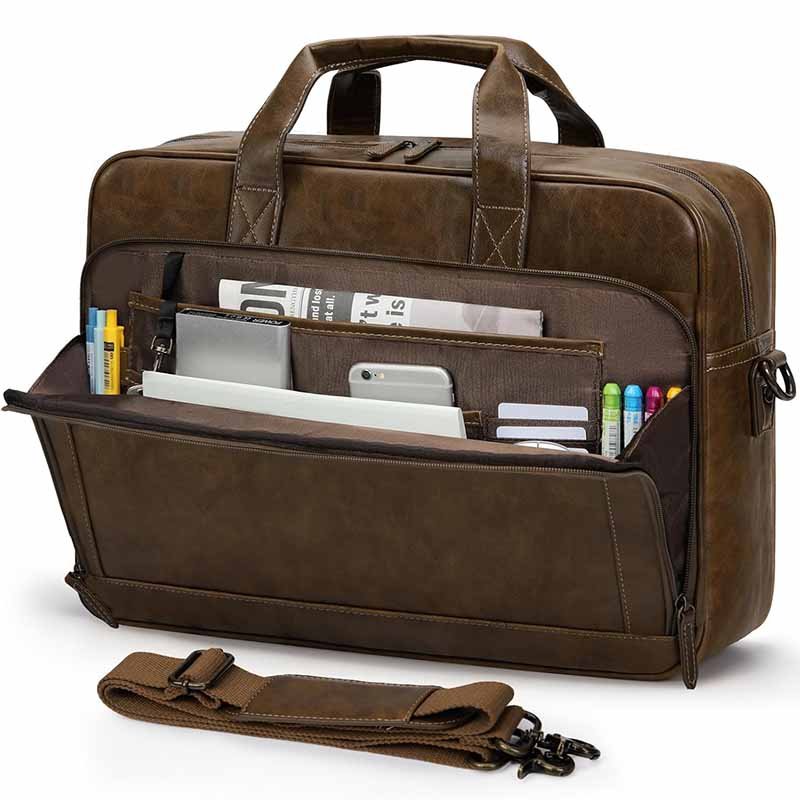
Standard briefcase dimensions typically range from 15–18 inches (38–46 cm) in width, 10–12 inches (25–30 cm) in height, and 3–5 inches (8–13 cm) in depth. This size range fits A4 documents, most 13–15.6 inch laptops, and daily business essentials while remaining comfortable for commuting and under-seat airline use. Exact “standard” size varies based on laptop fit, document type, and carry style.
What is a “standard” briefcase size in inches and cm?
There is no single global standard for briefcase dimensions. Instead, “standard” is a functional range shaped by three real-world constraints:
- Paper formats (A4 vs US legal)
- Laptop sizes (13″–15.6″ being the most common)
- Human carry comfort (arm length, shoulder balance, daily load)
In modern professional use, most standard briefcases fall into this engineered range:
| Category | External Dimensions (inches) | External Dimensions (cm) | Typical Use |
|---|---|---|---|
| Slim / Compact | 14.5–15.5 × 10–11 × 3 | 37–39 × 25–28 × 8 | Tablet or light laptop, documents |
| Standard (Most Common) | 15.5–17 × 11–12 × 3.5–4.5 | 39–43 × 28–30 × 9–11 | Daily office & business travel |
| Large / Expanded | 17–18 × 12–13 × 4.5–5.5 | 43–46 × 30–33 × 11–14 | Multiple devices, overnight use |
This “standard” range exists because it balances:
- Interior usability (papers + laptop + accessories)
- Exterior portability (commuting, meetings, flights)
- Visual proportion (professional, not bulky)
Anything outside this range typically sacrifices either comfort or practicality.
Are there small, medium, and large briefcase size ranges?
Yes—and misunderstanding these ranges is one of the most common causes of poor user experience.
Small / Slim Briefcases
- Depth usually under 3.5 inches (9 cm)
- Designed for minimal carry: laptop + documents only
- Look clean and modern, but little margin for accessories
- Best for short commutes and digital-first professionals
Medium / Standard Briefcases
- Depth between 3.5–4.5 inches (9–11 cm)
- The most versatile category
- Fits laptop, charger, notebook, mouse, and folders
- Ideal for full workdays and mixed office + travel use
Large Briefcases
- Depth over 4.5 inches (11.5 cm)
- Can replace a small travel bag
- Require stronger structure and reinforcement
- Poorly designed large briefcases often feel heavy or unbalanced
From a manufacturing perspective, depth matters more than width. Increasing depth without redesigning structure leads to sagging, zipper stress, and handle fatigue—issues experienced factories actively engineer against.
What is a woman’s briefcase called, and does its size differ?
This is a high-frequency search question, but the answer is more practical than stylistic.
Common terms include:
- Women’s briefcase
- Business tote
- Work satchel
- Laptop tote
However, dimensionally, most women’s briefcases:
- Are slightly narrower (by 10–20 mm)
- Are slightly lighter in total weight
- Maintain the same internal height to fit A4 documents
The core requirements—documents, laptop, charger—do not change by gender. What changes is:
- Carry method (shoulder vs hand)
- Body proportion and balance
- Weight sensitivity over long commutes
In professional leather manufacturing, experienced factories do not design by gender first. They design by carry behavior, load distribution, and ergonomic balance, then adjust proportions accordingly.
Which Briefcase Dimensions Fit A4 or Legal Documents
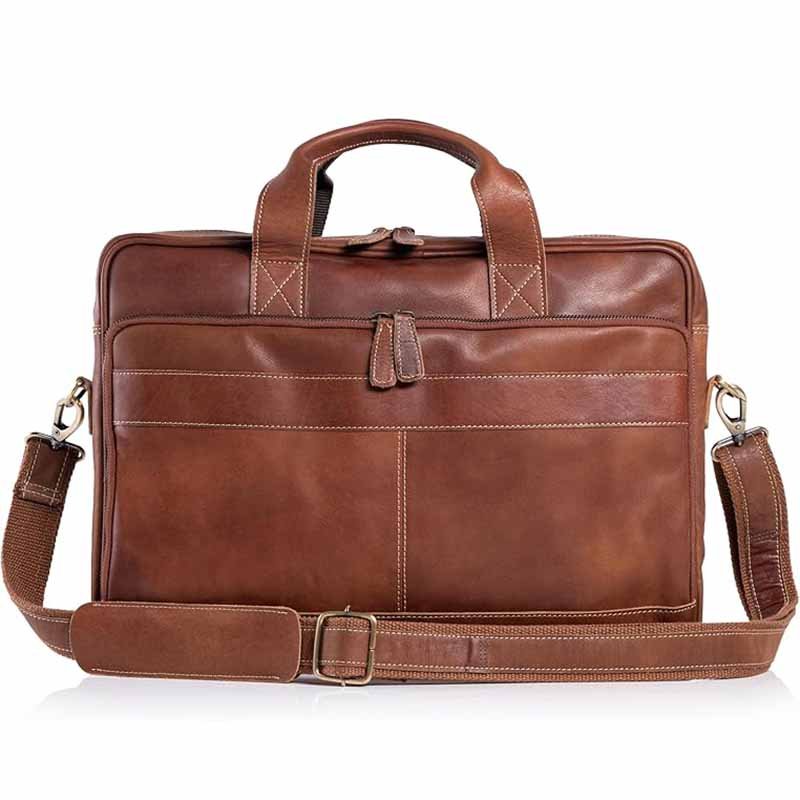
To fit A4 documents, a briefcase needs an internal width of at least 12.2 inches (31 cm) and a height of 11.8 inches (30 cm). Legal-size documents require wider briefcases with an internal width of 14–14.5 inches (36–37 cm). Always check internal usable dimensions, as padding and structure reduce space inside most briefcases.
Which internal dimensions fit A4 papers and folders?
A4 paper measures 210 × 297 mm (8.27 × 11.7 inches), but fitting A4 comfortably requires more than matching those numbers.
In real use, documents are rarely inserted perfectly flat. Users carry:
- Multiple sheets
- File folders with tabs
- Notebooks stacked together
- Slightly curled or angled papers
Because of this, a briefcase designed for A4 should meet minimum internal clearances, not paper size alone.
Recommended internal dimensions for A4 use:
| Item Type | Minimum Internal Width | Minimum Internal Height |
|---|---|---|
| Loose A4 papers | 12.0 in / 30.5 cm | 11.8 in / 30 cm |
| A4 folder or file | 12.2–12.6 in / 31–32 cm | 12.0 in / 30.5 cm |
| A4 binder (spine 30 mm) | 12.8 in / 32.5 cm | 12.2 in / 31 cm |
Why the extra space matters:
- Prevents corner bending
- Allows quick insertion without alignment
- Reduces zipper and seam stress
- Keeps leather panels flat over time
From a manufacturing standpoint, professional factories usually design +8–12 mm tolerance beyond document size to ensure long-term usability.
Do legal-size documents require a wider briefcase?
Yes—and this is one of the most common sizing mistakes made by buyers.
US legal paper measures 8.5 × 14 inches (216 × 356 mm). That extra length changes everything.
A briefcase that fits A4 perfectly may still:
- Bend legal documents
- Force diagonal insertion
- Cause zipper resistance on closure
Recommended internal dimensions for legal-size documents:
| Document Type | Recommended Internal Width | Recommended Internal Height |
|---|---|---|
| Loose legal papers | 14.0 in / 35.6 cm | 12.2 in / 31 cm |
| Legal folder | 14.3–14.6 in / 36.5–37 cm | 12.4 in / 31.5 cm |
| Legal binder | 14.8+ in / 37.5+ cm | 12.8 in / 32.5 cm |
Important insight:
- Most global briefcases are A4-optimized
- Legal-size compatibility usually requires intentional width expansion
- Even +20 mm width can make the difference between “fits” and “fails”
For US-focused markets such as law, real estate, government, and compliance roles, legal-size compatibility is often non-negotiable.
Why external briefcase size alone is misleading for documents
Many users assume that a briefcase measuring 16 inches wide externally will fit legal documents. Often, it does not.
Why? Because internal usable space is reduced by:
- Leather thickness (1.4–2.0 mm per panel)
- Foam padding
- Lining folds
- Structural reinforcement
- Pocket walls
In practice, internal width is often 20–35 mm smaller than external width.
Example:
| External Width | Typical Internal Usable Width |
|---|---|
| 16.0 in (40.6 cm) | 14.6–15.0 in (37–38 cm) |
| 15.5 in (39.4 cm) | 14.0–14.4 in (35.5–36.5 cm) |
This is why professional manufacturers always design from document size outward, not from appearance inward.
A4 vs Legal: how geography affects briefcase design
Document standards vary by region, which directly affects ideal briefcase dimensions:
| Region | Primary Document Standard | Design Priority |
|---|---|---|
| Europe | A4 | Balanced width, slimmer profile |
| Asia | A4 | Compact proportions |
| US | Legal + Letter | Wider briefcases |
| Global business travel | Mixed | Hybrid sizing |
For brands selling internationally, many factories (including Szoneier Leather) recommend:
- Designing two widths for the same model
- Or creating a hybrid width that fits legal documents while maintaining A4 elegance
This approach avoids market-specific redesign later and reduces return risk.
What Briefcase Dimensions Fit a 13, 14, 15.6, or 17-Inch Laptop
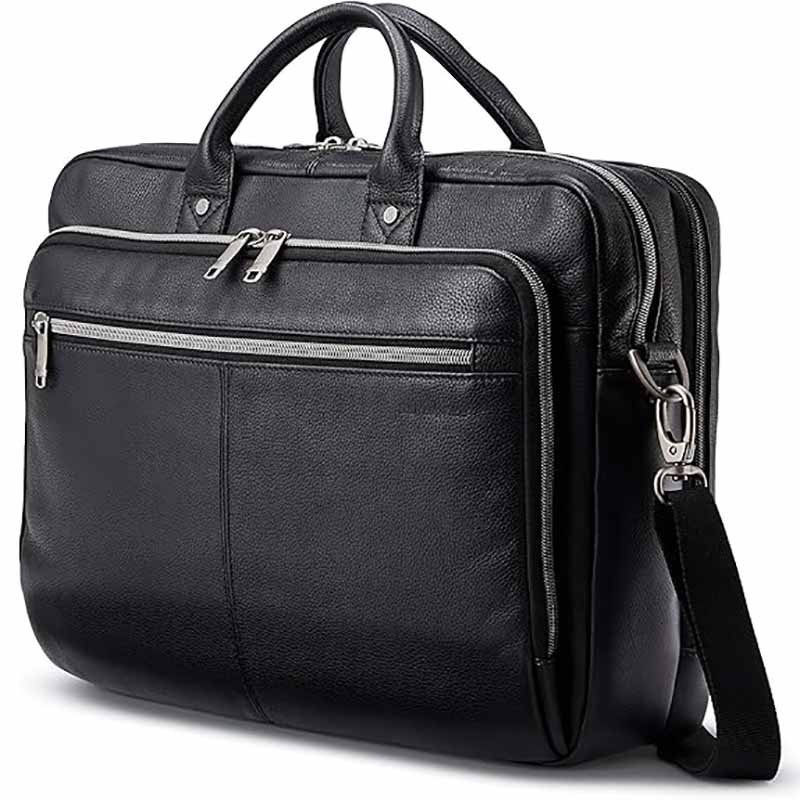
Laptop size labels refer to screen diagonal, not the device’s real width or thickness. A briefcase should have a laptop compartment 0.6–1 inch (15–25 mm) larger than the laptop’s actual dimensions. For example, a 15.6-inch laptop typically requires an internal compartment about 14.8–15.2 inches wide. Always size for padding, accessories, and long-term use.
Is laptop “inch size” the same as the laptop compartment size?
No—and this misunderstanding is the single biggest cause of poor briefcase fit.
Laptop sizes (13″, 14″, 15.6″, 17″) measure the diagonal length of the screen only. They do not reflect:
- Total device width
- Hinge thickness
- Bezel size
- Edge curvature
- Added protection cases
Two laptops labeled “15.6-inch” can differ in width by 20–30 mm, which is enough to make a briefcase feel tight or unusable.
That’s why professional briefcase design never starts with the screen size—it starts with the physical device envelope.
What internal briefcase dimensions fit each laptop size?
Below is a real-world sizing table based on common modern laptops (business and consumer models), including tolerance for padding and lining.
| Laptop Label | Typical Laptop Width | Typical Laptop Height | Recommended Internal Compartment (W × H) |
|---|---|---|---|
| 13″ | 11.8–12.2 in (30–31 cm) | 8.2–8.6 in (21–22 cm) | 12.8–13.2 × 9.2 in (32.5–33.5 × 23.5 cm) |
| 14″ | 12.6–13.0 in (32–33 cm) | 8.7–9.1 in (22–23 cm) | 13.6–14.0 × 9.6 in (34.5–35.5 × 24.5 cm) |
| 15.6″ | 14.0–14.4 in (35.5–36.5 cm) | 9.5–9.8 in (24–25 cm) | 14.8–15.2 × 10.4 in (37.5–38.5 × 26.5 cm) |
| 17″ | 15.2–15.8 in (38.5–40 cm) | 10.3–10.8 in (26–27.5 cm) | 16.2–16.8 × 11.2 in (41–42.5 × 28.5 cm) |
Key principle: If the laptop compartment width is exactly the laptop width, the briefcase is undersized.
How much extra space should you allow for padding and protection?
A laptop briefcase must protect the device, not just contain it.
Recommended allowances:
- +0.4–0.6 in (10–15 mm) for foam padding
- +0.2–0.4 in (5–10 mm) for lining and seam fold
- +0.2–0.4 in (5–10 mm) for ease of insertion
This results in a total tolerance of 0.6–1 inch (15–25 mm) beyond the laptop’s actual width.
Why this matters:
- Padding compresses over time
- Leather relaxes and reshapes
- Tight sleeves increase zipper failure risk
- Users often slide laptops in at slight angles
Professional factories design for year-two usability, not just day-one fit.
Do chargers, mice, and cases affect laptop briefcase dimensions?
Yes—significantly.
Many briefcases technically “fit” the laptop but fail once accessories are added.
Common overlooked items:
- Power adapters (especially bulky ones)
- External mice
- USB hubs
- Laptop hard shells or sleeves
If accessories share the same compartment, you should add:
- +0.3–0.5 in (8–12 mm) in depth
- Or use a separate padded laptop sleeve inside the briefcase
For business travelers, separating the laptop sleeve from accessory storage dramatically improves packing speed and reduces device pressure.
Why a briefcase can fit your laptop but still feel wrong
A briefcase can meet size requirements and still perform poorly if:
- The laptop sits too high or too low
- Weight isn’t centered over the handle
- The sleeve is stitched flat instead of floating
- The base lacks reinforcement
Laptop size affects not just dimensions, but structure:
- Handle placement
- Base thickness
- Gusset depth
- Panel stiffness
This is why professional briefcase development treats laptop fit as a structural design problem, not a simple measurement task.
How Do Airline Rules Affect Briefcase Dimensions
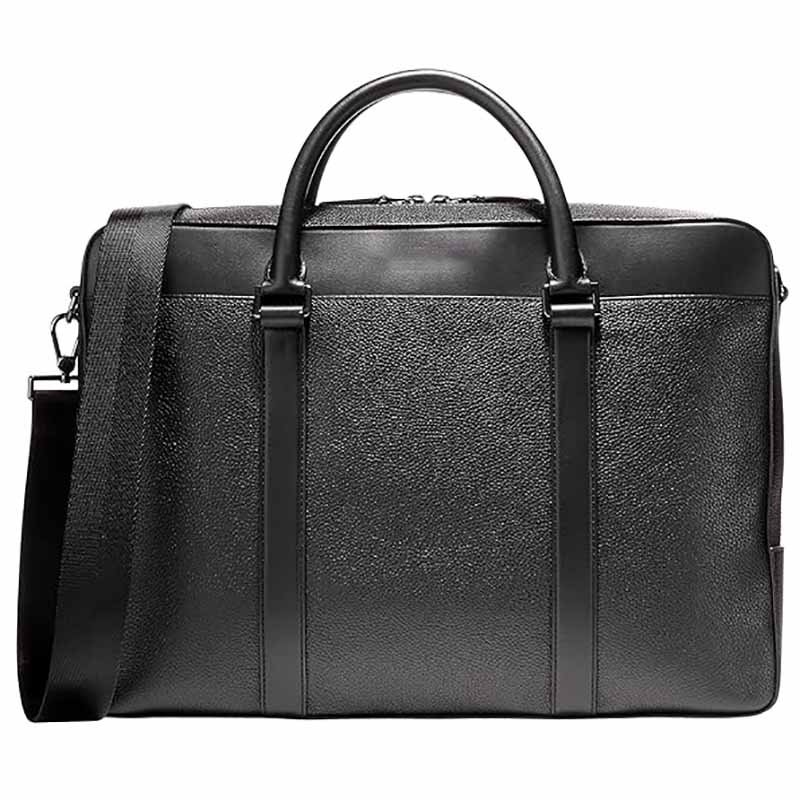
Airlines usually allow briefcases as personal items if they fit under the seat, commonly within 18 × 14 × 8 inches (45 × 35 × 20 cm). Slim and medium briefcases with depths under 4.5 inches (11.5 cm) are the safest choice. External dimensions, handle height, and bag flexibility matter more than advertised capacity when flying.
What size briefcase counts as a “personal item” under-seat?
Most airlines define a briefcase as a personal item, not a carry-on, as long as it fits completely under the seat in front of you.
While exact rules vary, real-world under-seat constraints are surprisingly consistent:
| Dimension | Safe Under-Seat Range |
|---|---|
| Width | ≤ 17.5 in (44.5 cm) |
| Height | ≤ 12 in (30.5 cm) |
| Depth | ≤ 4–4.5 in (10–11.5 cm) |
Why depth matters most:
- Seat support bars limit front-to-back space
- Bulging pockets instantly exceed limits
- Rigid leather won’t compress like fabric
From a design standpoint, many briefcases fail under-seat tests not because they are too wide, but because they are too thick once loaded.
Experienced manufacturers design “flight-safe” briefcases by controlling gusset depth, not overall width.
Which briefcase dimensions are safest across major airlines?
Frequent travelers don’t want to check airline charts before every flight. The safest approach is to design for cross-airline compatibility.
A globally safe briefcase dimension range is:
16–17 × 11–12 × 4 inches (40–43 × 28–30 × 10 cm)
This size works because it:
- Fits under seats on narrow-body aircraft
- Clears seat rails and power boxes
- Doesn’t intrude on legroom
- Avoids gate-agent scrutiny
Briefcases exceeding 5 inches (12.5 cm) in depth often fail on:
- Budget airlines
- Regional jets
- Older aircraft with lower seats
This is why many travel-optimized briefcases appear intentionally slim—they are designed for predictable airline behavior, not maximum volume.
Why external dimensions matter more than internal capacity when flying
Airlines do not care what fits inside your briefcase. They judge:
- External width
- External height
- Fully loaded thickness
- Fixed handle height
Common mistakes travelers make:
- Choosing a briefcase that “fits empty” but bulges when packed
- Ignoring rigid handles that add height
- Assuming leather will compress like nylon
In practice, external dimensions can exceed airline limits by 15–25 mm once the bag is fully packed. Professional manufacturers account for this by:
- Reducing external panel thickness
- Designing flatter pocket profiles
- Using structured but flexible internal frames
Do different travel scenarios require different briefcase sizes?
Yes. Airline rules affect briefcase choice differently depending on how you travel.
Frequent short-haul flyers
- Benefit from slim briefcases (≤4 in depth)
- Faster under-seat placement
- Easier airport movement
Business travelers with connections
- Need stable shape for repeated handling
- Prefer moderate depth with reinforced base
- Must balance capacity and airline compliance
International travelers
- Face stricter enforcement on some routes
- Should avoid expandable gussets entirely
- Benefit from hybrid sizes that fit both office and flight use
This is why many professionals eventually switch from “large business briefcases” to travel-optimized standard sizes—not because they carry less, but because airline constraints force smarter packing.
How briefcase structure affects airline compliance
Two briefcases with identical dimensions can behave very differently on a plane.
Structural factors that improve airline compatibility:
- Flat bottom panels
- Rounded external corners
- Soft internal padding instead of rigid boards
- Handles that fold or sit flush
Poor structure leads to:
- Snagging under seats
- Forced placement
- Visible bulging that attracts attention
This is where experienced leather manufacturers outperform generic designs: they engineer for movement, compression, and repeat travel, not showroom appearance alone.
How Do You Measure Briefcase Dimensions Correctly
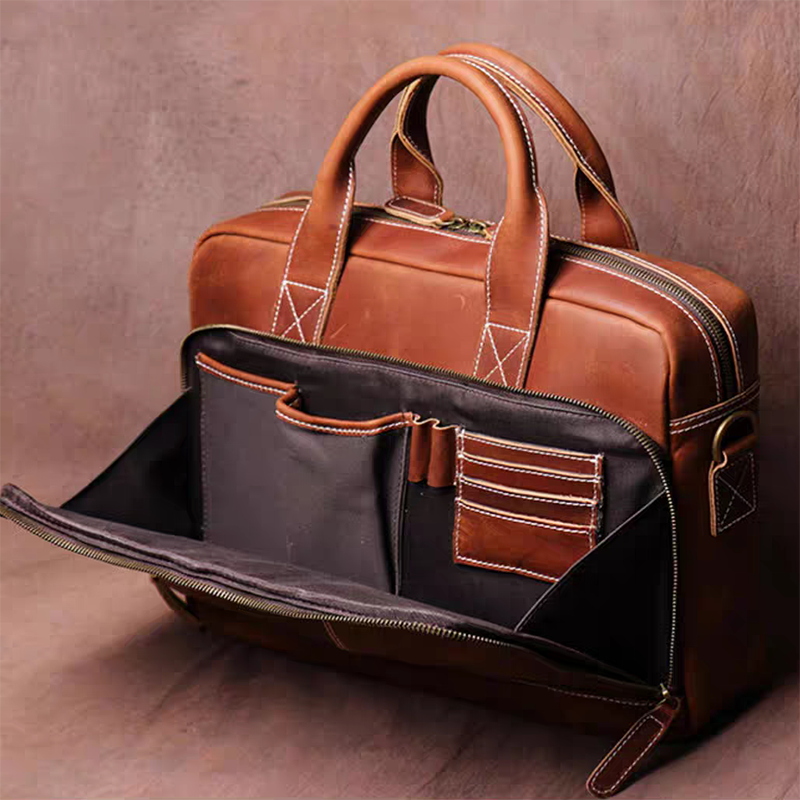
To measure briefcase dimensions correctly, measure the external width, height, and depth using the bag’s widest points, including fixed handles and pockets. Then measure the internal usable space, excluding padding and seams. External dimensions determine portability and airline compliance, while internal dimensions determine whether laptops and documents fit. Always measure a briefcase fully packed, not empty.
What are the correct external dimensions, and how should they be measured?
External dimensions describe how big the briefcase appears and whether it meets travel or commuting constraints.
To measure external size correctly:
- Width (W) Measure left to right at the widest point, including structured side panels or bulging pockets.
- Height (H) Measure from the bottom of the base to the highest fixed point (usually the top of the handle attachment, not removable straps).
- Depth (D) Measure front to back when the bag is naturally filled, not flattened.
Critical mistake: Many people measure an empty briefcase lying flat. This underestimates real depth by 10–30% once the bag is in use.
External dimensions matter most for:
- Airline under-seat compliance
- Visual bulk
- Comfort when carried close to the body
If an airline agent or gate sizer checks your bag, only external dimensions count.
How do you measure internal usable dimensions accurately?
Internal dimensions determine whether items actually fit—but they are never equal to external dimensions.
To measure internal space correctly:
- Open the briefcase fully
- Measure clear internal width and height
- Exclude:
- Padding thickness
- Lining folds
- Reinforcement boards
- Pocket walls
In leather briefcases, usable internal space is typically 15–25 mm smaller per side than the external size.
Rule of thumb:
If the internal width is exactly the same as your laptop or document width, the briefcase is too small.
Professional manufacturers design internal dimensions first, then engineer structure around them. Measuring the outside alone gives a false sense of capacity.
Why handles, pockets, and gussets change real-world size
Fixed components often push a briefcase beyond its “listed” dimensions.
Elements that affect real size:
- Rigid top handles (add height)
- Front organizer pockets (add depth when loaded)
- Expansion gussets (increase depth beyond airline limits)
- Structured corners (increase width slightly)
Example:
| Feature | Typical Size Increase |
|---|---|
| Fixed handle | +0.4–0.8 in (10–20 mm) |
| Loaded front pocket | +0.5–1 in (12–25 mm) |
| Expansion gusset | +1–2 in (25–50 mm) |
This is why experienced designers measure a fully loaded prototype, not an empty shell. A briefcase must be evaluated as it is actually used.
Should you measure a briefcase empty or packed?
Always measure packed.
A briefcase that fits perfectly when empty may:
- Bulge when filled
- Become difficult to close
- Exceed airline limits
- Feel uncomfortable when carried
Proper measurement method:
- Insert laptop
- Add charger, notebook, documents
- Close the briefcase naturally
- Measure width, height, and depth
This reflects true operating size, not showroom size.
Why internal layout affects measurement more than people realize
Two briefcases with identical external dimensions can feel radically different because of internal layout.
Layout elements that reduce usable space:
- Fixed laptop sleeves stitched flat
- Thick dividers
- Overbuilt padding
- Narrow gusset openings
Layout elements that improve usability:
- Floating laptop sleeves
- Flexible dividers
- Tapered padding
- Well-positioned gussets
This is why professional factories don’t just “scale” a design up or down—they re-engineer internal structure when dimensions change.
How Do You Choose the Right Briefcase Size for Work or Travel
The right briefcase size depends on what you carry, how you commute, and how often you travel. For daily office use, slim to standard sizes (around 15.5–16.5 inches wide) offer comfort and professionalism. For work trips, slightly larger briefcases (16.5–17.5 inches wide) provide extra capacity while remaining airline-friendly. Always choose size based on real contents, not appearance.
What briefcase size works best for daily office work?
For most professionals, daily work involves:
- One laptop
- A4 or letter documents
- Charger, notebook, small accessories
The ideal daily-work briefcase size typically falls within:
15.5–16.5 × 11–12 × 3.5–4 inches (39–42 × 28–30 × 9–10 cm)
Why this range works:
- Slim enough to look professional in meetings
- Light enough for daily commuting
- Large enough for essentials without overpacking
Going larger often adds unnecessary weight and bulk. Many users who buy oversized briefcases eventually downsize because the bag feels tiring after long workdays.
For desk-to-meeting-to-commute routines, comfort and balance matter more than maximum capacity.
What briefcase size is best for commuting by car, train, or walking?
Commuting method strongly affects how a briefcase feels in daily use.
- Car commuting Slightly larger briefcases work well because the bag is carried for short distances.
- Train or subway commuting Slim or medium sizes perform best. Narrow depth prevents bumping into others and makes standing more comfortable.
- Walking or cycling Weight and balance become critical. Overly wide or deep briefcases strain shoulders and arms.
For active commutes, many professionals prefer:
- Reduced depth (≤4 inches)
- Balanced handle placement
- Lightweight structure
Choosing a size that matches how you move daily is often more important than how much the briefcase can hold.
What size briefcase is ideal for 1–2 day business trips?
Short business trips blur the line between a briefcase and a small travel bag.
The most versatile size range is:
16.5–17.5 × 12 × 4.5–5 inches (42–44 × 30 × 11–13 cm)
This size allows space for:
- Laptop and documents
- Charger and accessories
- A change of clothes or toiletry pouch
However, exceeding this range often leads to airline issues or uncomfortable carry. For frequent flyers, it’s better to:
- Use a standard-size briefcase
- Pair it with a small carry-on
This combination offers flexibility without forcing the briefcase to do everything.
How do travel frequency and airline rules affect size choice?
If you fly often, airline rules should heavily influence your decision.
Frequent travelers should prioritize:
- External width under 17.5 inches
- Depth under 4.5 inches
- Minimal external pockets that bulge when packed
A briefcase that fits under the seat consistently reduces stress during boarding and transfers.
Occasional travelers may tolerate slightly larger sizes, but frequent flyers almost always prefer predictable, airline-safe dimensions over extra capacity.
Should you choose a slim or larger briefcase “just in case”?
Many buyers choose larger briefcases “just in case” they need more space. In practice, this often backfires.
Oversized briefcases:
- Encourage overpacking
- Feel heavier even when half full
- Look bulky in professional settings
- Cause shoulder and arm fatigue
Slim or standard sizes:
- Enforce intentional packing
- Maintain clean proportions
- Are easier to carry and store
- Work better across environments
A good rule:
If you only need extra space once or twice a month, don’t size your briefcase for those days.
How professionals actually decide on the “right” size
Experienced users don’t ask, “What’s the biggest size I can carry?” They ask, “What size disappears into my routine?”
The right briefcase size:
- Fits your laptop and documents easily
- Closes smoothly when full
- Doesn’t bump into people while commuting
- Doesn’t draw attention for being bulky
- Feels comfortable after hours of carry
If you stop noticing the briefcase during the day, you’ve chosen the right size.
Conclusion
The size of a briefcase has a far greater impact on comfort, practicality, and durability than the type of leather or hardware used. A properly sized briefcase seamlessly integrates into daily life—it’s quiet, reliable, and easy to use.
Szoneier Leather has over 18 years of experience in leather product development and manufacturing.
If you are developing a new briefcase or improving an existing design, size design is crucial and should not be overlooked.
Please contact Szoneier Leather to discuss custom briefcase sizing, prototyping, and OEM manufacturing. Share your target market, usage requirements, and design goals—our team will help you create the perfect briefcase.


