
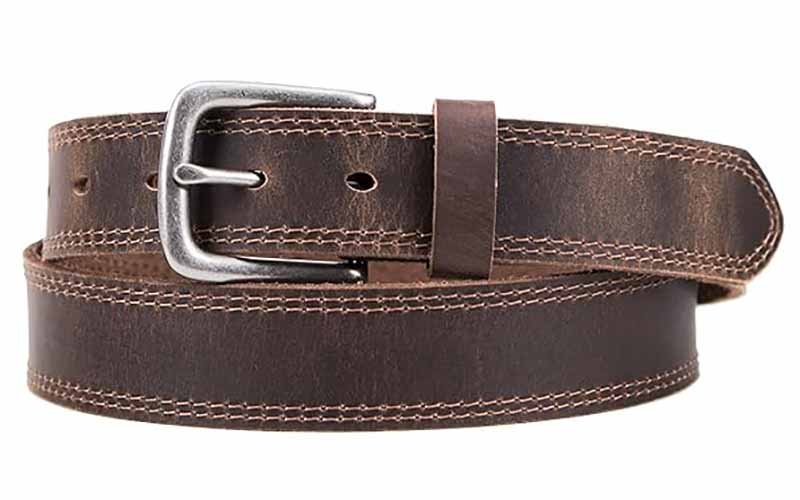
A leather belt can look beautiful on a shelf and still disappoint once it reaches real customers. That happens more often than many people think. The buckle may be solid, the leather may look genuine, and the color may be attractive, yet after a few weeks of wear the belt starts curling, stretching, cracking at the holes, or feeling too stiff around the waist. In many cases, the hidden problem is not the buckle or even the leather grade alone. It is thickness.
Thickness changes almost everything about how a belt performs. It affects comfort when sitting, the way the strap bends through belt loops, how well it supports daily wear, how premium it feels in hand, and how long it keeps its shape. A belt that is too thin can feel weak and insubstantial. A belt that is too thick can feel bulky, resist bending, and create discomfort, especially in dresswear. That is why thickness is one of the most important decisions in belt development and manufacturing.
Leather belt thickness usually ranges from about 2.5 mm to 5.0 mm, depending on the belt type, leather construction, and intended use. Dress belts are normally thinner for flexibility and clean appearance, casual belts use a medium thickness for balance, and work belts are thicker for strength and long-term structure. Choosing the right thickness means matching comfort, durability, leather type, buckle size, and user expectations.
At SzoneierLeather, this is often the point where a good belt idea becomes a strong product line. A small change in thickness can completely change how customers describe the belt: refined, rugged, soft, firm, heavy-duty, or premium. That is why thickness should never be treated as a minor technical detail. It is one of the clearest product decisions your customer can actually feel the moment they touch the belt.
What Is Leather Belt Thickness?
Leather belt thickness is the actual thickness of the belt strap, usually measured in millimeters or ounces. It influences flexibility, strength, shape retention, weight, and wearing comfort. In custom manufacturing, correct thickness selection helps the belt match its intended use, whether for dresswear, casual wear, or heavy-duty applications.
What Is Leather Belt Thickness?
Leather belt thickness is the vertical measurement from the top surface of the belt strap to the bottom surface. In factory production, the most common unit is millimeters, while some markets, especially in North America, also refer to ounces, where 1 oz is roughly 0.4 mm. That sounds simple, but in actual product development, thickness carries far more meaning than a number on paper.
A belt strap does not perform only because it is genuine leather. It performs because the thickness works together with the leather type, tanning method, edge treatment, lining, reinforcement, and buckle size. For example, a 3.0 mm full-grain vegetable-tanned belt and a 3.0 mm corrected-grain bonded construction may measure the same, but they will not feel the same, age the same, or hold shape the same.
Thickness affects several things immediately:
- How stiff or flexible the belt feels in hand
- How easily the belt passes through trouser loops
- How well the strap supports repeated pulling at the holes
- How premium or substantial the product feels
- How suitable it is for formal, casual, or utility use
Here is a simple way to understand thickness levels:
| Thickness Range | General Feel | Common Product Position |
|---|---|---|
| 2.5–3.0 mm | Slim, flexible, refined | Dress belt |
| 3.0–4.0 mm | Balanced, stable, versatile | Casual belt |
| 4.0–5.0 mm+ | Firm, rugged, heavy-duty | Work belt |
Another point many customers overlook is that thickness also changes the visual proportion of a belt. A formal belt with a slim buckle and smooth polished surface usually looks better at a slimmer thickness. A casual pull-up leather belt often feels more authentic and substantial when it has more body. A thick belt gives a stronger presence, but only when it matches the style direction.
At SzoneierLeather, thickness is usually discussed together with end use from the very beginning. That approach avoids a common mistake: choosing thickness by appearance alone. A beautiful sample can still fail in the market if the strap does not feel right during daily wear. Thickness is one of the fastest ways customers judge whether a belt feels cheap, balanced, or truly well made.
How to Measure Leather Belt Thickness?
Measuring leather belt thickness accurately is essential in manufacturing because even small variations can change the final feel of the product. In development and production, thickness is usually checked before edge paint, edge folding, or final assembly, because those finishing steps can visually enlarge the strap but do not reflect the actual core leather thickness.
The most reliable tools are:
- Digital caliper for precise manual measurement
- Leather thickness gauge for workshop and production checks
- Splitting machine settings for controlling thickness during leather preparation
In custom belt production, measurement should be taken at the main body of the strap, not at the edge, embossed area, or stitched fold. Leather is a natural material, so thickness may vary slightly across different parts of the hide. That is why factories do not just measure once. They usually check several points across the strap or across multiple straps in a production batch.
The relationship between ounces and millimeters is useful for international communication:
| Ounce (oz) | Approx. Millimeter (mm) |
|---|---|
| 6 oz | 2.4 mm |
| 7 oz | 2.8 mm |
| 8 oz | 3.2 mm |
| 9 oz | 3.6 mm |
| 10 oz | 4.0 mm |
| 11 oz | 4.4 mm |
| 12 oz | 4.8 mm |
For most branded production, a practical factory tolerance is around ±0.2 mm. A tolerance wider than that may create noticeable inconsistency in feel, hole durability, and buckle fit, especially in premium collections. If one belt in a shipment feels slim and another feels bulky, customers notice immediately.
There is also a difference between single-layer thickness and finished belt thickness. A lined belt may be made from two thinner leather layers bonded together, while a heavy-duty belt may use a single thick strap. Both may reach a similar final thickness, but they behave differently in wear. One may bend more smoothly. The other may feel tougher and denser.
This is why measuring thickness is not just a technical routine. It is part of quality control, product consistency, and brand presentation. A customer may never use a caliper, but they will absolutely feel the difference when belts within the same order do not match.
Why Leather Belt Thickness Matters?
Leather belt thickness matters because it directly shapes how the product performs, feels, and lasts. Many end customers do not talk about thickness using technical terms, but they describe the results very clearly. They say the belt feels too soft, too rigid, too thin, too bulky, too weak at the holes, or not solid enough for the price. Those comments often point back to thickness selection.
The practical impact of thickness can be grouped into five main areas:
- Comfort: thinner belts bend more easily around the waist
- Durability: thicker belts usually resist stretching and distortion better
- Appearance: thickness changes whether the belt looks formal or rugged
- Fit: thick belts may not pass smoothly through narrow belt loops
- Perceived value: a belt that feels too light may feel cheap, even if the leather is real
Here is a useful performance view:
| Thickness | Comfort | Shape Retention | Hole Durability | Style Signal |
|---|---|---|---|---|
| 2.5–3.0 mm | High | Medium | Medium | Formal, refined |
| 3.0–4.0 mm | High-Medium | High | High | Casual, versatile |
| 4.0–5.0 mm+ | Medium-Low | Very High | Very High | Rugged, workwear |
Still, thicker is not always better. That is one of the most important points in belt development. A 5 mm belt may sound stronger than a 3 mm belt, but if it is used for office trousers or fashion retail, it can feel clumsy and uncomfortable. On the other hand, a slim 2.8 mm belt may look elegant with formal wear, but if used for jeans every day, it may lose structure too quickly.
This is where thickness must be matched to the product purpose. A belt should not only survive. It should feel right for the user and the styling category. When thickness is chosen correctly, the belt becomes easier to wear, more believable in its price range, and more likely to win repeat orders. For professional customers developing their own line, that balance matters far more than simply asking for the thickest leather available.
Which Leather Belt Thickness to Choose?
The right leather belt thickness depends on the product category, expected daily use, target customer, and style positioning. Dress belts need a slimmer and more flexible profile, casual belts need balance, and work belts need more body and strength. The best thickness is the one that fits real wearing conditions, not just visual preference.
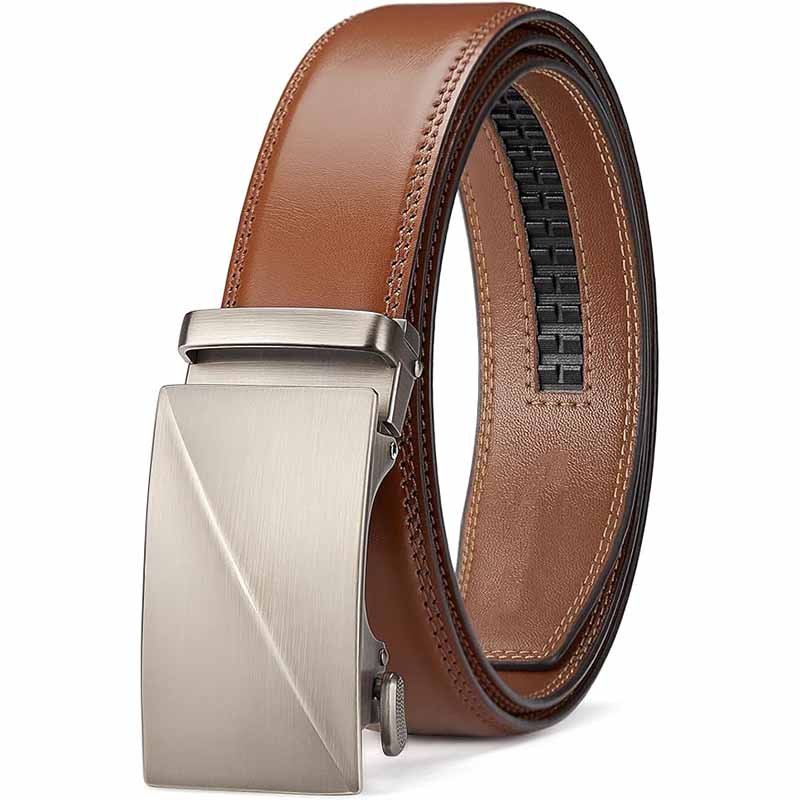
Leather Belt Thickness for Dress Belt
Dress belts are meant to work with formal trousers, suits, business wear, and polished shoes. That immediately sets clear expectations for thickness. The belt should feel clean, elegant, and easy to wear for long periods. In most cases, the best thickness range for a dress belt is around 2.5 mm to 3.0 mm.
This range works well because it offers:
- Better flexibility around the waist
- Easier movement through narrower formal belt loops
- A cleaner profile under tucked shirts and suit jackets
- Better visual proportion with slimmer formal buckles
A dress belt that is too thick can quickly feel out of place. It may push awkwardly against the waistband, create extra stiffness when sitting, and make the overall look feel too heavy. Even if the leather quality is excellent, the wrong thickness can make the product look less refined.
Material and construction also matter. Many dress belts are not built from a single heavy strap. They may use:
- Smooth top-grain or full-grain outer leather
- Leather or microfiber lining
- Reinforced but slim internal construction
- Edge folding or polished painted edges for a cleaner finish
Here is a practical guide:
| Dress Belt Type | Recommended Thickness | Why It Works |
|---|---|---|
| Classic business belt | 2.8–3.0 mm | Balanced structure and comfort |
| Slim formal belt | 2.5–2.8 mm | Elegant appearance and lighter feel |
| Premium lined dress belt | 2.8–3.2 mm | Refined look with better structure |
Another important factor is buckle scale. A slim, polished buckle usually pairs best with a slimmer strap. If the buckle is delicate and the belt is too thick, the proportions feel off. This is especially important for brands targeting officewear, luxury gifting, or formal fashion.
At SzoneierLeather, dress belt projects usually require tighter thickness control because the end customer notices small differences more easily in formal products. A 0.3 mm change that might be acceptable in a rugged belt can feel very obvious in a dress collection. That is why thinner belts often require even more careful material preparation and finishing than thicker ones.
Leather Belt Thickness for Casual Belt
Casual belts sit in the middle of the market and usually carry the widest commercial opportunity. They need to feel strong enough for jeans and daily use, but not so stiff that they become uncomfortable. This is why the most practical thickness range for a casual belt is usually 3.0 mm to 4.0 mm, with 3.4–3.8 mm being especially popular in custom production.
This range works because it gives a strong balance of:
- Enough body to feel durable
- Enough flexibility for daily wear
- Better visual match with denim, chinos, and casual footwear
- Better support for pull-up, crazy horse, nubuck, and oiled finishes
Casual belts are also where leather personality becomes more visible. Unlike dress belts, which often aim for a clean and uniform surface, casual belts often benefit from texture, grain character, color pull-up, wax effect, and a more natural edge look. A medium thickness helps support that identity. The belt feels more substantial in hand and more believable as an everyday product.
Here is a useful casual belt reference:
| Casual Belt Style | Recommended Thickness | Common Leather Direction |
|---|---|---|
| Everyday casual belt | 3.2–3.6 mm | Full-grain or top-grain |
| Jeans belt | 3.5–4.0 mm | Pull-up, crazy horse, oiled leather |
| Casual fashion belt | 3.0–3.4 mm | Softer or more flexible leather |
One of the most common market mistakes is making a casual belt too thin in order to reduce material cost. The belt may still look acceptable in product photos, but once worn with jeans, customers often feel it lacks confidence and structure. The opposite mistake also happens: making it too thick without considering flexibility, which creates a heavy strap that feels more like workwear than casualwear.
For brands and wholesalers, casual belts often represent the best place to differentiate through feel. A well-made 3.5 mm casual belt can communicate strength, comfort, and quality very quickly. That makes this category especially important in private label development, because small improvements in thickness and leather selection can produce a noticeable upgrade in customer perception.
Leather Belt Thickness for Work Belt
Work belts are built for a very different purpose. They are expected to handle heavier trousers, frequent use, more pulling at the buckle and holes, and in some cases the added stress of attached tools or utility demands. That is why work belts normally sit in the 4.0 mm to 5.0 mm+ range.
The reason for this heavier construction is straightforward:
- More thickness improves rigidity
- More body helps the belt resist stretching
- Thicker leather maintains shape longer under repeated load
- Larger buckles pair better with heavier straps
For true workwear use, customers usually care less about refined softness and more about long-term reliability. The strap should feel substantial from day one. It should not collapse or twist easily. It should support daily wear in rougher conditions without quickly becoming misshapen.
A work belt may include:
- Heavy full-grain leather
- Double-layer construction
- Reinforced stitched keeper areas
- Strong buckle attachment
- More substantial edge finishing or raw-edge styling
Here is a practical comparison:
| Work Belt Type | Recommended Thickness | Performance Priority |
|---|---|---|
| Standard rugged belt | 4.0–4.5 mm | Daily durability |
| Heavy-duty work belt | 4.5–5.0 mm | Strength and structure |
| Utility or tool-support belt | 5.0 mm+ | Load support and stiffness |
But there is an important trade-off. A thicker belt takes longer to break in. It may feel stiff during the first weeks of wear. It also adds weight and can feel excessive for users who only want the visual style of rugged leather, not the full performance level. That is why thickness should still be matched carefully to actual usage rather than exaggerated for marketing language alone.
At SzoneierLeather, work belt development often focuses not only on leather thickness but also on the full construction system. A thick strap with poor hole reinforcement or weak buckle attachment is still a weak product. Real strength comes from combining the right thickness with the right leather quality, hardware, and assembly method. That is what turns a heavy belt into a dependable one.
How to Pick Leather Belt Thickness?
Choosing the right leather belt thickness is about matching the product to real use conditions. It is not about selecting the thickest option or following a fixed number. The correct thickness depends on how the belt will be worn, how often it will be used, what type of clothing it will match, and what level of durability the customer expects.
A well-chosen thickness improves comfort, extends product life, and creates a stronger product position in the market.
How to Match Leather Belt Thickness to Use?
The first step in selecting leather belt thickness is to clearly define how the belt will be used. Different usage scenarios create very different stress patterns on the strap.
For example:
- Office wear → light tension, frequent sitting
- Daily casual wear → moderate tension, repeated use
- Work or utility use → high tension, heavy load
Each of these requires a different balance between flexibility and strength.
A practical matching guide looks like this:
| Use Scenario | Recommended Thickness | Key Reason |
|---|---|---|
| Formal / office | 2.5–3.0 mm | Comfort and clean appearance |
| Casual daily wear | 3.0–3.8 mm | Balance of strength and flexibility |
| Heavy-duty / work | 4.0–5.0 mm+ | Load resistance and durability |
Beyond usage, clothing style also matters. Slim trousers and formal wear often have narrower belt loops, which naturally limit thickness. Jeans and work pants usually allow thicker belts and benefit from stronger structure.
Another factor is wear frequency. A belt worn occasionally does not require the same durability as one worn every day. Many customers underestimate this and choose a thinner belt to reduce cost, only to face faster wear and higher replacement rates.
From factory experience, the most common improvement is not making belts thicker, but making them more appropriate for their actual use case. A well-matched 3.4 mm belt often performs better in the market than an overbuilt 4.5 mm belt used in the wrong category.
How Leather Belt Thickness Affects Comfort?
Comfort is one of the first things customers notice when wearing a belt, and thickness plays a direct role in that experience.
A thinner belt bends more easily around the waist, making it more comfortable when sitting, walking, or wearing for long periods. This is why dress belts are typically thinner. On the other hand, a thicker belt resists bending, which can create pressure points, especially at the front waist and hip areas.
Comfort impact by thickness:
| Thickness | Flexibility | Comfort Level | Typical Feedback |
|---|---|---|---|
| 2.5–3.0 mm | High | High | Soft, easy to wear |
| 3.0–4.0 mm | Medium | Balanced | Comfortable and stable |
| 4.0–5.0 mm+ | Low | Lower initially | Strong but stiff |
However, comfort is not only about softness. A belt that is too thin can also feel uncomfortable because it lacks support. It may twist, dig into the waist unevenly, or feel unstable when tightened.
Another important factor is break-in behavior. Thicker belts often feel stiff at the beginning but become more comfortable after repeated use. Thinner belts feel comfortable immediately but may lose shape faster over time.
Additional comfort factors linked to thickness:
- Edge finishing (smooth edges reduce friction)
- Leather type (vegetable-tanned vs chrome-tanned)
- Lining structure (lined belts can feel softer even at similar thickness)
- Strap width (wider belts distribute pressure better)
For product development, comfort should be tested in real wearing conditions, not just by hand feel. Sitting, walking, and daily movement reveal issues that are not visible in static evaluation.
How Leather Belt Thickness Affects Durability?
Durability is where thickness shows its value most clearly, but it must be understood correctly. Thicker leather generally improves durability, but only when combined with proper material quality and construction.
Key durability factors influenced by thickness:
- Resistance to stretching
- Resistance to deformation
- Strength at adjustment holes
- Ability to carry repeated load
Here is a durability comparison:
| Thickness | Stretch Resistance | Shape Retention | Hole Durability |
|---|---|---|---|
| 2.5–3.0 mm | Medium | Medium | Medium |
| 3.0–4.0 mm | High | High | High |
| 4.0–5.0 mm+ | Very high | Very high | Very high |
However, thickness alone is not enough. A thick belt made from low-quality leather may still stretch, crack, or delaminate.
Real durability depends on:
- Leather grade (full-grain performs better)
- Tanning process (vegetable-tanned often holds structure longer)
- Construction (single-layer vs bonded vs stitched)
- Reinforcement (hole area, buckle area)
Another important point is hole durability. This is one of the most common failure points. A thicker belt distributes stress better around the holes, reducing tearing over time.
But over-thickness also has downsides:
- Harder to insert into buckle
- More pressure on stitching and edges
- Increased weight and stiffness
For most commercial products, the goal is not maximum thickness, but optimized durability within a comfortable range. This is why the 3.2–3.8 mm range is often the most commercially successful for everyday belts.
How Is Leather Belt Thickness Made?
Leather belt thickness is not accidental. It is controlled through a combination of material selection, splitting, layering, and finishing processes. Understanding how thickness is created helps ensure consistency and quality in bulk production.
How Factories Control Leather Belt Thickness?
In leather manufacturing, thickness control starts at the raw material stage.
The main process used is splitting, where a thick hide is divided into layers to reach the desired thickness.
Key steps:
- Raw hide selection
- Different parts of the hide have different natural thickness
- High-quality sections are selected for belts
- Splitting process
- Leather is passed through a splitting machine
- Thickness is adjusted to target specification
- Calibration
- Multiple measurements ensure consistency
- Adjustments are made during production
- Pre-production sampling
- Samples are checked before bulk cutting
Control standards:
| Control Area | Typical Standard |
|---|---|
| Thickness tolerance | ±0.2 mm |
| Surface consistency | No major variation |
| Edge uniformity | Clean and even |
Factories with better control systems can maintain consistent thickness across thousands of belts, which is critical for brand reliability.
What Tolerance for Leather Belt Thickness?
Tolerance refers to how much variation is acceptable in thickness.
In leather products, some variation is natural because leather is not a synthetic material. However, excessive variation can create visible and functional problems.
Typical tolerance levels:
| Product Level | Thickness Tolerance |
|---|---|
| Basic production | ±0.3–0.5 mm |
| Standard production | ±0.2–0.3 mm |
| Premium production | ±0.1–0.2 mm |
Why tolerance matters:
- Inconsistent thickness → uneven feel across products
- Different flexibility → customer dissatisfaction
- Fit issues → belt may feel tighter or looser
For premium brands, tighter tolerance is essential because customers notice small differences more easily.
At SzoneierLeather, thickness control is usually kept within ±0.2 mm, which ensures consistent product experience.
How Layers Change Leather Belt Thickness?
Leather belts can be constructed in different ways, and layering plays a big role in final thickness.
Common constructions:
1. Single-layer belt
- One piece of leather
- Strong and natural look
- Used for casual and work belts
2. Double-layer belt
- Two layers bonded or stitched
- More structured
- Used for dress belts
3. Reinforced belt
- Multiple layers with internal support
- Higher durability
- Used for premium or heavy-duty belts
Comparison:
| Construction | Thickness Control | Durability | Flexibility |
|---|---|---|---|
| Single-layer | Simple | High | Medium |
| Double-layer | Precise | Medium–High | High |
| Reinforced | Complex | Very high | Medium |
Layering also allows customization. For example:
- A 2.0 mm outer layer + 1.2 mm lining = slim but structured belt
- A 3.5 mm single layer = rugged natural belt
This flexibility is important for brands developing different product lines.
How to Customize Leather Belt Thickness?
Customizing leather belt thickness is one of the most important steps in developing a successful product line. It is not just about choosing a number in millimeters. It is about matching thickness with your brand positioning, target customer, price level, and real usage scenarios.
A well-defined thickness strategy helps you:
- Differentiate your product from competitors
- Improve customer satisfaction and repeat orders
- Control cost without sacrificing performance
How to Set Leather Belt Thickness for Custom?
Setting the right leather belt thickness starts with understanding your product direction.
Key questions to define before production:
- What type of belt is this? (dress, casual, work)
- How often will it be worn? (daily, occasional)
- What clothing will it match? (suits, jeans, uniforms)
- What is the target price range?
Based on these, thickness can be defined more accurately.
Here is a practical selection guide:
| Product Type | Recommended Thickness | Key Focus |
|---|---|---|
| Formal dress belt | 2.5–3.0 mm | Flexibility, refined look |
| Smart casual belt | 3.0–3.5 mm | Balance and comfort |
| Casual jeans belt | 3.5–4.0 mm | Strength and durability |
| Heavy-duty work belt | 4.0–5.0 mm+ | Load resistance |
Another important factor is buckle size. Larger buckles require thicker straps for visual balance and structural support. A mismatch between buckle and strap thickness can make the product feel poorly designed.
At SzoneierLeather, customization usually begins with sample development. Customers can compare different thickness options side by side, which makes decision-making much easier than relying on specifications alone.
What Leather Belt Thickness Do Brands Use?
Different brands use different thickness strategies depending on their market positioning.
Here is a general pattern observed in the market:
| Brand Position | Thickness Strategy | Product Focus |
|---|---|---|
| Fast fashion | 2.5–3.2 mm | Lightweight, low cost |
| Mid-range brands | 3.0–3.8 mm | Balanced performance |
| Premium brands | 3.2–4.2 mm | Quality feel and durability |
| Workwear brands | 4.0–5.0 mm+ | Strength and reliability |
Premium brands often choose slightly thicker belts, but more importantly, they ensure consistency and material quality. Customers at this level are more sensitive to product feel, so even small improvements in thickness and structure can significantly increase perceived value.
Another trend is layered construction in premium belts. Instead of using a single thick piece, some brands combine layers to achieve:
- Better flexibility
- Cleaner finish
- More refined edge structure
This approach allows brands to control thickness more precisely while improving comfort.
How Leather Belt Thickness Affects Cost?
Thickness directly impacts cost, but not always in the way customers expect.
Main cost drivers related to thickness:
| Factor | Impact on Cost | Explanation |
|---|---|---|
| Leather consumption | High | Thicker leather uses more material |
| Leather grade | High | Better leather costs more regardless of thickness |
| Construction method | Medium | Layered belts increase labor cost |
| Cutting efficiency | Medium | Thicker leather reduces yield |
| Finishing process | Low–Medium | Edge work may increase cost |
Typical cost relationship:
| Thickness Range | Cost Level |
|---|---|
| 2.5–3.0 mm | Lower |
| 3.0–4.0 mm | Medium |
| 4.0–5.0 mm+ | Higher |
However, reducing thickness to save cost can create problems:
- Shorter product lifespan
- Higher return or complaint rate
- Lower perceived value
In many cases, increasing thickness slightly (for example from 3.0 mm to 3.5 mm) can significantly improve product performance without a large increase in cost.
For commercial success, the goal is not the lowest cost, but the best cost-performance balance.
Quality Control for Leather Belt Thickness
Maintaining consistent thickness across production is critical for product quality and brand reputation.
Key control points:
1. Raw Material Inspection
- Check leather thickness variation
- Ensure consistent quality across hides
2. Splitting Accuracy
- Adjust machine settings precisely
- Monitor thickness during production
3. Cutting Consistency
- Ensure uniform strap width and thickness
- Avoid edge distortion
4. Assembly Check
- Confirm thickness remains stable after layering
- Check stitching does not compress material excessively
5. Final Inspection
- Random sampling measurement
- Functional testing for flexibility and strength
Common problems and solutions:
| Problem | Cause | Solution |
|---|---|---|
| Uneven thickness | Poor splitting control | Improve calibration |
| Belt feels too stiff | Over-thickness | Adjust thickness or material |
| Belt stretches | Under-thickness or weak leather | Upgrade material or thickness |
| Inconsistent feel | Large tolerance | Tighten QC standards |
At SzoneierLeather, thickness consistency is controlled within ±0.2 mm, ensuring uniform product feel across large orders.
Why Work with SzoneierLeather
Choosing the right manufacturing partner is as important as choosing the right thickness.
More importantly, SzoneierLeather focuses on real product performance. The goal is not just to produce belts that look good, but belts that feel right and last in real use.
Start Your Custom Leather Belt Project
If you are planning to develop a leather belt line, defining the right thickness is one of the most important early decisions.
You can share:
- Target market and product positioning
- Style direction (dress, casual, work)
- Desired thickness range
- Price target and quantity
Based on that, SzoneierLeather can help you:
- Select the right leather and thickness combination
- Develop samples for real-use testing
- Optimize cost and durability balance
- Ensure consistent production quality
Whether you are launching a new collection or improving an existing product, the right thickness will directly impact how your customers feel about your belt.
Send your inquiry today and let SzoneierLeather help you create leather belts that balance comfort, durability, and strong market appeal.