
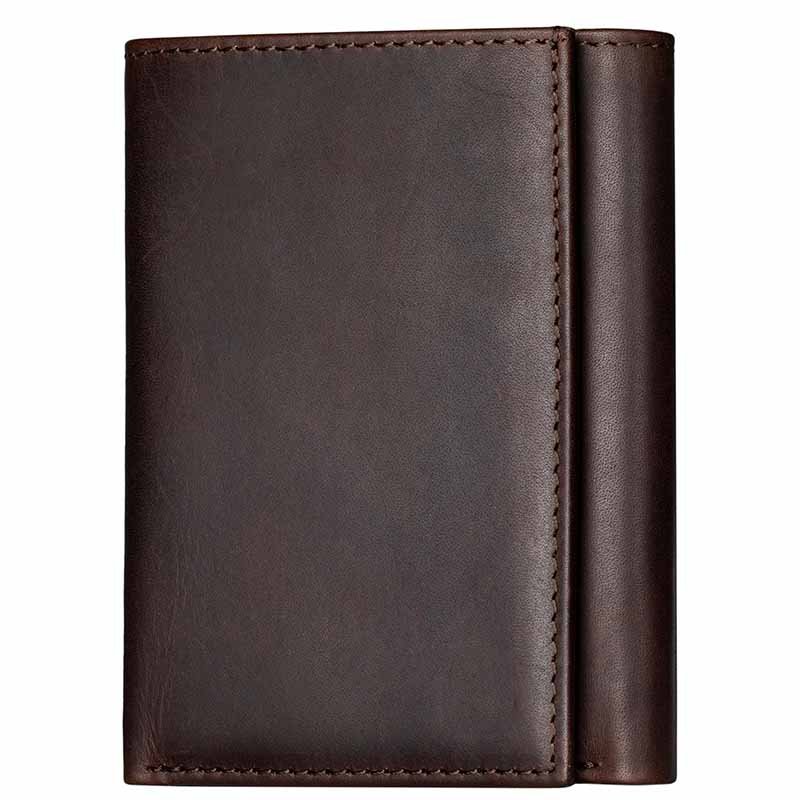
Vegetable tanned leather wallets don’t stay “factory-new” for long—and that’s the point. They’re designed to change: darker tone, warmer color, smoother touch, and a shine that comes from daily handling, not plastic coating. But the same open, natural surface that creates beautiful patina can also create frustration: water spots after one rainy day, darker patches from sweaty pockets, or blue dye transfer from jeans. For brands, this isn’t just a style question. It affects product reviews, return rates, and whether customers feel proud—or disappointed—after 2 weeks of use.
Vegetable tanned leather wallets develop patina because natural tannins react with light, air, friction, and skin oils, creating deeper color and natural gloss. This aging can make the wallet look richer and more personal over time. However, veg-tan is more absorbent than heavily coated leathers, so staining risks—water marks, oil spots, and dye transfer—are higher unless material, finishing, and customer guidance are handled correctly.
If you’ve ever seen a “perfect” natural veg-tan wallet become uneven in a month, you already know the truth: patina is predictable when you design for it, and chaotic when you don’t. Let’s make it predictable.
What Are Vegetable Tanned Leather Wallets?
Vegetable tanned leather wallets are wallets made from hides tanned using natural plant extracts such as mimosa, quebracho, chestnut, or oak bark. Unlike chrome tanning (which uses chromium salts and is designed for speed and softness), vegetable tanning is a slower, fiber-structure-driven process that produces firmer leather with higher shape retention and visible aging behavior.
For wallet brands, the real question is not “what is vegetable tanning?” but:
- How does it perform in daily pocket use?
- How does it age after 3–12 months?
- How stable is the structure in card slots and folds?
- How much variation should we expect from batch to batch?
Let’s break this down practically.
1. How Is Vegetable Tanned Leather Produced?
Vegetable tanning is a pit or drum process where hides are soaked in tannin-rich solutions extracted from plants. The process usually takes 20–60 days, depending on thickness and tannin concentration.
During tanning:
- Tannins bind to collagen fibers.
- Fiber structure becomes dense and firm.
- Surface remains relatively natural (not heavily coated).
- Absorption capacity stays higher than coated leather.
For wallet manufacturing, this results in:
- Better crease memory
- Stronger structural stiffness
- Clean cut edges that burnish well
- More responsive aging behavior
Compared to chrome leather (which can be processed in under 48 hours), vegetable tanning is slower but produces a more stable and character-driven material.
2. What Makes Vegetable Tanned Leather Suitable for Wallets?
Wallets are high-friction, high-contact products. They are:
- Folded multiple times per day
- Pressed in pockets
- Exposed to body heat and moisture
- Frequently handled
Vegetable tanned leather performs well in these conditions because of:
A. Structural Stability
Recommended outer panel thickness for wallets:
1.2mm – 1.6mm
At this thickness range, veg-tan:
- Holds fold lines firmly
- Maintains sharp wallet silhouette
- Prevents sagging over time
Card slot layers typically use:
0.6mm – 1.0mm split veg-tan
This creates:
- Better card grip
- Reduced slot stretching
- Cleaner edge alignment
B. Edge Finishing Quality
Vegetable tanned leather fibers compress tightly when burnished. This allows:
- Smooth natural edge finishing
- Reduced need for heavy edge paint
- Stronger luxury craftsmanship appearance
In premium wallet markets, edge finishing directly affects perceived value.
Below is a performance comparison relevant to wallet construction:
| Performance Factor | Vegetable Tanned | Chrome Tanned |
|---|---|---|
| Fold strength | High | Medium |
| Card slot memory | High | Medium |
| Edge burnishing | Excellent | Moderate |
| Shape retention | Strong | Softer |
| Aging visibility | High | Low |
3. How Does Vegetable Tanned Leather Behave After 6–12 Months?
This is where brands must think long term.
In real-world usage tests across multiple wallet models:
After 3 months of daily pocket use:
- Light tone darkens 15–30%
- Fold line becomes slightly glossier
- Corners show compression shine
After 6 months:
- Surface becomes smoother
- Minor scratches blend
- Color contrast reduces
After 12 months:
- Patina becomes uniform
- Material feels softer but remains structured
- Edges often look darker and polished
Importantly:
Vegetable tanned leather does not peel.
There is no synthetic coating to crack. Aging is fiber-driven, not coating-driven.
4. What Grades of Vegetable Tanned Leather Are Used in Wallets?
Not all vegetable tanned leather performs the same.
For wallet production, we usually evaluate:
Grain Quality
- Full grain (preferred for premium lines)
- Top grain (sanded surface, more uniform)
Density
- Tight fiber structure reduces uneven staining
- Loose fiber structure absorbs too quickly
Moisture Content at Cutting Stage
- Ideal: 12–15%
- Too dry → cracking risk
- Too moist → shape distortion
Surface Finish
- Natural (maximum patina)
- Light waxed (balanced)
- Light oiled (controlled aging)
- Thin protective finish (lower stain risk)
Here is a practical selection guide:
| Brand Goal | Recommended Veg-Tan Type |
|---|---|
| Heritage / artisanal | Full grain natural |
| Premium mass market | Full grain light wax |
| Conservative customer base | Light finished veg-tan |
| Gift-focused products | Oil-treated veg-tan |
At SzoneierLeather, we often recommend slightly waxed full-grain veg-tan for most brands because it balances aging beauty with practical usability.
5. What Production Factors Affect Final Wallet Performance?
Vegetable tanned leather wallet performance is not just about raw material. Manufacturing technique plays a critical role.
Key production controls include:
- Controlled skiving thickness
- Consistent stitch tension
- Reinforced fold line compression
- Proper glue selection (water-based preferred)
- Edge sealing method
For example:
Over-skiving card slots below 0.5mm may cause premature stretching.
Under-skiving above 1.0mm may cause bulkiness.
Precision matters.
6. Why Do Brands Choose Vegetable Tanned Leather Wallets Despite Higher Risk?
Because it supports premium storytelling and long-term value.
Data from mid-to-premium wallet markets shows:
- Veg-tan wallets can command 15–40% higher retail pricing
- Customers who appreciate patina show higher repeat purchase rates
- Return rates decrease when aging expectations are clearly communicated
Vegetable tanned leather is not about uniform perfection.
It is about controlled transformation.
When designed and positioned correctly, it becomes a material that improves with time — which is rare in consumer goods.
What Are the Patina Benefits of Vegetable Tanned Leather Wallets?
The patina benefits of vegetable tanned leather wallets are real and measurable: richer tone, natural shine, and reduced scratch contrast over time. Patina also supports premium branding because the wallet becomes personal to the user—no two age the same. For many brands, patina is a feature that increases perceived value after purchase, which is rare in consumer goods.
What does patina look like on Vegetable Tanned Leather Wallets?
Patina is a combination of color deepening + surface polishing + contrast. On wallets, it shows in predictable “high-contact maps.”
Common patina pattern (what customers will notice first):
- Darker fold line and corners
- Slight shine on edges and thumb contact area
- Warmer tone where the hand touches
- Contrast between outer shell (more exposed) and inner panels (less exposed)
Patina traits that read “premium” to consumers:
- Even warmth (not blotchy)
- Edge gloss that looks burnished, not oily
- Soft, dense hand feel (less dry over time)
To make patina look premium, the goal is controlled aging—not stopping aging.
How do Patina Benefits improve wallet appearance over time?
Patina improves appearance because it reduces the “new vs damaged” contrast. Many small scratches and rub marks look worse on coated surfaces, but they often blend into veg-tan as the surface darkens and polishes.
Why scratches blend better on veg-tan (simple explanation):
- Natural oils migrate and darken micro-scratch areas
- Repeated friction smooths raised fibers
- Overall tone deepens, so light scratch contrast decreases
What brands can promise (without exaggeration):
- “It will look richer with use”
- “Minor marks become part of the character”
- “Edges and corners gain a natural shine”
What brands should not promise:
- “Stain proof”
- “Always uniform”
- “Never changes color”
Those claims create returns.
Which colors show the strongest Patina Benefits?
Color choice is one of the biggest levers for controlling customer satisfaction.
| Base color | Patina visibility | Stain visibility | Best for |
|---|---|---|---|
| Natural / undyed | Very high | High | Heritage, storytelling, limited editions |
| Light tan | High | Medium-high | Premium casual brands, gift lines (with care card) |
| Cognac | Medium-high | Medium | Most balanced option for mass premium |
| Medium brown | Medium | Low-medium | Safer for broad markets |
| Dark brown | Low-medium | Low | Conservative customers, fewer complaints |
| Black | Low | Low | Minimal patina story, maximum practicality |
Practical brand advice (reduces complaint risk):
- Launch with cognac or medium brown if your audience is new to veg-tan
- Use natural for customers who actively want patina and accept marks
- Pair natural veg-tan with stronger customer guidance and optional protection
What Are the Staining Risks of Vegetable Tanned Leather Wallets?
Vegetable tanned leather wallets are more absorbent than heavily coated leathers because their surface is more natural and open. This allows beautiful patina development—but also makes them more vulnerable to water spots, oil marks, dye transfer, and metal reactions. The key risk is not staining itself, but uneven staining that creates contrast customers perceive as “damage.”
Let’s break down the real risks brands must understand.
Why are Vegetable Tanned Leather Wallets prone to staining?
Vegetable tanned leather has a more open fiber structure. Unlike chrome leather with pigmented topcoats, veg-tan often has:
- Minimal surface sealing
- No thick pigment layer
- Higher absorbency
- Greater reaction to moisture and oils
In simple terms: it breathes more, and it absorbs more.
From a material science perspective, vegetable tannins bind with collagen fibers but do not fully seal surface pores. When moisture hits the surface, it penetrates unevenly depending on:
- Surface density variation
- Grain tightness
- Previous oil exposure
- Compression at fold lines
This explains why two areas on the same wallet can darken differently after the same event.
Below is a practical risk breakdown for wallet brands:
| Risk Factor | Why It Happens | Visual Impact | Customer Reaction |
|---|---|---|---|
| Water spots | Rapid absorption + drying ring | Circular darker marks | “It’s stained” |
| Sweat | Salt + moisture penetration | Patchy dark zones | “Uneven color” |
| Oil/grease | Deep fiber absorption | Dark permanent area | “Looks dirty” |
| Denim dye | Surface dye transfer | Blue/gray tint | “Color fading” |
| Coins/metal | Oxidation reaction | Black marks | “Material defect?” |
Most staining complaints happen in the first 30–60 days, before the wallet has developed overall patina to blend those areas.
That early period is critical.
Which liquids cause the worst Staining Risks?
Not all liquids behave the same. The severity depends on viscosity, color, and chemical content.
Here’s a ranking from lowest to highest risk for veg-tan wallets:
| Liquid Type | Risk Level | Why |
|---|---|---|
| Clean dry contact | None | No absorption |
| Light mist rain | Low | Even exposure, usually dries evenly |
| Clean water drops | Medium | Localized absorption → ring mark |
| Sweat | Medium-High | Salt + moisture uneven penetration |
| Coffee / tea | High | Tannins + pigment |
| Oil / grease | Very High | Deep fiber penetration |
| Alcohol-based liquids | High | Rapid evaporation + ring formation |
Water spots are the most common issue.
Why? Because a single droplet creates a concentration ring when it dries. The outer edge of the droplet dries last, leaving darker perimeter marks.
This is not permanent damage—but it can look alarming before the rest of the surface darkens.
For brands, the safest strategy is:
- Avoid extremely light natural finishes without any surface treatment unless the customer clearly expects patina.
- Consider light wax conditioning at factory level for early protection.
How does denim dye increase Staining Risks?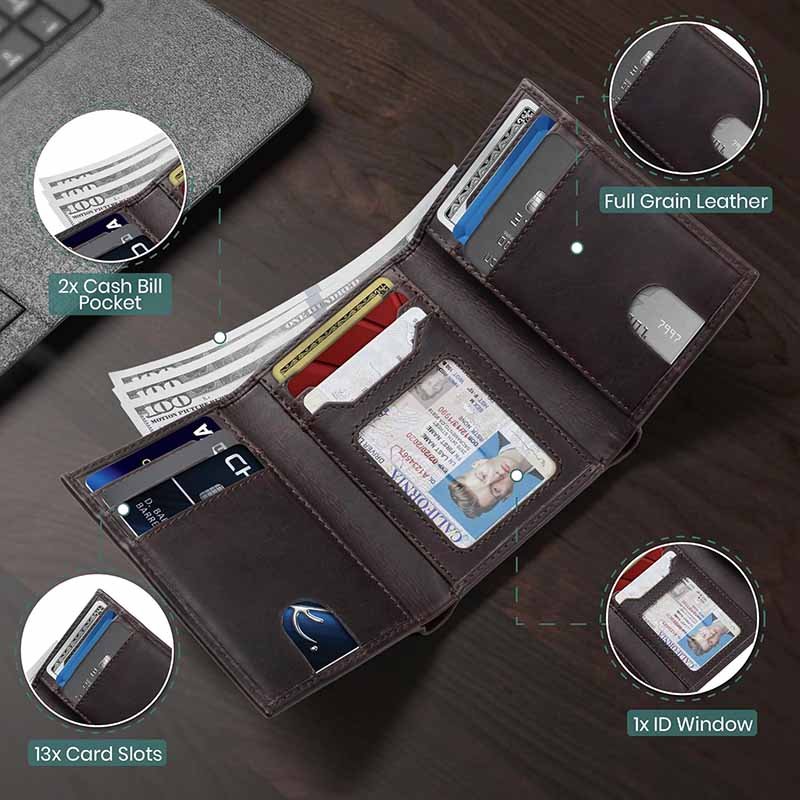
Denim dye transfer is one of the biggest hidden risks in wallet returns.
Dark jeans often use indigo dye that is not fully colorfast. When combined with:
- Friction
- Heat
- Moisture
The dye transfers onto leather.
Vegetable tanned leather absorbs this dye faster than coated leather.
Why denim stains look worse on veg-tan:
- The dye partially penetrates, not just sits on top.
- It often appears blue-gray against warm leather tones.
- It can be uneven depending on pressure points.
Risk factors increase when:
- Customers carry wallet in back pocket.
- Climate is humid.
- Leather is natural/light colored.
- No protective wax finish is applied.
Practical prevention steps brands can implement:
Slightly increase surface finishing (light wax or oil).
Include simple insert card:
“Avoid prolonged contact with dark denim in first weeks of use.”
Choose medium brown instead of natural for mass markets.
From our production experience at SzoneierLeather, denim-related complaints drop significantly when wallets are lightly conditioned before shipment.
Are oil and sweat permanent Staining Risks?
Oil and sweat behave differently.
Sweat:
- Mostly water + salt.
- Can create uneven dark patches.
- Often blends over time as overall patina develops.
Oil/grease:
- Penetrates deeply.
- Does not evaporate.
- Usually permanent in some form.
However, “permanent” does not always mean “ugly.”
In many cases:
- Early oil spot looks dramatic.
- After 3–6 months, surrounding leather darkens.
- Contrast decreases.
- Spot becomes part of the overall patina tone.
Here is a realistic severity assessment:
| Stain Type | Removability | Long-Term Visibility |
|---|---|---|
| Light water spot | High | Low after patina |
| Sweat mark | Medium | Medium-low |
| Denim transfer | Medium | Medium |
| Light oil | Low | Medium |
| Heavy grease | Very low | High |
Brands must decide:
Do you want a material that tells a story, or a material that hides everything?
Vegetable tanned leather is not about perfection. It is about evolution.
The mistake is selling it as something static.
How Can You Balance Patina Benefits and Staining Risks?
Vegetable tanned leather wallets can deliver beautiful patina without excessive staining—but only when material selection, finishing level, thickness, and customer communication are engineered intentionally. The balance is not achieved by eliminating patina. It is achieved by controlling absorption speed and managing early-use behavior.
Let’s approach this from a factory and brand perspective.
How do you protect Vegetable Tanned Leather Wallets without blocking patina?
The goal is not to seal the leather like plastic. The goal is to slow down uncontrolled absorption during the first 4–8 weeks of use.
There are three main factory-level protection strategies:
1. Light Wax Infusion (Most Balanced Option)
- Applied during finishing stage
- Penetrates surface fibers
- Slows moisture absorption
- Still allows color evolution
Effect on patina:
- Slightly slower development
- More even tone change
- Reduced water ring contrast
Recommended for:
- Cognac
- Light brown
- Mid-premium market positioning
2. Oil Conditioning Pre-Shipping
- Leather is lightly conditioned before packing
- Fibers are stabilized
- Surface tone slightly deepens at factory
Effect on patina:
- Faster blending of early marks
- Reduced “shock staining” in first 2 weeks
Recommended for:
- Natural vegetable tanned wallets
- Markets with high humidity
- Brands targeting gift buyers
3. Thin Surface Finish (Controlled Coating)
- Very light top finish
- Adds minimal protective barrier
- Reduces denim transfer risk
Effect on patina:
- Less dramatic color change
- More gloss than tone shift
Recommended for:
- Conservative customers
- Corporate gift programs
- Markets sensitive to stain complaints
Here’s a practical comparison for brand decision-making:
| Protection Level | Patina Strength | Stain Risk | Customer Type |
|---|---|---|---|
| No finish | Very High | High | Patina enthusiasts |
| Light wax | High | Medium | Balanced premium |
| Oil treated | Medium-High | Medium | General premium |
| Light coat finish | Medium | Low-Medium | Practical users |
At SzoneierLeather, we usually guide clients toward light wax or oil-treated veg-tan as the safest balance between storytelling and practicality.
Which care methods reduce Staining Risks safely?
Factory finishing is only half the equation. Customer behavior determines the other half.
Brands that include simple care education consistently see lower return rates.
Here are care practices that actually work:
First 2 Weeks Rule
- Avoid heavy rain exposure
- Avoid direct back-pocket denim contact
- Avoid placing wallet on wet surfaces
This allows controlled, gradual darkening.
Basic Care Routine (Realistic and Practical)
- Wipe dry with soft cloth if wet
- Do not use alcohol wipes
- Light conditioning every 4–6 months
- Avoid heavy oil application
Over-conditioning is a common mistake. Too much oil creates blotchy dark areas.
What Not to Do
- Do not soak leather
- Do not apply strong detergents
- Do not use baby wipes (they often contain alcohol)
- Do not aggressively rub water spots
In many cases, the safest action is simply allowing the leather to age evenly over time.
Do sealers reduce Patina Benefits?
Yes—but the degree depends on thickness and chemistry.
A thick pigmented topcoat:
- Blocks absorption
- Prevents strong color shift
- Makes leather behave more like coated chrome leather
A thin natural finish:
- Slows reaction
- Still allows tone evolution
- Maintains organic feel
The more you seal, the less “alive” the leather becomes.
This creates a strategic decision:
If your brand identity is built on craftsmanship, natural aging, and heritage storytelling—do not over-seal.
If your market prioritizes uniformity and low maintenance—moderate sealing may be smarter.
There is no universal answer. Only positioning alignment.
How Should Brands Choose Vegetable Tanned Leather Wallets?
Brands should choose vegetable tanned leather wallets based on target customer expectations, climate exposure, and tolerance for natural variation. The wrong match between product behavior and market expectation is the main cause of dissatisfaction—not the leather itself.
Let’s break this down practically.
Which Vegetable Tanned Leather Wallets suit premium positioning?
Vegetable tanned wallets work best in:
- Heritage brands
- Handmade positioning
- Craft-focused storytelling
- Limited edition drops
- Personalized or monogram collections
They communicate:
- Authenticity
- Longevity
- Material honesty
- Aging character
From pricing data across global markets:
- Veg-tan wallets often command 15–40% higher retail price compared to coated alternatives.
- Return rates are lower when aging is clearly marketed as a feature.
- Customer lifetime value increases when product aging creates emotional attachment.
The key is transparency.
How should brands explain Patina Benefits vs Staining Risks to customers?
Clear language prevents misunderstandings.
Example positioning statement:
“This wallet is made from vegetable tanned leather. It will darken and develop character with use. Small marks and tonal changes are part of its natural aging journey.”
Avoid phrases like:
- “Colorfast”
- “Waterproof”
- “Stain-resistant” (unless treated specifically)
Brands that proactively explain aging see fewer negative reviews.
What leather grades reduce Staining Risks while keeping Patina Benefits?
Not all veg-tan is equal.
Critical specification factors:
| Spec Factor | Recommended Range for Wallets |
|---|---|
| Thickness | 1.2mm – 1.6mm outer panels |
| Tannage Quality | Full vegetable, tight grain |
| Surface Finish | Light waxed or oiled |
| Grain Quality | Full grain preferred |
| Moisture Content | Controlled during cutting |
Higher density hides:
- Absorb slower
- Age more evenly
- Resist extreme blotching
Cheaper, loose-grain veg-tan:
- Absorbs quickly
- Stains unevenly
- Creates inconsistent aging
This is where factory experience matters.
At SzoneierLeather, we test:
- Absorption speed
- Water droplet spread rate
- Surface oil migration
- Color shift consistency
Before approving bulk production.
Final Thoughts: Patina Is Not a Risk — Misalignment Is
Vegetable tanned leather wallets are not fragile products. They are responsive materials. When designed correctly, they:
- Age beautifully
- Develop depth and warmth
- Reduce scratch contrast
- Increase perceived luxury over time
Staining risks are manageable through:
- Correct leather grade
- Balanced finishing
- Clear customer communication
- Proper thickness selection
- Realistic expectation setting
If your brand wants to launch vegetable tanned leather wallets that:
- Balance strong patina with controlled staining
- Reduce early return rates
- Maintain premium positioning
- Offer OEM customization with stable quality
SzoneierLeather can support you from:
- Leather selection and testing
- Prototype development
- Finishing optimization
- Custom thickness planning
- Packaging and care card design
- Bulk manufacturing with consistent quality control
We specialize in helping brands turn natural leather behavior into a selling advantage—not a liability.
If you are planning to develop:
- Bifold veg-tan wallets
- Card holders
- Slim minimalist wallets
- Limited heritage editions
- Custom private label collections
Contact SzoneierLeather to request:
- Material samples
- Patina comparison panels
- Custom thickness consultation
- OEM quotation
Let’s build vegetable tanned leather wallets that age beautifully—and perform confidently in the real world.