

Vegetable tanned leather is one of the few materials that “records” the owner’s life. It darkens where hands touch it most, softens at fold lines, and gains a warm glow that no factory can fake. That is exactly why many premium brands choose it for wallets, belts, straps, bags, and rigid items like leather boxes. But there’s a trade-off that customers also notice fast: a single water droplet can leave a mark; a bit of hand cream can create a darker patch; a light-colored veg-tan surface can look “uneven” within days.
Here’s the plain truth: vegetable tanned leather goods are designed to change, and not every customer is ready for that change. If your market expects a “perfect-looking” product forever, veg-tan can become a customer-service headache. If your market loves authenticity and aging, veg-tan becomes a loyalty driver.
Vegetable tanned leather goods develop a rich patina through light exposure, oxygen, friction, and skin oils—adding depth and character. But because veg-tan is more absorbent and often lightly finished, it also shows water spots, oil darkening, dye transfer, and uneven marks more easily than heavily coated leathers. The right leather grade, finishing level, and product design decide whether patina becomes a selling point or staining becomes a return reason.
At SzoneierLeather, we’ve worked with vegetable tanned leather for 18+ years across leather bags, wallets, belts, straps, accessories, and structured leather boxes. The best projects start with one simple alignment: what kind of “aging story” does the brand want the product to tell?
What Are Vegetable Tanned Leather Goods?
Vegetable tanned leather goods are products made from hides tanned with plant-based tannins (bark/wood extracts). Compared with chrome-tanned leather, veg-tan is usually firmer, more moldable, and more reactive to light, oils, and moisture. That reactivity creates patina over time—but it also increases the chance of visible staining, especially on light or minimally finished surfaces.
Why this matters for product development (not just education)
When customers buy veg-tan, they are not only buying a material—they are buying a behavior. That behavior impacts:
- Appearance changes in the first 7–30 days
- How “clean” the product looks in photos vs real life
- Return rate risk (especially in e-commerce)
- Care instructions and customer expectations
- How consistent a batch looks across production
A practical way SzoneierLeather frames it for brands is:
Veg-tan is a “living surface.” If you design it like a coated leather, you’ll get complaints. If you design it like a living surface, you’ll get fan customers.
What makes Vegetable Tanned Leather Goods unique?
Veg-tan stands out because it has high surface honesty: it shows contact, handling, and environment more quickly than many coated leathers.
Key differences that matter to brands:
| Attribute that customers notice | Vegetable tanned leather goods | Heavily coated / pigmented leather goods |
|---|---|---|
| Aging look | Deepens, warms, “glows” | Stays similar for longer |
| Early marks | Shows quickly | Hides better |
| Feel | Firmer, drier hand feel | Often smoother, more uniform |
| Tooling/embossing | Very friendly for deep stamping | Can resist deep impressions |
| Molded structure (boxes, stiff wallets) | Strong shape retention | Often softer, needs reinforcement |
For structured categories—belts, straps, rigid wallets, leather boxes—veg-tan is highly valued because it can hold edges, form clean lines, and keep geometry stable.
But uniqueness also comes with risk factors you need to communicate or design around:
- higher absorbency
- faster color change
- uneven darkening if usage is uneven
From a customer viewpoint, veg-tan can feel “premium” because it looks handcrafted and personal. From a brand viewpoint, it requires better expectation-setting and smarter finishing choices.
How do Vegetable Tanned Leather Goods age?
Veg-tan ages through a blend of oxidation + UV exposure + oil absorption + mechanical friction. The result is darker color, smoother surface, and more depth.
What changes first:
- Color shift (often within weeks on light veg-tan)
- Darkening at touch zones (wallet corners, belt holes, strap handles)
- Slight gloss in high-friction areas
What changes later:
- overall warmth and tone uniformity
- softer feel at fold lines
- deeper “mellow” look
Approximate patina timeline (real-life, not lab-perfect):
| Time frame | Visible changes | What triggers it most |
|---|---|---|
| 3–7 days | small dark patches at touch zones | hand oils, pocket friction |
| 2–4 weeks | clear overall warm shift | daily carry + light exposure |
| 2–6 months | richer tone + more even blend | repeated handling + oxidation |
| 6–18 months | mature depth and glow | long-term use |
Climate influences the speed:
- Sunny / high UV → faster darkening
- Humid → higher risk of water marks + faster oil spread
- Very dry → slower change, but can look “thirsty” without care
For brand projects, this matters because “before/after” marketing should match real aging behavior. If you promise a slow patina but the leather darkens in 10 days, customers may interpret it as staining rather than character.
Are Vegetable Tanned Leather Goods finished or natural?
They can be either, and this choice is one of the biggest levers you have to balance patina and staining.
Veg-tan finishing levels (practical view):
| Finish level on veg-tan | Patina visibility | Stain risk | Best fit product types |
|---|---|---|---|
| Natural / minimal finish | Very high | High | artisan wallets, heritage straps |
| Light wax / light top coat | High | Medium | belts, daily wallets |
| Oil/wax enriched | High | Medium | straps, handles, travel goods |
| Semi-protective top finish | Medium | Lower | bags for wider audience |
| Strong protective finish (still veg-tan base) | Lower | Lowest | mass market, low complaint tolerance |
Two customer truths to respect:
- The more protection you add, the more you reduce the “raw” patina look.
- The less protection you add, the more you must accept visible marks.
At SzoneierLeather, we often recommend matching finish level to customer profile:
- If your customers love heritage and craft: keep finish light, provide clear care guidance.
- If your customers want “clean and consistent”: add a controlled protective finish and design to hide unavoidable marks.
What Is Patina on Vegetable Tanned Leather Goods?
Patina on vegetable tanned leather goods is the gradual darkening, warming, and surface polishing that happens through exposure to light, oxygen, friction, and skin oils. Unlike surface damage, patina is a natural transformation of the leather fibers and tannins. It deepens color, adds contrast, and creates a personalized aging pattern that many customers consider a premium feature.
Understanding Patina Beyond Marketing Language
Patina is often romanticized, but from a product-development standpoint, it is a controlled oxidation and oil absorption process.
Vegetable tannins react with:
- UV light
- Air (oxidation)
- Natural skin oils
- Environmental heat
This reaction shifts the color spectrum gradually from pale beige to honey, amber, and deeper brown.
The speed and evenness of patina depend on:
- Leather thickness
- Dye penetration level
- Finish coating thickness
- Handling frequency
- Climate exposure
A key development insight:
Patina is most attractive when it develops evenly. Uneven patina can be perceived as staining.
What creates patina on Vegetable Tanned Leather Goods?
Four main factors create patina:
1. UV Light Exposure
Sunlight accelerates color darkening. Even indirect light can deepen tone within weeks.
2. Oxidation
Air exposure triggers slow chemical reactions in the tannins.
3. Skin Oils
Natural oils from hands darken contact zones—wallet edges, strap handles, belt holes.
4. Friction and Compression
Repeated bending and pressure smooth the surface, adding subtle gloss.
Here is a simplified influence comparison:
| Patina Factor | Speed Impact | Visibility Impact | Most Affected Areas |
|---|---|---|---|
| UV light | Medium–High | High | Entire exposed surface |
| Skin oils | High | High | Corners, handles, fold zones |
| Friction | Medium | Medium | Edges, contact zones |
| Oxidation | Slow | Medium | Overall tone |
For brands, understanding these factors helps determine whether to highlight patina as a feature—or moderate it with finishing.
How does patina change Vegetable Tanned Leather Goods look?
Patina affects three visual elements:
- Color depth
- Surface sheen
- Contrast between high-touch and low-touch areas
Over time, veg-tan gains:
- richer tone
- subtle gloss
- darker edges
In structured products like leather boxes or belts, patina often enhances perceived craftsmanship. In lighter wallets or bags, uneven darkening may be more visible.
Patina visibility varies by color:
| Original Color | Patina Visibility |
|---|---|
| Natural beige | Very high |
| Light tan | High |
| Medium brown | Moderate |
| Dark brown | Low |
This matters when developing product lines. Light natural veg-tan makes patina dramatic but also increases visible early marks.
Do Vegetable Tanned Leather Goods patina faster in certain climates?
Yes.
Climate significantly affects aging speed.
| Climate Type | Patina Speed | Stain Risk |
|---|---|---|
| Sunny / dry | Fast | Moderate |
| Humid | Medium | High |
| Cold / low light | Slow | Low–Moderate |
In humid environments, oil spread and water marks become more visible. In sunny climates, color darkening accelerates quickly.
For global brands, this means product performance can vary by region. A bag that ages beautifully in Europe may darken rapidly in Southeast Asia.
When SzoneierLeather develops for international markets, we often adjust finishing levels depending on distribution region.
What Causes Stains on Vegetable Tanned Leather Goods?
Stains occur when liquids, oils, or dyes penetrate the porous surface of vegetable tanned leather and alter its color beyond normal aging. Unlike patina, stains are usually localized, sudden, and uneven. Because veg-tan has minimal surface coating, it absorbs foreign substances quickly.
The key difference between patina and staining:
- Patina develops gradually and often evenly.
- Staining happens instantly and unevenly.
What stains most affect Vegetable Tanned Leather Goods?
Here is a severity ranking based on penetration speed and cleanup difficulty:
| Substance | Speed of Marking | Visibility | Cleanup Difficulty |
|---|---|---|---|
| Water droplets | Fast | High (light leather) | Medium |
| Rain exposure | Medium | Medium–High | Medium |
| Hand sanitizer | Very Fast | Very High | Hard |
| Coffee / tea | Fast | High | Hard |
| Oil / lotion | Very Fast | High | Very Hard |
| Denim dye transfer | Medium | Medium | Hard |
Oil-based substances are the most difficult because they penetrate deeply and permanently darken fibers.
How do liquids stain Vegetable Tanned Leather Goods?
Liquids stain in three stages:
- Absorption into surface fibers
- Darkening reaction with tannins
- Drying and permanent tone shift
Water stains are common because they create “ring marks” when drying unevenly. The center may lighten while the edge darkens.
Oil stains spread differently:
- They migrate through capillary action.
- They often expand beyond initial contact zone.
- They permanently darken affected areas.
From a manufacturing perspective, light wax finishing reduces water ring formation but does not fully prevent oil penetration.
Do Vegetable Tanned Leather Goods resist oils differently than water?
Yes.
Water tends to evaporate and may fade somewhat over time. Oil bonds more strongly to fibers and creates lasting dark patches.
Comparison:
| Factor | Water | Oil |
|---|---|---|
| Evaporation | Yes | No |
| Darkening | Temporary–Moderate | Permanent–Strong |
| Spread risk | Low–Medium | High |
| Recovery chance | Moderate | Low |
This is why wallets and straps—items exposed to skin oils daily—darken quickly around edges.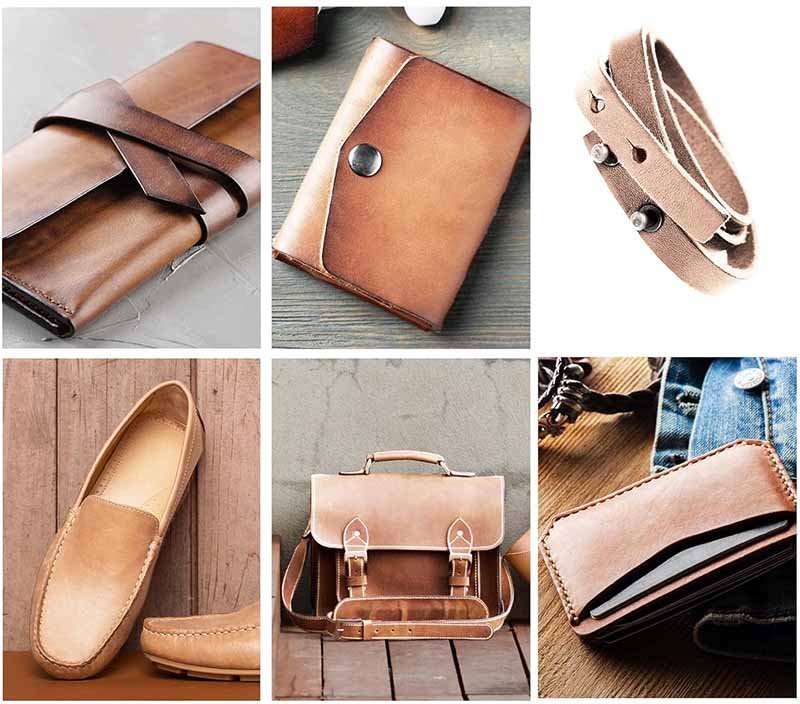
How to Balance Patina & Staining in Vegetable Tanned Leather Goods
Balancing patina and staining is not about eliminating change — it is about controlling how change appears. The most successful vegetable tanned leather goods are designed with a clear aging strategy from day one. Brands that ignore this often face uneven darkening, customer confusion, and unnecessary returns.
The goal is simple:
Encourage beautiful patina. Reduce unwanted stains.
This balance depends on four decisions:
- Finish level
- Color selection
- Product geometry
- Protective detailing
Let’s examine each from a development perspective.
How do finishes affect Vegetable Tanned Leather Goods patina?
Finish level is your first control lever.
Light finishes allow strong patina but higher stain sensitivity. Protective finishes reduce sudden staining but soften patina depth.
Here’s a practical comparison:
| Finish Type | Patina Visibility | Stain Resistance | Best For |
|---|---|---|---|
| Raw / natural | Very high | Low | Heritage lines |
| Light wax | High | Medium | Belts, straps |
| Oil finish | High | Medium | Wallets, bags |
| Light top coat | Moderate | Higher | Commercial retail |
| Protective semi-finish | Lower | High | Mass market |
If your product targets customers who appreciate “living leather,” light wax or oil finish is ideal. If your market expects consistent color for longer, add a subtle protective layer.
At SzoneierLeather, we often recommend testing two finish levels side by side before production approval. This avoids costly repositioning later.
How do linings help Vegetable Tanned Leather Goods resist stains?
Interior design matters more than many brands expect.
For example:
- A vegetable tanned leather bag without lining allows oil transfer from cosmetics or hand cream inside.
- A lined wallet reduces internal oil migration.
- A leather box with fabric lining protects contents from direct contact.
Lining benefits:
- Prevent internal oil penetration
- Improve shape retention
- Reduce friction marks
- Enhance perceived luxury
Lining material comparison:
| Lining Type | Oil Barrier | Structure Support | Luxury Feel |
|---|---|---|---|
| Cotton | Medium | Medium | Classic |
| Microfiber | High | High | Premium |
| Synthetic blend | High | Medium | Durable |
Structured leather boxes especially benefit from interior reinforcement to prevent oil contact from stored items.
How does design minimize staining on Vegetable Tanned Leather Goods?
Design geometry directly affects mark visibility.
Smart design tactics:
- Darken high-touch zones slightly in advance.
- Use edge paint to seal cut edges.
- Avoid large uninterrupted light surfaces.
- Introduce panel segmentation to “break up” visual staining.
- Use stitching color that blends with aging tone.
Product category comparison:
| Product Type | Patina Value | Stain Risk | Design Strategy |
|---|---|---|---|
| Wallet | High | Medium | Darker edges, interior lining |
| Belt | High | Low–Medium | Pre-burnished edges |
| Bag handles | Very High | High | Oil-treated handles |
| Structured box | Medium | Low | Interior lining, stable panels |
Wallets benefit from natural aging. Large flat bag panels show stains more easily. Belts often age beautifully because contact is consistent.
Design decisions should match exposure patterns.
How to Care for Vegetable Tanned Leather Goods
Care education reduces returns and increases long-term satisfaction. Brands that provide clear guidance protect both product image and customer trust.
Vegetable tanned leather goods need:
- Gentle cleaning
- Controlled conditioning
- Dry storage
- Awareness of oil exposure
How to clean stained Vegetable Tanned Leather Goods?
Immediate action matters.
If water contacts the surface:
- Blot gently with clean cloth.
- Avoid rubbing.
- Let dry naturally.
- Condition lightly if surface feels dry.
For oil marks:
- Do not apply water.
- Blot gently.
- Allow natural absorption to even out.
- Avoid aggressive chemical cleaners.
Improper cleaning often causes more damage than the stain itself.
How to condition Vegetable Tanned Leather Goods without harming patina?
Over-conditioning is a common mistake.
Conditioning frequency guideline:
| Usage Level | Conditioning Interval |
|---|---|
| Daily wallet | Every 3–6 months |
| Belt | Every 6 months |
| Bag | Every 4–6 months |
| Leather box | Once per year |
Light, neutral conditioner is recommended. Heavy oils can darken leather unevenly.
Conditioner goals:
- Restore flexibility
- Prevent cracking
- Maintain controlled aging
How to store Vegetable Tanned Leather Goods safely?
Storage mistakes accelerate staining.
Best practices:
- Avoid plastic bags.
- Store in breathable dust bag.
- Keep away from direct sunlight.
- Avoid humid environments.
- Insert shape fillers for bags.
Moisture and heat are the main risks during storage.
Development Strategy for Brands
Before launching vegetable tanned leather goods, brands should clarify:
- Is patina part of our story?
- What finish level matches our target audience?
- Do we want visible aging within 30 days?
- Are we ready to educate customers?
- What climate markets will we serve?
Vegetable tanned leather is powerful — but only when expectations match reality.
Why Develop Vegetable Tanned Leather Goods with SzoneierLeather?
SzoneierLeather has over 18 years of experience in leather goods manufacturing, including:
- Vegetable tanned leather bags
- Wallets
- Belts
- Straps
- Accessories
- Structured leather boxes
Our capabilities include:
- Raw material sourcing and R&D
- Leather selection guidance
- Finish development
- Prototype sampling
- Production manufacturing
- Packaging design
- Quality control
We help brands:
- Select the right veg-tan grade
- Adjust finish for stain balance
- Engineer structure for durability
- Reduce complaint risk
- Develop scalable OEM programs
Whether you are a heritage brand emphasizing patina or a modern label seeking controlled aging, we tailor vegetable tanned leather goods to your positioning.
Final Thoughts
Vegetable tanned leather goods are not meant to stay unchanged. They are meant to evolve.
Patina is a feature — when understood.
Staining is a risk — when unmanaged.
The difference lies in:
- Material selection
- Finish strategy
- Design engineering
- Clear customer expectations
If you are planning to develop vegetable tanned leather bags, wallets, belts, straps, accessories, or leather boxes, SzoneierLeather can support you from concept to production.
Contact SzoneierLeather today to discuss your custom vegetable tanned leather goods project.
Share your target market, finish preference, and aging expectations — and we will recommend a tailored production solution.
Design leather that ages with purpose — not by accident.