
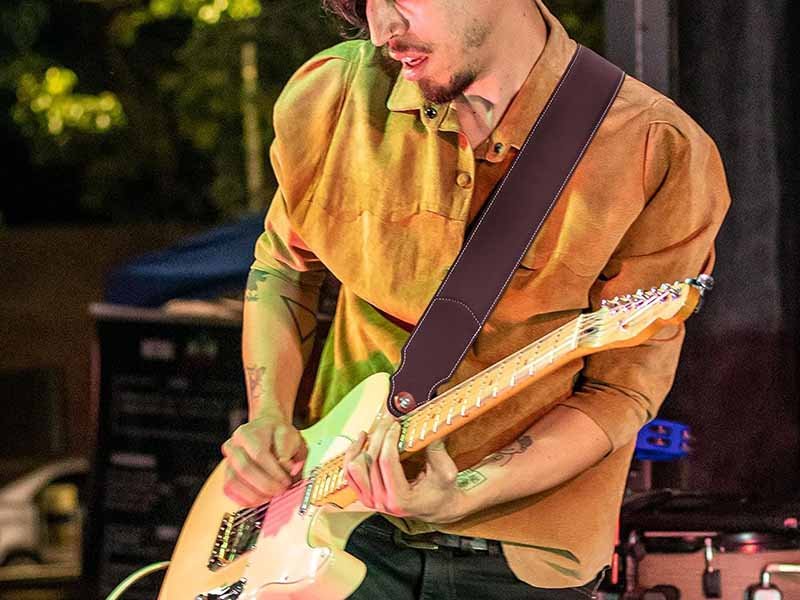
A leather guitar strap is one of those “small” accessories that quietly decides whether your gig feels effortless or exhausting. The strap doesn’t just hold the instrument—it manages pressure, friction, balance, and micro-movement for hours. Electric and acoustic guitars push a strap in different ways: electrics tend to deliver dense, downward load, while acoustics often feel “pull-forward” because of body depth and playing position. That’s why two straps that look the same can feel completely different after 45 minutes on stage.
Electric leather guitar straps usually need stronger structure to resist stretch and protect strap holes under higher, concentrated load. Acoustic leather guitar straps often need more width and controlled grip to spread pressure and reduce forward pull from deeper bodies. The best strap depends on guitar weight, balance, and how you play—width, thickness, backing, and stitching must work together for comfort.
If you’ve ever watched a player adjust a slipping guitar between songs, you’ve already seen the real problem: the wrong strap doesn’t fail instantly—it slowly steals comfort and confidence. Let’s fix that with clear specs, real numbers, and design logic that actually matches how guitars behave.
What makes electric and acoustic leather guitar straps different?
Electric leather guitar straps usually prioritize load strength and stability because solid-body guitars concentrate weight on a smaller shoulder contact area. Acoustic leather guitar straps prioritize pressure spread and anti-slip control because acoustic bodies are deeper and tend to pull the guitar forward and downward. The “difference” is not style—it’s how weight and balance interact with your shoulder and posture.
Why do electric guitars need stronger leather guitar straps?
Electric guitars often feel “simple” to carry, but the weight is dense and concentrated. Many solid-body electrics sit in the 7–10 lb (3.2–4.5 kg) range, and some builds can exceed that with heavy bridges, big hardware, and thick bodies. That load creates a steady downward force on the strap, especially at the shoulder contact line and at the strap holes.
What “stronger” really means in strap specs (not marketing):
- Leather thickness that resists stretch: a structural layer around 3.5–4.5 mm is common for heavy-use electrics.
- Tear resistance at strap ends: the strap end is the highest-stress zone; it needs reinforcement.
- Stitch pattern that holds under cyclic load: gigs and rehearsals create repeated pulling cycles.
Practical load-risk checklist for electric leather guitar straps
- If your guitar is >8.5 lb, avoid single-layer thin leather.
- If you use strap locks, ensure hole diameter + leather firmness match the lock pin (too soft = deformation).
| Electric use case | Guitar weight (common) | Strap width | Leather thickness | Strap end build | Stitching recommendation |
|---|---|---|---|---|---|
| Daily practice + light gig | 6–7.5 lb | 2″ | 3.0–3.5 mm | single layer + local reinforcement | double row |
| Weekly gigging | 7.5–9 lb | 2.5″ | 3.5–4.0 mm | 2-layer strap end | box stitch or bar tack |
| Touring / heavy hardware | 9–11 lb | 2.5–3″ | 4.0–4.5 mm | 2–3 layer strap end | box stitch + rivet (optional) |
A strap can look “thick” but still stretch if the leather is too soft or poorly tanned. For electrics, you want a controlled temper (not overly spongy), plus reinforcement exactly where the load lives: holes + ends + shoulder zone.
Why do acoustic guitars need wider leather guitar straps?
Acoustics can be lighter than electrics on a scale, but they often feel heavier on the body. The reason is geometry: acoustic bodies are deeper and sit farther from your centerline, so they create a forward pull that increases shoulder fatigue. A strap that’s too narrow concentrates pressure and amplifies that “digging” sensation over time.
Why width matters more for acoustic leather guitar straps:
- Wider straps reduce pressure per area (same weight, more contact).
- Wider shoulder zones help stabilize the guitar’s tendency to rotate forward.
- Wider straps also reduce small rolling movements that irritate the collarbone area.
Here’s the comfort math in plain terms:
| Strap width | Contact area effect | What players often feel on acoustic |
|---|---|---|
| 2″ | smallest shoulder contact | sharp hotspot after 30–60 min |
| 2.5″ | moderate spread | noticeably less shoulder bite |
| 3″ | strong spread | better long-session comfort |
| 3.5″ | maximum spread | great for heavy/deep bodies, can feel bulky |
Recommended widths by acoustic body style
- Dreadnought / Jumbo: 3″ is often the sweet spot
- OM / Concert: 2.5″–3″
- Parlor / travel acoustic: 2″–2.5″ can be enough
Customer concern you should address directly: People buying straps for acoustics often complain about “slipping.” That’s usually not solved by padding alone. It’s solved by a combination of width + backing friction + shoulder contour.
How does playing style affect leather guitar strap comfort?
Two people can play the same guitar and need totally different straps because posture and motion change how the strap behaves. Comfort is not just weight—it’s how the load moves.
Standing performance (electric and acoustic):
- You need stability against micro-slip during movement.
- Anti-slip backing can help, but too much friction can grab clothing and feel “sticky.”
- A moderate-friction backing (like suede) often balances hold and comfort.
Seated practice (often acoustic):
- Straps still matter because they stabilize the guitar angle.
- Overly stiff straps can dig into the neck/shoulder when sitting.
- A strap with controlled softness prevents edge bite.
Stage motion / energetic playing (often electric):
- Too-wide straps may restrict arm movement.
- Too-thick straps can feel stiff and fight your body.
- Most players prefer 2″–2.5″ with a well-shaped shoulder zone.
| Playing style | Main comfort problem | What the strap must do | Good strap direction |
|---|---|---|---|
| Standing gigs | fatigue + slip | hold position, spread pressure | 2.5″ width + controlled grip |
| Seated long practice | edge bite | soften contact, flex naturally | medium temper leather + softer edges |
| High-movement stage | restriction | stay stable without bulk | 2″–2.5″ width, shaped shoulder zone |
| Studio sessions | heat + pressure | reduce hotspots, stay quiet | smooth lining, moderate padding |
Padding is not automatically comfort. Thick padding can increase heat and reduce mobility. For many players, the real upgrade is better width + better edge finishing + better balance, not just more foam.
Which leather guitar strap width and thickness work best?
For electric leather guitar straps, 2″–2.5″ width with 3.5–4.5 mm structural leather typically delivers the best mix of mobility and support. For acoustic leather guitar straps, 2.5″–3.5″ width often improves comfort by spreading pressure and stabilizing forward pull; thickness around 3.0–4.0 mm balances flexibility and durability. The best choice depends on weight, body depth, and session length.
Which width suits electric leather guitar straps best?
Electric players usually want freedom of motion without shoulder pain. Width affects both. Narrow straps feel agile but create hotspots. Very wide straps spread pressure but can feel bulky and limit movement—especially when you’re moving around a lot.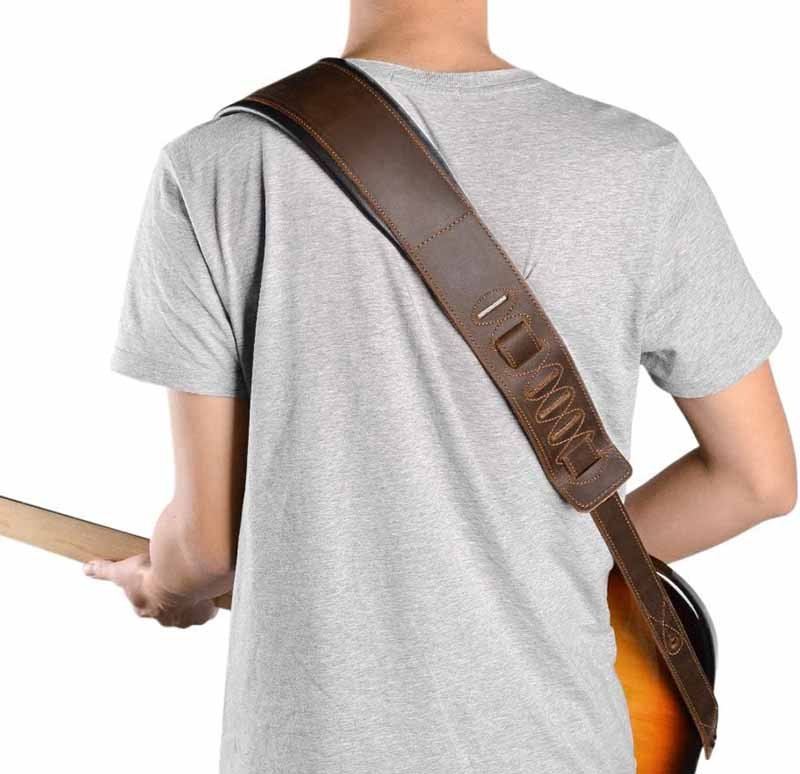
Practical width guidance for electric leather guitar straps:
- 2″: best for lighter electrics and players who move a lot
- 2.5″: best all-around for gigging and rehearsals
- 2.75″–3″: best for heavy electrics or long sessions when fatigue is the main issue
| Electric guitar weight | Recommended strap width | Why |
|---|---|---|
| 6–7 lb | 2″ | mobility + enough comfort |
| 7–9 lb | 2.5″ | spreads pressure without bulk |
| 9–11 lb | 2.75″–3″ | reduces fatigue in long sets |
Small design detail that matters: A 2.5″ strap that is shaped wider only at the shoulder zone (and narrower near ends) often feels more comfortable than a full-width strap everywhere. It reduces bulk at the hardware while keeping comfort where it counts.
Which width suits acoustic leather guitar straps best?
Acoustics often benefit from more width because body depth increases perceived weight and encourages forward rotation. That forward pull loads your shoulder differently, so spreading pressure is usually the fastest way to improve comfort.
Practical width guidance for acoustic leather guitar straps:
- 2.5″: for smaller bodies or players who dislike bulk
- 3″: most comfortable “default” for dreadnought/OM
- 3.5″: for jumbo bodies, long sets, or sensitive shoulders
| Acoustic body type | Recommended width | Comfort result |
|---|---|---|
| Parlor / travel | 2″–2.5″ | light and stable |
| OM / concert | 2.5″–3″ | balanced comfort + control |
| Dreadnought | 3″ | reduces shoulder hotspot |
| Jumbo | 3″–3.5″ | best against forward pull |
If a player says “my acoustic feels heavy,” the solution is often width + grip, not more padding. A wide strap with good backing reduces both pain and slipping.
How does thickness change leather guitar strap feel?
Thickness changes three things players feel immediately: flex, edge bite, and break-in time. It also changes what happens after six months: stretch and hole deformation.
Thickness guidance that maps to real use:
- 2.8–3.2 mm: flexible, comfortable fast, best for lighter acoustics
- 3.3–3.8 mm: balanced, works for most players and guitars
- 3.9–4.5 mm: durable and supportive, best for heavier electrics
| Thickness range | First-week feel | After 3–6 months | Best match |
|---|---|---|---|
| 2.8–3.2 mm | soft, easy | can stretch if leather is too soft | light acoustic / casual use |
| 3.3–3.8 mm | firm but comfortable | stable with good tanning | most guitars |
| 3.9–4.5 mm | stiff at first | very stable, low stretch | heavy electric / touring |
Players often confuse “thick” with “comfortable.” A thick strap with sharp edges can still hurt. Comfort comes from edge finishing + width + shoulder contour, while thickness mainly supports durability and shape stability.
How can brands design better leather guitar straps?
Brands design better leather guitar straps by aligning leather selection, ergonomic width, structural reinforcement, edge finishing, and hardware compatibility with real playing conditions. Successful OEM straps are engineered for durability, comfort, and long-term balance rather than appearance alone. Clear technical specifications and controlled production standards ensure consistent quality for musicians and retail customers.
Which leather types feel best for leather guitar straps?
Leather choice determines touch, flexibility, durability, and long-term shape stability. While many straps look similar on the surface, fiber structure and tanning method create major differences in performance.
Common leather options used in professional guitar straps:
| Leather Type | Surface Feel | Durability | Best Use Case |
|---|---|---|---|
| Full-grain cowhide | Firm, natural texture | Very high | Heavy electrics, touring straps |
| Top-grain leather | Smooth, slightly softer | High | Mid-weight guitars, retail straps |
| Nubuck leather | Velvet-like touch | Medium-high | Comfort-focused premium straps |
| Suede split leather | Soft, high friction | Medium | Acoustic anti-slip backing layers |
Key material insights for OEM development:
- Full-grain fibers resist stretching under constant load, making them ideal for structural layers.
- Suede backing improves shoulder grip, especially for acoustic players who experience forward pull.
- Nubuck surfaces balance softness and durability, often used in premium lifestyle music accessories.
For brands, combining full-grain structural cores + soft comfort layers delivers both reliability and user comfort—this layered construction is widely used in high-end strap manufacturing.
How do edges and lining improve leather guitar strap comfort?
Many comfort complaints are not caused by weight, but by edge pressure and sweat friction. Edge finishing and lining materials directly influence how a strap feels during long sessions.
Critical comfort engineering details:
- Edge rounding and burnishing
- Prevents sharp pressure lines on the shoulder or neck.
- Reduces long-term skin irritation during rehearsals.
- Soft lining materials
- Suede or microfiber linings increase friction without stiffness.
- Breathable layers reduce heat buildup under stage lighting.
- Tapered shoulder shaping
- Wider center distributes load.
- Narrower ends maintain flexibility near strap buttons.
| Comfort Feature | Player Benefit | OEM Design Value |
|---|---|---|
| Rounded edges | Less skin pressure | Higher perceived quality |
| Suede lining | Anti-slip stability | Better long-session comfort |
| Breathable padding | Reduced sweat | Premium positioning |
| Shoulder contour | Even load spread | Ergonomic differentiation |
Musicians often judge strap quality within the first 10 minutes of use. Smooth edges and stable grip create immediate trust in the product.
What OEM details define quality leather guitar straps?
For brands and wholesalers, product success depends on clear, repeatable manufacturing specifications rather than visual style alone. A professional OEM leather guitar strap should define:
Core structural specifications
- Leather grade and thickness tolerance
- Strap width and adjustable length range
- Reinforcement layers at holes and shoulder zone
- Stitch type, thread material, and stitch density
Functional compatibility
- Standard strap button hole size
- Strap lock compatibility
- Load-bearing test requirements
- Flex and fatigue resistance targets
Brand presentation
- Embossed or stitched logo method
- Custom color dyeing or contrast stitching
- Retail packaging design
- Barcode and labeling compliance
| OEM Specification Area | Why It Matters for Brands |
|---|---|
| Material consistency | Prevents quality complaints |
| Structural reinforcement | Reduces warranty risk |
| Ergonomic sizing | Improves user reviews |
| Custom branding | Builds market identity |
| Packaging quality | Enhances retail value |
Reliable manufacturers test tensile strength, color fastness, abrasion resistance, and stitch fatigue before mass production. These hidden processes separate professional leather strap factories from simple assembly workshops.
Work with SzoneierLeather for Custom Leather Guitar Straps
Choosing the right leather guitar strap is not only about comfort—it is about protecting instruments, supporting performance, and representing your brand’s quality in the hands of musicians.
SzoneierLeather brings over 18 years of leather product manufacturing experience, offering:
- Full-grain, top-grain, nubuck, and suede material sourcing
- Ergonomic strap structure development for electric and acoustic guitars
- Reinforced stitching and load-tested construction
- Custom logo embossing, colors, and retail packaging
- Low MOQ production with fast sampling support
- Stable quality control for global brand clients
Whether you are launching a new music accessory line, upgrading an existing strap design, or developing private-label leather guitar straps, our engineering and production teams can help transform your concept into a reliable, market-ready product.
Contact SzoneierLeather today to request samples, discuss OEM specifications, or receive a quotation tailored to your project. A well-designed leather guitar strap does more than hold a guitar—it carries your brand’s reputation on every stage.