
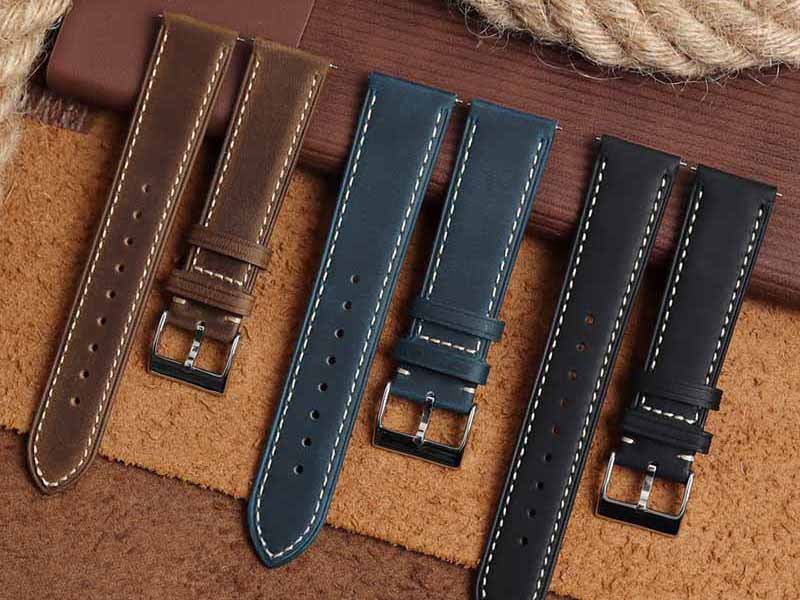
Send your strap specifications to Szoneier Leather today Our engineering team will review your design, identify cost drivers, and provide a quote you can actually rely on.
Leather strap pricing looks simple on the surface—until you actually try to source or customize one. Many buyers expect a clear price list, yet quickly discover that the same “leather strap” can cost $2 or $20, depending on decisions that are often invisible at first glance.
The real issue is not price itself, but pricing logic. Leather straps sit at the intersection of raw material quality, structural engineering, hand labor, and brand expectations. A strap designed for a fashion tote behaves very differently from a watch strap, camera strap, or reinforced shoulder strap. Treating them as comparable products almost always leads to cost surprises.
Leather strap price is determined by a combination of leather grade, strap dimensions, construction method, hardware quality, finishing details, and order volume. Full-grain or vegetable-tanned leathers cost significantly more than split or bonded options, while padding, edge finishing, stitching density, and metal hardware often add more cost than the leather itself. Accurate pricing requires complete technical specifications and realistic MOQ planning.
In our factory experience at Szoneier Leather, most pricing disputes don’t come from “high cost,” but from unclear expectations. A buyer imagines one strap; a factory quotes another. The gap between those two ideas is where misunderstandings—and wasted time—begin. Let’s break that gap down carefully.
What is the typical leather strap price range
The typical leather strap price ranges from USD 1.80 to USD 25.00 per piece, depending on leather grade, strap size, construction complexity, hardware quality, and order quantity. Entry-level straps made with split or coated leather and basic zinc hardware fall at the low end, while premium full-grain or vegetable-tanned leather straps with padding, refined edge finishing, and stainless steel hardware sit at the high end.
In-Depth Explanation: Understanding real leather strap price brackets
Leather strap pricing is not linear and cannot be explained with a single “market price.” Instead, prices cluster into clear functional tiers, each tied to how the strap is expected to perform, age, and represent a brand.
Below is a realistic OEM manufacturing price framework based on common factory quotations.
Typical Leather Strap Price Breakdown
| Strap Category | Typical Price Range (USD / pc) | Common Characteristics |
|---|---|---|
| Entry-level straps | $1.80 – $3.50 | Split or coated leather, simple stitching, zinc alloy hardware |
| Standard quality straps | $3.50 – $6.50 | Top-grain leather, painted edges, reinforced ends |
| Mid-premium straps | $6.50 – $12.00 | Full-grain leather, folded edges or padding, better hardware |
| Premium / brand-grade straps | $12.00 – $25.00+ | Veg-tan or specialty leather, complex construction, stainless/brass hardware |
These ranges assume OEM production, not retail pricing, and exclude tooling or sampling fees.
Why leather strap prices vary so widely
Many buyers are surprised to see the same strap type quoted at very different prices by different suppliers. The reason is simple: “leather strap” is a category, not a specification.
Price variation usually comes from five invisible factors:
- Leather utilization efficiency A longer or wider strap often wastes more hide area, especially with full-grain leather. Yield loss directly raises cost.
- Construction method Folded edges, padding layers, linings, and reinforced ends add labor steps that compound cost quickly.
- Hardware dependency A strap with swivel hooks or buckles requires not only hardware cost, but reinforcement stitching and load testing.
- Labor time per unit Two straps using the same leather can differ by 2–3× in labor time depending on stitching density and finishing detail.
- Order quantity (MOQ) Low-volume orders absorb pattern making, setup, and color-matching costs into each unit.
Price differences by strap application
Leather strap price also varies by end use, even when size looks similar.
| Strap Application | Typical OEM Price Range |
|---|---|
| Bag shoulder straps | $3.50 – $15.00 |
| Crossbody straps | $4.50 – $18.00 |
| Watch straps | $5.00 – $25.00 |
| Camera straps | $6.00 – $20.00 |
| Decorative straps (non-load) | $2.00 – $5.00 |
Functional straps that carry weight always cost more due to reinforcement, testing, and failure-risk control.
Why online prices and retail references are misleading
Searching online often shows leather straps priced at $5–10 in retail stores. These prices cannot be used as OEM references because retail straps usually:
- use bonded or split leather
- apply simplified edge finishing
- rely on mass-produced standard hardware
- amortize tooling over very large volumes
OEM or custom straps must include development, testing, and production risk, which is why factory pricing follows a different logic.
What buyers should understand before asking for price
If a supplier quotes a leather strap price without asking about:
- leather grade
- strap dimensions
- construction details
- hardware type
- target quantity
that price is only an estimate, not a production-ready quote.
What factors affect leather strap price the most
Leather strap price is mainly affected by leather grade, tanning method, strap dimensions, construction complexity, labor intensity, hardware quality, and order volume. While leather sets the base cost, labor-driven elements—such as edge finishing, stitching density, padding, and reinforcement—often contribute more to final pricing than raw materials alone. Accurate pricing depends on how these factors interact, not on any single element.
In-Depth Explanation: The real cost drivers behind leather strap pricing
Leather strap pricing is best understood as a system, not a checklist. Many buyers focus on one visible element—usually leather type—while factories calculate price based on risk, repeatability, and production efficiency.
Below are the factors that most strongly influence leather strap cost in real manufacturing environments.
1. Leather grade and usable yield
Leather grade determines not only material cost but also how much of the hide can actually be used.
- Full-grain leather has the highest raw cost and lowest yield due to natural scars and grain variation.
- Top-grain leather offers better yield consistency with slightly reduced surface character.
- Split or bonded leather lowers raw cost but often requires extra coatings and reinforcements.
In many cases, moving from top-grain to full-grain increases total strap cost by 50–120**%**, largely due to yield loss rather than leather price alone.
2. Tanning method and process stability
Tanning affects strap cost through processing time, defect risk, and handling difficulty.
- Vegetable-tanned leather costs more due to longer tanning cycles and higher sensitivity to thickness and humidity.
- Chrome-tanned leather offers better color consistency, faster processing, and lower rejection rates.
- Combination tanning balances softness and structure but limits supplier availability.
Vegetable tanning typically raises strap price by 20–40%, but is chosen for aging behavior and brand positioning rather than cost efficiency.
3. Strap dimensions: width, thickness, and length
Dimensions influence price beyond simple material usage.
- Wider straps intersect more hide defects.
- Thicker straps require precision skiving to maintain flexibility.
- Longer straps reduce cutting layout efficiency.
A 38 mm wide, 4 mm thick strap can cost 30–50% more than a 25 mm wide, 3 mm strap using the same leather.
4. Construction method and edge finishing
Construction is one of the largest hidden cost drivers.
- Painted edges require multiple coating and drying cycles.
- Folded edges add skiving, gluing, and stitching steps.
- Padding and lining double cutting and alignment operations.
Edge finishing alone can account for 15–30% of total strap cost in mid- to high-quality straps.
5. Stitching density and labor time
Stitching is time-based cost.
- Higher stitch density increases machine run time.
- Reinforced stitching at hardware points adds manual operations.
- Decorative stitching often requires slower machine speeds.
A small increase in stitch density can raise labor cost by 20–30**%** with minimal visual difference.
6. Hardware type and installation complexity
Hardware affects cost in two ways:
- Component cost (material and plating)
- Structural reinforcement required for installation
Stainless steel and solid brass hardware cost more upfront but reduce failure risk. Hardware and its installation can represent 20–40% of total strap cost in load-bearing designs.
7. Order quantity (MOQ) and production scale
MOQ has a non-linear impact on price.
Low-volume orders must absorb:
- pattern development
- die cutting
- color matching
- hardware sourcing
As volume increases, unit cost stabilizes. This is why professional factories focus on spec optimization, not just price negotiation.
8. Quality control and testing requirements
Higher performance expectations increase cost through:
- pull-force testing
- flex-fatigue testing
- edge durability evaluation
Quality control does not add visible features, but it protects against returns and brand damage—making it a necessary cost, not an optional one.
Which leather materials cost more for straps
Leather materials that cost more for straps include full-grain cowhide, vegetable-tanned leather, buffalo leather, specialty oil-pull-up leathers, and exotic hides. Higher cost is driven not only by raw hide price, but also by lower usable yield, stricter quality selection, longer processing cycles, and higher failure risk during cutting and finishing. Premium materials are chosen for durability, aging behavior, and brand positioning—not cost efficiency.
Why some leathers are more expensive in strap production
Leather cost for straps is determined by how the material behaves under stress, not just how it looks. Straps are dynamic components—they bend, pull, rub against hardware, and age visibly. Materials that perform well under these conditions usually cost more to source and process.
Below is a manufacturer-level comparison of leather materials commonly used for straps, ranked by cost and practical implications.
Leather material cost comparison for straps
| Leather Material | Relative Cost Level | Why It Costs More |
|---|---|---|
| Full-grain cowhide | High | Low yield, minimal surface correction, natural defects |
| Vegetable-tanned leather | High | Long tanning cycle, limited supply, handling sensitivity |
| Buffalo leather | High | Thicker fiber structure, heavier handling, limited availability |
| Oil-pull-up / waxed leather | Mid-High | Complex finishing, high rejection rate |
| Goat leather | Mid | Smaller hide size, reduced cutting efficiency |
| Top-grain cowhide | Mid | Balanced yield and appearance |
| Split leather (coated) | Low | High yield, surface correction |
| Bonded / fiber leather | Very Low | Uniform sheet production |
Why full-grain leather costs more than other options
Full-grain leather retains the original hide surface with minimal correction. This creates:
- visible natural character
- stronger fiber structure
- better aging over time
However, it also means:
- scars and wrinkles cannot be removed
- cutting layouts are less efficient
- rejection rates are higher
In strap production, full-grain leather often increases total cost by 40–120% compared to top-grain or split leather—not because of leather price alone, but because of material waste and stricter QC thresholds.
Why vegetable-tanned leather is among the most expensive
Vegetable-tanned leather is prized for:
- stiffness control
- natural patina development
- plastic-free processing
Its cost is driven by:
- tanning cycles lasting weeks instead of days
- sensitivity to humidity and thickness variation
- limited global suppliers
For straps, veg-tan leather also requires skilled skiving and finishing, increasing labor cost. This material is selected for premium positioning, not mass-market efficiency.
Why buffalo leather and specialty hides raise strap cost
Buffalo leather has a denser fiber structure and higher tear resistance, making it suitable for load-bearing straps. However:
- hides are heavier and harder to process
- thickness consistency is harder to control
- supplier availability is limited
Similarly, oil-pull-up and waxed leathers require complex finishing layers that increase defect risk during cutting and edge finishing, raising cost even when raw leather pricing is moderate.
Why smaller hides like goat leather can still be costly
Goat leather is softer and more flexible, ideal for fashion straps. But:
- hide sizes are small
- cutting efficiency is low
- more pieces are required per order
This makes cost per finished strap higher than expected, even when per-square-foot pricing seems reasonable.
Are “genuine leather” and bonded leather cheaper options?
Yes—but with trade-offs.
- Genuine leather usually refers to coated split leather.
- Bonded or fiber leather is made from leather scraps and binders.
These materials reduce raw cost but often require:
- thicker coatings
- reinforcement layers
- stricter durability testing
They are suitable for price-driven projects but rarely meet premium brand expectations for aging and durability.
How recycled and sustainable leathers affect pricing
Recycled or regenerated leathers are not always cheaper. Their pricing is influenced by:
- certification costs
- limited supplier networks
- batch inconsistency
They are chosen for sustainability compliance or branding, not for cost reduction.
How do strap specifications change the price
Strap specifications change the price by directly affecting material consumption, labor time, defect risk, and production stability. Width, thickness, length, edge construction, padding, lining, stitching density, and reinforcement details can raise leather strap cost by 15% to over 60%, even when the same leather is used. Small spec changes often have a larger pricing impact than upgrading leather grade.
In-Depth Explanation: Why specifications are a major pricing driver
In leather strap manufacturing, specifications define difficulty. Two straps made from the same leather can differ drastically in price because specs determine how many operations, checks, and corrective steps are required to make each unit pass quality control.
Factories do not price “appearance.” They price repeatability under scale.
1. Strap width: more than just leather usage
Wider straps consume more leather, but the real cost impact comes from defect exposure.
- Wider cuts intersect more natural hide scars and fiber inconsistencies
- Yield loss increases disproportionately with width
- Scrap rate rises on full-grain leathers
For example, increasing width from 25 mm to 38 mm often raises strap cost by 20–35%, even before adding reinforcement or padding.
2. Strap thickness: flexibility vs processing difficulty
Thickness affects:
- skiving precision
- folding accuracy
- flexibility under load
Thicker straps require multi-step skiving to prevent stiffness and cracking, especially at fold points and hardware ends.
A change from 3.0 mm to 4.0 mm thickness can increase labor cost by 15–25%, particularly on padded or folded-edge designs.
3. Strap length: yield efficiency and continuity
Longer straps reduce cutting efficiency.
- Continuous long straps require clean fiber alignment
- Jointed straps require reinforcement and extra stitching
- Long lengths increase hide layout constraints
Even a 10–15 cm increase in length can cause a non-linear cost jump, especially on premium leathers.
4. Edge construction: one of the biggest hidden costs
Edge finishing is a labor-intensive process.
- Painted edges require sanding, coating, drying, and re-coating
- Folded edges require precise skiving, gluing, and stitching
- Raw cut edges are cheaper but limit product positioning
Edge construction alone can account for 15–30% of total strap cost, often exceeding the cost difference between leather grades.
5. Padding and internal structure
Padding adds complexity beyond material cost.
- Padding layers must be shaped and aligned
- Adhesive application increases rejection risk
- Thickness consistency must be controlled
A lightly padded strap may increase cost by 10–20%, while heavily padded straps can add 30% or more, depending on structure.
6. Lining leather: doubling operations
Lined straps look refined but are expensive to execute well.
- Double cutting operations
- Edge alignment tolerances tighten
- Stitching precision becomes critical
Lining often adds 20–40**%** to strap cost, particularly when premium lining leather is used.
7. Stitching density and reinforcement
Stitching cost is time-based.
- Higher stitch density slows machine speed
- Reinforcement stitching at hardware ends is manual
- Decorative stitching increases QC scrutiny
A shift from standard to dense stitching can raise labor cost by 20–30% without a dramatic visual change.
8. Reinforcement at stress points
Load-bearing straps require:
- internal reinforcement tapes
- multi-layer leather stacks
- stress-distribution stitching
These elements protect against failure but increase material and labor cost significantly. Reinforcement decisions are often more important than leather upgrades.
Typical price impact by strap specification change
| Specification Change | Typical Cost Impact |
|---|---|
| Increase width (25 → 38 mm) | +20–35% |
| Increase thickness (3.0 → 4.0 mm) | +15–25% |
| Add painted edges | +15–30% |
| Add folded edges | +20–35% |
| Add padding | +10–30% |
| Add lining | +20–40% |
| Increase stitch density | +20–30% |
Which hardware choices increase leather strap price
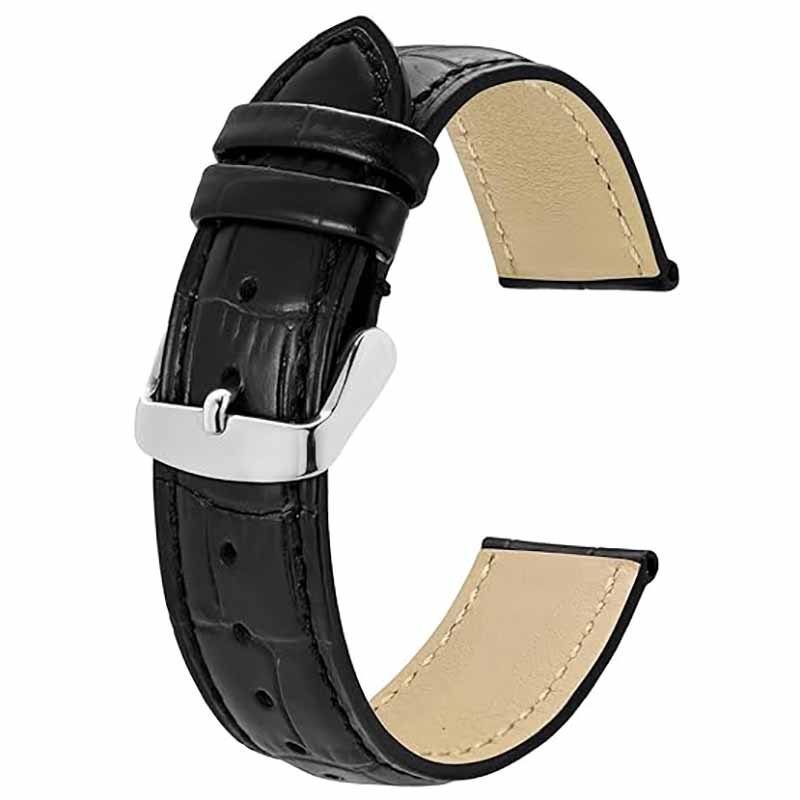
Leather strap price increases significantly with premium hardware materials, load-bearing designs, custom molds, high-grade surface plating, and complex installation requirements. Stainless steel, solid brass, and custom-designed buckles cost more than zinc alloy or stock hardware, while reinforced installation and testing can make hardware account for 20–40% of total strap cost, sometimes exceeding leather cost itself.
In-Depth Explanation: Why hardware is one of the biggest cost multipliers
Many buyers underestimate hardware because it appears small. In reality, hardware determines structural safety, durability, and perceived quality, and often triggers additional leather reinforcement, labor steps, and testing requirements.
From a factory perspective, hardware is priced not just as a component—but as a system.
1. Hardware material: stainless steel vs zinc alloy vs brass
Hardware material directly affects both component price and long-term performance.
- Stainless steel hardware is corrosion-resistant, structurally stable, and preferred for premium products. It costs more to produce and machine.
- Solid brass offers weight and premium feel but requires polishing and protective coating.
- Zinc alloy is cheaper and easier to cast but softer and more prone to deformation.
Switching from zinc alloy to stainless steel typically increases strap cost by 10–25%, but reduces failure and return risk.
2. Load-bearing hardware design and safety requirements
Hardware used for weight-bearing straps (shoulder straps, camera straps) must meet tensile and fatigue standards.
This leads to:
- thicker metal sections
- reinforced leather ends
- denser stitching patterns
These structural requirements add cost beyond the hardware itself. Load-rated hardware can double installation labor compared to decorative hardware.
3. Custom vs stock hardware
Stock hardware benefits from mass production and low MOQs.
Custom hardware requires:
- mold development fees
- higher minimum order quantities
- sampling and testing cycles
Custom buckles or clasps can raise unit cost significantly until volume offsets tooling investment. For small runs, custom hardware often dominates pricing.
4. Surface finishing and plating quality
Plating quality affects both cost and durability.
- Thin decorative plating is cheaper but wears quickly.
- Thick, multi-layer plating resists corrosion and abrasion.
- Special finishes (matte, antique, PVD) require additional processing.
Upgraded plating can increase hardware cost by 30–60%, but is often essential for brand consistency and longevity.
5. Hardware complexity and moving parts
Hardware with moving components—swivel hooks, quick-release buckles, spring clasps—requires:
- precision machining
- assembly labor
- functional testing
Each moving part adds failure risk, which factories must control through tighter QC. Complexity directly increases cost.
6. Installation difficulty and reinforcement
Hardware installation often triggers extra leather operations:
- skiving for fold-over ends
- reinforcement layers
- box or bar-tack stitching
Even simple hardware can become expensive when installation requires precision alignment. Installation labor is frequently underestimated in pricing discussions.
7. Branding on hardware
Branded hardware (logos, custom engravings) adds cost through:
- engraving or mold modification
- higher rejection rates
- stricter visual QC
While branding cost per unit is usually moderate, it increases setup complexity and reduces flexibility for low-volume orders.
Typical hardware-driven cost impact
| Hardware Upgrade | Typical Strap Cost Increase |
|---|---|
| Zinc → stainless steel | +10–25% |
| Decorative → load-rated hardware | +20–40% |
| Stock → custom mold | +15–50% (volume-dependent) |
| Standard → premium plating | +10–30% |
| Simple buckle → swivel/quick-release | +15–35% |
How do you get a factory-accurate quote for leather straps
To get a factory-accurate quote for leather straps, you must provide complete technical specifications, including leather type, dimensions, construction details, hardware material, quantity, and packaging requirements. Accurate pricing depends on production feasibility, material yield, labor time, and risk control—not rough descriptions or reference photos alone. Incomplete information always leads to estimated pricing that changes later.
Why “accurate pricing” starts with engineering, not numbers
Many buyers believe factories already “know the price” of a leather strap. In reality, factories only know how to calculate cost once the strap is clearly defined. Without full specs, any quote is a placeholder.
A factory-accurate quote is one that:
- remains stable during sampling and mass production
- reflects real material and labor cost
- avoids re-pricing after development starts
Below is how professional manufacturers arrive at reliable pricing—and how buyers can enable it.
1. Provide complete leather specifications (not just “genuine leather”)
Leather description must go beyond generic terms.
A factory needs to know:
- leather type (full-grain, top-grain, split, recycled)
- tanning method (veg-tan, chrome-tan, combination)
- finish (aniline, semi-aniline, pigmented, waxed)
- target thickness range (mm or oz)
- color requirements (standard vs custom dye)
Without this, factories cannot calculate usable yield, which is one of the biggest cost variables.
2. Define exact strap dimensions and tolerance
“Standard size” does not exist in manufacturing.
Provide:
- width (mm)
- length (mm)
- thickness before and after skiving
- tolerance expectations (± mm)
Even small dimension changes can affect cutting layout, labor time, and rejection rate. Factories price based on worst-case tolerance control, not ideal samples.
3. Specify construction and finishing method clearly
Construction details often affect cost more than leather itself.
Key items include:
- edge treatment (painted, folded, raw cut)
- padding or internal structure
- lining leather (yes/no, type)
- stitching method and density
- reinforcement at stress points
If construction is unclear, factories must assume higher complexity to avoid underquoting.
4. Detail hardware type, material, and finish
Hardware is never “just an accessory.”
Accurate quoting requires:
- hardware type (buckle, hook, ring, clasp)
- material (zinc alloy, stainless steel, brass)
- surface finish (polished, matte, plated, PVD)
- load-bearing requirement (yes/no)
- branding on hardware (logo, engraving)
Hardware choices often trigger additional leather reinforcement and labor, which must be priced upfront.
5. State realistic order quantity and target MOQ
Quantity directly affects unit price.
Factories need:
- initial order quantity
- potential annual volume
- flexibility on MOQ (if any)
Low-volume orders absorb:
- pattern making
- tooling
- color matching
- hardware sourcing
Accurate quotes balance short-term unit cost with long-term scalability.
6. Clarify packaging and branding requirements early
Packaging is part of production cost, not an afterthought.
Specify:
- individual packaging type
- logo printing or labeling
- inserts or hangtags
- export carton standards
Custom packaging can add more cost than expected, especially at low volume.
7. Understand the role of sampling in pricing accuracy
Sampling is not just for visuals—it validates pricing assumptions.
A proper sample allows factories to:
- confirm material yield
- measure real labor time
- test edge durability and hardware strength
- identify hidden risks before mass production
Quotes based on confirmed samples are far more reliable than paper estimates.
8. Why reference photos alone are not enough
Photos show appearance, not structure.
Factories cannot accurately price from images because photos do not reveal:
- internal layers
- reinforcement methods
- leather temper
- tolerance requirements
Photos are useful—but only when paired with written specs.
Factory-accurate quote checklist
| Item | Required for Accurate Quote |
|---|---|
| Leather type & finish | ✅ |
| Strap dimensions & tolerances | ✅ |
| Construction method | ✅ |
| Hardware details | ✅ |
| Order quantity / MOQ | ✅ |
| Packaging requirements | ✅ |
| Sample confirmation | Strongly recommended |
Conclusion
Leather strap pricing is never just a number. It is the result of material science, structural design, skilled labor, and supply-chain control.
If you are sourcing leather straps for bags, watches, belts, or accessories—and want pricing that is accurate, scalable, and aligned with real manufacturing logic—Szoneier Leather can help.
With over 18 years of experience, in-house R&D, sampling, and full production capability.