
Leather dog collars made in the USA have become a symbol of quality, craftsmanship, and trust. For pet owners, they represent durability and comfort. For brands and retailers, “Made in USA” often signals ethical manufacturing, higher standards, and a story customers are willing to pay for. But as demand grows, so does confusion. Not every collar labeled “Made in USA” is truly American-made—and not every leather collar is created equal.
Many buyers assume that a higher price automatically means better leather, stronger hardware, or safer construction. In reality, quality depends on where materials come from, how the collar is constructed, and whether the manufacturer truly understands leather as a functional material—not just a decorative one. This matters even more for brands sourcing private label or OEM dog collars, where returns, complaints, and reputation are on the line. Leather dog collars made in USA are collars manufactured with significant production, labor, and assembly completed in the United States. High-quality versions typically use full-grain or top-grain leather, solid hardware, and reinforced stitching for durability and safety. Buyers should verify whether “Made in USA” applies to materials, labor, or final assembly, as definitions vary widely across brands.
Behind every great leather dog collar is a chain of decisions—leather type, tanning method, edge finishing, hardware choice, sizing accuracy. Get those wrong, and even a “Made in USA” label won’t save the product. Let’s start by clarifying what this label really means.
What Does “Leather Dog Collars Made in USA” Really Mean
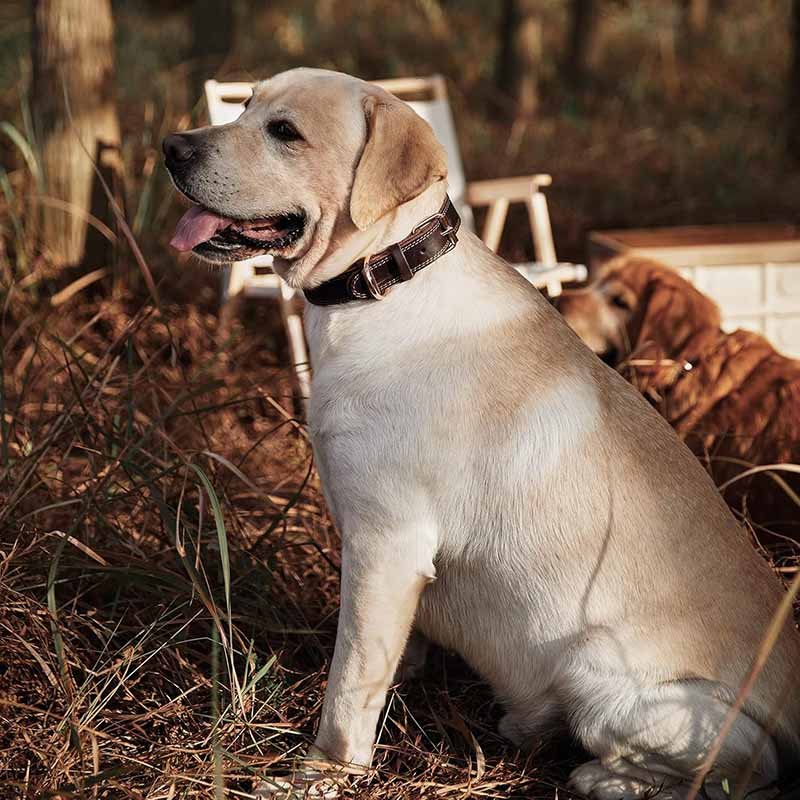
“Leather dog collars made in USA” generally means that significant manufacturing steps—such as cutting, stitching, finishing, or final assembly—are completed in the United States. However, it does not always mean the leather or hardware is sourced from the U.S. Buyers should verify whether the claim refers to materials, labor, or assembly, as definitions and practices vary between brands.
The phrase “Made in USA” carries strong emotional and commercial value. Consumers associate it with craftsmanship, safety, and ethical production. However, in the pet accessories industry—especially leather dog collars—the term is often used loosely, leading to confusion and unrealistic expectations.
Understanding what “Made in USA” actually covers helps buyers make better purchasing and sourcing decisions.
What Qualifies as “Made in USA” Under U.S. Guidelines?
In the United States, “Made in USA” claims are regulated by the Federal Trade Commission (FTC).
According to FTC guidance:
- Products must be “all or virtually all” made in the U.S.
- Final assembly or processing must occur in the U.S.
- The majority of manufacturing costs should be domestic
However, the FTC does not require 100% domestic sourcing, which means imported leather or hardware can still be used legally.
Is “Assembled in USA” the Same as “Made in USA”?
No—these two labels are not equivalent, and confusing them is one of the most common mistakes buyers make.
- Made in USA → Major manufacturing steps + labor are domestic
- Assembled in USA → Components may be imported; final assembly is domestic
Many leather dog collars labeled “Made in USA” are actually assembled in the U.S. using imported leather straps and hardware. This is legal, but it changes the value proposition.
Which Parts of a Leather Dog Collar Matter Most for Origin Claims?
A leather dog collar consists of three critical components:
- Leather strap
- Hardware (buckles, D-rings)
- Labor (cutting, stitching, finishing)
From a performance and quality perspective:
- Leather quality affects durability and comfort
- Hardware quality affects safety and strength
- Labor quality affects consistency and lifespan
A collar assembled in the U.S. with low-grade imported leather may still fail quickly—origin alone does not guarantee quality.
Does “Made in USA” Automatically Mean Better Quality?
No. This is a common misconception.
While U.S.-made collars often offer:
- Higher labor standards
- Better transparency
- Smaller-batch craftsmanship
Quality still depends on:
- Leather grade (full-grain vs genuine leather)
- Tanning method
- Stitching and reinforcement
- Hardware strength
A well-made collar produced overseas with strict QC can outperform a poorly made “Made in USA” collar.
Why Do Brands Emphasize “Made in USA” for Dog Collars?
Brands use this label because:
- Consumers associate it with trust and safety
- It supports patriotic or local-brand messaging
- It allows premium pricing
In the pet market, where safety and emotional attachment are high, origin claims strongly influence buying decisions—even when buyers don’t fully understand the technical details.
What Questions Should Buyers Ask About “Made in USA” Claims?
To evaluate a claim accurately, buyers should ask:
- Where is the leather sourced?
- Where is the hardware manufactured?
- Which steps are done in the U.S.?
- Is the collar fully made, or only assembled, domestically?
Transparent brands will answer these questions clearly.
Common “Made in USA” Scenarios Explained
| Scenario | Is It Legal? | What It Really Means |
|---|---|---|
| Leather + hardware + labor all U.S. | Yes | True domestic production |
| Imported leather, U.S. assembly | Yes | Assembly-based claim |
| Imported components, minimal U.S. work | Risky | May be misleading |
| Overseas manufacturing, U.S. branding | No | Misrepresentation |
Which Types of Leather Dog Collars Are Most Popular
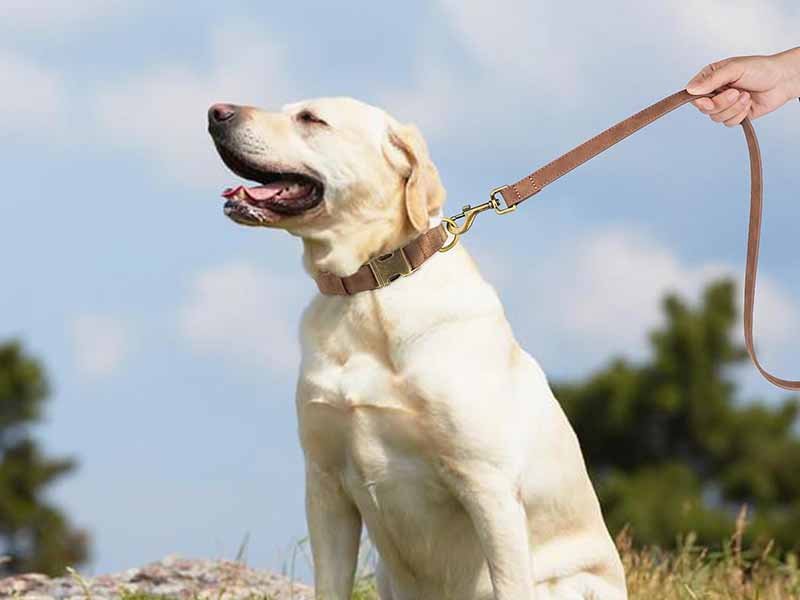
The most popular leather dog collars include flat leather collars for everyday use, rolled leather collars for long-haired breeds, martingale leather collars for training, wide leather collars for large dogs, and decorative leather collars for fashion-focused buyers. Popularity depends on comfort, safety, dog size, coat type, and intended use rather than appearance alone.
Leather dog collars are not one-style-fits-all products. Each popular type exists because it solves a specific functional or comfort problem. Brands that understand these differences reduce returns, improve reviews, and build stronger customer trust.
Are Flat Leather Dog Collars the Most Popular for Daily Use?
Yes. Flat leather collars are the most widely used and commercially successful type.
They are popular because they:
- Distribute pressure evenly around the neck
- Are comfortable for all-day wear
- Work well with standard leash attachments
Flat leather collars are ideal for:
- Daily walks
- Identification tag attachment
- Casual and lifestyle use
For most brands, flat leather collars represent the core product line due to broad market acceptance and lower sizing complexity.
Are Rolled Leather Collars Better for Long-Haired Dogs?
Yes. Rolled leather collars are specifically designed for long-haired or thick-coated breeds.
Key benefits include:
- Reduced friction against fur
- Less matting and hair breakage
- Improved coat appearance over time
Because rolled collars require:
- Higher leather quality
- Precise stitching and shaping
They are often positioned as premium products and appeal to knowledgeable dog owners.
Why Are Martingale Leather Collars Popular for Training?
Martingale leather collars are popular because they offer control without choking.
They work by:
- Tightening slightly when the dog pulls
- Preventing dogs from slipping out of the collar
- Releasing pressure immediately when pulling stops
These collars are especially popular for:
- Training sessions
- Dogs with narrow heads (e.g., Greyhounds)
- Owners seeking safer alternatives to choke collars
Leather martingale collars combine training function with premium aesthetics.
Are Wide Leather Collars Preferred for Large or Strong Dogs?
Yes. Wide leather collars are essential for large, strong, or powerful breeds.
Why width matters:
- Distributes force across a larger surface
- Reduces pressure on the dog’s neck
- Improves control and safety
Large-breed collars typically feature:
- Thicker leather layers
- Wider strap widths (1.25–2 inches)
- Reinforced stitching and heavy-duty hardware
For safety-focused brands, wide collars are non-negotiable for big dogs.
Are Decorative or Fashion Leather Dog Collars Popular?
Yes—especially in boutique, lifestyle, and gift markets.
These collars may include:
- Embossed or stamped patterns
- Studs, rivets, or decorative hardware
- Hand-painted or dyed finishes
However, popularity here depends on balancing style and safety. Decorative collars must still meet strength and comfort standards to avoid negative reviews.
Are Adjustable vs Fixed-Size Leather Collars More Popular?
Adjustable leather collars are generally more popular.
Advantages include:
- Better fit as dogs grow
- Easier sizing for online buyers
- Lower return rates
Fixed-size collars are still used in:
- Luxury or handcrafted markets
- Custom-fit collar programs
For eCommerce brands, adjustable collars offer better scalability and customer satisfaction.
Popularity by Collar Type (Quick Overview)
| Collar Type | Popularity Level | Best For |
|---|---|---|
| Flat leather collar | Very High | Daily use |
| Rolled leather collar | High | Long-haired breeds |
| Martingale leather collar | Medium–High | Training |
| Wide leather collar | High (large breeds) | Safety & control |
| Decorative leather collar | Medium | Fashion / gifts |
| Adjustable leather collar | Very High | Online retail |
What Leather Is Best for Dog Collars
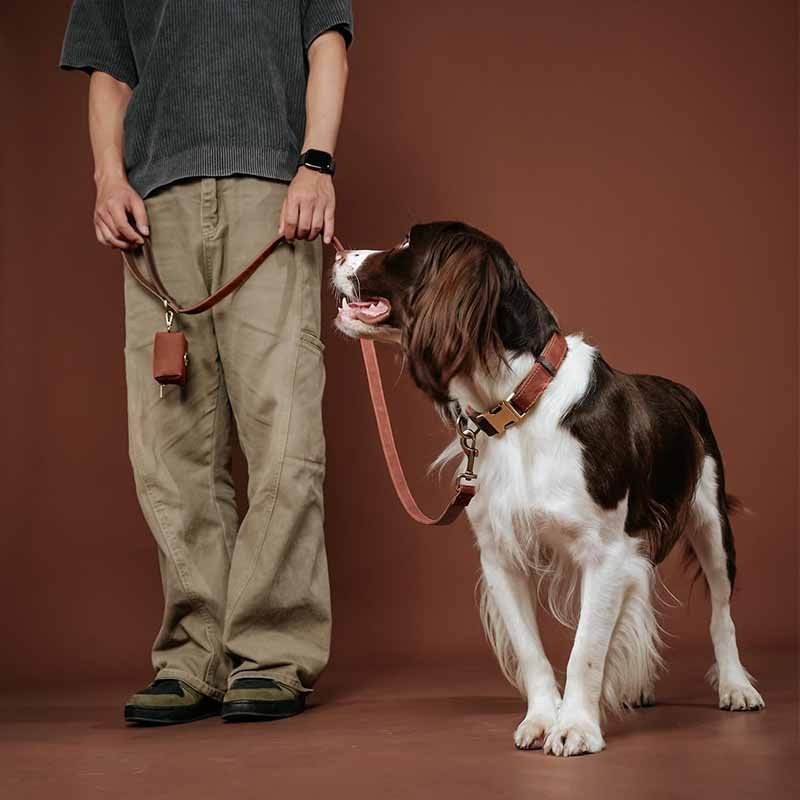
The best leather for dog collars is full-grain or high-quality top-grain leather because it offers superior strength, flexibility, and long-term durability. Vegetable-tanned leather is preferred for premium dog collars due to its skin safety and natural aging properties, while chrome-tanned leather provides softness and color consistency. Low-grade “genuine leather” is generally not suitable for durable, long-lasting dog collars.
A dog collar is not just a fashion accessory—it is load-bearing equipment that experiences constant pulling, friction, and exposure to moisture. The best leather for dog collars must perform well mechanically and remain comfortable against fur and skin.
Is Full-Grain Leather the Best Choice for Dog Collars?
Yes. Full-grain leather is widely considered the best leather for dog collars, especially for medium to large dogs.
Why full-grain leather works best:
- Retains the strongest natural fiber structure
- Resists cracking, peeling, and delamination
- Maintains flexibility under repeated stress
- Ages naturally with a patina instead of surface damage
Full-grain leather is particularly important for:
- Large or strong breeds
- Daily-use collars
- Long-term wear where safety matters
It costs more, but it dramatically reduces failure risk.
Is Top-Grain Leather Also Suitable for Dog Collars?
Yes. Top-grain leather is a common and acceptable choice, especially for mid-range and premium collars.
Top-grain leather:
- Has a lightly sanded surface
- Offers a more uniform appearance
- Provides good durability with slightly softer feel
It is often used for:
- Lifestyle and fashion collars
- Small to medium dog collars
- Brands prioritizing visual consistency
While slightly less strong than full-grain, high-quality top-grain leather still performs well when properly constructed.
Which Tanning Method Is Better: Vegetable-Tanned or Chrome-Tanned?
Tanning method affects safety, comfort, and aging behavior.
Vegetable-tanned leather:
- Uses natural tannins
- More skin-friendly and breathable
- Develops a natural patina over time
- Preferred for premium and eco-conscious dog collars
Chrome-tanned leather:
- Softer and more flexible initially
- Better color consistency
- Faster production and lower cost
For collars worn continuously against the dog’s neck, vegetable-tanned leather is often the safer and higher-end choice, especially for sensitive dogs.
Is “Genuine Leather” Good for Dog Collars?
In most cases, no.
“Genuine leather” is a marketing term, not a quality grade.
Typical characteristics:
- Made from split leather or reconstituted layers
- Lower tensile strength
- Higher risk of cracking or peeling over time
While genuine leather collars may look fine initially, they are not ideal for safety-critical products like dog collars, particularly for larger breeds.
How Does Leather Thickness Affect Collar Performance?
Thickness is just as important as leather type.
General guidelines:
- Small dogs: thinner leather (but still full/top-grain)
- Medium dogs: moderate thickness with reinforcement
- Large dogs: thick, layered leather with reinforced stitching
Too-thin leather stretches and fails; too-thick leather can be stiff and uncomfortable. The best collars balance thickness, flexibility, and reinforcement.
Which Leather Is Best for Dogs with Sensitive Skin?
For sensitive dogs, the best options are:
- Vegetable-tanned leather
- Undyed or lightly dyed leather
- Smooth edge-finished collars
Avoid:
- Poorly finished edges
- Low-quality dyed split leather
- Hard coatings that reduce breathability
Skin comfort directly impacts customer satisfaction and repeat purchases.
How Does Leather Choice Affect Collar Lifespan?
High-quality leather collars:
- Stretch minimally
- Maintain shape under load
- Last several years with basic care
Low-quality leather collars:
- Crack, peel, or delaminate
- Lose structural integrity
- Lead to safety concerns and returns
For brands, leather choice is directly tied to return rates and reviews.
Leather Comparison for Dog Collars
| Leather Type | Durability | Comfort | Safety | Best Use |
|---|---|---|---|---|
| Full-grain | Very High | High | Excellent | Large dogs, premium |
| Top-grain | High | High | Very Good | Daily & fashion |
| Veg-tan | High | Very High | Excellent | Sensitive dogs |
| Chrome-tan | Medium–High | High | Good | Lifestyle collars |
| Genuine leather | Low | Medium | Poor | Not recommended |
How Do You Tell If a Leather Dog Collar Is High Quality
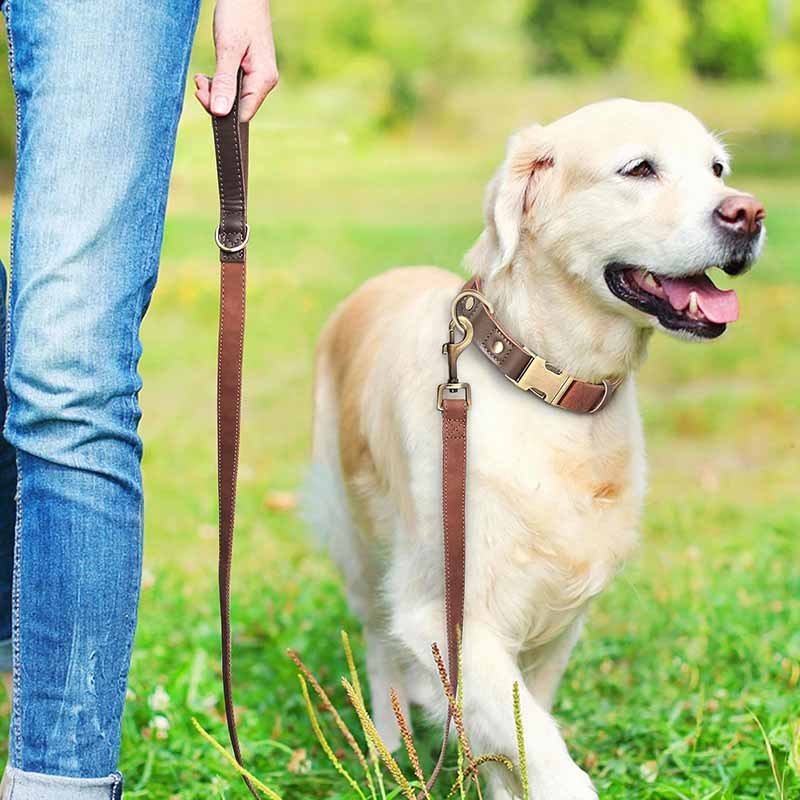
A high-quality leather dog collar uses full-grain or top-grain leather, reinforced stitching, smooth edge finishing, and solid metal hardware. It should feel flexible but strong, maintain shape under pulling, and show consistent craftsmanship with no loose threads or weak points. Leather quality, construction details, and hardware strength matter more than appearance or branding alone.
A leather dog collar is safety equipment, not just an accessory. Quality determines whether it will last for years—or fail under stress. Below are the most reliable indicators professionals use to judge collar quality.
What Type of Leather Is Used? (The First and Most Important Test)
High-quality leather dog collars are made from:
- Full-grain leather (best option)
- High-grade top-grain leather
You can often tell by:
- Natural grain patterns (not overly uniform)
- No peeling or plastic-like surface
- Leather thickness that feels dense, not spongy
Low-quality collars often use:
- Split leather
- Bonded or coated leather
- “Genuine leather” with surface finishes
Leather choice alone can determine 80% of a collar’s lifespan.
How Does the Leather Feel and Bend in Your Hands?
A simple physical test reveals a lot.
A high-quality collar:
- Bends smoothly without cracking
- Returns to shape after flexing
- Feels firm but not stiff
Poor-quality leather:
- Feels overly rigid or overly soft
- Shows surface cracks when bent
- Stays creased after folding
Leather must balance strength and flexibility to remain safe and comfortable.
What Stitching Quality Should You Look For?
Stitching is one of the most common failure points.
High-quality stitching shows:
- Even stitch spacing
- Tight, consistent tension
- Reinforced box or saddle stitching at stress points
Watch out for:
- Loose threads
- Uneven spacing
- Single straight stitches at load-bearing areas
Good stitching prevents seam tearing long before the leather itself wears out.
How Are the Edges Finished?
Edge finishing is a clear quality signal.
High-quality collars have:
- Burnished or folded edges
- Smooth, rounded feel
- No sharp or fuzzy fibers
Poor edge finishing leads to:
- Fraying
- Skin irritation
- Faster leather breakdown
Edge work is time-consuming, which is why low-end collars often skip it.
What Hardware Is Used—and How Is It Attached?
Hardware directly affects dog safety.
Best hardware materials:
- Solid brass (corrosion-resistant, durable)
- Stainless steel (very strong, rust-proof)
Check that hardware:
- Is solid, not hollow
- Is properly riveted or stitched into leather
- Does not flex under hand pressure
Weak hardware causes catastrophic failures—even if the leather is excellent.
Does the Collar Hold Shape Under Pulling?
A quality collar should:
- Stay flat when pulled
- Not curl or twist excessively
- Maintain hole shape around buckle pins
Stretching or deformation under light force is a sign of:
- Thin leather
- Poor fiber structure
- Insufficient reinforcement
Shape retention is especially important for large or strong dogs.
Is the Thickness Appropriate for the Dog Size?
Quality includes correct specification, not just material grade.
General rule:
- Small dogs → thinner but high-grade leather
- Medium dogs → moderate thickness + reinforcement
- Large dogs → thick, layered leather with wide straps
Too thin = unsafe. Too thick = uncomfortable.
Good manufacturers match thickness to real load conditions.
Are the Adjustment Holes Reinforced and Evenly Spaced?
This detail is often overlooked.
High-quality collars feature:
- Cleanly punched holes
- Even spacing
- Reinforced leather around holes
Poor hole finishing leads to:
- Tearing
- Loss of adjustability
- Early failure
This is a common cause of returns in eCommerce.
Does the Collar Smell Like Leather—or Chemicals?
Smell is a surprisingly useful indicator.
- Natural leather smell → good sign
- Strong chemical or plastic odor → possible low-grade tanning or coatings
Especially for collars worn daily, chemical residue can cause skin irritation.
Quick Quality Checklist
| Quality Factor | High Quality Indicator |
|---|---|
| Leather type | Full-grain / top-grain |
| Flexibility | Bends smoothly, no cracks |
| Stitching | Even, reinforced |
| Edge finish | Smooth, burnished |
| Hardware | Solid brass / stainless |
| Shape | Holds under pulling |
| Holes | Reinforced, clean |
| Smell | Natural leather scent |
How Do Sizing, Fit, and Safety Work for Dog Collars
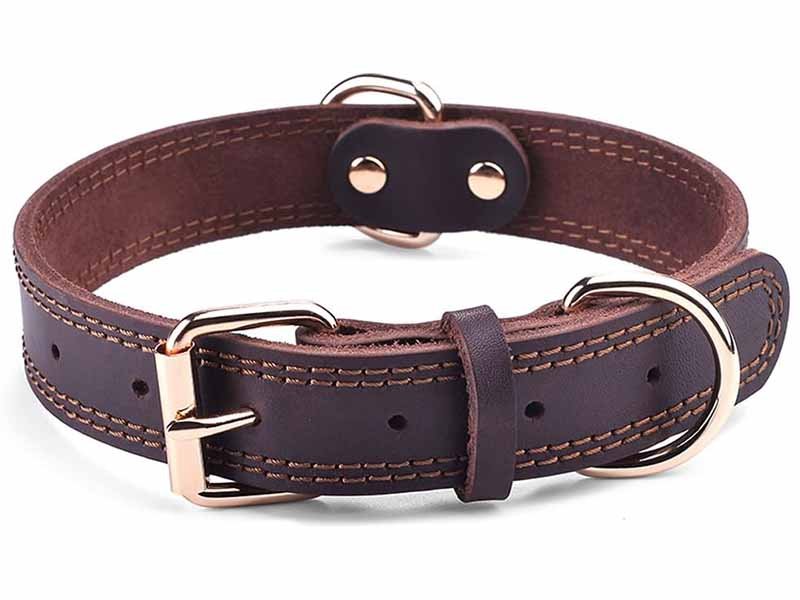
Proper sizing, correct fit, and safe construction are critical for leather dog collars. A well-fitted collar should allow two fingers between the collar and the dog’s neck, match the dog’s size and strength, and use durable leather and secure hardware. Incorrect sizing or poor construction can cause discomfort, escape risks, or even injury, making fit and safety more important than style alone.
Leather dog collars are worn daily and continuously, often under pulling force. A collar that looks good but fits poorly can lead to chafing, breathing restriction, or escape. For brands and sellers, sizing and safety issues are among the top causes of negative reviews and returns.
How Do You Measure a Dog Correctly for a Collar?
Accurate measurement is the foundation of proper fit.
The correct method:
- Measure the dog’s neck circumference using a soft tape
- Measure where the collar naturally sits (not too high, not too low)
- Add adjustment allowance rather than guessing
Never use:
- Weight alone
- Breed name alone
Dogs of the same breed can vary significantly in neck size. Clear sizing charts reduce returns dramatically.
What Is the “Two-Finger Rule” and Why Does It Matter?
The two-finger rule is the most widely accepted safety guideline.
A properly fitted collar should:
- Allow two fingers to slide comfortably between collar and neck
- Sit snug without tightening when the dog moves
- Not rotate excessively
Too tight:
- Restricts breathing
- Causes skin irritation
Too loose:
- Increases escape risk
- Allows twisting and uneven pressure
This rule balances control, comfort, and safety.
How Do Width and Thickness Affect Safety?
Width and thickness must match dog size and strength.
General guidelines:
- Small dogs → narrow, lighter collars
- Medium dogs → moderate width and thickness
- Large or strong dogs → wider, thicker collars
Why width matters:
- Wider collars distribute pressure
- Reduce strain on the neck
- Improve control during pulling
A thin collar on a large dog concentrates force and increases injury risk.
How Does Collar Fit Differ for Puppies vs Adult Dogs?
Puppies grow quickly, making fit especially important.
For puppies:
- Choose adjustable collars
- Allow room for growth
- Check fit weekly
Using non-adjustable collars on puppies often leads to:
- Rapid outgrowing
- Tightening risks
- Early replacement
For adult dogs, stability and consistent sizing matter more than growth allowance.
Are Buckles, D-Rings, and Hardware Part of Safety?
Absolutely. Hardware is a critical safety component, not just decoration.
Safe hardware should:
- Be made of solid brass or stainless steel
- Be securely riveted or stitched
- Match the collar’s load rating
Weak hardware can fail suddenly, leading to dog escape—even if the leather is strong.
Are Quick-Release Buckles Safe on Leather Dog Collars?
Quick-release buckles can be safe in specific cases.
They are suitable for:
- Small to medium dogs
- Low-pull environments
- ID-only collars
They are not recommended for:
- Large or strong dogs
- Training collars
- Dogs that pull aggressively
Traditional buckle systems remain the safest option for load-bearing use.
How Does Poor Fit Lead to Skin or Fur Problems?
Incorrect fit can cause:
- Fur matting
- Hair breakage
- Pressure sores
- Neck irritation
Rolled leather collars help long-haired breeds, while smooth edge finishing prevents friction. Comfort directly affects how often owners keep the collar on—impacting brand perception.
How Can Brands Reduce Sizing-Related Returns?
Professional brands reduce issues by:
- Providing clear sizing charts
- Offering adjustable hole ranges
- Including fit instructions
- Testing collars on real dogs
Fit education is as important as product design.
Sizing & Safety Quick Reference
| Factor | Best Practice |
|---|---|
| Measurement | Neck circumference, not weight |
| Fit rule | Two fingers between collar & neck |
| Width | Wider for larger dogs |
| Thickness | Matched to pull strength |
| Hardware | Solid, load-rated |
| Puppies | Adjustable collars only |
Are Custom or Private Label Leather Dog Collars Worth It
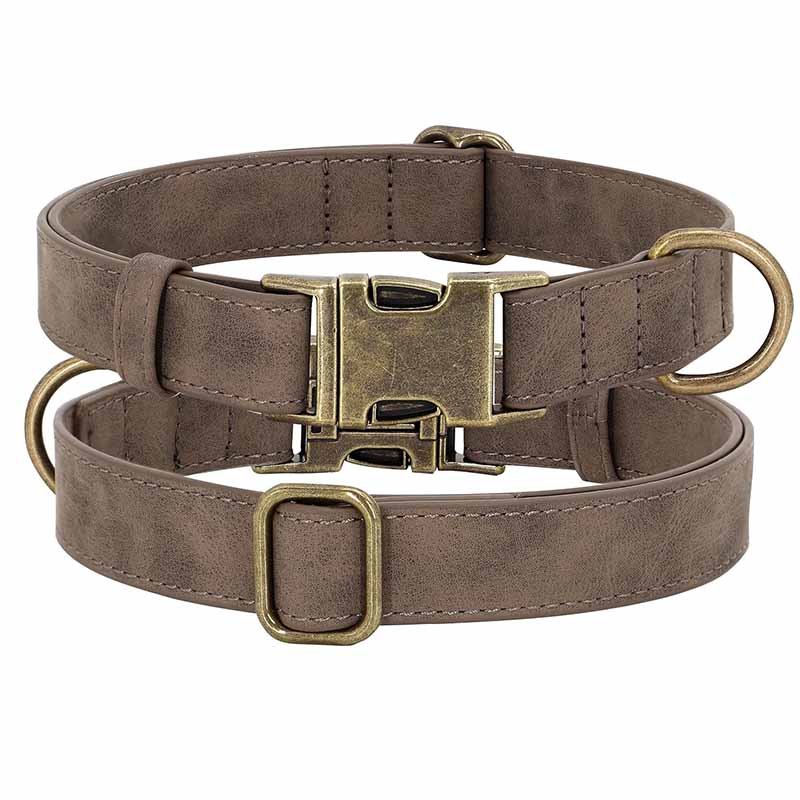
Yes, custom or private label leather dog collars are worth it for brands that want differentiation, quality control, and long-term customer trust. Custom manufacturing allows control over leather type, sizing accuracy, hardware strength, and branding details, which reduces returns and improves perceived value. While initial costs may be higher than off-the-shelf products, custom collars offer better margins and stronger brand positioning.
Selling generic, off-the-shelf leather dog collars is easy—but it also creates price competition, quality inconsistency, and weak brand loyalty. Custom and private label collars exist because brands need more control than standard wholesale products can offer.
What Problems Do Off-the-Shelf Leather Dog Collars Create?
Mass-market collars are designed to fit everyone—which often means they fit no one particularly well.
Common problems include:
- Inconsistent leather quality
- Poor sizing accuracy
- Weak hardware not suited for large dogs
- Generic designs shared across many sellers
For eCommerce brands, these issues lead directly to:
- High return rates
- Negative reviews
- Low customer trust
Customization solves these problems at the source.
How Does Customization Improve Product Quality and Safety?
Custom manufacturing allows brands to control critical safety-related details, such as:
- Leather grade (full-grain vs lower grades)
- Leather thickness matched to dog size
- Hardware strength and material
- Stitching patterns and reinforcement
Instead of adapting your brand to an existing product, custom collars allow the product to be engineered around real dog behavior and use cases.
Which Customization Options Matter Most for Leather Dog Collars?
Not all customization adds value. The most impactful options include:
- Leather selection (full-grain, veg-tan, thickness control)
- Collar width and hole spacing (better fit, fewer returns)
- Hardware choice (solid brass or stainless steel)
- Edge finishing (comfort and durability)
- Logo application (debossing, embossing, stamping)
These details are invisible at first glance—but obvious after weeks of use.
Does Private Label Manufacturing Improve Brand Perception?
Yes—significantly.
Private label collars allow brands to:
- Offer consistent quality across collections
- Build a recognizable design language
- Justify premium pricing
Customers may not know leather grades—but they feel the difference in comfort, durability, and reliability. That experience builds brand trust faster than marketing claims.
Are Custom Leather Dog Collars More Profitable?
In most cases, yes—over time.
While custom collars may have:
- Higher initial sampling cost
- Slightly higher unit cost
They often deliver:
- Higher perceived value
- Lower return and replacement costs
- Better customer retention
Brands focused on long-term growth usually outperform those competing only on price.
Is Custom Manufacturing Suitable for Small or Growing Brands?
Yes—if low MOQ and fast sampling are available.
Many modern OEM/ODM manufacturers now support:
- Low minimum order quantities
- Rapid prototyping
- Iterative design improvements
This makes private label feasible not only for large brands, but also for:
- DTC startups
- Amazon sellers
- Boutique pet brands
How Do You Choose the Right OEM/ODM Partner for Dog Collars?
A reliable manufacturer should provide:
- Transparent leather sourcing
- Clear quality standards
- Real load and durability testing
- Consistent production capability
More importantly, they should understand that dog collars are safety products, not just fashion accessories.
Manufacturers like Szoneier Leather support brands by integrating leather R&D, prototyping, testing, and scalable production—helping reduce risk while improving product consistency.
Which Quality Control Steps Reduce Returns for Online Sellers?
Effective QC for custom collars includes:
- Leather thickness and tensile testing
- Stitching inspection at stress points
- Hardware pull-strength testing
- Size tolerance checks
These steps dramatically reduce:
- Size-related returns
- Hardware failure complaints
- Negative safety reviews
Custom vs Off-the-Shelf: Quick Comparison
| Factor | Off-the-Shelf Collars | Custom / Private Label |
|---|---|---|
| Leather quality | Inconsistent | Controlled |
| Fit accuracy | Generic | Optimized |
| Branding | Limited | Fully customized |
| Safety control | Low | High |
| Differentiation | None | Strong |
| Long-term margin | Low | Higher |
FAQs About Leather Dog Collars Made in USA
Are Leather Dog Collars Made in USA Better Quality?
Not always. Leather dog collars made in the USA often benefit from skilled craftsmanship and stricter production oversight, but quality still depends on leather grade, tanning method, stitching, and hardware. A poorly made collar labeled “Made in USA” can perform worse than a well-engineered collar made elsewhere. Materials and construction matter more than origin alone.
Does “Made in USA” Mean the Leather Is American-Sourced?
No. In many cases, “Made in USA” refers to manufacturing or assembly, not material origin. Leather and hardware may be imported, while cutting and stitching happen in the U.S. Buyers should check whether the claim applies to leather sourcing, labor, or final assembly.
Is “Assembled in USA” the Same as “Made in USA”?
No. “Assembled in USA” means parts may be imported and only final assembly occurs in the U.S. “Made in USA” generally implies that most manufacturing steps are domestic. The difference affects transparency, pricing, and perceived value.
What Leather Is Commonly Used in American-Made Dog Collars?
Most high-quality American-made collars use full-grain or top-grain leather. Vegetable-tanned leather is common in premium products due to skin safety and natural aging, while chrome-tanned leather is used for softer, color-consistent designs.
Are Leather Dog Collars Made in USA Safer for Dogs?
They can be, but safety depends on design and materials. A safe collar requires strong leather, reinforced stitching, proper thickness, and solid hardware. Origin alone does not guarantee safety—engineering and quality control do.
Do Leather Dog Collars Stretch Over Time?
High-quality full-grain or top-grain leather stretches very little when properly constructed. Excessive stretching usually indicates thin leather, poor tanning, or inadequate reinforcement. Minimal stretch over time is normal and does not affect safety.
Are American-Made Leather Dog Collars Waterproof?
No leather dog collar is fully waterproof. Some American-made collars use treated or waxed leather for water resistance, but prolonged exposure to water can still affect leather. Conditioning after wet use helps extend lifespan.
Are Leather Dog Collars Made in USA Worth the Higher Price?
They are worth it when the higher price reflects better leather, stronger hardware, and skilled workmanship. However, some products charge more based on origin alone. Buyers should evaluate materials and construction—not just the label.
How Can You Verify a “Made in USA” Claim?
Ask:
- Where is the leather sourced?
- Where is the collar cut and stitched?
- Is it fully made or only assembled in the U.S.?
Transparent brands clearly disclose this information.
Are Custom or Private Label Collars Better Than Retail American-Made Collars?
Often yes. Custom or private label collars allow brands to control leather quality, thickness, sizing accuracy, and hardware strength. This reduces returns and improves long-term customer satisfaction compared to generic retail products.
Do Leather Dog Collars Made in USA Last Longer?
They can last many years if made with full-grain leather, reinforced stitching, and solid hardware. Lifespan depends more on construction quality and care than country of manufacture.
How Should You Care for a Leather Dog Collar?
Basic care includes:
- Wiping with a damp cloth
- Letting it air dry naturally
- Conditioning periodically with leather conditioner
Proper care significantly extends collar life.
Are Leather Dog Collars Made in USA Better for Large Dogs?
They can be, but only if designed correctly. Large dogs require wider collars, thicker leather, and heavy-duty hardware. Not all collars—American-made or otherwise—are suitable for strong breeds.
Why Do Some Brands Manufacture Leather Dog Collars Outside the USA?
Many brands choose overseas manufacturing to:
- Access specialized leather supply chains
- Achieve consistent quality at scale
- Offer better customization and lower MOQs
Quality manufacturing is possible globally when proper standards are followed.
Can Brands Offer “Made in USA” Quality Without Manufacturing in the USA?
Yes. Brands working with experienced OEM/ODM manufacturers can achieve equal or higher quality by controlling leather grade, tanning, construction, and QC—even if production occurs outside the U.S.
Manufacturers like Szoneier Leather support global brands with full-grain leather sourcing, engineering-level QC, and private label development for premium leather dog collars.
Conclusion
Premium leather dog collars are not accidental products. They are the result of informed material choices, disciplined craftsmanship, and real understanding of how dogs move, pull, and wear collars daily.
Szoneier Leather Company has over 18 years of experience in leather research and manufacturing.
Whether you are building a premium pet brand, upgrading from generic collars, or launching a private label line, Szoneier Leather helps you move from idea to reliable production—without compromise.
Contact Szoneier Leather today to discuss custom leather dog collar development, request samples, or receive a tailored quotation for your brand.