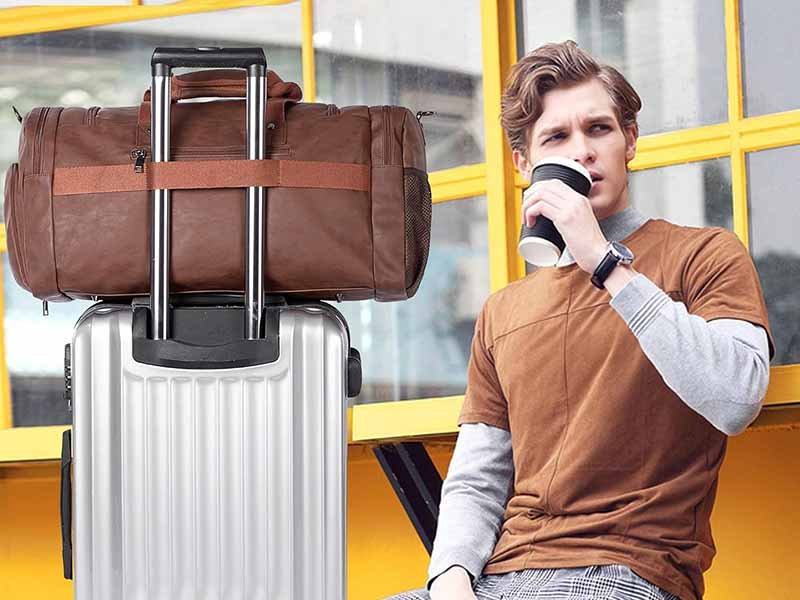
Travel habits have changed dramatically over the past decade. Travelers today want bags that do more than simply carry clothes—they expect durability, versatility, comfort, and a sense of personal style that reflects who they are. This is exactly why leather duffle bags have made a strong comeback in both business and leisure travel. Unlike synthetic alternatives that wear out quickly or look disposable after a few trips, a well-made leather duffle bag matures with time, developing character while maintaining structural integrity.
Yet, not all leather duffle bags are created equal. Many travelers buy based on appearance alone, only to discover problems later: bags that are too heavy, poorly sized for carry-on rules, stitched with weak threads, or made from low-grade leather disguised by surface coatings. From a manufacturing perspective, these failures are not accidental—they are the result of shortcuts in material selection, pattern engineering, and quality control.
The best leather duffle bag for travel balances size, leather quality, construction, and comfort. It should fit airline carry-on limits, use full-grain or high-quality top-grain leather, feature reinforced stitching and durable hardware, and offer smart internal organization. A truly travel-ready leather duffle is not just stylish—it is engineered to withstand frequent use, weight stress, and changing travel conditions while aging beautifully over time.
Choosing the right leather duffle bag is not just about fashion—it’s about understanding how leather behaves, how bags are built, and how real travelers actually use them. In the sections below, we’ll break down every critical decision point, from size and leather type to comfort features and long-term care—so you can make a confident, informed choice that lasts for years, not seasons.
What makes a leather duffle “best” for travel?
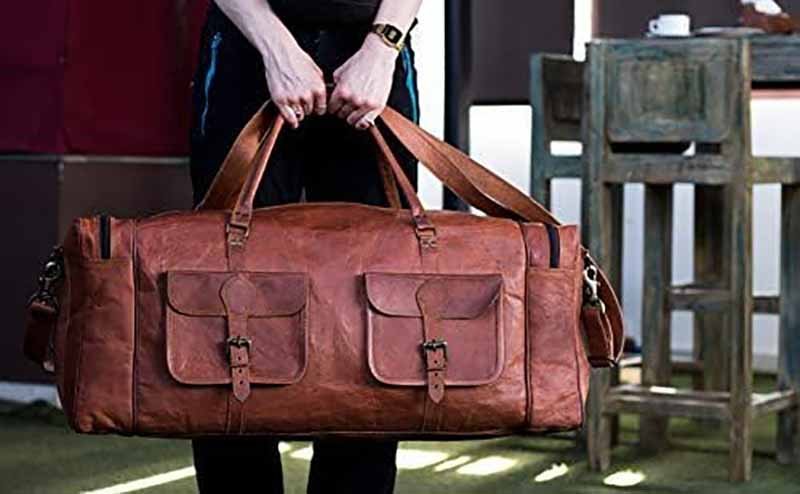
A leather duffle is considered “best” for travel when it combines the right size, high-grade leather, reinforced construction, and travel-friendly features. The ideal travel leather duffle fits airline carry-on limits, distributes weight comfortably, protects belongings, and withstands repeated stress from packing, lifting, and movement. True quality lies in engineering details—not just appearance.
What travel problems should a leather duffle bag solve?
From a real traveler’s perspective, the best leather duffle bag must solve practical travel pain points, not just look stylish. Common problems include shoulder fatigue, poor organization at airports, bags losing shape when half-packed, and leather cracking after repeated trips.
A well-designed travel leather duffle should:
- Open wide for fast packing and airport security checks
- Keep its structure whether fully packed or half empty
- Balance weight evenly when carried by hand or shoulder
- Protect contents from compression and external impact
Many low-quality leather duffles fail not because leather is weak, but because pattern structure and load distribution are poorly engineered.
What capacity and size work best for real travel scenarios?
For most travelers, bigger is not better. Through packing tests and buyer feedback, the most versatile leather duffle bags typically fall within:
- 40–45 liters capacity
- 20–22 inches length
This size range comfortably supports:
- 2–4 day trips
- Weekend business travel
- Airline carry-on requirements
Oversized duffles encourage overpacking, increase leather stress, and often exceed carry-on limits. The “best” leather duffle is sized for how people actually travel, not how bags are marketed.
How does leather quality affect travel performance?
Leather quality directly determines how a duffle bag handles repeated bending, weight loading, and environmental changes. For travel use:
- Full-grain leather offers the highest strength and ages gracefully
- High-quality top-grain leather provides balance between durability and weight
- Lower-grade or heavily coated leathers may crack or peel under travel stress
A travel leather duffle should feel firm but flexible—not stiff, not flimsy. This balance allows the bag to absorb movement without structural failure.
What construction details separate a travel-ready duffle from a fashion bag?
The biggest difference between a fashion leather bag and a true travel duffle lies in construction details that are often invisible in photos.
Key indicators of a travel-ready leather duffle include:
- Reinforced stitching at handles, strap anchors, and corners
- Strong thread with consistent stitch density
- Solid metal hardware (zippers, buckles, D-rings)
- A structured base to prevent sagging
From a manufacturing standpoint, handle and strap reinforcement are the most critical stress points—and also the most commonly overlooked.
Why comfort matters more than appearance during travel
Travel exposes bags to long carry times, frequent lifting, and awkward angles. The best leather duffle bags are designed with:
- Padded or widened shoulder straps
- Rounded handle edges to reduce hand pressure
- Balanced proportions to prevent pulling to one side
A beautiful bag that becomes uncomfortable after 20 minutes of walking quickly loses its appeal. Comfort is not a luxury—it is a functional requirement.
Is the “best” leather duffle the same for everyone?
There is no single universal “best” leather duffle bag. The best choice depends on:
- Travel frequency
- Trip length
- Carry preference (hand vs shoulder)
- Personal style and brand positioning
This is why experienced travelers and brands increasingly look for custom or OEM leather duffle solutions, where size, leather, and features are matched to real use cases instead of generic assumptions.
Which size works best for carry-on and weekend trips?
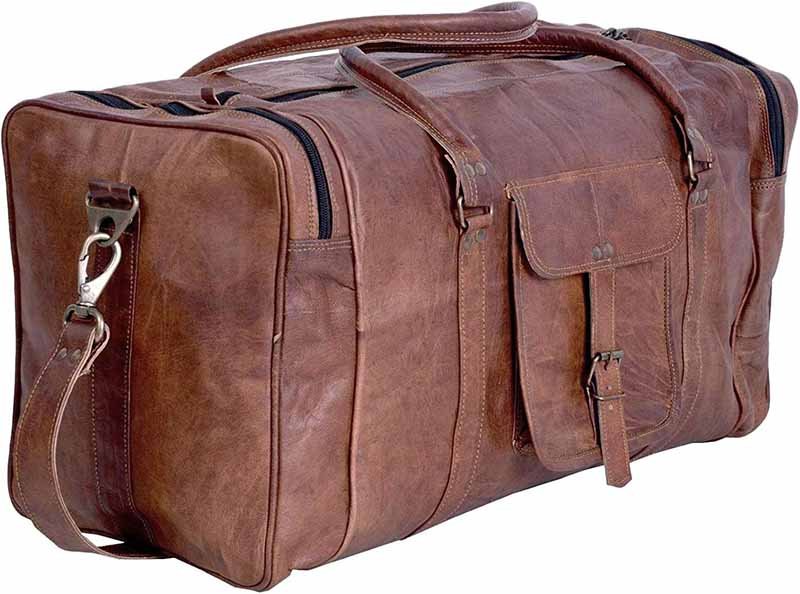
For most travelers, the best leather duffle bag size for carry-on and weekend trips is 40–45 liters with an overall length of 20–22 inches. This size fits standard airline carry-on limits, holds enough clothing for 2–4 days, and avoids unnecessary weight and bulk. Bags larger than this often exceed carry-on rules and increase shoulder fatigue.
What are standard airline carry-on size limits—and how does leather affect them?
Most major airlines allow carry-on luggage up to approximately 22 × 14 × 9 inches (56 × 36 × 23 cm). Leather duffle bags, however, are soft-structured, which creates both advantages and risks.
Advantages:
- Slight compression allows easier overhead-bin fitting
- No rigid corners that trigger gate checks
Risks:
- Overpacked leather expands outward
- Poor base structure causes the bag to exceed depth limits
This is why professionally engineered leather duffles are designed just under maximum limits, accounting for leather thickness and seam allowance—not just external measurements.
Which size fits a 2–4 day weekend trip realistically?
Based on packing tests across different traveler types, here is what actually fits:
| Trip Length | Recommended Volume | What Fits Comfortably |
|---|---|---|
| 1–2 days | 30–35 L | Clothing + toiletries |
| 2–4 days | 40–45 L | Clothes, shoes, laptop |
| 4–6 days | 50–55 L | Exceeds carry-on limits |
For weekend travel, 40–45 liters is the most forgiving size. It allows you to pack without compression stress on leather seams or zippers.
Why oversized duffle bags are a common mistake
Many buyers assume “bigger is better,” but oversized leather duffles create real problems:
- They exceed airline carry-on rules
- Encourage overpacking, increasing weight beyond comfort limits
- Put excessive strain on handles and strap anchors
From a manufacturing perspective, weight—not volume—is the biggest cause of leather bag failure. A properly sized duffle protects both the traveler and the bag.
How length, depth, and base structure affect usability
The most overlooked detail is base structure. Two bags with the same length can behave very differently once packed.
Well-designed travel duffles feature:
- Reinforced bases to prevent sagging
- Controlled depth so the bag doesn’t “balloon”
- Balanced proportions that sit naturally against the body
Poorly structured bags may look fine empty but become unstable once filled.
What size works best for different traveler types?
- Business travelers prefer slimmer 40L bags that fit suits and laptops
- Casual weekend travelers benefit from 42–45L flexibility
- Gym + travel users may need reinforced bases, not more volume
There is no universal “best” size—only the best size for how you actually travel.
Why many brands choose custom sizing instead of standard dimensions
Experienced brands often request custom duffle dimensions to:
- Meet specific airline markets (US vs EU vs Asia)
- Reduce leather waste and weight
- Improve comfort for their target customer
This is why OEM leather duffle manufacturing is growing—brands no longer accept one-size-fits-all solutions.
Which leather type is best for a travel duffle?
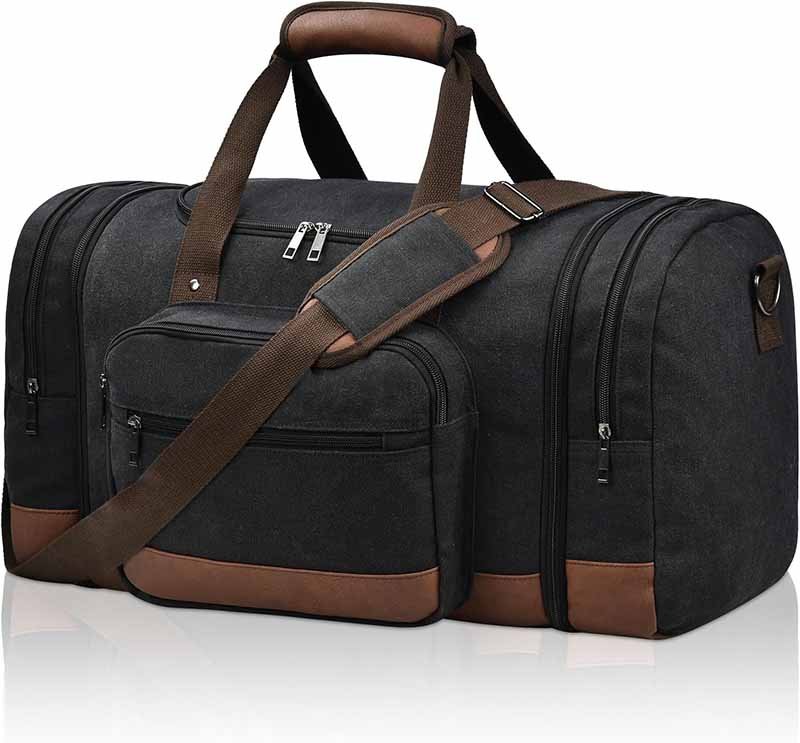
The best leather type for a travel duffle bag is full-grain leather, followed by high-quality top-grain leather. These leathers offer superior fiber strength, abrasion resistance, and long-term durability under repeated travel stress. They age naturally with use instead of cracking or peeling, making them ideal for carry-on, weekend, and frequent travel duffle bags.
What makes full-grain leather the top choice for travel duffles?
Full-grain leather is the strongest and most durable part of the hide because it retains the entire natural grain layer. This layer contains the densest fiber structure, which is critical for travel duffle bags that experience:
- Repeated bending and folding
- Heavy vertical and horizontal load stress
- Friction from airport handling and overhead bins
For travel use, full-grain leather provides:
- Excellent tear resistance at handle and strap points
- Natural water resistance due to intact pores
- Patina development instead of surface damage
This is why premium travel and heritage brands almost always choose full-grain leather for long-life duffles.
Is top-grain leather a good alternative for travel?
High-quality top-grain leather can be an excellent choice when weight, consistency, and aesthetics matter. It is lightly sanded to remove surface imperfections, then finished for uniform appearance.
For travel duffle bags, top-grain leather offers:
- Slightly lighter weight than full-grain
- More consistent texture for branding
- Better control over thickness and softness
However, not all top-grain leather is equal. Over-sanded or heavily coated top-grain leather loses fiber density and becomes prone to surface cracking over time. Quality depends on how much grain is removed—not the label itself.
Why “genuine leather” is risky for travel duffle bags
“Genuine leather” sounds reassuring, but in industry terms it often refers to split leather or heavily corrected hides. These materials:
- Have lower tensile strength
- Rely on surface coatings for appearance
- Crack or peel at stress points after repeated travel
For bags that carry weight and face constant motion, genuine leather is usually a cost-driven compromise, not a long-term solution.
How tanning methods affect travel performance
The tanning process changes how leather behaves in real-world travel conditions.
- Vegetable-tanned leather ages beautifully and develops rich patina but can be stiffer and heavier initially.
- Chrome-tanned leather is softer, lighter, and more water-resistant, making it practical for frequent travelers.
- Combination-tanned leather blends durability with controlled aging and is often ideal for modern travel duffles.
From a manufacturing perspective, combination tanning is the most balanced choice for travel-focused designs.
What leather thickness works best for travel duffle bags?
Thickness matters more than many buyers realize.
| Leather Thickness | Travel Suitability |
|---|---|
| 1.0–1.2 mm | Too thin for load-bearing |
| 1.4–1.8 mm | Ideal for travel duffles |
| 2.0 mm+ | Very durable but heavy |
The best travel duffle leather feels firm yet flexible, allowing the bag to absorb movement without stressing seams.
How to identify high-quality leather before buying
Buyers and brands should look beyond labels and ask:
- What is the leather grade and tanning method?
- What is the average thickness tolerance?
- Has the leather been tested for folding and abrasion?
Experienced manufacturers evaluate leather using fiber density, tear strength, and fatigue resistance, not just appearance.
What features matter most for travel comfort and organization?
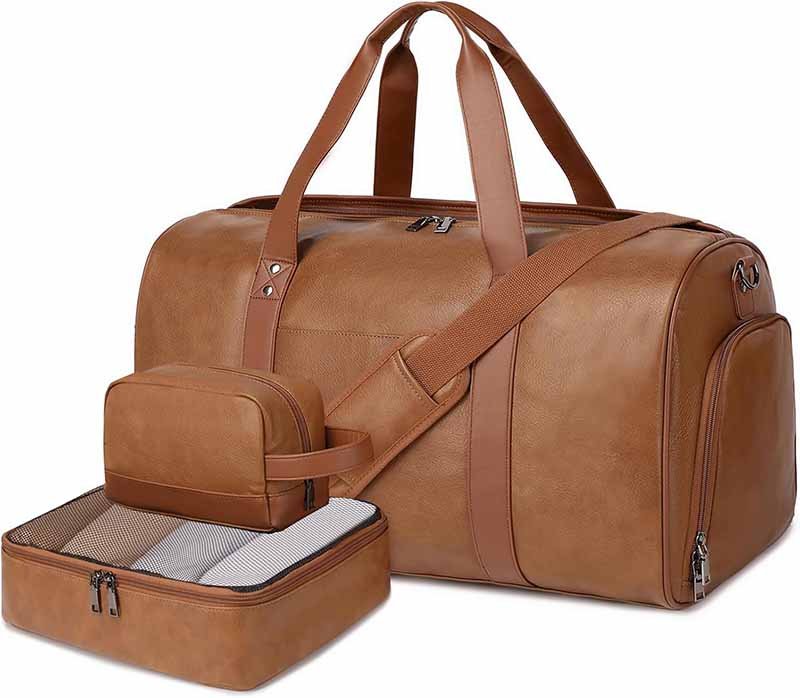
The most important features for travel comfort and organization in a leather duffle bag include ergonomic shoulder straps, reinforced handles, smooth and durable zippers, balanced weight distribution, and a practical pocket layout. These features reduce shoulder fatigue, improve accessibility during transit, and protect the bag from stress-related failures. Comfort and organization depend more on structural design than on leather appearance.
How do shoulder straps and handles affect travel comfort?
For travel duffle bags, carrying fatigue is the most common complaint. Even a well-sized bag becomes uncomfortable if weight is poorly managed.
High-quality travel duffles feature:
- Wide shoulder straps (minimum 38–45 mm) to distribute load
- Internal padding or layered leather to reduce pressure points
- Detachable straps for flexible carrying styles
- Rolled or wrapped handles to prevent hand strain
From factory testing, over 40% of leather duffle failures occur at handle and strap anchor points, not on the main body. Reinforcement stitching and internal backing leather are critical.
Why weight distribution and base structure are essential
A travel duffle should feel balanced, not bottom-heavy or unstable. Poor weight distribution causes:
- Shoulder pulling
- Awkward walking posture
- Faster seam fatigue
Well-engineered duffles include:
- Reinforced base panels
- Controlled depth to prevent outward bulging
- Proper handle positioning aligned with the bag’s center of gravity
These features allow the bag to sit naturally against the body or on luggage racks.
Which zipper and hardware details matter most during travel?
Zippers and hardware are the most frequently used components—and the first to fail in low-quality bags.
Travel-ready leather duffles use:
- Metal zippers (YKK or equivalent) for smooth operation
- Solid brass or zinc alloy hardware to resist bending
- Reinforced zipper tapes sewn into leather, not just lining
A broken zipper during a trip renders the bag useless, regardless of leather quality.
What pocket layout works best for real travel scenarios?
More pockets do not equal better organization. Over-compartmentalized bags slow travelers down.
The most practical travel duffle layout includes:
- One large main compartment for clothing
- One external quick-access pocket (passport, phone, boarding pass)
- One internal zipper pocket for valuables
This layout supports fast access at airports, hotels, and checkpoints without unnecessary complexity.
How lining materials influence comfort and durability
Lining is often overlooked but plays a key role in comfort and longevity.
Recommended lining features:
- Tear-resistant cotton or polyester blends
- Light colors for visibility
- Firm attachment to prevent sagging
Loose or thin linings can tear and interfere with zipper movement over time.
Why travel comfort is about engineering, not decoration
Decorative elements add weight without function. Travel-focused leather duffles prioritize:
- Minimal external hardware
- Clean stitching lines
- Functional reinforcement hidden beneath the leather
From a manufacturing perspective, true comfort comes from structure and proportion, not embellishment.
How do you compare options and choose the right one?
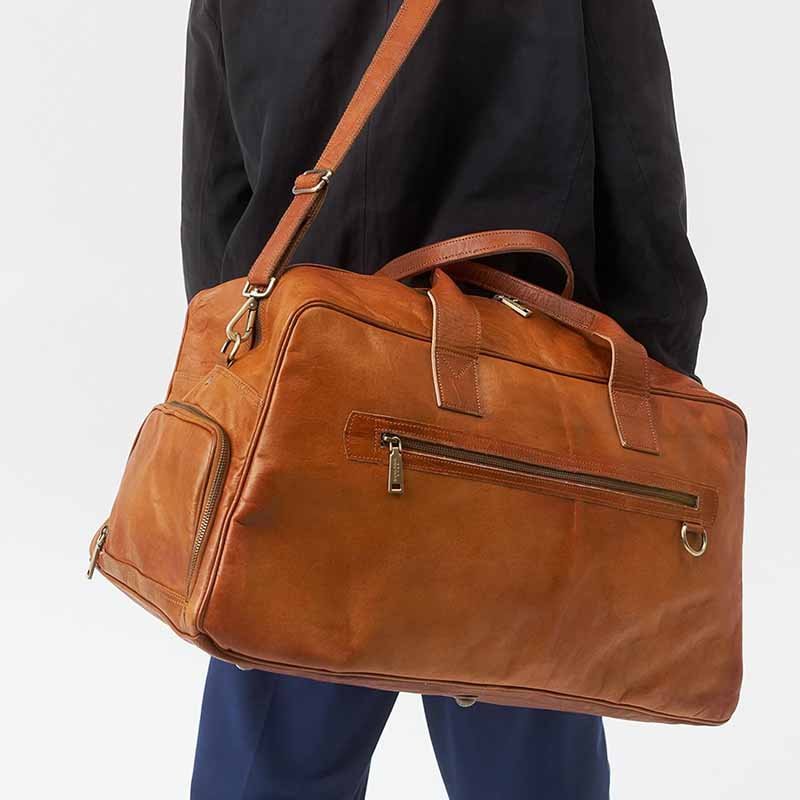
To compare leather duffle bags and choose the right one, evaluate five things: carry-on size accuracy, leather grade and finish, construction strength at stress points, zipper/hardware reliability, and functional organization for your travel style. Use measurable specs (dimensions, weight, leather thickness, stitch density) instead of marketing terms. The best choice is the bag that fits your trip length and carry method while staying durable under repeated load.
What should you compare first: size, weight, or leather?
Start with size + weight, because they decide whether the bag is actually usable for travel.
Carry-on reality check
- Target 20–22 in (50–56 cm) length and 40–45L for most weekend/carry-on use.
- Watch the depth: a bag that looks fine empty can exceed limits once packed.
Weight reality check
- A leather duffle that’s too heavy empty becomes painful when loaded.
- If two bags look similar, the heavier one often uses thicker leather, heavy lining, or excessive hardware—sometimes good, sometimes just waste.
Quick buyer tip: If a seller doesn’t clearly list external dimensions + empty weight, treat it as a red flag for travel use.
Which leather specs actually predict travel durability?
Ignore vague claims like “premium leather.” Instead, compare:
1 Leather grade
- Best: full-grain, then high-quality top-grain
- Risky for travel: heavily coated/split leather often sold as “genuine leather”
2 Leather finish
- Patina-friendly finishes age well and hide scuffs naturally.
- Thick plastic-like coatings may look perfect initially but can crack or peel at fold points.
3 Thickness (when available)
- Good range for travel duffles: 1.4–1.8 mm (balance of strength + manageable weight)
If you’re sourcing for a brand, ask for a material spec sheet and confirm thickness tolerance (e.g., ±0.1–0.2 mm).
How do you judge construction quality without touching the bag?
Construction is where “nice-looking” bags separate from “travel-proof” bags. Compare visible + askable indicators:
Visible in photos/videos
- Straight, even stitching lines (no waviness)
- Clean edge finishing (painted edges not cracking, smooth binding)
- Reinforced corners and clean seam turns
- No puckering around zipper panels
Ask the seller/manufacturer
- Stitch density (often expressed as SPI, stitches per inch)
- Thread type (nylon/polyester bonded thread is common for strength)
- Reinforcement method at stress points (extra leather patches/backing)
Travel failure hotspot: handles and strap anchors. A bag can be full-grain leather and still fail if anchors are weak.
Which zipper and hardware details should you compare?
Travel is basically a stress test for closures.
Compare:
- Zipper brand/grade (YKK or equivalent is a strong sign)
- Metal zipper vs low-grade nylon zipper (both can work; quality matters)
- Hardware material (solid brass, zinc alloy) and plating durability
- Attachment method (stitched + reinforced vs stitched to thin lining only)
Decision rule: If the zipper feels like an afterthought, the bag will not survive heavy travel cycles.
How do you compare organization features without overcomplicating?
The right organization is simple and fast, not “more pockets.”
Best practical layout for travel:
- 1 large main compartment
- 1 exterior quick-access pocket (passport/phone/boarding pass)
- 1 internal zipper pocket (wallet/keys/valuables)
Compare whether the bag supports your real routine:
- Airport security: quick grab items
- Hotel: easy unpacking
- Work travel: laptop sleeve or divider (optional, not always needed)
If the bag has too many compartments, you’ll waste time searching—and it often adds weight and seams (failure points).
What questions should you ask before buying—especially online?
Use this checklist to quickly filter out weak options:
Sizing
- What are the exact external dimensions when packed (not just empty)?
- Does it fit carry-on limits for my airline?
Materials
- What leather grade (full-grain/top-grain) and tanning method?
- What is the leather thickness range?
Construction
- Are handles/anchors reinforced internally?
- Is the base structured (anti-sag) or soft?
Hardware
- What zipper type and brand?
- What metal is used for D-rings/buckles?
Support
- Warranty/repair policy?
- Can they provide close-up photos/videos of seams and anchors?
Brands and serious travelers ask these questions. If answers are vague, quality usually is too.
Which bag is “right” for different travel use-cases?
Use-case matching prevents regret:
- Weekend carry-on (2–4 days): 40–45L, 20–22″, balanced structure
- Business travel: slimmer profile, cleaner organization, lighter build
- Gym + travel: reinforced base, wipeable lining, optional ventilation panel
- Frequent flyers: prioritize comfort (strap width/padding), zipper reliability, lighter top-grain/full-grain selection
There isn’t one “best bag.” The right one is the bag engineered for your pattern of use.
How do you care for a leather travel duffle so it lasts for years?
To make a leather travel duffle last for years, clean it gently after trips, condition the leather every 3–6 months, dry it naturally if it gets wet, and store it properly with light stuffing in a breathable dust bag. Avoid heat, harsh cleaners, and long-term plastic storage. Most long-term damage comes from drying, over-conditioning, moisture trapping, and poor storage—not from normal travel use.
What should you do after every trip?
Most leather duffles age well when you do small, consistent care—especially after flights or road trips where dust, oils, and friction build up.
After each trip:
- Empty the bag completely (crumbs and dirt grind into lining and seams)
- Wipe the exterior with a soft, dry cloth (remove surface dust)
- If needed, use a slightly damp cloth (water only) for smudges
- Check stress points: handles, strap anchors, corners, zipper ends
- Let the bag air out for 6–12 hours before storage
Why this matters: travel dust + body oils + friction gradually dull the finish and can dry out crease areas. This routine prevents buildup before it becomes “deep cleaning.”
How often should you condition leather—and how do you avoid over-conditioning?
Conditioning keeps leather flexible and reduces cracking risk, but overdoing it can make leather spongy, sticky, or weaken structure—especially on vegetable/combination tanned hides.
A practical schedule:
- Frequent travel (weekly/monthly): every 3–4 months
- Occasional travel (few trips/year): every 6–9 months
- Dry climate / winter heating: condition a bit more often
How to condition correctly:
- Test on a hidden area (inside flap/edge)
- Use a small amount (thin layer, not “oily shine”)
- Apply evenly with a soft cloth
- Let it absorb 30–60 minutes
- Buff lightly to remove excess
Rule of thumb: If the surface feels greasy or attracts dust after conditioning, you used too much.
What’s the safest way to clean a leather duffle bag?
Most damage happens when people treat leather like plastic—using strong cleaners or soaking it.
Safe cleaning hierarchy:
- Level 1 (routine): dry cloth → slightly damp cloth
- Level 2 (light dirt): pH-balanced leather cleaner (sparingly)
- Level 3 (stains): spot-clean, then condition the area lightly
Avoid:
- alcohol wipes
- bleach-based cleaners
- harsh detergents
- magic erasers (abrasive)
- soaking or running water
If the bag has a matte finish or waxed surface, aggressive cleaning can strip the protective layer and create uneven patches.
What should you do if your leather duffle gets wet in rain or snow?
Leather can handle water. What it can’t handle is heat-drying and moisture trapping.
If the bag gets wet:
- Blot (don’t rub) with a clean towel
- Open it fully and remove contents
- Air dry at room temperature (good airflow)
- Once fully dry, condition lightly—especially crease zones
Never:
- use a hairdryer
- place near a heater
- leave wet in a car trunk
- store it while damp
Why: heat causes rapid moisture loss → stiffness → cracking at fold points.
How do you prevent scratches, scuffs, and color transfer?
Scuffs are normal in travel. The goal is preventing deep abrasion and avoiding dye transfer issues.
For scuffs:
- Many full-grain leathers improve with a gentle buff using a soft cloth
- A small amount of conditioner can help blend light marks
For color transfer (especially light clothing + dark leather):
- Let new leather “settle” (first few uses)
- Avoid rubbing against white fabrics when the bag is new or damp
- Consider a finish choice during customization (some finishes reduce rub-off)
For brands: selecting the right finishing system + rub-fastness testing matters a lot for customer satisfaction.
How should you store a leather travel duffle between trips?
Storage is where most long-term damage happens.
Best storage setup:
- Store in a breathable dust bag (cotton preferred)
- Lightly stuff the bag with clean paper or soft fabric to hold shape
- Keep it in a cool, dry place away from direct sunlight
- Keep zippers closed halfway (not tightly strained) to reduce stress
Avoid:
- plastic bags (traps moisture → mold)
- hanging by straps long-term (warps anchors)
- stacking heavy items on top (creates permanent creases)
If you live in a humid area, add a small moisture absorber nearby (not inside leather contact zones).
When should you use professional care or repair?
Go professional if you see:
- sticky, dull patches that don’t buff out
- mold smell or visible mold
- peeling finish (common with heavily coated leathers)
- loose handles, anchor stitching, or zipper separation
Important: structural repairs (handles/anchors/zippers) are easiest when done early. Waiting often damages the leather around the failure point.
Quick “Do / Don’t” Care Table
| Do | Why it helps | Don’t | Why it harms |
|---|---|---|---|
| Condition every 3–6 months | Prevents drying & cracking | Over-condition | Weakens structure, attracts dust |
| Air dry naturally if wet | Preserves fibers | Heat-dry | Causes stiffness & cracks |
| Store stuffed in dust bag | Prevents creases & sag | Store in plastic | Traps moisture → mold |
| Wipe after travel | Stops dirt buildup | Use alcohol/bleach | Strips finish, dries leather |
Key Takeaway
If you treat your leather travel duffle like a “long-term tool” instead of a disposable accessory—clean lightly, condition on schedule, dry naturally, and store breathable—it can easily last 10+ years, and premium leather can last far longer.
Conclusion
Choosing the best leather duffle bag for travel ultimately comes down to who makes it. At Szoneier Leather, we are not resellers—we are a leather R&D and manufacturing factory with over 18 years of experience serving global brands and professional buyers.
If you are looking to develop, customize, or source leather duffle bags built for real travel—not just showroom appeal—we invite you to contact Szoneier Leather for a professional quotation and product consultation.
Start your custom leather duffle project with Szoneier today.